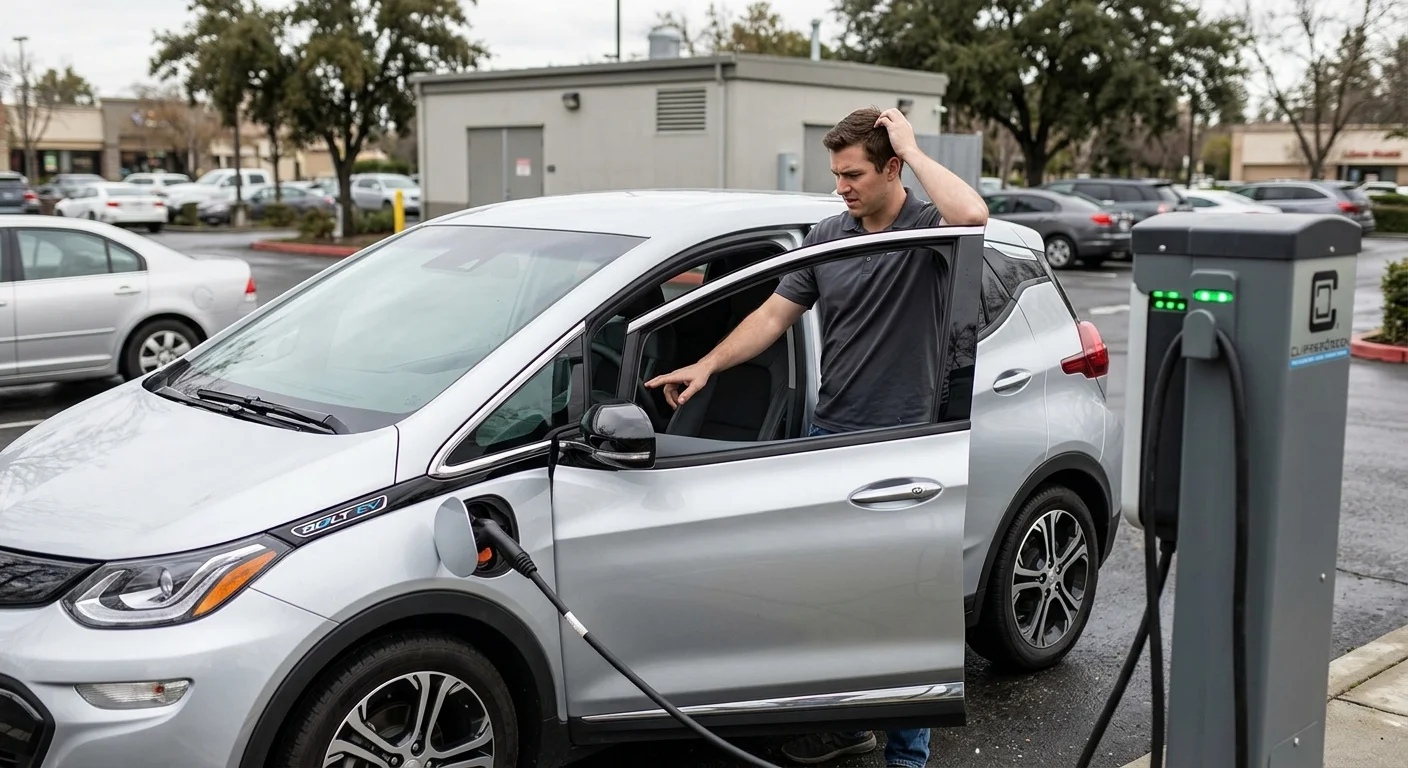
Your Chevy Bolt won’t charge at a city stall. You’re a renter who needed this public session. The stall, the cable, or a weak 12V is usually why. Don’t leave the bay until you’ve split those three. A hook to the next garage doesn’t fix a refused handshake.
West Hollywood, Santa Monica, and downtown Los Angeles are full of renters in older buildings. Census ACS 2019-2023 figures put pre-1980 housing at 80.5% in West Hollywood. Culver City sits at 85.5%, and Santa Monica sits at 75.0%. The City of Los Angeles sits at 71.0% on the same table. East Los Angeles sits at 86.2%, and Huntington Park sits at 76.7%. Those buildings often have shared garages and street parking, not a private Level 2 circuit. Public stalls are how a lot of Bolt owners fill up here.
East Los Angeles and Huntington Park sit on older Eastside stock. Santa Monica and West Hollywood are older too, with a different renter mix.
Charge Pro LA is a referral line for Los Angeles County. We match stranded EV drivers with independent mobile operators. We don’t own trucks or employ technicians. We don’t set prices or promise when someone arrives.
Why city renters hit this at a public stall
A Bolt that lives in a Koreatown garage depends on public charging. The same is true on West Hollywood streets and around UCLA in Westwood. USC lots near downtown see the same renter pattern. You’re not debugging a dead wall unit in a single-family driveway. You’re standing at a mall dispenser, a campus lot, or a city garage kiosk.
LADWP serves the City of Los Angeles. It’s the largest municipal utility in the United States. Most of the rest of the county is Southern California Edison territory. Clean Power Alliance buys generation for many cities while SCE still delivers the power. Those CPA cities include West Hollywood, Santa Monica, Culver City, and Beverly Hills. They also include Manhattan Beach, Redondo Beach, and unincorporated Los Angeles County. A renter’s generation choice doesn’t change a stall that won’t start. It does mean you shouldn’t assume one utility when a building circuit is the question.
If you do have a shared garage outlet, an older panel is a real suspect. That’s a licensed electrician’s job, not a roadside guess. The backup pattern is in old electrical panels and mobile charging.
Heat inland still matters on a city fill. The San Fernando and San Gabriel Valleys run hotter than the coast. Recurrent Auto’s published range work shows heat and air-conditioning cut real miles. A Santa Monica to Pasadena hop can land you thinner than the dash suggested.
Stall, building power, or the Bolt
Charging is a three-way handshake among the stall, the feed, and the Bolt. The dispenser has to be live. The building or network has to feed it. The Bolt has to accept the session. A fault on any side stops the kWh.
If another stall on the same island looks live, try it. If you can still roll, try a different site. Public dispensers go offline, freeze mid-session, or fail the handshake. A cable that says connected with no power moving is a known mess. Walk that in public charger connected but not charging.
At a shared garage, reseat the plug until it clicks. Reseat the wall end too. Look at the cable for a crushed jacket, heat marks, or a bent pin. Swap cables if you have a spare. A tripped breaker on a building EV circuit is common in older stock. Reset only if the panel is dry and you can reach it safely. If it trips again, stop. That’s building wiring, not a Bolt glitch.
Level 1, Level 2, and DC fast charge use different talks. A dead DC stall doesn’t prove Level 2 is dead. A failed garage Level 2 doesn’t prove every public stall will refuse you. Test a second method if you still have enough range to move.
Chevy Equinox EV drivers hit the same stall-versus-car split. That walkthrough is in Chevy Equinox EV won’t charge.
What the dash is actually telling you
Chevy’s “Unable to Charge” line is a blanket stop. The car and the equipment negotiate power and safety. If that talk fails, the Bolt refuses the session. The stall can be the weak side. The port latch can be the weak side. The onboard charger can be the weak side. The Bolt will protect the pack if the feed looks unsafe.
You won’t get a shop diagnosis from that one line. If the Driver Information Center shows a number, write it down. Share it with a Chevy dealer or the operator who quotes you. This page can’t map those codes. Chevrolet’s manuals set that mapping. Those bulletins weren’t in the research behind this piece.
Don’t pry the port with a metal tool. A stuck cable is a separate problem from a refused session.
Work the stall before you give up the space
You’re in a timed city garage or a busy street bay. Stay through a short, safe check first. Another stall two blocks over doesn’t help if the Bolt is refusing.
Watch the dispenser screen and the Bolt cluster together. A stall error with a quiet car points at the equipment. A car message with a happy stall points at the Bolt. No lights on either side can be building power. In a downtown structure that can mean a tripped house panel. It can also mean the network dropped the session.
If the latch never grabs, unplug and reseat once. Don’t yank on a live cable. If the handle stays locked after a failed start, wait for the session to end. Then try the car’s charge-port release in the owner’s manual for your year.
Campus lots at UCLA and Cal State LA follow the same order. So do hospital decks at Cedars-Sinai and LAC+USC. So does a Griffith Observatory visit that ran longer than the pack budget.
Airport parking adds a twist that looks like a charge failure. LAX terminal structures P1 through P7 offer Level 2 and DC fast charging. The Economy Parking garage has more than 4,000 stalls, including 514 active EV chargers. A traveler can still return to a car that won’t accept a plug. A dead 12V is not an empty pack. Chargers in the lot don’t keep that auxiliary battery alive.
A reset is a pause, not a repair
Software glitches stall the handshake, and a restart often clears them. You can do this in a garage stall if it’s safe.
Unplug and wait until the session is fully ended. Power the Bolt off. Open the driver’s door, then close it. Give the modules a few minutes to go quiet. Power the car back on. Plug in again and watch for a real start, not just a click.
If nothing changes, you didn’t waste the try. Next is the 12V, then outside help. Don’t hold jumper clamps on while you guess. Don’t open high-voltage orange gear. The pack isn’t a DIY jump point.
A weak 12V can block charging with miles still in the pack
The drive battery moves the car. The 12V runs the computers that let charging start. Relays, screens, locks, and charge-port logic sit on that small battery. If it’s weak, the Bolt can look bricked. “Unable to Charge” can show while the pack still holds range.
Clues stack when the 12V is weak. The dash stays dark and accessories blink out. Locks act odd and the port never wakes. Those clues overlap a dead pack, so don’t guess from one symptom.
Find the 12V in the owner’s manual for your year. Locations vary by model year. This page won’t invent an under-hood map. Look for corrosion on the terminals if you can see them safely. Chevrolet doesn’t publish a roadside voltage number in the research behind this site.
A 12V jump or replacement is work for someone who knows EV low-voltage systems. The operators we connect you with can jump that 12V on site. They can replace it on site too. They also bring a 240V Level 2 source for the pack. For a Bolt they use a CCS or J1772 adapter. That boost typically adds 10 to 20 miles of range. That happens in 15 to 30 minutes of charging. That window is charging time, not an arrival time. The operator quotes you before any work starts and bills you directly.
Non-Tesla EV rescue is the matching service for a Chevy Bolt. Mobile EV charging is the truck that brings 240V to the curb.
If the stall is in a garage, on a street, or on a freeway
Stay with the car if you can. Private lots can start a tow under California Vehicle Code 22658 when posted rules are followed. That statute requires 17-by-22-inch entrance signage and written authorization from the owner or agent. It also requires immediate written notice to the registered owner. It requires notice to local law enforcement within one hour. If you return before the car leaves the lot, the operator must release it. Storage rates can’t exceed law-enforcement or CHP-approved rates.
On a freeway, California Vehicle Code 21718 generally bans stopping. A disabled vehicle is an exception once you’ve summoned help. Stay out of live lanes and use the hazard lamps. California Vehicle Code 21809 is the move-over law. Drivers must move over for a stopped emergency, tow, or Caltrans vehicle with flashing lights. If they can’t change lanes, they have to slow to a reasonable speed.
Metro Freeway Service Patrol is free on congested Los Angeles County freeways. Dial 511 and say Motorist Aid. Published help includes a gallon of gas, a radiator refill, and a tire change. It can tow a disabled vehicle at no charge to a CHP-chosen safe spot. The published list doesn’t include mobile EV charging. An empty or bricked Bolt is outside that menu.
Don’t wait four hours on a freeway hoping the car revives. California Vehicle Code 22651 lets an officer remove a vehicle left that long.
Metro ExpressLanes run on I-10 and I-110. A FasTrak transponder tied to a funded account is required to enter. This page doesn’t claim a disabled-vehicle procedure inside those lanes. Metro’s published FAQ didn’t state one in the research behind this piece. If you’re stopped in a travel lane anywhere, call 911.
A tow moves the car. It doesn’t make the Bolt accept a charge
A hook is right after a crash or a seized drivetrain. It’s also right if you can’t wake the car after the 12V is handled. A hook is a weak first call for a refused charge. You can spend the tow and still meet a stall that won’t handshake.
On-site work can jump the 12V or reseat a port. It can also add enough Level 2 range to reach a stall that works. Tell the operator what you already tried. Say whether the dash is dark. Say whether “Unable to Charge” is the only line. Name the city and the garage if you know them. That briefing is how they bring a Bolt adapter, not a Tesla plug.
West Hollywood street parking follows the same rule. So does a Santa Monica city garage or an East Los Angeles lot. So does a Culver City structure off the 405. Charge Pro LA serves every city in the county. For local charging context in the city proper, use the Los Angeles city page. Westside renters can start with EV roadside assistance in West Hollywood.
The operators we connect you with are licensed and insured. Charge Pro LA doesn’t hold a trade license and doesn’t perform the work.
When the stall still says no
If the cable is seated and a second stall still refuses, stop. If the reset is done, look at the 12V clues next. A dark dash means you need a person at the bumper.
A Chevy dealer is the right call when high-voltage warnings stay after a successful jump. A dealer is also the right call when charge-system messages keep returning.
Charge Pro LA matches you with independent local mobile rescue operators. Call (858) 925-5546 and we’ll connect you with a local operator. That operator quotes you before starting and can work a Bolt on site.