After an EV stalls in Redondo Beach, get the car out of live traffic first. Tell a local operator if the traction pack is empty. A dead 12-volt battery is a different problem. That split decides a mobile Level 2 charge or a tow.
Why renters stall along the South Bay beach cities
Redondo Beach covers about 6.2 square miles of the Westside and the Beaches. Census figures put the city near 70,000 people. About two-thirds of the housing was built before 1980. Coastal renters in those older buildings often use public stations. They finish a session, then drive toward the water. King Harbor and the pier pull weekend traffic onto PCH. Stop-and-go miles on SR-1 eat the last of a public charge.
The marine layer keeps summers cool and damp. Locals call it May Gray and June Gloom. Heat isn’t the range problem on this coast. Slow beach traffic is the range drain instead.
Our Redondo Beach EV charging page covers the city. This post covers the next steps after a stall.
Get out of the travel lane before you call
Your stopping place comes before any charging talk. If the car still rolls, leave the live lane when it’s safe. PCH, Artesia Blvd, Aviation Blvd, and Torrance Blvd all carry beach traffic that doesn’t wait.
Turn on the hazards as soon as you stop. Stay inside if the curb or shoulder is tight. California Vehicle Code 21718 covers a disabled vehicle on a freeway. The exception applies once you’ve already called for help. A stalled EV waiting for an operator fits that rule.
On I-405 or I-110, Metro’s Freeway Service Patrol may move you. Dial 511 and ask for motorist aid. Their published help list covers gas, flats, and a free tow. It does not list mobile EV charging on that page.
Stay in the seat instead of walking the car in traffic. Describe the car from the seat, not from the travel lane. Note shoulder width, barriers, driveways, and how exposed the charge port is.
The operator on the call decides if the curb can take a charge truck. If it can’t, they may quote a move or a tow instead.
Empty pack versus a 12-volt failure
Drivers say “dead battery” for two different failures. The traction pack may simply be at zero. The 12-volt battery may have dropped too low to wake the car.
Tell the operator what happened just before the car stopped. Share the last percentage or estimated range you saw. Repeat any low-charge, reduced-power, charging-error, or low-voltage wording from the dash. Exact dash text beats a guess every time.
Then tell them what still works on the car. Say whether the screens light up and the doors unlock. Tell them if you can select drive or neutral. Note whether the charge port still responds from inside.
A dark cabin doesn’t prove the pack is empty. A visible percentage doesn’t explain every no-start. The matched operator reviews the symptoms, the vehicle, and the site. Some jobs need transport instead of a curb charge.
Requests that look like an empty pack go through out-of-charge recovery. The operator still confirms whether a mobile charge fits that car and that curb.
The U.S. Department of Energy publishes general EV charging background. It doesn’t diagnose a stalled car on the curb. Follow the maker’s own warnings for towing and roadside steps.
Don’t keep cycling controls when a warning you don’t understand is on the screen. Photograph the message if you can do it from the seat.
Pin King Harbor, Riviera Village, or the Esplanade
Redondo Beach alone is too vague to dispatch from. The city spans ZIP codes 90254, 90277, and 90278. North Redondo, South Redondo, Riviera Village, the Esplanade, and Golden Hills take different approaches.
If you’re on PCH, say northbound or southbound first. Name the nearest cross street you can see. King Harbor, the pier, and a Riviera Village storefront are useful landmarks. A dropped map pin beats a neighborhood nickname.
If you already left PCH, say which road you used. Artesia, Aviation, and Torrance Blvd each open a different path for a service vehicle. Add the lot entrance, garage name, or business you can see.
Access details matter more than the street label. A curb on the Esplanade is one kind of workspace. A gated apartment in Golden Hills is another. A hotel lot and a King Harbor garage differ again. Share the floor, the entrance name, gate instructions, and any clearance signs. Don’t assume a service vehicle can enter every structure.
Identify the car before anyone rolls to you. Share the make, model, year, and charge-port side if you know it. Say whether you have a charging adapter with you. Don’t assume it matches their NACS, CCS, or J1772 gear. They still confirm compatibility before they start work.
Vehicle color alone won’t find you in Riviera Village on a Saturday. Add a plate description and a fixed landmark. Stay reachable if they need a better pin.
For other stall types in this city, see EV roadside assistance in Redondo Beach.
Let the operator choose a charge or a tow
A mobile charge isn’t automatic for every stalled EV. The operator reviews battery state, dash warnings, the port, traffic, and working room.
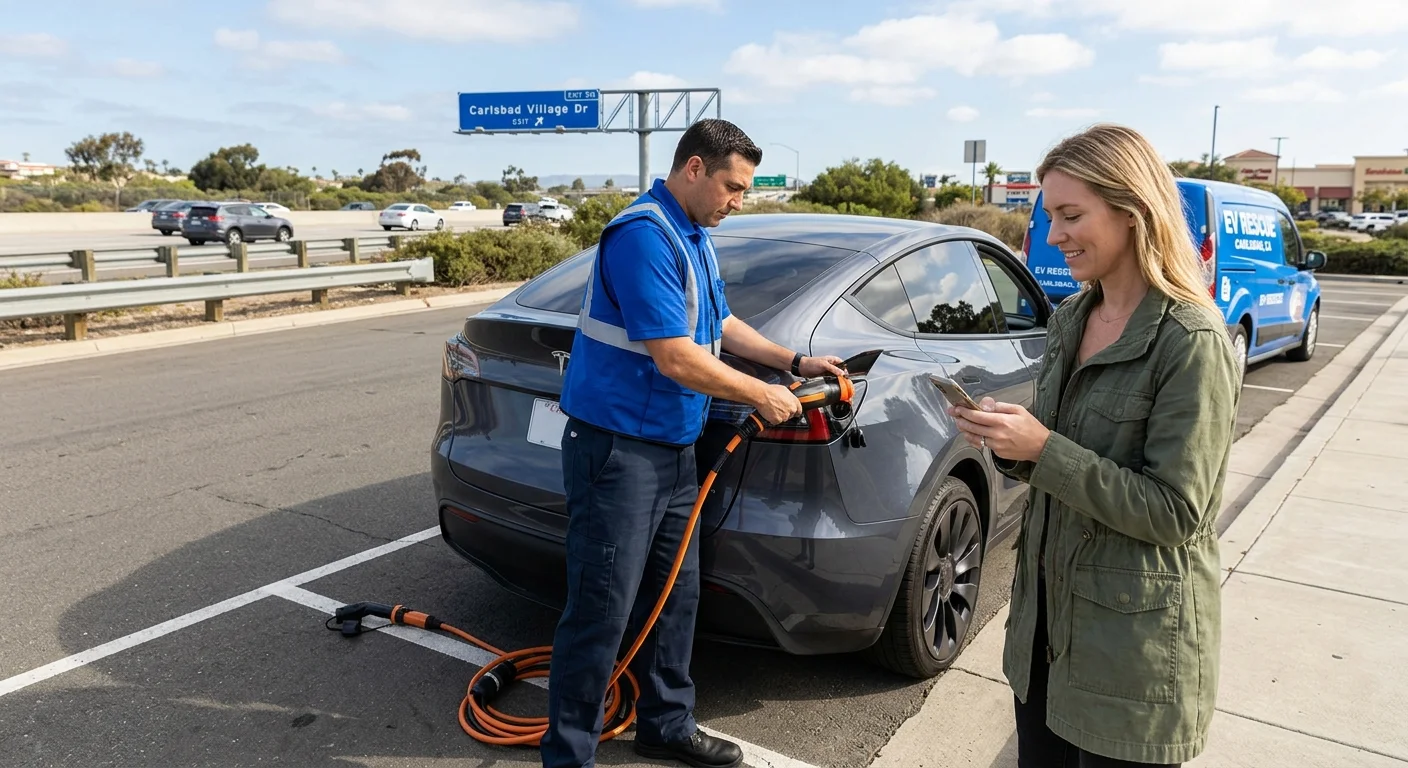
On-site charging may fit when the pack looks empty. The site also has to take the truck. The pros we connect you with bring a 240-volt Level 2 source. They plug it into the car on site. Teslas use a native NACS plug on that truck. Other EVs use a CCS or J1772 adapter. A typical session adds about 10 to 20 miles of range. That takes 15 to 30 minutes of charging time. That figure is charging time, never an arrival window. The pros we connect you with are licensed and insured.
Our mobile EV charging page explains how that referral works. Charge Pro LA doesn’t own trucks, hold a shop, or set rates. We don’t promise a connector, an output, or a resulting range.
The operator quotes you before they start any work. They bill you directly for the work they do. Ask for the current amount and the terms before you approve the work. Your insurer, automaker, or roadside plan may also say whether a policy applies. We couldn’t confirm a fixed Redondo Beach price because we don’t set one.
Transport may fit when the curb can’t support a charge. It may also fit when the symptoms point past an empty pack. Think about the next safe destination before you pick. A small roadside boost isn’t proof that every issue is gone. Ask what the delivered charge is meant to do. Check the display before you rejoin PCH.
If a tow is already hooked in a private lot, California Vehicle Code 22658 applies. Confirm the current process with the lot and the tow company.
On a freeway, CVC 22651 lets an officer remove an unattended vehicle. That clock starts after more than four hours. Don’t abandon a stalled EV that long while you walk toward a public stall.
Other South Bay cities run the same choice. Manhattan Beach, Torrance, El Segundo, Hawthorne, and Gardena sit next door. A stall on the 405 through Torrance still needs its own pin. See EV roadside assistance in Torrance if that’s where you actually stopped.
The same fork is in our charge, jump, or tow guide.
What to have ready, including a failed public stall
Have the pin, your direction of travel, and a nearby landmark. Have the make, model, and year of the car. Have the last battery reading and the exact dash wording. Note whether you’re on a curb, a shoulder, a driveway, or a garage floor.
If a public station was the last stop, say what the stall actually did. Run the checks in our public charger guide before you leave the stall.
Stay by the phone until the operator has what they need. They may need a gate code or a second pin first.
When to call
Call when your EV has stalled in Redondo Beach. Ask for an operator to assess a mobile charge or a tow. Have the location, vehicle details, battery reading, and dash messages ready. Call (858) 925-5546 and we’ll connect you with a local EV rescue operator.