When your EV dies on the 405 through Torrance, you need power at the car. A tow is the last option, not the first. South Bay 405 traffic and Harbor 110 idle leave you on the shoulder. An empty pack is the usual result. Charge Pro LA is a referral line. We connect stranded drivers with independent mobile rescue operators in Los Angeles County.
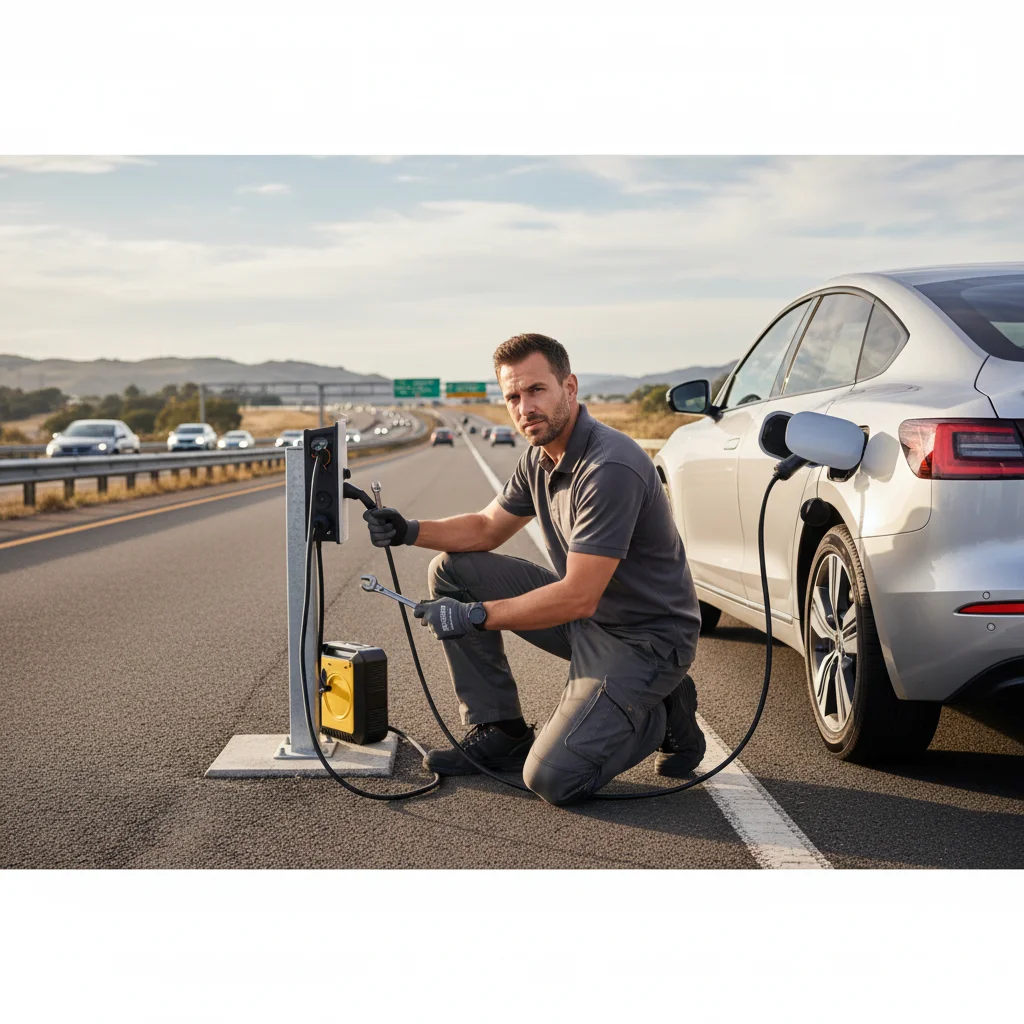
South Bay traffic, not a mountain grade
Torrance sits in the South Bay and the Harbor. Daily driving here runs the 405, the 110, and PCH. Hawthorne Blvd, Crenshaw Blvd, and Del Amo carry the rest. Old Torrance, Southwood, and Hollywood Riviera feed those roads. West Torrance and the Del Amo district do the same.
This isn’t a Grapevine climb, and it isn’t Antelope Valley heat. Torrance has a mild marine climate. May Gray and June Gloom keep summers cool and damp. Cabin heat isn’t the main range hit. Stop-and-go beach traffic is the real drain.
Hawthorne Blvd is also SR-107. It crawls past auto-industry and aerospace campuses. Del Amo mall traffic stacks through the district on weekends and weeknights. PCH, which is SR-1, runs the west edge of town. Cars strand on Hawthorne Blvd and the PCH corridor.
Census ACS figures put Torrance at 143,499 residents. The 2024 Census estimate is 139,576. Most housing, 83.3 percent, was built before 1980.
Southern California Edison delivers electricity in Torrance, not LADWP. A home charger rebate doesn’t reach a freeway shoulder. If you stall, you need a Level 2 source at the car.
Three Torrance places an EV actually stops
The 405 through the South Bay is the commute spine. Northbound and southbound both clog at peak. You feel it in small speed changes, not one steep hill. Each slowdown, brake, and crawl uses more energy than a steady cruise. A dawn range estimate in West Torrance won’t match evening traffic.
The Harbor 110 is the other freeway. Metro ExpressLanes run on the 110. You need a FasTrak transponder tied to a funded account to enter those lanes. Without one, Metro bills by plate under Pay-As-You-Go. If you stall, say whether you’re in the ExpressLanes or the general lanes. Give the nearest exit and what you can see from the seat.
Surface streets are the third pattern. Hawthorne, Crenshaw, Del Amo, and PCH aren’t freeways. They still trap a low pack in live traffic. Hollywood Riviera sits toward the coast, next to Redondo Beach. Old Torrance sits closer to the Harbor side. Southwood and West Torrance feed the 405. A stall at Harbor-UCLA after an appointment is a parking-lot problem. The car still won’t move.
A stall in a Del Amo lot is private property, not a freeway. Read the posted tow sign on site. CVC 22658 rules apply to those removals. A statewide dollar cap couldn’t be confirmed.
What to do on the shoulder before you call
California Vehicle Code 21718 bars stopping on a freeway, with listed exceptions. A disabled EV that’s already called for help is one of those exceptions. Signal right as soon as range is critically low. Get to the shoulder if you can. Hazards on before you fully stop. Stay in the car with the seatbelt on unless you’re in immediate danger.
If you’re still in a travel lane, call 911 first. CHP handles traffic after that 911 call, then you arrange EV help.
Metro Freeway Service Patrol roams congested Los Angeles County freeways. It’s a joint program of Caltrans, the California Highway Patrol, and LA Metro. It’s free to motorists. FSP can change a flat, offer a gallon of gas, or refill a radiator. It can tape a hose or tow you to a CHP-chosen safe spot. Dial 511 and say Motorist Aid. Hours are typically weekday peak commute periods. Confirm current hours on metro.net. Don’t assume a window.
FSP’s published motorist list is written for gasoline cars. It names gas, coolant, and tires. It doesn’t list mobile EV charging or an empty-pack boost. An EV at zero is outside that charging list. A free tow to a safe location is the EV option FSP publishes. That reading is from metro.net and chp.ca.gov, dated September 2026.
CVC 21809 is the move-over law. A driver approaching a stopped emergency or Caltrans vehicle with flashing lights has a duty. Change to a non-adjacent lane if that move is safe. Otherwise slow to a reasonable speed. That law protects you on the shoulder. You still stay inside the car.
CVC 22651 lists when an officer may remove a vehicle. Blocking traffic is on that list. So is sitting unattended on a freeway for four hours or more. Call while you still fit the disabled-vehicle exception. Don’t leave the car on the 405 and walk to an exit.
If a CHP rotation tow is already coming, tell the mobile operator. Details of the Los Angeles area rotation list couldn’t be confirmed against CHP’s published materials.
For the 405 climb farther north, between the Westside and the Valley, read out of charge on the 405 at Sepulveda Pass. That pass is a grade problem. Torrance is a traffic problem. If the stall is on the Harbor freeway itself, out of charge on the 110 walks that corridor.
Empty pack or a 12V brick
Two failures look identical from the driver’s seat. The traction pack can be at zero after Hawthorne or 405 miles. Or the 12-volt battery can be dead while the main pack still holds energy. The 12V runs computers, locks, lights, and the contactors that close the high-voltage system. Without it, the car is a brick.
A long park at Del Amo is a classic 12V setting. So is a Harbor-UCLA visit or an aerospace campus lot. The dash stays dark, and handles may not work the usual way. That isn’t an empty drive pack. Operators jump or replace a dead 12V on site.
An empty traction pack needs energy added. Operators bring a 240V Level 2 source to the car. Teslas take a native NACS plug. Other EVs use a CCS or J1772 adapter. Typical charging adds 10 to 20 miles in 15 to 30 minutes of charging. That window is charging time. It isn’t an arrival time. Charge Pro LA doesn’t promise when someone shows up.
The operator quotes you before any cable goes in. The operator bills you directly. Charge Pro LA doesn’t set prices, own trucks, or employ technicians. The brand holds no trade license. The pros we connect you with are licensed and insured.
If you can’t tell which failure you have, say what the dash shows. The operator will check both.
What a mobile Level 2 rescue is, and is not
Mobile EV charging is a Level 2 boost at the car. It isn’t a Supercharger, and it isn’t DC fast charging. The goal is enough range to leave the shoulder. From there you roll to charging you choose, or you head home.
Out-of-charge recovery is the empty-pack case. EV roadside assistance is the broader roadside menu, including a 12V jump. Non-Tesla EV rescue covers CCS and J1772 cars. Operators handle Tesla and every major EV brand. You don’t have to reach a public stall first.
Share your direction, the nearest exit or cross street, and the make and model. On the 405, northbound or southbound matters. On Hawthorne or PCH, the cross street matters. On the 110, say if you’re in ExpressLanes.
Charge Pro LA serves every city in Los Angeles County. Torrance borders Redondo Beach, Gardena, Hawthorne, Manhattan Beach, and Carson. A Hollywood Riviera stall can sit a few blocks from the Redondo line. West Torrance dumps onto the 405. Old Torrance sits nearer the Harbor side of town. The same operator pool covers those adjacent cities.
For a city overview, use the Torrance charging page.
Frequently asked questions
Does Freeway Service Patrol charge an empty EV on the 405?
No. FSP’s published list covers gas, coolant, tires, and a free tow to a safe spot. It doesn’t list EV charging. If a patrol truck arrives, take the safety help. Then still arrange a mobile Level 2 boost if the pack is empty.
How do I tell an empty pack from a dead 12V?
A range readout at zero after 405 or Hawthorne traffic usually means the traction pack. A dark car after a long Del Amo or Harbor-UCLA park often means the 12V. You don’t have to be sure. Tell the operator what you see. Operators can jump a 12V and they can add Level 2 energy.
Can a non-Tesla get a boost on PCH or Hawthorne Blvd?
Yes. Operators bring a CCS or J1772 adapter for non-Tesla EVs. Hyundai, Kia, Ford, Chevy, Rivian, Volkswagen, and other major brands are in that group. The quote happens before any cable goes in.
Call (858) 925-5546 when you’re stuck on the 405, the 110, Hawthorne, or PCH. We match you with a local operator. The operator quotes before work starts and bills you directly. If a tow is the safer call, the operator will say so.