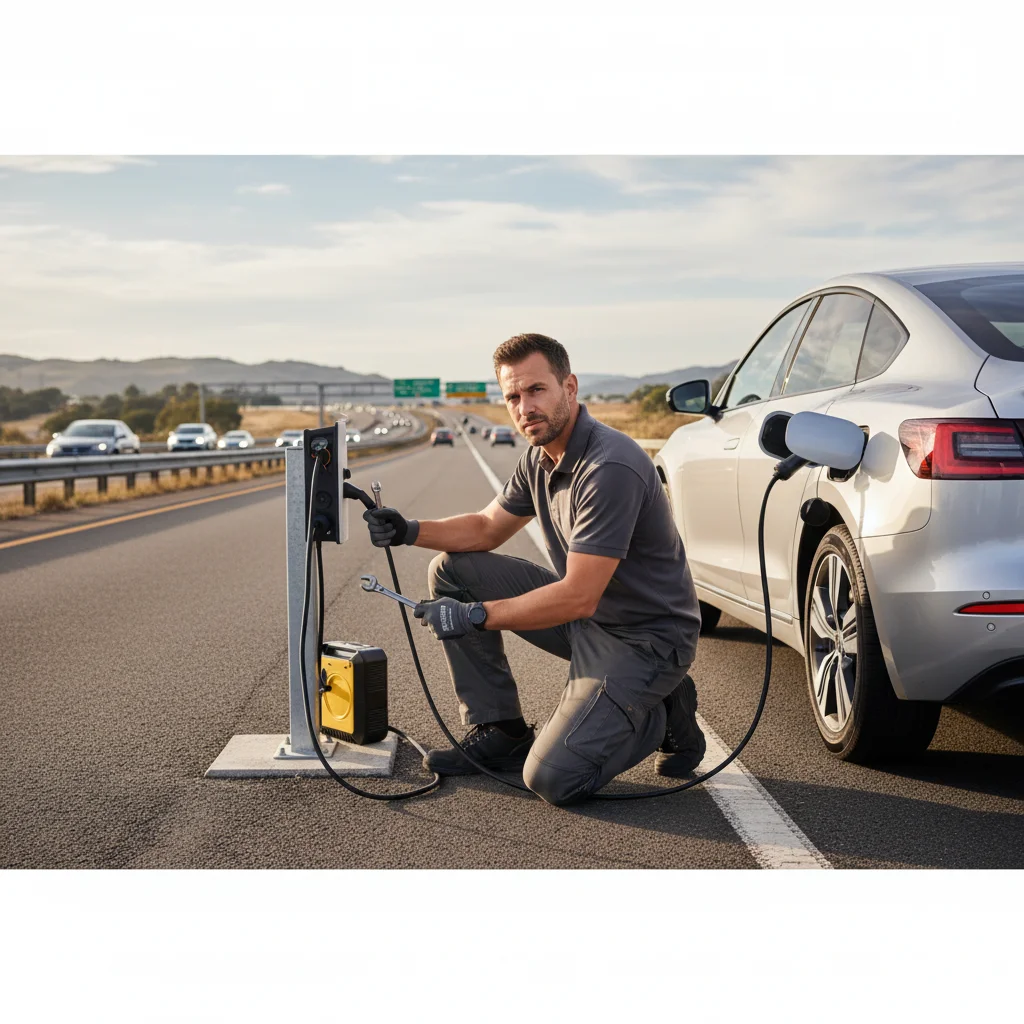
Your EV just hit zero on the 405 at Sepulveda Pass. Get fully onto the right shoulder. Put the hazards on and stay with the car. Then call for help. This climb is the daily range trap. It sits between the Westside and the San Fernando Valley. A local operator can bring a 240-volt Level 2 boost. The boost happens where you sit. Typical charging time is 15 to 30 minutes. That adds about 10 to 20 miles of range. That’s charging time, never an arrival time. It’s enough to leave the freeway under your own power.
The pass that ties two climates together
Sepulveda Pass on the 405 is a commute, not a road trip. You leave Santa Monica, Culver City, West Hollywood, or UCLA in Westwood. Then you climb toward Glendale, Burbank, and the rest of the Valley. The southbound run is the same grade in reverse. Afternoon heat and the air conditioner both tax the pack.
Recurrent Auto tested 30-plus EV models. At 32F they kept about 78% of rated range. At 20F they kept about 70%. Cabin heat was the main drain. Heat and heavy AC cut range in summer too. Los Angeles County doesn’t need snow for that math. The Valley runs hotter than the coast. The marine layer that cools Santa Monica doesn’t follow you over the pass. NWS Los Angeles/Oxnard describes May Gray, June Gloom, and Santa Ana winds. Station-level temperature normals aren’t attached in our source set. This page doesn’t invent a high or a low.
You don’t need a summit figure to feel the grade. The pack works harder on a sustained climb than on flat miles. A thin buffer after the Getty Center can vanish on the way up.
The City of Los Angeles is LADWP territory. LADWP is the largest municipal utility in the United States. Most of the rest of the county sits in Southern California Edison territory. Clean Power Alliance buys generation for Santa Monica, Culver City, Beverly Hills, and West Hollywood. Calabasas and unincorporated Los Angeles County are members too. SCE still delivers the power and reads the meter. That split doesn’t change a shoulder rescue. A stranded driver still needs a charge, a 12V wake-up, or a tow.
Culver City’s ACS 2019-2023 population is 39,993. About 85.5% of its housing predates 1980. Glendale, on the Valley side, has an ACS population of 192,270. Those are different housing stocks and different heat loads. The 405 is the road that ties them together.
Get off the live lane while the car still rolls
When the low-range warning hits, ease right. Don’t wait for a zero. A car that’s still moving is easier to place. A car that’s already shut down is not.
California Vehicle Code 21718 generally bars stopping on a freeway. A disabled vehicle is an exception when you’ve summoned help. It’s an exception when you must stop to avoid injury or damage. It’s an exception when an officer directs you. Calling for roadside help puts you in that exception. It doesn’t make the shoulder safe. It only makes the stop lawful.
Do this, in order.
Hazards first. Other drivers need that signal before your speed falls far below the pack.
All the way onto the right shoulder. Get as far from the travel lane as the pavement allows. If there’s a barrier, sit close to it. Don’t straddle the fog line.
Exit on the passenger side if you can. The driver’s door opens into traffic. Stay on the barrier side of the car, never the lane side.
Stay with the vehicle. Don’t walk toward an exit. Pedestrians on a freeway shoulder are hard to see, especially after dark.
Call 511 and say Motorist Aid. Report your direction of travel and a landmark you can name. Give a description of the car. That logs the stop with the system Caltrans, CHP, and Metro use.
California Vehicle Code 21809 is the move-over law. Drivers approaching a stopped emergency vehicle, tow truck, or Caltrans vehicle with flashing lights have a duty. They must move to a non-adjacent lane if it’s safe. If they can’t, they must slow to a reasonable speed. You can’t control other drivers. You can make yourself easier to see.
CVC 22651 lists when an officer may remove a vehicle. One trigger is a car left unattended on a freeway for four hours or more. Stay with the car. Keep the hazards on. Keep your phone awake.
What Metro Freeway Service Patrol will actually do
Metro Freeway Service Patrol is a joint program of Caltrans, the California Highway Patrol, and LA Metro. It’s free to motorists. The trucks roam congested Los Angeles County freeways to clear incidents. Coverage is typically Monday through Friday during peak commute hours. It also runs all day in designated construction zones. Metro says midday and weekend coverage is expanding on the busiest corridors. Dial 511 and say Motorist Aid.
What FSP publishes is built around gasoline cars. The published list includes a gallon of gas. It includes a radiator refill and hose tape. It includes a flat-tire change. It includes a free tow of a disabled vehicle to a safe pre-designated location chosen by CHP. The published motorist-assistance list doesn’t include mobile EV charging or out-of-charge pack help. That’s an observed absence from Metro and CHP materials read on 2026-09-18. It’s not a guess about unpublished policy.
If your traction battery is empty, FSP can still get you off the live freeway. The tow goes to a CHP-chosen safe spot. It won’t refill the pack. An empty EV isn’t a car that needs a gallon of gas.
CHP also dispatches tows from a rotation list for disabled and abandoned vehicles on the freeway. Rotation details for the Los Angeles area weren’t confirmed in our source set. Don’t assume the first truck that stops is set up for a live charge.
City of Los Angeles Official Police Garages handle LAPD impounds. Specific release steps and fees weren’t verified here. Confirm them on lapdonline.org or lacity.gov if an officer removes the car. California doesn’t set one statewide tow price. Non-consensual private-property tows are constrained by CVC 22658 and CHP-approved rates. Freeway tows follow CHP rotation agreements.
Charge where you sit, or accept a dead car at a lot
A tow gets the car off the 405. It doesn’t put miles back in the pack. Most EVs need a flatbed. Rolling the drive wheels on a dolly can damage the drivetrain. The truck then drops you where the tow company can take you. You still have a dead car, and you still need a charge.
Ask any tow operator for a quote before the hook goes on. This page doesn’t publish a dollar figure because no verified corridor rate was confirmed. A longer look lives here: why towing a dead EV in Los Angeles County is the last call.
A mobile Level 2 boost is a different job. An independent operator brings a 240-volt source to the car. Tesla owners get a native NACS plug. Other EVs use a CCS or J1772 adapter. Typical charging time, not travel time, is 15 to 30 minutes. You leave with about 10 to 20 miles of range. That’s enough to leave the pass and reach a place you choose. The operator quotes you before work starts and bills you directly.
Charge Pro LA is a referral line. We match stranded drivers with independent local mobile rescue operators. We don’t own the trucks. We don’t set the price. We don’t promise an arrival window. The pros we connect you with are licensed and insured. You get the quote before anything starts. We serve every city in Los Angeles County, including both sides of this pass.
If the car is empty, use out-of-charge recovery. If you’re not sure it’s the pack or the 12-volt, say so. A dead 12V can look like an empty pack. The dash stays dark. The doors may not wake. The 12-volt battery runs the computers that close the contactors on the main pack. Operators in the network can jump or replace that 12V on site. EV roadside assistance in Los Angeles when AAA isn’t enough walks through that fork.
What to tell dispatch from the shoulder
When you call, keep it short and exact.
- Northbound or southbound on the 405
- Last place you can name: Westwood, the Getty Center, Glendale, Burbank, or the city you just left
- Year, make, model, and color
- Whether the high-voltage pack is at zero, or the car won’t wake at all
- Whether hazards are on and you’re fully on the right shoulder
That’s enough for an operator to bring the right connector. Tesla, Rivian, Ford, Hyundai, Kia, and GM are in scope. So is every other major EV brand in the network.
If you still have a sliver of range, get off at the next exit you can reach. Don’t force a merge you can’t complete. If the car is already slowing hard, take the shoulder. If the car still rolls and you can reach a surface street, say so. An operator can meet you there instead of on the freeway. If you can’t, stay on the right shoulder.
Westside start, Valley finish
A Santa Monica morning can feel cool under May Gray or June Gloom. By the time you crest toward Burbank or Glendale, the Valley is a different day. Recurrent’s heat and AC research is why that gap shows up on the gauge. Cabin cooling on a grade isn’t free energy.
Dead EV in Culver City: help on the 405 and the 90 is the Westside page for drivers who stall before they even reach the climb. On the Valley side, mobile EV charging across the San Fernando Valley covers Glendale, Burbank, San Fernando, and the basin beyond. Calabasas already lives with canyon grades. The pass is the urban version of the same problem.
Don’t treat the City of Los Angeles as one climate. Coastal Westside, the central city, and the Valley don’t share the same heat load. Plan the commute for the hotter side of the trip, not the side where you parked.
If you can still roll, pick a place you know
This page won’t guess the nearest charger. Public maps change. Stalls go down. A pin that looked close in the app can be full when you get there. If you still have miles, use your charging app, pick an exit you know, and go there. If you don’t have miles, stay put and wait for a boost.
UCLA in Westwood, the Getty Center, and Cal State Northridge are durable landmarks. Give one of those to dispatch. They beat a vague “I’m on the 405.” Combine a landmark with northbound or southbound.
For Tesla-specific zero-pack steps, Tesla at zero on the road walks through charge-in-place versus a tow. The physics on the pass are the same for a Model Y as for a non-Tesla. The grade spends energy. An empty pack doesn’t care about the badge.
After you’re moving again
Once you have those 10 to 20 miles, leave at the first exit you can take safely. Don’t try to finish a Valley-to-Westside day on a recovery charge. Get to a charger you trust. Or get home if home can take a plug.
Bookmark out-of-charge recovery before you need it again. The pass is a weekday habit for a lot of this county. The rescue number should be too.
Frequently asked questions
What should I do first if my EV dies on the 405 at Sepulveda Pass?
Get fully onto the right shoulder with hazards on. Stay with the car, passenger side if you can. Call 511, say Motorist Aid, and report direction plus a landmark. Then arrange a mobile Level 2 boost so you can leave under your own power.
Will Metro Freeway Service Patrol charge my EV on the 405?
The published FSP list covers gas, coolant, tires, and a free tow. The drop is a CHP-chosen safe spot. It doesn’t list mobile EV charging. An empty pack still needs a charging operator, or a tow that leaves the car empty.
Can a mobile rescue help a non-Tesla on Sepulveda Pass?
Yes. Operators in the network bring a 240-volt Level 2 source. They use a native NACS plug, plus CCS or J1772 adapters. Tesla and every major EV brand are in scope. The operator quotes you before starting and bills you directly.
The pack just hit zero on the 405 at Sepulveda Pass. Call Charge Pro LA at (858) 925-5546. We’ll connect you with a local operator who can bring a charge to the shoulder. You get a quote before work starts.