The cost to tow an EV in Los Angeles County isn’t one posted number. California doesn’t publish a statewide cap you can copy from a blog. Metro Freeway Service Patrol can still tow an empty EV to a CHP-chosen safe spot. That truck won’t charge the pack. On a private lot, the hook follows California Vehicle Code 22658. A tow is the last call because it moves the car, not the energy.
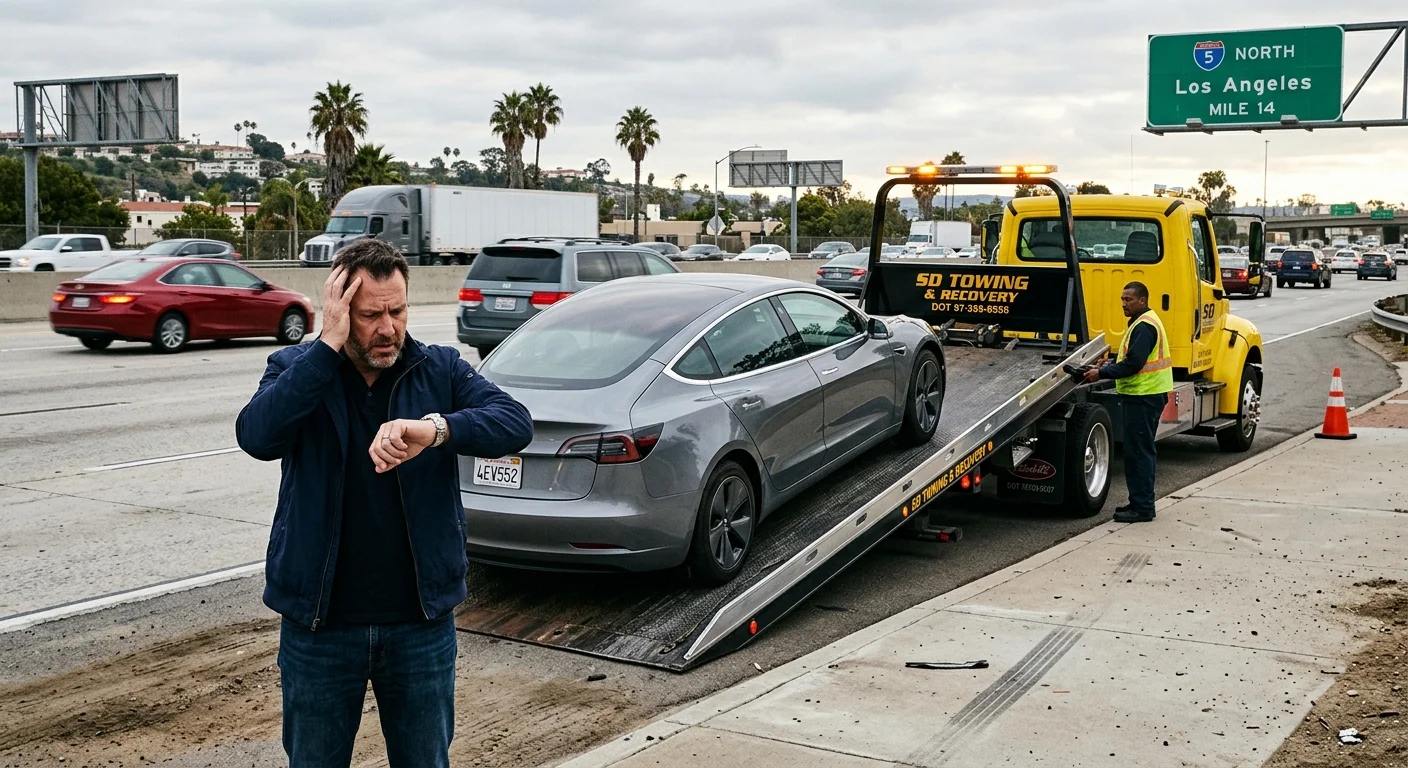
FSP can tow you, but it can’t charge you
Metro Freeway Service Patrol is free to motorists. Caltrans, the California Highway Patrol, and LA Metro run it together. Patrol trucks roam congested Los Angeles County freeways to clear stalls. Dial 511 and say Motorist Aid if you want that help.
The published aid list is written for gasoline cars. FSP offers a gallon of gas if you run out. Crews can refill a radiator and tape a hose. They can change a flat tire. They can also tow a disabled vehicle at no charge. CHP picks the safe drop spot. You don’t pick a shop or a house.
We checked that list on metro.net and chp.ca.gov. It doesn’t name mobile EV charging. It doesn’t name an out-of-charge pack fill. Treat that as an observed gap in the published materials. It isn’t a secret policy we invented. An empty EV can still get the free tow off the lanes. It won’t get a Level 2 boost from that truck.
Hours are typically Monday through Friday during peak commute windows. Coverage also runs all day in designated construction zones. Metro has been expanding midday and weekend coverage on the busiest corridors. Confirm today’s window on metro.net before you count on a truck.
The cost to tow an EV has no statewide figure
People type “cost to tow an EV” because they want a sticker price. Los Angeles County doesn’t publish one we can reprint. California doesn’t set a single statewide tow rate. Non-consensual tow and storage charges sit under CVC 22658 on private property. Freeway tows can sit under CHP rotation agreements. A flat statewide cap wasn’t verified in the materials we read. Don’t pay from a blog post. Ask the tower for the current amount before a hook goes on.
Inside the City of Los Angeles, impounds can run through Official Police Garages. Release generally needs proof of ownership. It can also need an LAPD release where that applies. The specific OPG steps and fee schedule weren’t verified for this page. Check lapdonline.org or lacity.gov before you treat any garage script as law.
Your electric bill doesn’t set the tow either. LADWP serves the City of Los Angeles. Most of the rest of the county is Southern California Edison territory. None of that fills an empty pack on the shoulder.
Private-property tows follow CVC 22658
A mall garage isn’t a freeway shoulder. Neither is an apartment lot, a stadium structure, or a hospital garage. Those stops fall under CVC 22658 when someone wants the car removed.
A vehicle may be removed from private property only with required signage. The signs have to be 17 by 22 inches at the entrances. The owner or agent also has to give written authorization. The tower has to give immediate written notice to the registered owner. Local law enforcement has to be notified within one hour.
If you return before the vehicle leaves the lot, they have to release it. If it’s already coupled but not yet moved, stop. The most they can collect is half the tow charge. Confirm that current text on leginfo.legislature.ca.gov. Don’t guess a dollar amount from memory. Storage rates can’t exceed law-enforcement or CHP-approved rates. California still doesn’t publish one statewide cap we can print.
Read the entrance sign. Ask who authorized the hook. Ask where the yard is. If you’re in a City of Los Angeles structure, ask which system it is. Ask whether this is an OPG tow or a private-lot tow. Those paths aren’t the same.
LAX parking is a frequent version of this stop. Terminal structures P1 through P7 all offer Level 2 and DC fast charging. The Economy Parking garage has more than 4,000 stalls, including 514 active EV chargers. A traveler can still return to a dead 12V. That failure isn’t an empty pack.
A freeway stall is a legal stop, then a choice
CVC 21718 bans ordinary stopping, parking, or leaving a vehicle standing on a freeway. A disabled EV that has summoned help fits an exception. Call first, then stay with the car if you can do that safely.
CVC 21809 is the move-over law. Other drivers must change to a non-adjacent lane when it’s safe. If they can’t, they have to slow to a reasonable speed. That rule covers a stopped emergency vehicle with lights on. It also covers a tow truck or a Caltrans vehicle. It protects you on the shoulder.
CVC 22651 lets an officer remove a vehicle left unattended on a freeway. The unattended window is four hours or more. Don’t treat the shoulder as overnight storage. If you’re in a live lane, call 911.
Name the pin with real roads. Northbound 5 approaching Santa Clarita differs from the 405 at Sepulveda Pass. The 10 through El Monte differs from the 110 Harbor Freeway. Metro ExpressLanes run on I-10 and I-110. A FasTrak transponder tied to a funded account is required to enter. A vehicle without one is billed by plate under Pay-As-You-Go. That billing includes a processing fee. Metro’s published FAQ doesn’t spell out a disabled-vehicle procedure inside those lanes. Don’t assume a shoulder you haven’t seen. Tell the operator you’re in an ExpressLane if that’s where you stopped.
The long grade on I-5 north of Castaic is the county’s hard climb. Antelope Valley heat and cold around Lancaster and Palmdale cut real range.
What the hook still leaves unfinished
A tow relocates a dead EV. It doesn’t put miles back in the pack. If the traction battery is at zero, the car is still empty at the drop. You still need a working charge or a 240-volt boost.
Don’t assume the first stall will finish the job. The plug may not match, or the stall may be occupied. That isn’t a claim that a neighborhood has no charging. Named sites exist, including the LAX structures above. Moving the car doesn’t guarantee a working session.
Most EVs shouldn’t roll on two wheels when the drive units can’t freewheel. Tesla’s transporter instructions live in that year’s owner’s manual. Follow those pages, not a wheel-lift habit from a gas car. Our Tesla tow checklist points at that manual.
A dead 12V can look like an empty pack from the curb. Dark screens and silent locks are clues. They aren’t proof. Sort that before anyone loads the car. Charge, jump, or tow walks through that fork.
If FSP already towed you to a CHP-chosen spot, you’re off the lanes. You’re not done. You still need energy, or a shop, or both.
When a mobile Level 2 boost fits first
When the pack looks empty and the car is intact, use power at the curb. The operators we connect you with bring a 240-volt Level 2 source to the car. Tesla cars often take a native NACS lead. Other brands need CCS or J1772 adapters. The operator confirms the plug before starting.
That session typically adds 10 to 20 miles of range. It usually takes 15 to 30 minutes of charging. That’s charging time, never an arrival time. It can be enough to reach a public stall or get home. It isn’t a full recharge.
The operator quotes you before any work starts. They bill you directly. Charge Pro LA doesn’t set that price. Read how mobile EV charging gets quoted before you assume a number. Mobile EV charging is the on-site path. Weigh it against a tow in on-site charging or a tow.
A boost doesn’t fit every pin. A live lane with no workspace is a safety problem first. Then a flatbed is the honest tool.
When a tow is still the right tool
Call for a tow when the car can’t be worked where it sits. That’s a crash, a broken axle, or a blocked travel lane. It’s also a parking structure the service vehicle can’t enter. If FSP arrives first, take the free tow to a safe spot. Then call for a charge from the safe location.
Private-lot tows remain last if you can reach the car first. CVC 22658 says they must release it if you return before it leaves. Get there if you can do that safely. Then decide on a boost, a 12V jump, or a consensual tow you chose.
Ask these questions before anyone hooks up
Ask where the car will go. Ask whether the destination can charge this plug. Ask whether this is a CHP rotation or an FSP drop. Ask whether it’s an OPG impound or a private-lot hook. Ask whether the truck is a flatbed. Ask for the current charge in writing before you pay. California doesn’t hand you a single number. The person on the ticket does.
If the pack is empty and reachable, ask about a Level 2 boost first. If the 12V looks dead, say that out loud. If you’re on the 5 north of Castaic, say the Grapevine. If you’re on the 10 or the 110 ExpressLanes, say that too.
Charge Pro LA matches stranded EV drivers with independent local mobile rescue operators. The pros we connect you with are licensed and insured. We don’t own the truck. Call (858) 925-5546 and we’ll connect you with an operator. That operator quotes the work they actually offer.