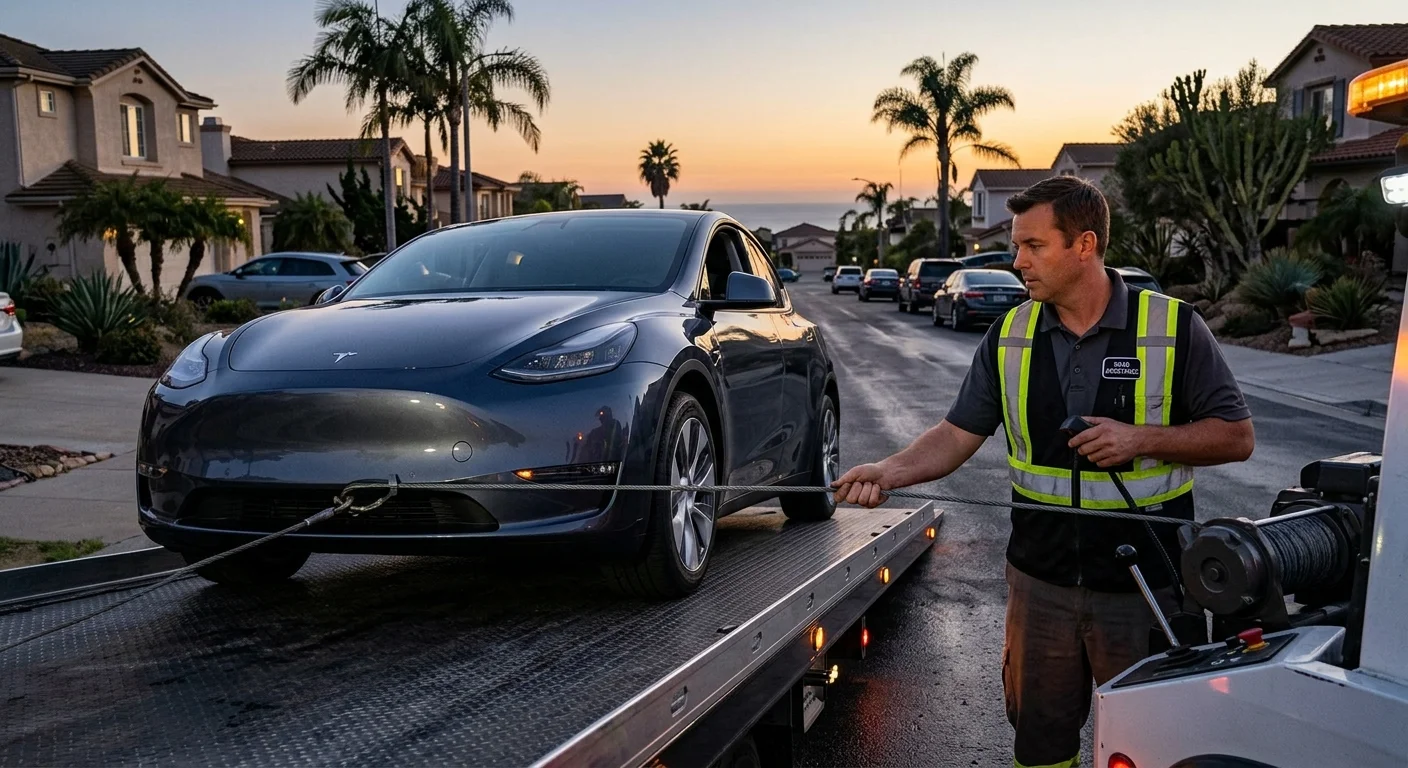
A dead Tesla still has to leave an LA County freeway safely. Metro FSP can tow you to a CHP-chosen safe spot at no charge. It won’t recharge the pack, and that limit matters. The patrol is a joint program of Caltrans, CHP, and LA Metro. It roams congested county freeways to clear stalled cars. Published help covers gas, a radiator refill, taped hoses, and a tire change. Then it tows a disabled vehicle to a pre-designated safe location. Mobile EV charging isn’t on that published list. Take the free move off the travel lanes if FSP arrives. After that you still need a charge, a 12V jump, or a flatbed.
What Metro FSP will and will not do
FSP is free to motorists on the freeways it covers. You reach it by dialing 511 and saying Motorist Aid. Coverage is typically Monday through Friday during peak commute hours. It also runs all day in designated construction zones. Metro’s been expanding midday and weekend coverage on the busiest corridors. Confirm today’s hours when you call 511, since Charge Pro LA doesn’t set that schedule.
FSP may be how you leave a live lane on the 5 near Santa Clarita. The same help can show up on the 405 through Sepulveda Pass. It’s also on the 10 through the San Gabriel Valley. California Vehicle Code 21718 generally bars stopping on a freeway. A disabled vehicle that’s already summoned help fits an exception. Keep the hazards on and stay out of the travel lanes. Under CVC 21809, drivers must change lanes or slow for a stopped tow with lights. That rule’s there to protect you on the shoulder.
What FSP won’t do is wake a Tesla. An empty pack or a dead 12V sits outside the published motorist-assistance list. That’s an observed absence from Metro’s and CHP’s published materials, not a policy guess. The patrol truck can move you to a safe spot, not plug in. After you’re clear of the freeway, you still choose the next step.
The same limit shows up from the Harbor Freeway to the Antelope Valley. A Torrance commute on the 405 isn’t a Palmdale run on the 14. Heat, grades, and cabin climate all cut real range below the sticker. FSP still only offers the gas-car toolkit plus a short tow.
Figure out why the car won’t move
A black screen is often a 12V problem, not an empty drive pack. The 12V battery runs the computer, locks, and touchscreen. When it dies, the car acts like a brick even with range left. A temporary 12V jump can wake the electronics, but it doesn’t refill the drive battery. It may let you enable Transport Mode or drive if the pack still has energy.
If the display still works and the car reports zero miles, the pack is empty. Then you choose an on-site mobile EV charge or a flatbed to a charger. Dragging the car with the drive wheels on the pavement is the option to refuse. For that fork, see charge, jump, or tow when the EV died.
Westside garage stalls, Burbank studio lots, and Antelope Valley grades produce the same three failures. The car is empty, the 12V is dead, or both. Name the failure before anyone hooks a cable. A traveler at LAX can look like an empty-pack case and not be one. Terminal parking structures P1 through P7 offer Level 2 and DC fast charging. The Economy Parking garage has more than 4,000 stalls, including 514 active EV chargers. A week-long trip can still leave a dead 12V that won’t wake the car.
Transport Mode when the screen stays dark
Tesla Transport Mode releases the parking brake and sets the drivetrain for being moved. You normally find it under Controls, then Service, on the touchscreen. With a dead 12V, that menu is gone. The screen stays black until low-voltage power returns. You can’t tap Transport Mode on a dark display.
The workaround is a 12V jump at the front terminals, not a pack charge. On many Teslas you reach those terminals behind the front tow-eye cover. That’s usually on the passenger side of the bumper. A jump pack wakes the low-voltage system long enough to use the screen. Then you can turn Transport Mode on before the car rolls. This isn’t a drive-away charge, only a brief wake-up for the parking brake.
A Tesla 12V jump on site is often what makes Transport Mode possible. If Transport Mode still won’t engage, don’t let anyone drag the car. Wait for a method that keeps the drive wheels from spinning.
Why a Tesla can’t roll on a dolly
A gas car can often roll with the drive wheels spinning. The transmission can disconnect the engine in that case. The motors on a Tesla sit at the wheels through a single-speed gearbox. If those wheels turn while the car is off, the motors generate current. That current has to go somewhere in the drivetrain. Without a prepared transport state, it can overheat the motors and stress the pack electronics.
Most Tesla AWD models drive all four wheels. A rear-drive Model 3 or Y still has a motor on the driven axle. A two-wheel dolly that leaves drive wheels on the road is the wrong tool. All four wheels belong on a flatbed before the truck lines up.
Regenerative braking is part of normal Tesla driving, not a towing feature. Don’t assume a rolling car will freewheel like a neutral automatic. If Transport Mode won’t enable, say so before any winch pull. The operator should confirm the recovery method for your exact model rather than improvising. See why towing a dead EV in Los Angeles County is the last call.
What to tell the operator before they hook up
Say it out loud in this order, and don’t skip steps. First, it’s a Tesla and it needs a flatbed, not a dolly. The 12V is dead or the pack is empty, so name which one. Transport Mode is on, or it isn’t, and you won’t guess. Wheels stay straight for the winch pull onto the bed. The winch uses Tesla’s designated tow points, not the suspension arms or random underbody metal.
If the operator wants to drag it a few feet, stop the job. A short roll can still spin a motor. On a freeway shoulder, CHP may already have called a rotation tow. The LA-area rotation list isn’t verified here, so ask what truck is coming. Ask whether it’s a flatbed before anything hooks up. You can decline a method that puts drive wheels on the ground.
After FSP: lots, ExpressLanes, and a city impound
FSP’s free tow ends at a safe spot CHP designates. It doesn’t plug the car in when you get there. From that lot or shoulder, you still need the next move. That’s a 12V jump, a mobile charge, or a proper flatbed.
Metro ExpressLanes run on the I-10 toward El Monte and on the I-110 Harbor Freeway. A FasTrak transponder tied to a funded account is how you enter. A vehicle without one is billed by plate under Pay-As-You-Go, with a processing fee. Metro’s published FAQ doesn’t spell out a disabled-vehicle procedure inside those lanes. If you stall in an ExpressLane, stay with the car if it’s safe. Call 511 and wait for direction from CHP. Don’t assume there’s a wide shoulder, and don’t assume there isn’t. Treat it as a live lane until a patrol unit says otherwise.
On city streets, CVC 22651 lets an officer remove a vehicle that blocks traffic. It also covers a car left unattended on a freeway for four or more hours. If LAPD tows inside the City of Los Angeles, impounds go through Official Police Garages. Release steps and fee schedules weren’t confirmed in our research. Check lapdonline.org or lacity.gov before you pay or argue a charge.
Private garage tows fall under CVC 22658. Entrances need the required 17-by-22-inch signs, plus written authorization from the owner or agent. The tow company must notify the registered owner and local law enforcement within one hour. If you return before the car leaves the lot, they have to release it. If it’s coupled but not yet moved, the charge can’t exceed half the tow. Confirm the current rate with the yard before you pay.
When a mobile charge should replace the tow
If the pack is empty and you’re already safe, skip a second tow. The independent operators we connect you with bring a 240V source to the car. Teslas take a native NACS plug from the operator. You typically get 10 to 20 miles in 15 to 30 minutes of charging. That window is charging time, not an arrival time. The operator quotes you before work starts and bills you directly. Charge Pro LA doesn’t set prices, own trucks, or perform the work.
Compare that path in on-site EV charging or a tow. See out of charge on the 5 near Santa Clarita. If the 12V is the only failure, skip the flatbed. For Tesla-specific help after the patrol truck leaves, start with Tesla roadside rescue.
Will Metro FSP recharge a stranded Tesla?
No, published help is gas, a tire, and a free tow to a CHP-chosen spot. It doesn’t list a pack boost, so charge or jump after you’re off the freeway.
How do you tow a Tesla with no power?
Use a flatbed so all four wheels leave the pavement. Jump the 12V if you can, enable Transport Mode, and use the designated tow points.
Does a dead 12V mean you need a tow?
Not by itself, if a low-voltage jump restores the screen. If the pack is empty, you still want a charge more than a dolly.
A Tesla with no power is a procedure problem, not a mystery. FSP can clear the freeway, but it can’t fill the battery. Call (858) 925-5546 and we’ll connect you with an independent local operator. That operator quotes before starting and bills you directly.