A dead EV on a Los Angeles County freeway counts as a disabled vehicle. Metro’s Freeway Service Patrol can tow it at no charge. The drop is a safe spot CHP chooses. What that patrol won’t do is refill the pack. FSP’s published list names a gallon of gas and a radiator top-off. It also names a taped hose and a tire change. Mobile EV charging isn’t on that list. The free truck can get you out of the lane. You still have a car with no miles left.
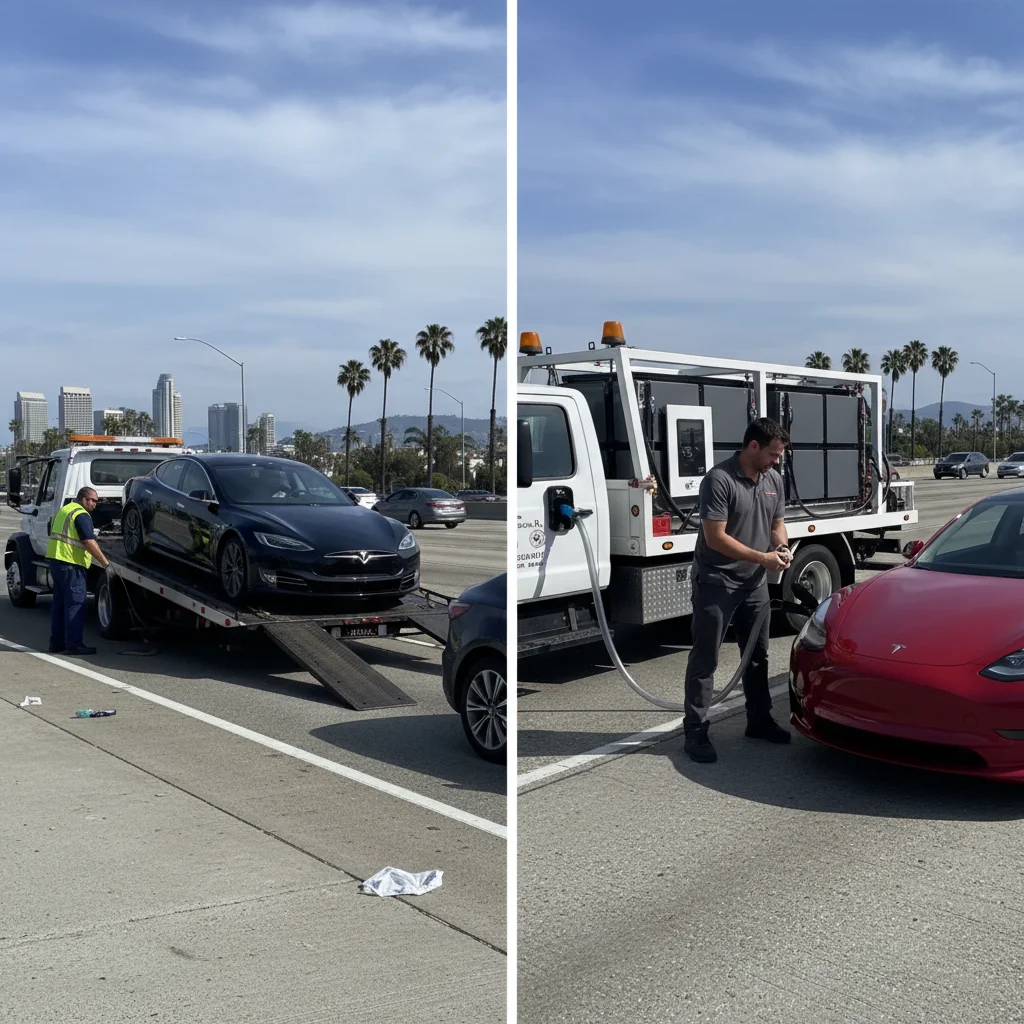
What Metro FSP will and won’t do
Metro Freeway Service Patrol is a joint program of Caltrans, CHP, and LA Metro. It’s free to motorists. Trucks roam congested county freeways to clear stalled cars. Typical hours are Monday through Friday during peak commutes. Coverage has also grown at midday and on weekends along the busiest corridors.
Call 511 and say Motorist Aid if you need them.
A gasoline car that ran dry can get a gallon. An EV at zero percent can’t. That absence is on their published materials, not a rumor. FSP can still tow the car to a pre-designated safe location chosen by CHP. That’s useful. It isn’t a charge.
CHP also runs a rotation tow list for disabled and abandoned freeway vehicles. That program’s separate from FSP. Neither one brings a 240-volt source to the shoulder.
Empty pack, dead 12V, or a broken car
Not every silent EV is out of range. A dead 12-volt battery can brick the car even with pack energy left. LAX terminal structures P1 through P7 offer Level 2 and DC fast charging. The Economy Parking garage has more than 4,000 stalls, including 514 active EV chargers. A failed 12V still won’t wake the car.
A true empty pack is the other case. Long grades eat range. The climb north of Castaic toward the Grapevine is the county’s hardest sustained drain. Sepulveda Pass on the 405 sits between the Westside and the San Fernando Valley. Heat and cabin AC cut real-world range below the window sticker. Recurrent Auto tested that loss across many models. About 78 percent of range was left at 32F. About 70 percent was left at 20F. Summer heat and AC load cut range too.
If the car’s healthy and simply empty, a tow doesn’t finish the job. You still need energy in the battery.
What an on-site charge actually is
Mobile EV charging brings a 240-volt Level 2 source to the car. Operators use a native NACS plug on Tesla. They carry CCS or J1772 adapters for other brands. A typical boost adds 10 to 20 miles of range. That energy goes in over 15 to 30 minutes of charging time. Charging time isn’t an arrival time.
The operator quotes you before any work starts. You hear the number, then you decide. The operator bills you directly. Charge Pro LA is a referral line. It matches stranded drivers with independent local operators. It doesn’t own trucks, set prices, or do the work.
That quote is the point of out-of-charge recovery. You get enough range to reach a public stall or get home. It’s delivered where you sit. How mobile EV charging gets quoted in Los Angeles County walks through that quote.
When a tow is still the right call
A curb-side charge is the wrong tool when the car is broken.
Dash warnings about powertrain failure aren’t an empty tank. A high-voltage battery error or a 12V system fault isn’t either. Pushing more energy won’t clear those. It can be unsafe. In that case the car needs a shop. A flatbed is the honest path.
Most EV makers, Tesla included, want a flatbed. A hook-and-chain or a wheel-lift dolly can damage the motors. If you need that tow, how to tow a Tesla with no power covers the setup.
A tow is also right when FSP or CHP needs the lane cleared. There’s no room to set up a charger in that case. California Vehicle Code 21718 generally bans stopping on a freeway. A disabled vehicle that has already summoned help is an exception. You still shouldn’t sit longer than you must. CVC 22651 lets an officer remove a vehicle left unattended on a freeway. That clock starts at four hours.
Private lots follow CVC 22658. The property needs 17-by-22-inch signs at the entrances. The owner or agent must authorize the tow in writing. They must notify local law enforcement within one hour. If you return before the car leaves the lot, they have to release it. If it’s coupled but not moved, they can charge at most half the tow. Storage can’t exceed the CHP or law-enforcement approved rates. We haven’t confirmed a published dollar figure for those rates. Ask the yard before you pay. City of Los Angeles impounds go through Official Police Garages. Confirm release steps on lapdonline.org or lacity.gov.
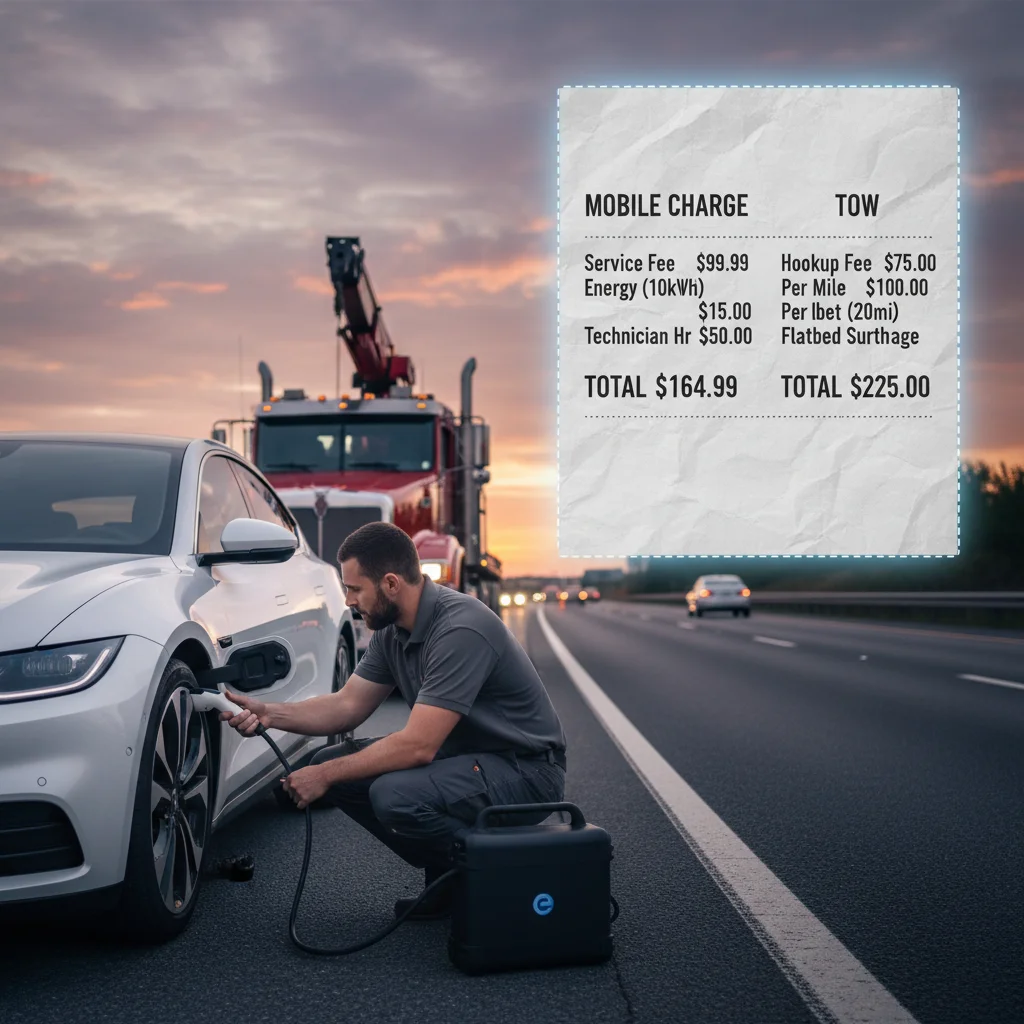
How the two invoices actually differ
No rescue operator in this metro publishes a rate card we can cite. California doesn’t set one statewide tow price either. Non-consensual tows and storage are constrained by CVC 22658 and by CHP rotation agreements. A single cap isn’t a figure we can verify.
What you can compare is the shape of each bill.
A mobile charge is quoted as a job. It covers getting the operator there, the setup, and the energy delivered. Distance still affects the operator’s time. It isn’t a meter that keeps running after the car is on a bed. You get the quote first.
A flatbed invoice is built another way. There’s a hook-up. There’s mileage to the drop. Tight garages, downtown ramps, and steep grades can add winching or extra labor. Nights, weekends, and holidays often cost more on both sides of this market. Storms, stadium traffic, and holiday weekends raise demand too. The charging operator still has to quote you before starting. You shouldn’t learn the total at the drop-off.
Towing also leaves the pack empty. After the unload you still have to charge, wait, and go. When a stalled EV needs a charge instead of a tow covers the healthy empty car. Why towing a dead EV in Los Angeles County is the last call walks the other side.
Clubs, Tesla roadside, and insurance add-ons
Many drivers assume a club or a policy will cover the whole incident. The fine print is usually narrower, and it’s written for tows.
AAA is still a towing network first. A long-distance tow benefit is a chip worth keeping. Using it on a short hop to a public stall wastes that chip. Save it for the day the car actually needs a shop. AAA has begun adding mobile charging trucks in some markets. We couldn’t confirm from their public pages that those trucks are available in this county. Ask the dispatcher. AAA or a mobile charge: what actually gets an empty EV moving is the longer walkthrough.
Tesla’s own support page treats an out-of-charge event as the driver’s responsibility. They typically cover a limited complimentary tow to the nearest public charger or Supercharger. Home, or any other drop, is on you for the difference. Repeat empty-pack calls may not stay complimentary. Tesla may send a third-party mobile charger where they have a local partner. That dispatch isn’t guaranteed.
Basic roadside add-ons from auto insurers are usually tow-shaped too. They often list a modest hook-up and leave mileage and extras on you. They almost never describe a Level 2 boost on the shoulder. Ask the carrier what the add-on actually names. Don’t assume it pays the operator.
None of those programs replace Metro FSP. FSP is free, freeway-only, and strongest in peak hours. It still isn’t a refill.
Shoulder law, ExpressLanes, and sitting too long
Keep the hazards on if you’re on the shoulder. CVC 21809 is the move-over law. Drivers approaching a stopped emergency vehicle, tow truck, or Caltrans truck have a duty. They must move to a non-adjacent lane if it’s safe. If they can’t, they must slow to a reasonable speed. That rule exists to protect you while you wait.
Metro ExpressLanes run on the I-10 through El Monte and on the I-110 Harbor Freeway. You need a FasTrak transponder on a funded account to enter. A vehicle without one is billed by plate under Pay-As-You-Go, plus a processing fee. Metro’s published FAQ doesn’t spell out a disabled-vehicle procedure inside those lanes. If you stall there, stay with the car if it’s safe. Call 511 and follow CHP. Don’t assume a wide shoulder is waiting.
On surface streets the risk is a lot tow, not CHP. In a downtown garage or a coastal lot, a dead EV looks abandoned. That’s when the posted CVC 22658 signs matter more than FSP.
Picking the call from the curb
Start with the dash, not the tow app.
Hard powertrain or high-voltage faults mean a flatbed to a qualified shop. Don’t ask anyone to push energy into a car throwing those codes.
If the car is locked, silent, or won’t wake, start with the 12V. Operators in this network can jump or replace a dead 12V on site. They handle Tesla and every major EV brand.
If the car is awake and the range reads zero, you’re out of charge. FSP can clear a freeway lane. It won’t give you miles. A mobile Level 2 boost puts miles back. A tow to a safe lot still leaves you needing a plug.
A stall on the 5 through Santa Clarita, before the Grapevine, is a range problem. A Long Beach or Torrance garage stall after work is often a 12V issue. A stall on PCH in Malibu is a shoulder and traffic problem first. In each case the operator still quotes before starting.
Charge Pro LA serves Los Angeles County. Independent operators cover the Westside and the San Fernando Valley. They cover the San Gabriel Valley, Gateway Cities, South Bay, Santa Clarita, and the Antelope Valley. The brand doesn’t run a yard or a fleet.
If you want the car charged where it sits, call (858) 925-5546. We connect you with a local operator who can quote the job. If you accept, that operator brings a Level 2 source to the car.