Your EV pack just hit zero in Los Angeles County. There’s no public price list for this job. The independent operator quotes mobile EV charging on the curb. Charge Pro LA is a referral line. We match stranded drivers with local mobile rescue operators. We don’t set the bill. We don’t own trucks. We don’t employ technicians. The operator quotes you before the cable goes in. Then that operator bills you directly.
Metro Freeway Service Patrol won’t charge an empty pack. FSP is a joint program of Caltrans, CHP, and LA Metro. The help is free to motorists. It roams congested county freeways to clear stalled cars. Its published motorist-help list names a gallon of gas. It also names a radiator refill and a tire change. It can tow a disabled vehicle to a safe spot CHP chooses. That tow is free to the motorist. The published list doesn’t name mobile EV charging. It doesn’t name out-of-charge battery help. Treat that as an observed absence in the published materials. It isn’t a guess about unpublished FSP policy. If the pack is empty, those pages offer a free tow. They don’t offer a charge.
Who actually quotes mobile EV charging service cost
Charge Pro LA doesn’t publish a rate. We can’t. A referral line doesn’t run the truck. The person who shows up sets the number. You hear it before work starts. You accept it, or you don’t. If you don’t, nothing gets plugged in.
That’s the whole cost model. There’s no menu on our site. There’s no countywide cap we can cite. California doesn’t set a single statewide figure for this work. Independent operators quote job by job. They look at where you sit. They look at what the car needs. They look at whether this is a pack boost or a 12V wake-up.
Ask for the quote in plain words. Ask what it covers. Ask whether energy is part of it. Ask whether a 12V jump is a different job. Write the number down before the session starts. If a figure wasn’t said out loud, treat it as not confirmed.
The operator bills you. We don’t. Confirm the current figure with the operator before you pay. A page that invents a typical range would be a liability. This page won’t do that.
What you’re buying on the curb
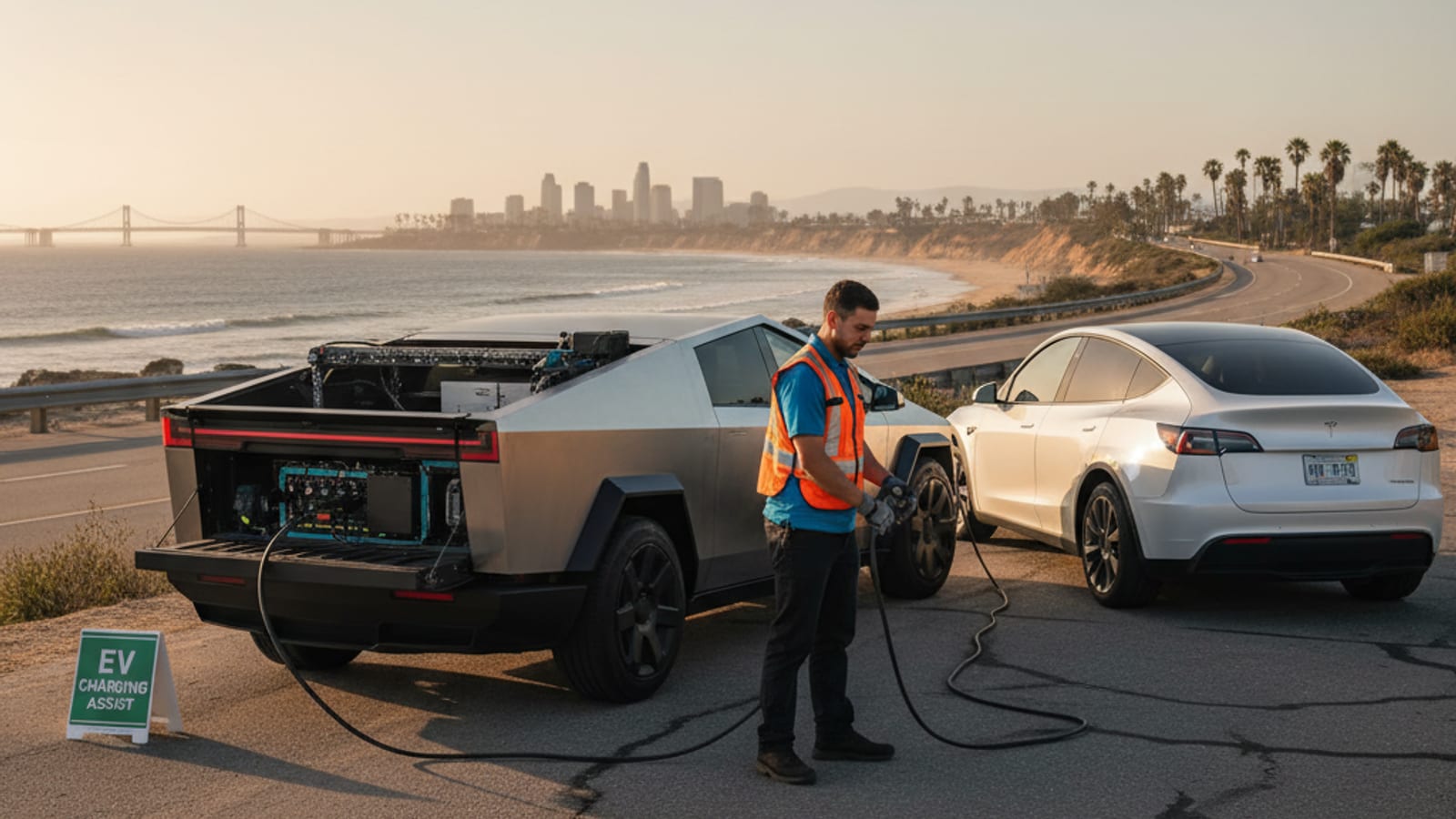
A mobile rescue isn’t a Supercharger on a truck. Operators we connect you with bring a 240V Level 2 source. They bring it to the car. Teslas take a native NACS plug. Other EVs take a CCS or J1772 adapter. The point is a short boost, not a full pack.
A typical stop adds 10 to 20 miles of range. That happens in 15 to 30 minutes of charging. That clock is charging time. It isn’t an arrival time. Nobody here can promise when a truck will appear.
If you need more range than that, say so when you call. The operator still quotes first. A longer session is a different conversation. It isn’t a hidden add-on we invent. It’s a new quote.
This is out-of-charge recovery, not a shop visit. You stay with the car. You drive away on the miles you just bought. You finish the trip at a public stall or at home. That’s the product. It isn’t a full charge. It isn’t a tow.
For a closer look at the hardware, see what’s on a mobile EV rescue truck. The short version is a Level 2 source and the right plug. The person on site quotes before they start.
Why Metro FSP is the wrong comparison
Drivers who grew up on gas cars reach for FSP first. That instinct is fair. The patrol is free. You dial 511 and say Motorist Aid. Coverage is typically Monday through Friday in peak commute hours. It also runs all day in designated construction zones. Metro says midday and weekend coverage is expanding on the most congested corridors. Confirm current hours on metro.net before you wait on the shoulder.
FSP was written for gasoline problems. A gallon of gas gets an empty tank moving. An EV pack doesn’t take that gallon. A taped hose doesn’t refill lithium cells. A tire change doesn’t wake a brick. The free tow still matters. It can get you off a live lane. It won’t put electrons in the pack.
CHP can also send a rotation tow for a disabled freeway vehicle. Details of the Los Angeles rotation list weren’t verified here. Don’t assume a posted county tow rate. California doesn’t publish one statewide cap we could cite. Non-consensual tow and storage rules sit in CVC 22658 for private property. Freeway rotation terms sit in CHP agreements. Confirm those with CHP or the city before you argue a bill.
So the cost question splits. FSP help on a congested freeway can be free. It can still leave the pack empty. A mobile Level 2 stop is a paid private job. The operator quotes it. You decide.
Freeway rules that change the stop
CVC 21718 bans stopping on a freeway in most cases. A disabled vehicle is an exception when you’ve summoned help. A stranded EV that’s called for rescue fits that exception. Stay out of live lanes. Keep occupants away from traffic if you can.
CVC 21809 is the move-over law. Drivers approaching a stopped emergency vehicle with flashing lights must move over. The same rule covers a tow truck and a Caltrans vehicle. Change to a non-adjacent lane if it’s safe. If you can’t, slow to a reasonable speed. That rule protects you on the shoulder. It also protects the operator walking up with a cable.
CVC 22651 lists when an officer can remove a vehicle. That includes traffic obstruction. It includes four or more hours unattended on a freeway. It includes seventy-two or more hours on a highway. An empty EV left on the 10 isn’t a parking plan.
Metro ExpressLanes run on I-10 and I-110. You need a FasTrak transponder tied to a funded account to enter. A vehicle without one is billed by plate under Pay-As-You-Go. Motorcycles are exempt. Metro’s published FAQ doesn’t spell out a disabled-vehicle procedure inside those lanes. Don’t assume a shoulder is waiting for you there. If you stall, follow CHP direction.
None of those statutes set a mobile charging price. They do change how long you can sit. They change how the operator works around you.
What moves the quote, without a fake number
No verified operator in this county publishes a public rate card we can reprint. So this page won’t invent one. What we can say is the shape of the conversation.
Where you sit matters. A West Hollywood garage stall is one kind of walk-up. A shoulder on the 14 near Acton is another. A studio-lot stop in Burbank isn’t a PCH pull-off in Malibu. A peninsula grade in Rancho Palos Verdes isn’t a surface street in Commerce. The operator has to reach you, park legally, and work safely. That’s why the quote happens after they hear the pin.
What failed on the car matters. An empty traction pack needs Level 2 time. A car that won’t wake may be a 12V job. Those aren’t the same task. A 12V jump or replacement can be the whole visit. Adding 10 to 20 miles is a different visit. Tell the operator which one you think you have. Let them confirm before they quote.
The plug matters less than people think. Operators bring native NACS for Tesla. They bring CCS or J1772 adapters for everyone else. Don’t assume a non-Tesla car carries a special surcharge we can name. We have no verified extra-adapter charge to publish. Ask the operator if your plug changes the quote. If they can’t say, treat it as not confirmed.
Time of day can change a private operator’s number. We don’t publish after-hours premiums. We don’t publish holiday rates. We don’t claim round-the-clock coverage. If the person you reach names a different figure at night, that’s their quote. It isn’t a Charge Pro LA schedule.
Membership can change what you pay out of pocket. It doesn’t change who quotes the roadside job. AAA, insurer add-ons, and maker programs are separate contracts. Check your own card. We can’t recite their coverage here. If they reimburse a mobile charge, get that in writing from them. AAA or a mobile charge walks through that fork.
Los Angeles County isn’t one driving day
Swapping a city name wouldn’t make this page honest. The housing, the heat, and the grades aren’t interchangeable.
The City of Los Angeles had 3,857,897 people in ACS 2019-2023. The 2024 Census estimate is 3,878,704. About 47.2% of residents are Hispanic or Latino. About 71.0% of housing was built before 1980. Older stock often still runs on older panels. That can make a home Level 2 install a separate project. It doesn’t set a roadside quote. It does explain why some central-city drivers stall in a driveway.
East Los Angeles is a different texture. ACS population is 114,617. Hispanic or Latino share is 95.6%. Pre-1980 housing is 86.2%. Huntington Park sits next door with a 96.6% Hispanic or Latino share. These aren’t beach-lot stops. They’re older streets and older buildings, and a home plug is often a separate project.
The Westside doesn’t drive like the eastside. Santa Monica, Manhattan Beach, Beverly Hills, Culver City, and Malibu are their own housing mix. A dead car at the Getty Villa or on PCH is still a curb quote. It isn’t a published Westside surcharge.
South Bay and Harbor cities lean older on housing. Torrance has 83.3% pre-1980 stock. Long Beach has 79.6%, with ACS population 458,491. Inglewood, Hawthorne, and Gardena sit in the LAX orbit. A traveler can land and find the car asleep. That can still be a 12V problem, not an empty pack.
The San Fernando Valley runs hotter than the coast. Glendale, Burbank, San Fernando, Calabasas, and Agoura Hills don’t share one utility. They don’t share one housing age either. Calabasas has only 38.0% pre-1980 housing. San Fernando has 82.3%. Glendale Water and Power serves Glendale. Burbank Water and Power serves Burbank. Those utilities don’t set the roadside bill. They set the home bill. Sepulveda Pass on I-405 is the climb between the Westside and the Valley.
Santa Clarita Valley is the I-5 north gate. Santa Clarita’s ACS population is 229,021. Only 30.4% of housing is pre-1980. Stevenson Ranch and Castaic are newer still. Stevenson Ranch has 3.4% pre-1980 housing. Castaic has 7.7%. The long grade north out of Castaic is this county’s defining EV-range corridor. That’s the Grapevine approach. Heat, A/C load, and a sustained climb cut real range below the sticker.
Recurrent Auto’s published work is the range source we can cite. EVs retain about 78% of range at 32F across 30-plus models. They retain about 70% at 20F. Cabin heating is the main driver. Summer heat and heavy A/C reduce range too. We’re not attaching a station-level temperature for Lancaster or Palmdale here. Antelope Valley heat and cold spend the pack faster than a flat coastal hop. A Grapevine climb under A/C does the same.
Palmdale’s Hispanic or Latino share is 62.8%. Lancaster’s is 45.9%. Lancaster ACS population is 170,013. Palmdale’s is 165,487. Palmdale housing is newer, with only 19.7% pre-1980. Acton is a small high-desert community on the 14. None of that lets us invent a high-desert roadside rate. It does explain why a pin in Palmdale isn’t a pin in Redondo Beach.
San Gabriel Valley cities stretch from Pasadena to Pomona. Pasadena Water and Power serves Pasadena. Azusa Light and Water serves Azusa. Most neighbors sit in Southern California Edison territory. Many buy generation through Clean Power Alliance. Pomona’s Hispanic or Latino share is 71.4%. The 10, the 60, and the 57 carry a lot of that traffic. A stall there is a freeway job under CVC 21718. It isn’t a mall-lot job.
Downey, Norwalk, Compton, and South Gate sit in the Gateway Cities. Whittier, Lakewood, and Bellflower do too. Whittier’s pre-1980 housing share is 88.9%. Lakewood’s is 88.8%. South Gate’s Hispanic or Latino share is 95.0%. These aren’t interchangeable with Calabasas. If you can’t charge at home, you meet the public network more often. When that plan fails, you’re asking an operator for a curb quote.
Landmarks don’t change the quote math. They do change the pin. Campus garages at UCLA, USC, and Caltech are long sits. So are Griffith Observatory and Universal Studios Hollywood. A car that sits for hours can wake with a dead 12V. That’s a jump quote, not a pack quote.
Your utility doesn’t write this invoice
Los Angeles County has no single electric company. The City of Los Angeles is LADWP territory. LADWP is the largest municipal utility in the United States. It publishes a Residential EV Charger Rebate Program. It publishes a Used Electric Vehicle Rebate Program. It publishes a commercial charger rebate. It also has a dedicated EV time-of-use rate. That rate needs a separate EV meter. Those programs change home charging. They don’t set what a mobile operator charges on the 405. Dollar amounts on ladwp.com aren’t reprinted here. A referral line doesn’t publish utility rebates as if they were our prices. Confirm current rebate figures on ladwp.com.
Most of the rest of the county is Southern California Edison territory. SCE publishes a Pre-Owned EV Rebate. It publishes Charge Ready Home. It publishes EV rate plans. Confirm those on sce.com. Don’t treat an old third-party reward name as a live figure. We couldn’t verify a current amount for that older program.
Clean Power Alliance buys generation for many cities. SCE still delivers the power. You may see two line items on the bill. Verified members include Santa Monica, West Hollywood, and Malibu. They also include Calabasas, Carson, and unincorporated Los Angeles County. That split doesn’t change a stranded-car rescue. It should change how you talk about your utility at home.
Glendale Water and Power runs its own grid. So do Burbank Water and Power and Pasadena Water and Power. Azusa Light and Water does too. We can name those utilities. We’re not publishing their EV rebate names or amounts. Those programs weren’t verified on each utility’s own site for this page.
Home kilowatt-hour rates aren’t roadside rates. Overnight charging on a utility EV plan is a different market. The operator who meets you on the shoulder isn’t selling LADWP energy. They’re selling a dispatch, a Level 2 session, and their time. Quote that session with them. Don’t reverse-engineer it from your home bill.
Tow, wait, or take the curb quote
You have a few paths when the car won’t move. You can wait for FSP on a congested freeway. Do that only in the hours it actually runs. That path can be free. It won’t charge the pack. You may get a tow to a CHP-chosen safe spot.
You can take a private tow. City of Los Angeles impounds run through Official Police Garages. Release needs proof of ownership. It may need an LAPD release. It needs payment of tow and storage. The exact OPG steps and fee schedule weren’t verified here. Confirm them on lapdonline.org or lacity.gov.
On private property, CVC 22658 sets the removal rules. Entrances need 17-by-22-inch signage. The owner or agent must give written authorization. If you return before the vehicle leaves the lot, it must be released. Storage can’t exceed law-enforcement or CHP-approved rates. A single statewide dollar cap isn’t verified. Don’t let anyone invent one for you.
You can take a mobile Level 2 boost. That’s the quote this page is about. Compare it against a tow in on-site EV charging or a tow. The operator still has to say the number first.
You can check a club or maker program. Coverage varies. We won’t invent a reimbursement figure. One EV charging another is rare. Most packs can’t do it. Don’t plan your evening around a stranger with bidirectional hardware.
Empty pack or dead 12V
A lot of out-of-charge calls aren’t empty packs. The 12-volt battery runs computers, contactors, and door latches. When it dies, the car acts like a brick. The big pack can still hold energy.
LAX makes this painfully clear. Los Angeles World Airports operates the airport. Terminal structures P1 through P7 offer Level 2 and DC fast charging. The Economy Parking garage has more than 4,000 stalls. That count includes 514 active EV chargers. A traveler can still return from a week away to a dark car. Chargers in the garage don’t prevent a 12V failure. A 12V failure isn’t an empty pack.
Hollywood Burbank, Long Beach Airport, and Van Nuys weren’t verified here for stall counts. The 12V-after-a-trip pattern still applies. If the dash is dark, tell the operator. A Tesla 12V battery jump is a different quote. It isn’t a 15 to 30 minute Level 2 session.
How to get a real quote
Leave a pin, not a neighborhood nickname. Say the freeway and the direction. Name the nearest exit if you’re on the 5, the 10, or the 14. Do the same on the 60, the 110, the 405, or the 710. Say whether you’re in a garage, a driveway, or on a shoulder. Say the make and model. Say whether the car unlocks. Say the indicated miles or percent, if the screen still works. Say whether you already called 511.
Stay in a safe spot. Keep hazard lights on. Keep occupants away from traffic when you can manage it. You’ve summoned help, so CVC 21718’s disabled-vehicle exception can apply. Don’t wander into the ExpressLanes assuming a procedure we couldn’t verify.
When the operator is on site, get the quote before the plug goes in. If the work changes from a jump to a charge, get a new quote. Pay that operator. Keep the receipt if you’ll ask a club or insurer later.
California is an all-party consent state for recording confidential calls. That’s Penal Code 632. If a dispatch line plays a recording notice, that’s why.
We serve every city in the county. That includes Los Angeles, Long Beach, and Santa Clarita. It includes Lancaster, Palmdale, Pasadena, Glendale, and Pomona. It includes the beach cities too. For local charging context, start at EV charging in Los Angeles. Context isn’t a rate card.
If you want the referral line, call (858) 925-5546. We connect you with an independent operator. That operator quotes. That operator bills. Nobody here promises an arrival clock.
Frequently asked questions
Does Metro FSP charge an empty EV pack?
No. FSP’s published help list doesn’t include mobile EV charging. It names gas, fluids, a tire, and a free tow to a safe spot. An empty traction pack is outside those published items. Dial 511 and say Motorist Aid on a congested freeway. Use that path when you need the free tow. Don’t wait on FSP for electrons.
Who sets mobile EV charging service cost in this county?
The independent operator who does the work. Charge Pro LA is a referral line. We don’t set prices. We don’t publish a menu. California doesn’t post a statewide cap for this private job. You hear the figure on site, or before the cable goes in. Confirm it before you pay. If nobody stated a number, it isn’t confirmed.
How much range does a mobile Level 2 stop add?
The operators we connect you with typically add 10 to 20 miles. That takes 15 to 30 minutes of charging. That’s charging time, not travel time. It’s enough to reach a stall or a driveway in many cases. It isn’t a full pack. If you need a different amount, ask for a fresh quote.