An EV charging truck is a self-contained vehicle that brings 240-volt Level 2 power to a stranded electric car. In Los Angeles County, Charge Pro LA doesn’t own that truck. We don’t employ the technician, and we don’t run a yard. We connect you with an independent mobile rescue operator. That operator quotes you before any charging starts, then bills you directly.
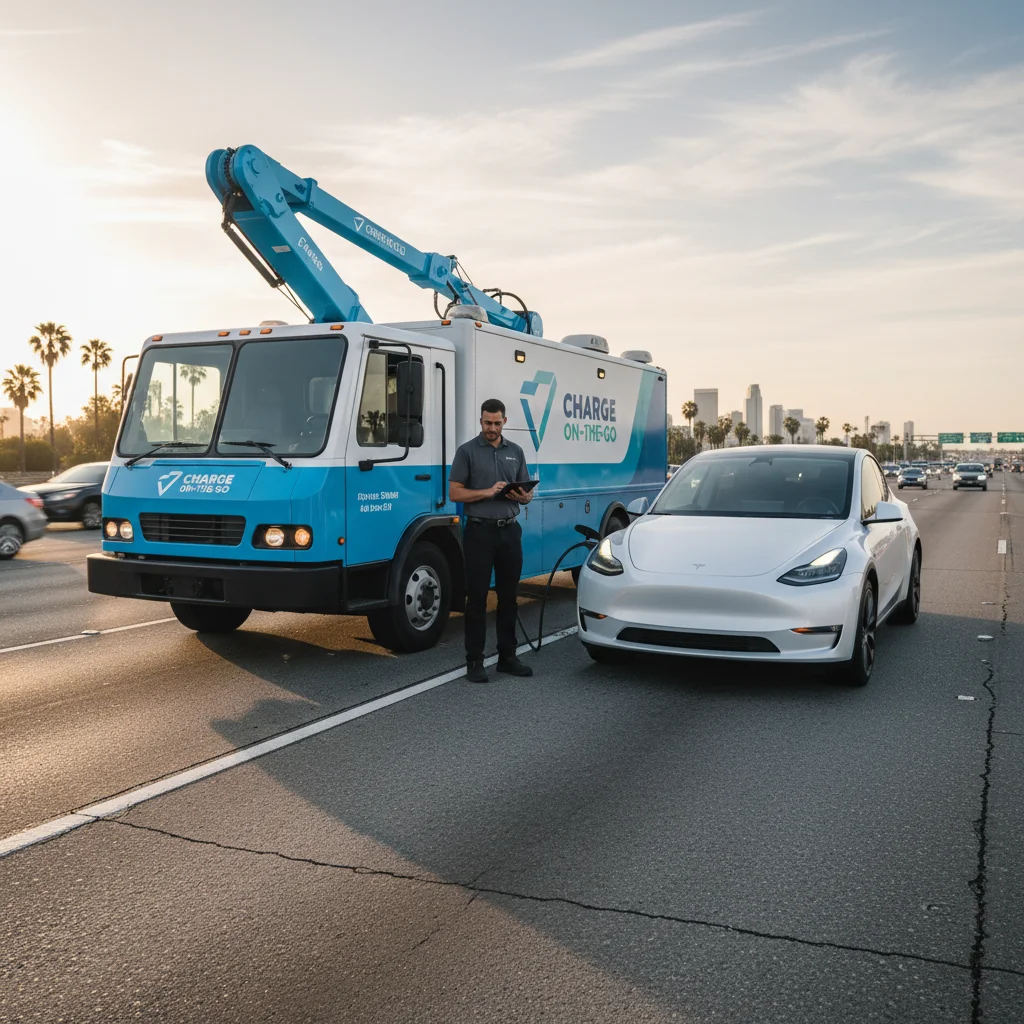
The truck comes to the car. You’re not hunting for an open Supercharger stall from the shoulder. Operators we refer bring a native NACS plug for Teslas. Non-Tesla EVs get a CCS or J1772 adapter. A typical session adds 10 to 20 miles of range in 15 to 30 minutes of charging. That window is charging time at the curb. It isn’t an arrival time, and we don’t publish one.
What an EV charging truck is in this county
People search “ev charging truck” looking for a rolling battery bank. Some writeups describe those units as mobile DC fast chargers. The rescue this line refers you to is Level 2. It’s 240 volts at the port you already use at home. It’s enough to reach a public stall, a home plug, or a safer place to sit. It isn’t a full pack fill on the freeway.
Think of it as a charged cable that travels. The operator arrives with energy already on board. They don’t need a wall outlet at your stall. That’s the point when you’re empty in a structure at LAX. It’s the same idea on a grade toward Castaic. It’s the same idea in a surface lot after the screens go dark.
The truck isn’t Metro’s Freeway Service Patrol either. FSP is a joint program of Caltrans, the California Highway Patrol, and LA Metro. It’s free on congested LA County freeways. The published help list names a gallon of gas. It names a radiator refill, a taped hose, and a tire change. It also names a free tow to a safe spot CHP chooses. It doesn’t list mobile EV charging or an empty-pack boost. FSP can still clear you from a live lane. It won’t refill the high-voltage battery. If you need that patrol, dial 511 and say Motorist Aid.
Charge Pro LA isn’t your electric utility. LADWP serves the City of Los Angeles. Southern California Edison delivers power across most of the rest of the county. Clean Power Alliance buys generation for many cities. That list includes Santa Monica, Culver City, Beverly Hills, and unincorporated Los Angeles County. SCE still runs the wires in those CPA cities. A stranded driver’s rescue doesn’t change with that bill. The operator brings the energy on the truck. Glendale Water and Power, Burbank Water and Power, and Pasadena Water and Power run their own grids. Azusa Light and Water does too. Name your city when you call. The operator still quotes the same way.
How the referral actually works
You call when the car is done. You give a city, a freeway, an exit, a garage level, or a map pin. You name the make and model. You say whether the screens wake. We pass that to an independent operator who covers that part of Los Angeles County.
The operator quotes you before charging starts. That’s the whole point of this line. If the quote isn’t right for you, you don’t take the work. If it is, they come to the car and bill you directly. We don’t set the price. We don’t collect it. For the quoting side in more detail, read how mobile EV charging gets quoted in Los Angeles County.
On scene, the operator stages with lights and cones. Vehicle Code 21809 is the move-over law. It tells other drivers to change lanes or slow for a stopped service vehicle with flashing lights. You’ve also got a disabled-vehicle exception under Vehicle Code 21718 once you’ve summoned help. Stay out of the travel lane. Keep passengers behind a barrier when you can.
Then they connect. Mobile EV charging here means a Level 2 boost, not a DC fill. Typical charging time is 15 to 30 minutes. Typical added range is 10 to 20 miles. That’s usually enough to reach a public charger or to get off a grade. It isn’t meant to replace overnight charging at home.
If the car is a brick, say so on the call. A dead 12-volt battery can freeze locks, screens, and the high-voltage contactors even when the pack still has range. Operators we connect you with can jump or replace that 12V on site. That’s a different job from out-of-charge recovery.
Two ways a truck can hold the energy
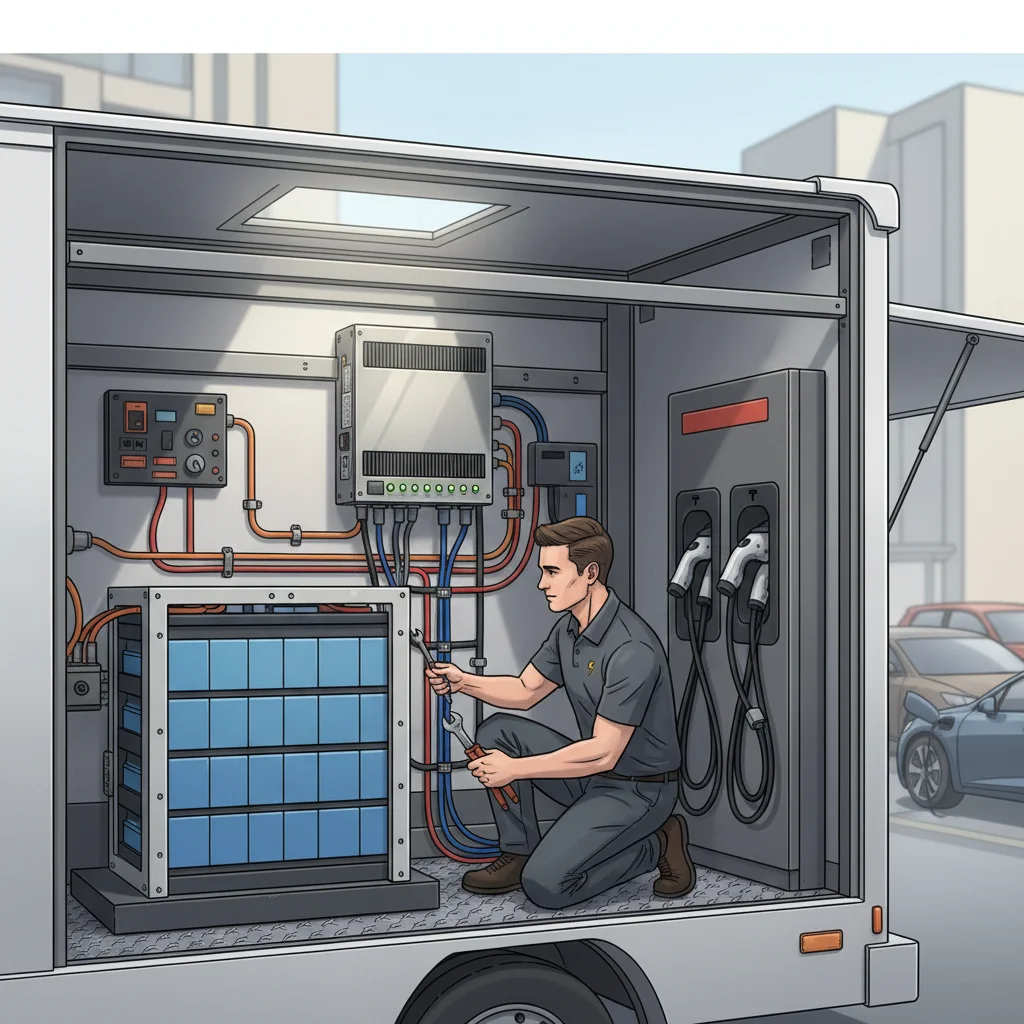
Not every mobile unit stores power the same way. Some carry a large onboard battery and invert it to 240 volts at your port. Some run a generator and convert that output for the same Level 2 session. Both can move energy into the car. They don’t sound the same on a quiet street.
A battery-fed unit is usually the quieter stop. A generator unit isn’t. The operator who quotes you can tell you which design they’re bringing. Don’t assume every truck in the county matches a photo you saw online. Don’t assume we own the hardware. We don’t. For a walk-through of typical gear, see what’s on a mobile EV rescue truck.
NACS, CCS, and J1772 on the same stop
North America still splits plugs. Tesla used NACS for years. Ford, GM, Rivian, and others have been moving new models onto that same connector. CCS1 is still the DC layout on many non-Tesla EVs. J1772 is the AC inlet those cars use for Level 2.
Operators we refer bring a native NACS cable. They also bring CCS or J1772 adapters. A Hyundai, Chevy, Kia, or Volkswagen shouldn’t wait on the wrong tip. You don’t have to recite the standard. Name the car. They match the handle.
A NACS handle on a Level 2 rescue is still AC charging. That’s why it’s slower than a Supercharger. It’s also why it can work in a tight garage stall. A large DC rig may not fit there. EV charging levels when you’re stranded breaks down what a Level 2 boost actually adds.
The county changes the stop, not the truck
Los Angeles County isn’t one commute. A beach-lot stall in Santa Monica is a different problem from a zero on the 5 north of Castaic. The hardware is still Level 2. The hazards aren’t.
Westside and airport parking often hide a 12V failure. At Los Angeles International, terminal structures P1 through P7 all offer Level 2 and DC fast charging. The Economy Parking garage has more than 4,000 stalls, including 514 active EV chargers. You can still return from a trip to a car that won’t wake. Chargers in the garage don’t revive a dead 12-volt. The pack can show miles and the car still sits. Hollywood Burbank Airport, Long Beach Airport, and Van Nuys Airport can produce the same 12V-after-a-trip stall. Parking-charger details for those fields weren’t confirmed in the sources we used. The 12V pattern still applies.
Sepulveda Pass on the 405 is the climb between the Westside and the San Fernando Valley. Remaining-range estimates get optimistic on a grade. If you stall there, treat it as a freeway disable, not a mall parking stop. Out of charge on the 405 at Sepulveda Pass walks through that corridor.
North county is the Grapevine. The sustained climb out of Castaic on I-5 is the county’s defining EV-range corridor. Heat, air conditioning, and cabin climate all cut real miles below the window sticker. Recurrent Auto’s published tests across 30-plus models show EVs keeping about 78 percent of range at 32°F. They keep about 70 percent at 20°F. Cabin heating is the main driver. Summer AC load cuts range too. Lancaster and Palmdale see both the heat and the cold end of that pattern. Don’t plan those trips on the brochure number.
The 10 through the San Gabriel Valley and the 110 Harbor Freeway carry Metro ExpressLanes. A FasTrak transponder tied to a funded account is required to enter. Without one, Metro bills the plate under Pay-As-You-Go. Metro’s published FAQ doesn’t spell out a disabled-vehicle procedure inside those lanes. If you stop, stay with the car if it’s safe. Call for help. Don’t assume a wide shoulder.
Housing age matters at home, not on the truck. East Los Angeles has 86.2 percent of housing built before 1980. Whittier is at 88.9 percent. Long Beach is at 79.6 percent. A lot of those panels were never designed around a 240-volt EV circuit. That isn’t a claim about public chargers on those streets. It’s why many drivers still lean on workplace and public stalls. Then they call when the last plan fails.
Charge on the wheels, or a tow
A flatbed is the last call. An on-site boost keeps the car on its tires. If the 12V failed, a jump may be the whole job. If the pack is at zero, Level 2 on the curb is the faster path to a real charger.
Private-property tows follow Vehicle Code 22658. The lot needs the required signage. It needs written authorization. If you return before the car leaves, they have to release it. Tell the operator if a garage is closing while you wait.
City of Los Angeles impounds go through Official Police Garages. The exact release steps and fees weren’t confirmed in the sources we used. Check lapdonline.org or lacity.gov before you assume a process. California doesn’t publish one statewide tow-rate cap we could verify. Don’t guess a number. Ask the yard.
What to have ready when you call
Call when you can’t reach the next charger under your own power. Call when the car won’t unlock after a long sit. Call when a public stall started then quit. You may not have the miles to hunt another one. Have the city or freeway. Have the nearest exit or garage level. Have the make and model. Say whether the screens wake. If you already plugged in somewhere, say what happened.
Charge Pro LA refers that work. We don’t perform it. The pros we connect you with are licensed and insured. They quote before they plug in.
If you’re empty, call (858) 925-5546. We’ll connect you with a local operator who quotes you before charging starts.