A stranded EV in Los Angeles County rarely needs a full pack. You need a charging level that puts miles back. EV charging levels describe how power reaches the battery. Level 1 is a 120-volt household outlet. Level 2 is 240-volt AC, the same class as a home wall unit. DC fast charging is a separate high-power DC feed at a public stall. If you’re already stopped, the useful tool is usually a mobile Level 2 boost. Independent operators we connect you with bring a 240V source to the car. They typically add 10 to 20 miles of range. That takes 15 to 30 minutes of charging. That window is charging time, not when someone arrives.
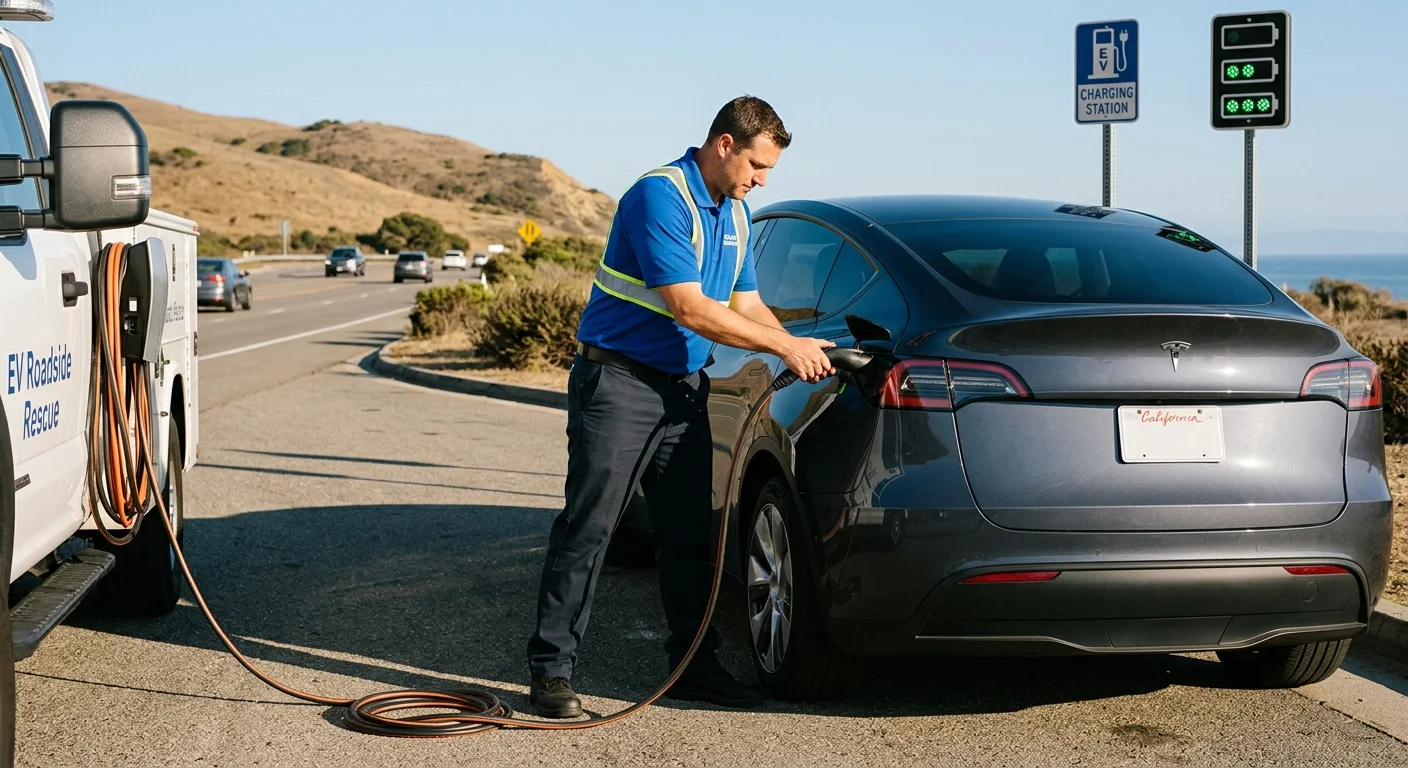
The three EV charging levels, in plain words
Drivers mix the labels because posters do too. The U.S. Department of Energy groups equipment three ways. Those groups are Level 1, Level 2, and DC fast charging. Confirm current station specs on the DOE Alternative Fuels Data Center. We don’t reprint kW caps here. Hardware changes, and your car decides what it’ll accept.
Level 1 is AC at 120 volts. It’s the outlet in a kitchen or garage. It can add range overnight when the car’s already parked. It’s a weak match for a live freeway shoulder. You still have to read the vehicle manual. You still have to confirm the circuit can handle the load. A plug that fits isn’t proof the outlet is approved.
Level 2 is AC at 240 volts in homes. Many commercial buildings supply 208 volts in the same class. That’s the voltage a mobile rescue operator brings to a stranded car. It isn’t a Supercharger or a DC stall. The job is enough energy to reach the next working plug.
DC fast charging pushes DC into the pack at a fixed stall. Tesla Superchargers sit in this family. So do CCS stalls used by most other brands. You can’t assume that hardware rolls to every curb. A car that can’t move still has to reach the stall. If it can’t, you need a different kind of help.
The poster on a cabinet is a maximum, not a guarantee. Heat, cold, and a low state of charge all change the result. Recurrent Auto’s published tests show EVs keep about 78 percent of range at 32F. They keep about 70 percent at 20F, with cabin heating as the main drain. In this county that shows up as air conditioning on a hot Lancaster run. It also shows up as heat on a cold Palmdale night.
Why this county isn’t one charging problem
Los Angeles County isn’t a single utility and isn’t a single road. The City of Los Angeles is mostly LADWP territory. LADWP is the largest municipal utility in the United States. It publishes a residential EV charger rebate and a used-EV rebate. It also offers a dedicated EV time-of-use rate that needs its own meter. Confirm current rules on ladwp.com. We don’t publish rebate amounts.
Most other cities sit on Southern California Edison lines. SCE publishes Charge Ready Home and a pre-owned EV rebate. Many SCE cities buy generation through the Clean Power Alliance. CPA members include Santa Monica, Culver City, West Hollywood, Beverly Hills, Redondo Beach, and Malibu. Hawthorne, Carson, Agoura Hills, Calabasas, and unincorporated county areas are on the list too. CPA doesn’t change what a roadside operator plugs in. It does change the generation line on your home bill.
Glendale, Burbank, Pasadena, and Azusa run their own municipal power utilities. Don’t assume an SCE flyer applies in those cities.
The freeways split the same way. A garage near UCLA in Westwood is a different scene. So is the 405 at Sepulveda Pass. The 5 through Santa Clarita heads toward the Grapevine grades north of Castaic. The 14 through Acton, Palmdale, and Lancaster is high-desert heat and cold. The 10 through El Monte and West Covina is a San Gabriel Valley commute. Eastside industrial streets in Commerce add truck traffic and tight lots.
None of that lets anyone guess the distance to the next public stall. If you need a named site, check a charging app, then the stall itself. Plan ahead on the Los Angeles EV charging hub. It’s a planning page, not a live map of working plugs.
What a mobile Level 2 boost actually adds
When the traction pack is empty, AC charging can still work. A mobile Level 2 session is the common roadside tool. The operator brings 240 volts to you. Tesla cars take a native NACS plug. Other EVs typically need a CCS or J1772 adapter on that same source. Ask the operator to confirm the port before the session starts.
The usual result is 10 to 20 miles of added range. That’s after 15 to 30 minutes of charging. That clock starts when the car is taking power. Charge Pro LA doesn’t set arrival times or quote a price. The independent operator quotes you before any work starts. That operator bills you directly.
Ten to twenty miles is often enough to reach a public stall. It can also cover a workplace plug or home. It isn’t a full recharge. Home wall units use the same voltage class. They’re built for hours overnight, not for a shoulder. For that contrast, read home 240-volt charging vs a mobile Level 2 boost. For Tesla session length, see how long a stranded Tesla takes to charge. For the truck itself, see what’s on a mobile EV rescue truck.
Request mobile EV charging with the make, model, dash reading, and pin. Mention a garage height limit, a gated lot, or a freeway shoulder. Those details decide whether the equipment can reach the inlet.
Empty pack, dead 12V, or a stall that won’t start
Start with the screen, not the rumor. An indicated zero on the drive battery points to charging. That’s out-of-charge recovery if the pack is empty. A Level 2 boost still requires the car to accept AC. A car that won’t wake is often the 12-volt battery. So is one that won’t unlock or close contactors. Operators we connect you with can jump or replace a dead 12V on site. That’s a different job from feeding the traction pack. If you’re unsure, see whether to charge, jump, or tow.
A traveler who left a car at LAX can hit either problem. Terminal structures P1 through P7 sit in the Central Terminal Area. They offer Level 2 and DC fast charging. The Economy Parking garage has 514 active EV chargers. A week in a stall can still kill the 12V. Chargers in the garage don’t wake a 12V that’s already dropped out.
Connectors to name, and freeway rules that apply
J1772 is the older AC inlet on many non-Tesla cars. NACS, also called J3400, is Tesla’s native AC and DC inlet. CCS adds DC pins to an AC inlet shape. A familiar-looking plug still needs a match to the truck. The operator should verify the port against the car in front of them.
California Vehicle Code 21718 bars stopping on a freeway except in listed cases. A disabled EV that has already summoned help fits the disabled-vehicle exception. CVC 21809 is the move-over law. Other drivers must change lanes when it’s safe. If not, they slow for a stopped service vehicle with lights on. Stay out of live lanes, and don’t drag cables across traffic. If the car is a hazard, call the authority that owns that road.
What Metro FSP will do, and what it doesn’t list
Metro Freeway Service Patrol is free to motorists. It’s a joint program of Caltrans, the California Highway Patrol, and LA Metro. You reach it by dialing 511 and saying Motorist Aid. Published help includes a gallon of gas and a tire change. It also includes a free tow to a safe spot chosen by CHP. The published list doesn’t name mobile EV charging or an empty-pack boost. An empty EV sits outside that menu except for the free tow. That’s an observed absence on metro.net and chp.ca.gov. If FSP tows you to a safe spot, you may still need Level 2 charging.
When a public stall or a tow is the better next step
DC fast charging is the right tool when you can already reach the stall. High power on a spec sheet doesn’t put a cabinet on your bumper. Transport enters the picture when the car won’t take the operator’s connector. It also fits when the pack or the port won’t start a session. A mobile session can make more sense in a lot than beside moving traffic. If compatible charging can’t reach the inlet, recovery or transport is the next talk.
How to request the right charging level
A mobile Level 2 boost fits when the traction pack is depleted. Charge Pro LA is a referral line. We match stranded drivers with independent local mobile rescue operators across Los Angeles County. We don’t own trucks, hold a contractor license, or perform the charge. The pros we connect you with are licensed and insured. They quote before they start, and any terms come from that operator. Call (858) 925-5546 and we’ll connect you with a local EV rescue operator.