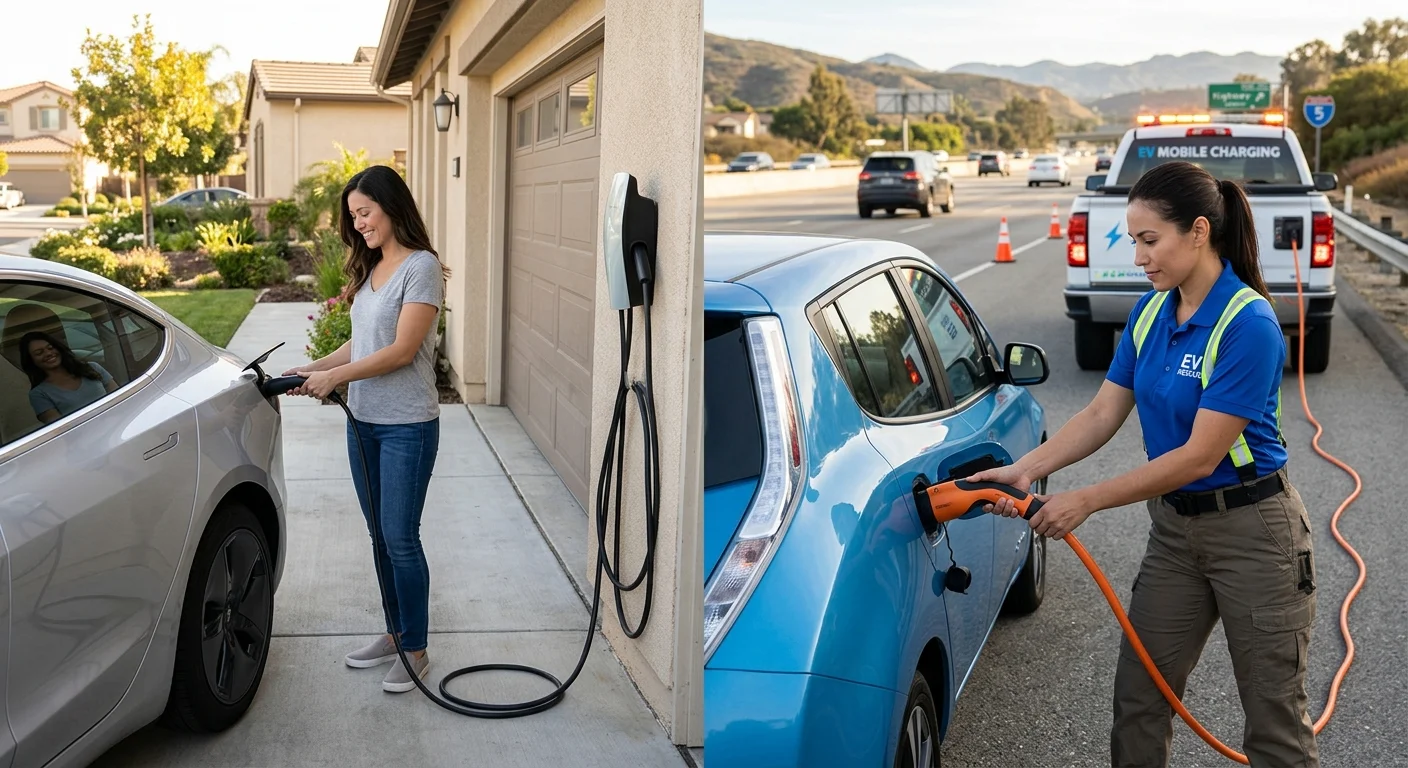
Most 240 volt EV charging in Los Angeles County is overnight Level 2 at home. A mobile Level 2 boost is a different job. It’s a short roadside patch when the car can’t reach a fixed charger. Plenty of drivers here never get that home outlet. Older buildings, shared parking, and street spots get in the way.
Housing age, not the car, decides who gets a wall plug
Los Angeles isn’t one housing market. The city of Los Angeles counted 3,857,897 people in ACS 2019-2023. About 71.0% of its housing was built before 1980. East Los Angeles is 86.2% pre-1980. Whittier is 88.9%. Culver City is 85.5%. West Hollywood is 80.5%. Long Beach is 79.6%. Santa Monica is 75.0%. Those shares are U.S. Census ACS 2019-2023 table B25034.
A pre-1980 building often has a panel that predates EV charging. Shared garages and curb parking are common on the Westside and the Eastside. You can’t drape a 240-volt cord from a walk-up to the street. Overnight charging then happens at work, at a public stall, or not at all.
Newer north-county tracts look different. Santa Clarita’s pre-1980 share is 30.4%. Palmdale’s is 19.7%. Lancaster’s is 34.0%. Stevenson Ranch is 3.4%. Castaic is 7.7%. A garage there is more likely to accept a dedicated circuit. That still isn’t automatic. A licensed electrician has to check the load. South Bay stock is old too. Torrance is 83.3% pre-1980. Rancho Palos Verdes is 85.0%. That check belongs at the house, not on the shoulder.
240 volts means Level 2, and that’s a range of power
The U.S. Department of Energy describes residential Level 2 as 240-volt service. Commercial sites may use 208 volts. Equipment can run from about 2.9 kW to 19.2 kW. Voltage alone doesn’t set how fast the pack fills. The circuit, the charger, and the car’s onboard limit all change the result.
DOE’s published Level 2 pace is about 25 miles of range per hour. That’s a charging-speed figure. It isn’t an arrival time. It isn’t a guarantee for your EV. Heat, cold, pack temperature, and accepted power all matter.
Operators in this network bring a 240V Level 2 source to the car. Teslas take a native NACS plug. Other EVs use a CCS or J1772 adapter. They typically add 10 to 20 miles of range. That takes 15 to 30 minutes of charging. That window is charging time only, never an arrival time. The point is enough miles to reach a stall you can use.
Level 1 is a regular 120-volt household outlet. DOE puts that near 5 miles of range per hour. It can cover a short commute if you park on that outlet every night. It won’t recover a stranded car on the 405 or the 5. Level 1 charging on LA County nights walks through that slower option.
A home station is electrical work, not a rescue call
A home 240-volt station needs a parking space you control. It needs overnight time. It needs a circuit that matches the charger. A California C-10 electrical contractor does that install. You can verify a license on the CSLB lookup. Charge Pro LA doesn’t install wall units. It doesn’t pull permits.
California AB 1236 and AB 970 require an expedited EV charger permit path. Those are statewide rules. They’re not a form you can copy from one city to another. Confirm current checklists with the building department that serves the address. A single countywide fee could not be confirmed, so this page doesn’t publish one.
The utility on the bill isn’t one company. LADWP serves the City of Los Angeles. It publishes a Residential EV Charger Rebate Program. It also publishes a dedicated EV time-of-use rate that needs a separate EV meter. Confirm current rebate rules on ladwp.com before you budget anything. Dollar amounts aren’t listed here.
Southern California Edison delivers power across most of the rest of the county. SCE publishes Charge Ready Home and EV rate plans. Confirm those on sce.com. Many SCE cities buy generation through Clean Power Alliance. Member cities include Santa Monica, West Hollywood, Culver City, and Beverly Hills. Malibu, Agoura Hills, and unincorporated Los Angeles County are CPA members too. SCE still delivers the power and reads the meter. A stranded car doesn’t care which generation line is on the bill.
Glendale, Burbank, Pasadena, and Azusa run municipal power utilities. This page could not verify current EV rebate names on those utilities’ own sites. Ask the utility printed on your bill. Don’t assume LADWP or SCE rules apply at that address.
If the car is already stuck, keep the two jobs separate. Home charger install versus mobile rescue is the comparison. Older panels and mobile charging covers the house side.
The wall unit stays home when the car doesn’t
A fixed outlet only helps if the car can reach it. A dryer receptacle in a nearby building isn’t a charging plan. You need the owner’s permission, a compatible circuit, and the right connector.
That limit shows up on the 405 at Sepulveda Pass. It shows up on the 5 north of Castaic toward the Grapevine. It shows up on the 10 through El Monte and West Covina. It shows up on the 110 Harbor Freeway. Metro ExpressLanes on the 10 and the 110 need a funded FasTrak account. A car without one is billed by plate. None of that puts a home wall unit on the shoulder.
Downtown parking structures are another version of the same split. Mobile EV charging in downtown Los Angeles is the in-structure path.
Metro Freeway Service Patrol is free on congested LA County freeways. Caltrans, CHP, and LA Metro run it. The published list covers a gallon of gas, a radiator refill, and a tire change. It also tows a disabled vehicle free to a CHP-chosen safe spot. It doesn’t list mobile EV charging. Dial 511 and say “Motorist Aid” if you need that patrol. An empty pack still needs an EV operator for energy at the bumper.
California Vehicle Code 21718 bars stopping on a freeway except in defined cases. A disabled EV that has already called for help fits the disabled-vehicle exception. CVC 21809 is the move-over law. Approaching drivers must change lanes or slow when they see flashing lights. If the car is in a dangerous spot, call 911.
Don’t guess how far a public stall sits from where you stopped. Confirm the network’s live status for your connector. Then decide whether a mobile Level 2 boost or a tow fits. EV charging levels when you are stranded maps those categories onto that choice.
More 240 volts won’t fix every dead EV
A dark dash isn’t always an empty traction pack. A dead 12-volt battery can brick the car while the pack still has energy. Level 2 at the port won’t wake a car that won’t close its contactors. Report the exact dash message. Don’t assume more energy will clear a fault.
The same split shows up after a long trip. LAX terminal structures P1 through P7 offer Level 2 and DC fast charging. The Economy Parking garage has 514 active EV chargers. A traveler can still return to a dead 12V. That failure isn’t an empty pack. Operators can jump or replace a dead 12V on site when that’s the job.
A failed overnight charge at home isn’t automatically a roadside case. If the car is parked safely, start with the breaker, the charger, or the vehicle. Call for a mobile visit when the car is away from a usable charger. Out-of-charge recovery is the service path for an empty pack.
Smoke, fire, a collision, or live traffic comes first. That’s 911, not charging advice.
A mobile boost is a short patch, not a full fill
Mobile charging can fit when the EV will accept compatible power where it sits. The usual goal is practical miles, not a full overnight fill. The operator checks the car, access, the plug, and the surroundings. Then they quote you before they start. They bill you directly.
Charge Pro LA is a referral line. It matches stranded drivers with independent local mobile rescue operators. It performs no work. It owns no trucks. It employs no technicians. It sets no prices. It promises no arrival time.
A tow can be the better path when the car won’t take power. It can also fit when the location won’t support a safe hookup. The operator names a charging site, a shop, or a stop you choose.
Ask what equipment will show up. Ask what outcome they expect. Ask what you’ll pay. No single countywide price could be confirmed. The provider and the situation set it. Confirm those details with the matched operator.
Heat and grades cut real range below the sticker. Antelope Valley heat and a Grapevine climb with AC on cut those miles.
When to call for a match
Call when the car can’t reach a usable charger. You need an operator to assess a charge or a tow. Charge Pro LA connects drivers with licensed, independent local operators across Los Angeles County. Call (858) 925-5546 and we’ll connect you with a local EV rescue operator.