You walk back into a downtown Los Angeles garage and the car won’t wake. Screens stay dark. Door handles may not even unlatch. A lot of drivers assume the drive pack hit zero. In these garages, the 12-volt battery often quits after a long sit. Renters across the city’s older apartment stock add a second problem. Mobile EV charging in downtown Los Angeles brings a Level 2 boost to that stall.
Why downtown parking structures drain the 12-volt battery
Every EV still has a small 12-volt battery. It runs the computers, locks, lights, and the contactors that wake the high-voltage pack. Park for hours in a downtown structure and those modules keep sipping power. Heat in the Los Angeles Basin makes that drain worse on 90-degree days. After a shift near USC, the car can act like a brick. The same thing happens after dinner in Koreatown or a long Downtown park.
This isn’t the same as an empty drive pack. The big battery can still hold tens of miles. The 12-volt pack just can’t close the circuit that lets the car start. Downtown structures make this more common because cars sit. Accessories stay in a low-power listen mode. That drain adds up in a concrete garage while the car sits unplugged.
A Tesla 12V jump on site is often the first move. The operator we send can test the 12-volt side before a tow talk. What a dead 12-volt pack does to the car is the longer walkthrough.
Older apartments and no overnight plug
The City of Los Angeles holds about 3.86 million people. Census figures show 71 percent of its housing was built before 1980. That stock predates home charging. Koreatown, Hollywood, Downtown, and Boyle Heights are dense with renters. Hollywood is a neighborhood of Los Angeles, not its own city. West Hollywood is a separate city just west of it. Both have the same renter pattern. Many buildings have no assigned EV stall and no panel a tenant can touch.
LADWP serves the City of Los Angeles. It publishes a residential EV charger rebate and a used-EV rebate. Those programs help if you can actually install a Level 2 unit. A renter in a pre-1980 walk-up usually can’t. They charge at work, at a public stall, or not at all. The car then sits in a downtown garage until the next errand. That’s when the 12-volt pack dies. That’s also when the drive pack runs closer to empty than the driver meant.
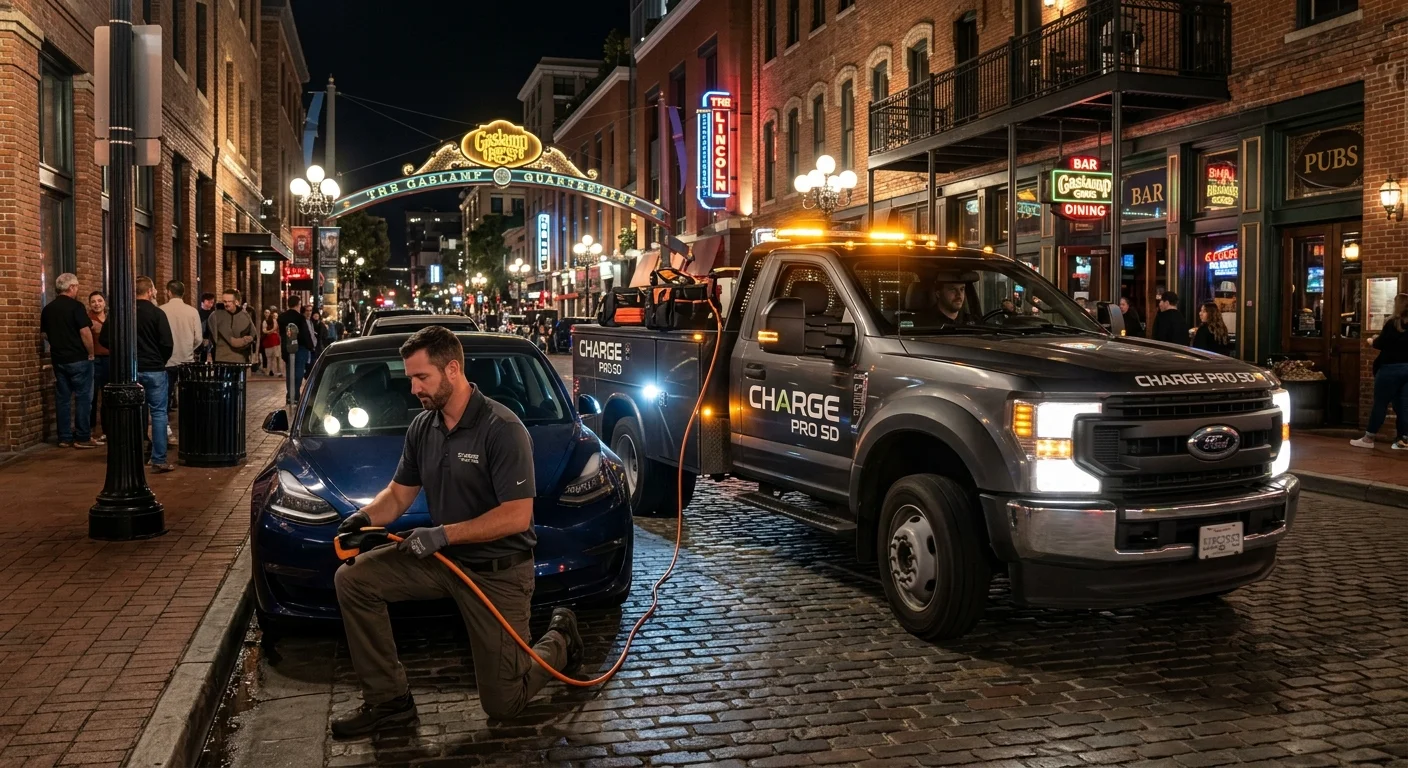
This is the core of mobile EV charging in downtown Los Angeles. The operator brings a 240-volt Level 2 source to the stall. Native NACS for Teslas. CCS or J1772 adapters for other brands. A typical session adds 10 to 20 miles of range in 15 to 30 minutes of charging time. That’s charging time, not a promise of when someone arrives. The operator quotes you before any cable goes in, then bills you directly.
A house in the city with an old panel is a different problem. Home charging versus a mobile boost covers that case.
Empty pack or dead 12V: tell them apart
Stand at the stall and check three things before you call. Check whether the lights and screens do anything when you tap the handle. Check whether the phone app still sees the car. Check the charge percentage you last saw when you parked.
If the app is dark and the screens are dead, start with the 12-volt battery. An empty drive pack usually still lets you unlock and see a zero-percent warning. A dead 12-volt pack takes the whole car offline. Jumping or replacing that small battery on site can wake the car. That holds for a Tesla, a Hyundai, a Ford, or a Chevy.
If the car is awake at zero percent, you need pack energy. That’s out-of-charge recovery. The operator still comes to the garage stall. You don’t have to roll the car to a street charger first.
Don’t keep trying the start button. Repeated wake attempts can pull the 12-volt pack even lower. Stay with the car if you can. If you have to leave the structure, note the level and stall number.
What a mobile Level 2 operator does in a garage
Charge Pro LA is a referral line. We match you with an independent local operator. We don’t own the truck. We don’t hold a contractor license. The person who shows up brings the charger, quotes the job, and bills you.
In a downtown structure the operator checks clearance, aisle width, and blocked stalls. Some garages have tight ramps and low beams. The operator decides if they can pull in beside you. You may need a short push to a more open bay. We can’t promise they’ll reach every stall. That call is theirs, on site.
Once they can get to the charge port, they plug in. Level 2 is 240 volts. It isn’t a Supercharger. It’s enough to get you out of the structure. Then you drive to a place you already planned to charge. Teslas take a native NACS plug. Other EVs use CCS or J1772 through an adapter on the same truck.
Stay nearby during the session. The operator is working in a live garage with other cars moving. If a parking attendant is on duty, tell them a service vehicle is coming. Private garages set their own entry rules. We don’t control those rules.
Towing out of a private garage is a last resort
A dead EV in a tight stall is a bad tow. Low clearance, tight turns, and a heavy battery pack make it slow work. Flatbed access is worse on upper levels. Some structures won’t let a full-size wrecker in at all.
California Vehicle Code 22658 covers towing from private property. The lot needs the required 17-by-22-inch signage at the entrances. The owner or agent has to authorize the tow in writing. Law enforcement gets notice within one hour. If you return before the car leaves the lot, they have to release it. Storage rates can’t exceed the law-enforcement-approved schedule. Confirm the current posting on the garage walls and with the attendant. Don’t take a verbal figure as the last word.
A mobile charge or a 12-volt jump usually beats fighting a private tow. See why towing a dead EV in Los Angeles County is the last call for pack protection. If the operator can’t reach the stall, reposition inside the garage. That still beats a street tow.
On a freeway the rules differ. CVC 21718 lets a disabled vehicle wait when help is already on the way. CVC 21809 is the move-over law. Those sections matter on the 110, the 10, and the 101. They don’t govern a private structure. Inside the garage, the property rules and 22658 do.
City of Los Angeles Official Police Garages handle city impounds. The exact OPG steps and fee schedule weren’t confirmed for this page. Check lapdonline.org or lacity.gov before you assume a process or a charge.
The freeway patrol won’t charge the car
Metro Freeway Service Patrol roams congested Los Angeles County freeways. It’s a joint program of Caltrans, the California Highway Patrol, and LA Metro. Published help includes a gallon of gas, a radiator refill, and a tire change. It can also tow you to a CHP-chosen safe spot. Dial 511 and say Motorist Aid.
The published list doesn’t include mobile EV charging or an out-of-charge boost. That’s an observed absence from Metro and CHP materials. If you stall on the 110 Harbor Freeway, FSP can move you off the lanes. The same is true on the 10 through Downtown. It won’t fill the pack. For that you still need a mobile operator or a charger you can reach.
Don’t sit in a travel lane. If you can roll to a shoulder or an off-ramp, do that first. Then call.
Around the core: the 110, the 10, and East LA
Downtown is one neighborhood inside the City of Los Angeles. The city is one municipality of about 3.9 million. Los Angeles County is 88 cities plus unincorporated land. Charge Pro LA covers the county.
The I-110, I-10, and US-101 feed the streets around Downtown. East of that, the East LA Interchange is the busiest freeway junction in the country. East Los Angeles is unincorporated county land. About 95.6 percent of residents there are Hispanic or Latino. Some 86 percent of the housing was built before 1980. A dead car in a downtown garage is often a commuter from east of the river. It can also be a Koreatown renter who parked for work.
The 101 through the Cahuenga Pass sits just northwest, toward Hollywood. Culver City, West Hollywood, Beverly Hills, and Santa Monica sit west. Inglewood sits south toward the 110. The 12-volt failure after a long park shows up in all of them.
For a city-level map of the same rescue, use the Los Angeles EV charging page.
How to call from the garage
Give the operator a level, a stall number, and the garage entrance you used. Say whether the car unlocks. Say the last charge percentage you saw. Say Tesla or the other brand, because the plug changes.
Charge Pro LA dispatches independent operators across Los Angeles County. Call (858) 925-5546 and we’ll connect you. The operator quotes before they start. They bill you. We don’t set the price and we don’t promise an arrival clock.
If the car wakes after a 12-volt jump, leave. Charge when you get where you meant to charge. If the pack is empty, take the Level 2 boost. Drive to the stall you already had in mind. Don’t sit in the garage waiting on another floor’s public unit. The 12-volt pack can sag again while you wait.