Your Hyundai Ioniq 5 won’t start. In Valley heat, that’s usually the 12-volt battery. The traction pack can still hold a full commute. The small battery is what wakes the computers. When it fails, the cabin goes silent. You get no dash, no chime, and no Ready mode.
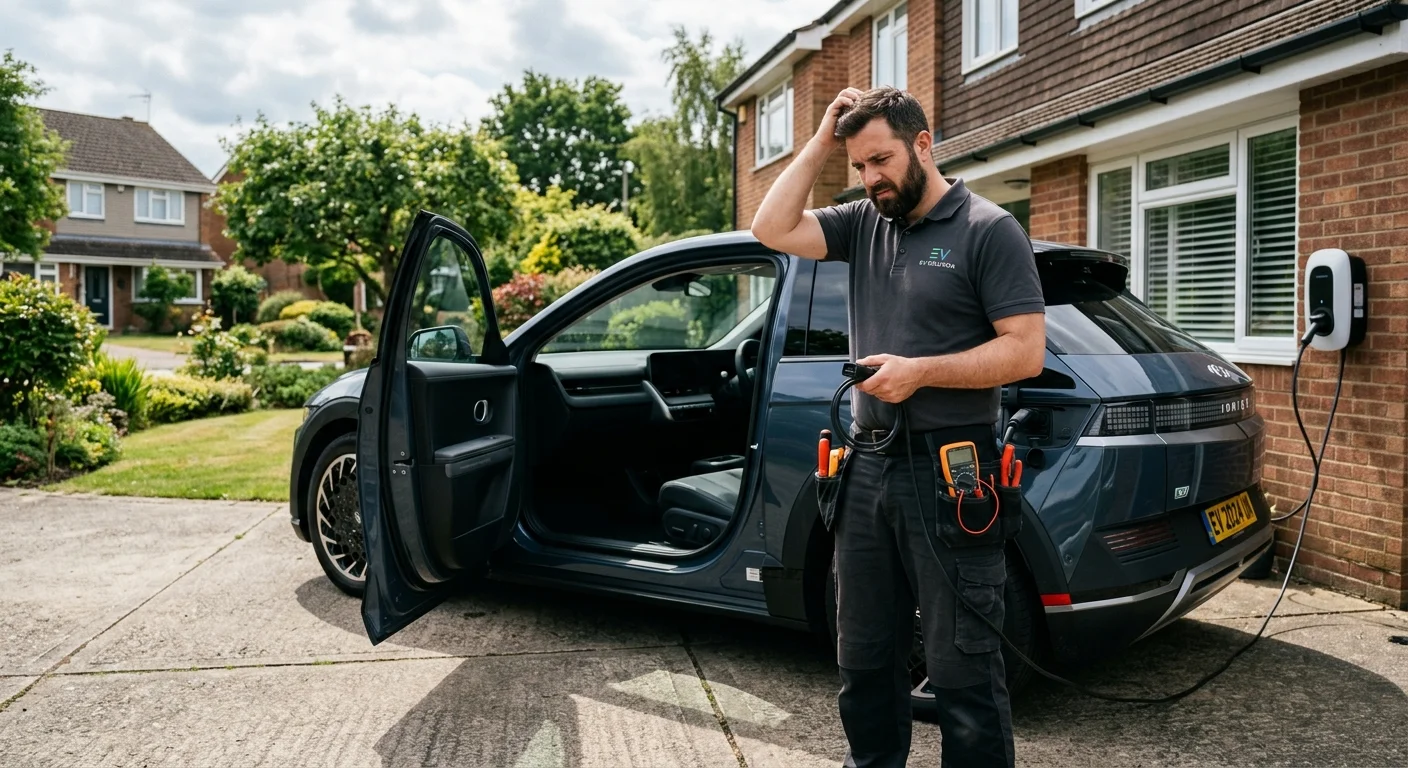
Valley heat is why Ioniq 5 12-volt packs fail here
Coastal parking in Santa Monica and Redondo Beach often sits under a marine layer. Inland north county does not. The San Fernando Valley runs hotter than the coast. The San Gabriel Valley does too. The Antelope Valley sees triple-digit summer heat and near-freezing winter nights. An Ioniq 5 that baked in Glendale or Burbank all afternoon takes a harder hit.
This isn’t a range lecture first. Recurrent Auto’s published tests show heat and air-conditioning load cut real range. Cabin climate is the main extra drain. For a silent Ioniq 5, the heat path is simpler. A 12-volt battery ages faster in an oven cabin. Parasitic drains keep running while you’re inside. By evening the modules won’t boot.
Housing stock feeds the pattern. ACS 2019-2023 figures show about 70.7% of Glendale housing was built before 1980. Burbank is about 72.8%. San Fernando is about 82.3%. Older inland housing sits in Valley heat, not under a coastal marine layer. An Ioniq 5 parked outside there soaks that heat into the 12-volt. LADWP serves the City of Los Angeles. Most Valley cities outside that city are Southern California Edison territory. Glendale Water and Power runs Glendale’s grid. Burbank Water and Power runs Burbank’s. None of those utilities can wake a dead 12-volt from the curb.
Studio-adjacent lots in Burbank see this too. So does street parking in Glendale. Universal Studios Hollywood parking can leave the same silent cabin after a full park day. You walk back. The car looks fine. The button does nothing.
Santa Clarita housing is newer, but driveways still heat-soak an unplugged Ioniq 5. Lancaster and Palmdale add desert heat on top of the same 12-volt physics. A parked battery doesn’t care that you still have miles in the traction pack.
Two batteries, and only one can start the car
Every Ioniq 5 carries two batteries. One is the high-voltage traction pack. The other is a small 12-volt auxiliary battery. The traction pack turns the motors. The 12-volt runs locks, lights, and the screen. It also wakes the modules that close the high-voltage contactors. If those modules never wake, the big pack can’t help you. That’s true with a lot of energy still in the main battery.
Owners often treat a silent EV as empty. Empty usually still shows life. A low traction pack lights warnings. A dead 12-volt shows none of that. The fob may not unlock the doors. You may need the physical key inside the fob. Interior lights stay off. The start button feels dead.
Flicker is the warning stage. Random errors flash, then everything goes dark. That’s a 12-volt on its last charge, not a pack at zero. When an EV 12V dies: why the car acts like a brick covers that cutoff.
Try the Ready sequence before you lift the hood
Hyundai’s start order is easy to skip when you’re hurried. Foot on the brake. Then press Start/Stop. No brake often turns on accessories only. The car never enters Ready. That looks like a no-start. It’s a missed step.
Do it twice, slowly. Watch for the Ready light. If accessories come on but Ready doesn’t, the 12-volt isn’t fully dead. You’re in accessory mode. If nothing happens, move to battery checks.
A weak fob can fake a no-start too. Try the spare. Hold it on the backup slot your manual marks. A tired fob cell is a small fix. It won’t restore a cabin that’s gone fully dark.
Read the cabin, then decide what failed
Work these checks in order.
Fob lock and unlock first. A silent fob points at the 12-volt.
Door handle and dome lights next. No lights means the low-voltage system is down.
Dash and infotainment after that. A black cluster isn’t a low-range warning.
Start with the brake held. Still nothing means the computers never booted.
Clicks, flicker, or a half-lit warning before blackout. That’s a weak 12-volt.
If the dash lights and reports low charge, that’s a pack problem. Operators Charge Pro LA connects you with can bring a 240-volt Level 2 source. They typically add 10 to 20 miles of range. That takes 15 to 30 minutes of charging time. That’s charging time, never an arrival time. The operator quotes you before work starts and bills you directly. See mobile EV charging for what that visit looks like.
A no-power Ioniq 5 almost never needs that boost first. It needs the 12-volt restored so the contactors can close.
Use the underhood jump points
Hyundai doesn’t want clamps on the 12-volt posts in the cargo well. The Ioniq 5 has dedicated jump terminals under the hood.
California Vehicle Code 21718 generally bans stopping on a freeway. A disabled vehicle that has already called for help is an exception. California Vehicle Code 21809 is the move-over law. Other drivers must change to a non-adjacent lane if it’s safe. If they can’t, they must slow down. That applies when they see flashing lights on a stopped service vehicle. Put your hazards on and stay out of live lanes.
- Pull the hood latch and prop the hood.
- Find the fuse box on the driver’s side of the front compartment. It sits under a black plastic cover.
- Open the cover. The positive terminal is under a red cap or flap. That’s the plus clamp.
- Pick a clean, unpainted metal ground or a marked ground stud. That’s the minus clamp. Don’t clamp the negative lead to the battery’s own negative post. Sparks near a battery aren’t worth the risk.
Hook up in this sequence. Red to the Ioniq 5 positive terminal. Red to the jump pack or donor positive. Black to the donor negative. Black to the Ioniq 5 ground last. Wait a couple of minutes so the 12-volt can take a small charge. Foot on the brake. Press Start/Stop. When Ready appears, pull the cables in reverse order.
Skip the clamps if you’re not sure. A reversed hookup can damage modules. Read how to jump start an electric car without damage before you clip on. Operators we connect you with can jump or replace the 12-volt on site. They handle Tesla and every major EV brand, including Hyundai. The pros we connect you with are licensed and insured. For CCS or J1772 they bring the matching adapter. That’s if the traction pack also needs a Level 2 session.
Treat a successful jump as a test
A jump that wakes the car isn’t the repair. Take it to a Hyundai dealer or an EV-capable shop. Have the 12-volt load-tested. Heat-soaked Valley batteries often fail again the next morning. If the car dies in a lot an hour later, it can’t hold a charge. Sometimes the converter that replenishes the 12-volt isn’t doing its job while you drive. That’s a shop diagnosis. It isn’t a curb guess.
Repeat failure has a meaning. This repeat-failure guide covers that loop. Don’t keep jumping it for a week. You’ll end up on a worse shoulder.
We can’t publish a county average for replacement age. Confirm the meter reading with the shop that tests the battery. Charge Pro LA doesn’t sell parts and doesn’t run a bay.
Reset only if the dash still has life
Software can hang with a healthy 12-volt. If the dash has power but Ready won’t come up, try a long press. Hold Start/Stop about 10 to 15 seconds without the brake. Screens may flicker. Wait a minute. Then brake and start as normal.
Check the underhood fuses against the diagram in your manual if you have it. A blown fuse is less likely than a dead 12-volt. That’s especially true when the cabin is fully dark. Don’t probe orange high-voltage cables. Those aren’t a 12-volt job.
If the car never had lights, skip the reset. Jump the 12-volt or call for on-site help.
Freeway patrol won’t jump this Hyundai
Metro Freeway Service Patrol covers congested Los Angeles County freeways. It’s a joint program of Caltrans, the California Highway Patrol, and LA Metro. It’s free. Dial 511 and say Motorist Aid. Published help includes a gallon of gas, a radiator refill, a taped hose, a flat change, and a no-charge tow to a CHP-chosen safe spot. Confirm hours on metro.net. The published list doesn’t name mobile EV charging or a 12-volt jump. A silent Ioniq 5 is outside that list, other than the free tow to a safe location.
CHP can send a rotation tow from its agreement list. That still doesn’t wake the 12-volt. In a private garage, California Vehicle Code 22658 governs private-property tows. Required entrance signage and written authorization apply. If you return before the car leaves the lot, it has to be released. Storage rates can’t exceed law-enforcement-approved rates. A statewide dollar cap isn’t verified here, so we don’t print one. If a garage is calling a hook, get the 12-volt jumped in place. Towing an unpowered EV the wrong way can hurt the driveline.
Airport parking is the other 12-volt trap
Los Angeles International can send you back to a silent Ioniq 5. It isn’t an empty pack. LAWA terminal structures P1 through P7 offer Level 2 and DC fast charging. The Economy Parking garage has more than 4,000 stalls, including 514 active EV chargers. That still won’t save a 12-volt that sat for a week. The auxiliary battery can go flat while the traction pack is fine. You return and the fob does nothing. Chargers in the same garage can’t wake a car that won’t boot.
Hollywood Burbank Airport can strand you the same way. Parking layouts and charger counts there weren’t verified for this page. Run the silent-cabin checks anyway.
What a local operator can do on site
Charge Pro LA is a referral line. We match stranded EV drivers with independent mobile rescue operators across Los Angeles County. We don’t hold a contractor license, own trucks, or employ technicians. We don’t set prices or publish hours. The operator quotes you before starting and bills you directly.
On an Ioniq 5, those operators jump or replace the 12-volt on site. If the traction pack is truly empty, they bring a 240-volt Level 2 source. Teslas take a native NACS plug. Hyundai and other non-Tesla EVs use a CCS or J1772 adapter. Typical add is 10 to 20 miles of range. Charging time is typically 15 to 30 minutes.
If you’re stuck in the Valley, mobile EV charging across the San Fernando Valley covers Glendale, Burbank, and San Fernando. Studio-lot calls are spelled out in EV roadside assistance in Burbank. For the Hyundai plug and 12-volt work, use non-Tesla EV rescue.
Call Charge Pro LA at (858) 925-5546 when the cabin is dark. Ask for an operator who can quote an on-site 12-volt jump. That’s a referral number. It isn’t a promise of when someone arrives.