The car woke after one jump, then died again in the same stall. A battery dying after jump start points at the 12-volt. Downtown and airport parking make that failure obvious. The drive pack isn’t the part that failed.
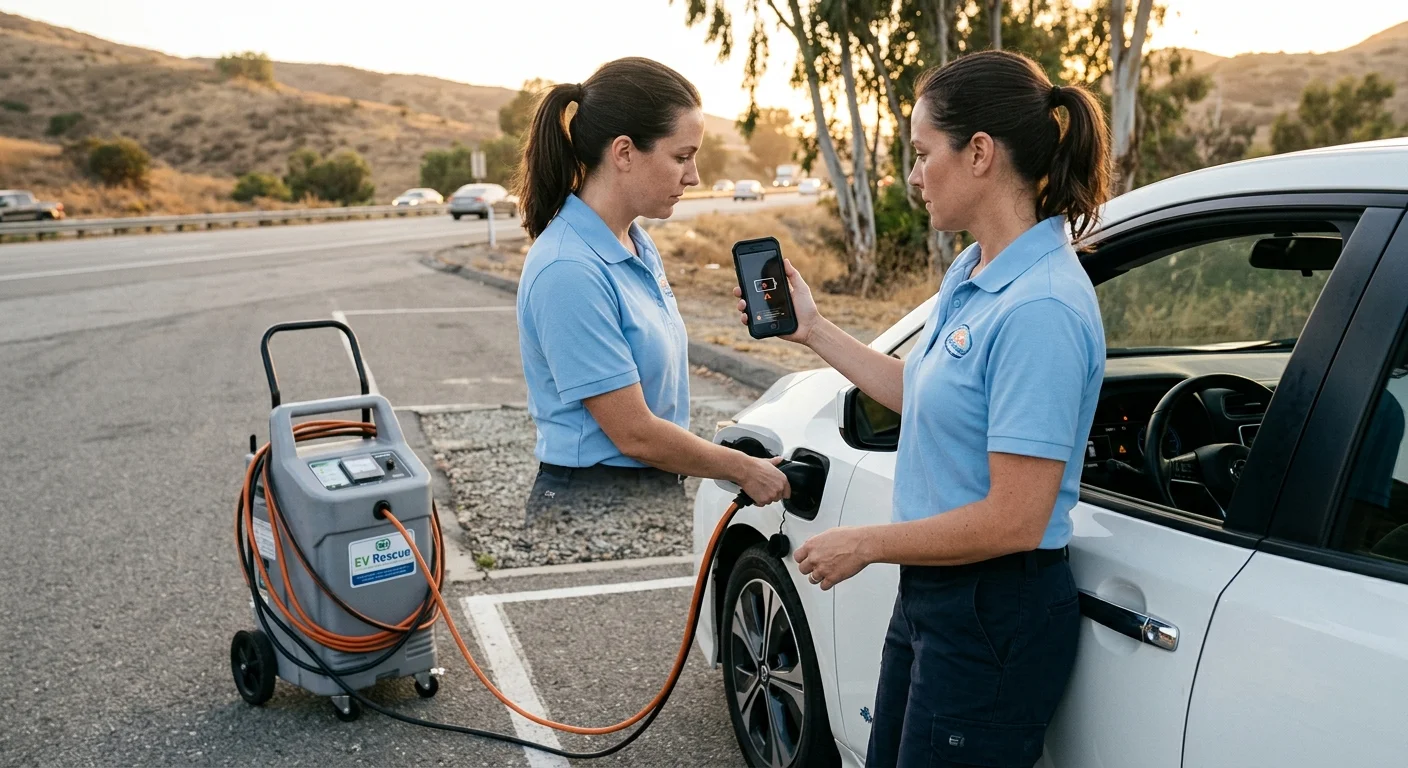
The second death is the message
A first jump only shows that voltage returned for a stretch. It doesn’t show the battery can hold that voltage. When screens go dark again in the same garage, treat the 12-volt as spent.
The drive pack still sits in the floor. It can report plenty of range while the 12-volt is dead. The 12-volt wakes computers, locks, and contactors. Without it, the car behaves like a brick.
Copy the dash text as written, and don’t convert it into a theory. Note 12V, low voltage, or a black screen with a live app reading.
Airport weeks and downtown stalls expose a weak 12-volt
Leave an EV at Los Angeles International for a week. You can return to a dead 12-volt. Terminal parking in structures P1 through P7 sits in the Central Terminal Area. Those structures offer Level 2 and DC fast charging. The Economy Parking garage has more than 4,000 stalls, including 514 active EV chargers. Those plugs don’t keep a failing 12-volt alive if the car sits unplugged. They also don’t revive a battery that dumps voltage after a jump.
You fly, then you come back to a pack that still shows range. The 12-volt sat idle and dropped. A jump gets the computers up, then it dies again at the next stop. That’s the accessory battery, not an empty pack.
The same 12-volt stall shows up after a long downtown Los Angeles garage day. Cars sit through work, dinner, or a late event. The 12-volt keeps clocks, alarms, and remote checks alive. No verified drain rate for those loads is published here. The pattern still shows up after a jump that doesn’t last.
Hollywood Burbank Airport, Long Beach Airport, and Van Nuys Airport follow this pattern too. Charging layouts at those three weren’t confirmed in this research. Check each airport’s own site before you count on a plug. A dead 12-volt still leaves the car dark. Chargers in the same garage don’t change that.
Griffith Observatory and Universal Studios Hollywood can hold a car for hours. If it dies again in that structure, skip chasing a stall as the fix.
Separate a dead 12-volt from a zero pack
Ask what still works: doors, dash, app connection, shift, and the charge port.
A dark dash with pack percent still in the app points at 12-volt. A car that wakes, drives, and then reads true zero has a pack problem.
Use the owner’s manual for that model year. Don’t follow steps written for another brand. Tesla, Hyundai, Ford, and Rivian hide 12-volt access in different spots.
When an EV 12V dies explains the brick-car pattern. It doesn’t replace the manual or a model-specific check.
Write the sequence while you still remember it
Keep a short log before the details fade.
- What you were doing when power first dropped
- Exact warning text, in the order it appeared
- Who performed the first jump, and with what gear
- Whether they used the documented posts for your model
- What returned: locks, screens, drive, or charging
- Whether the car moved or stayed parked
- What happened right before the second blackout
Photograph the full dash when you can. Don’t crop to one banner. If messages cycle, capture each one. An app screenshot helps when the dash is already black. Don’t clear the warnings to make a prettier screen, and leave the history for the next person.
Pin the car with real access notes. Naming only Los Angeles isn’t a location. Name the garage, level, stall, and gate path. At LAX, say P1 through P7 or Economy, plus the floor. On a freeway, give the route, direction, and nearest exit.
If you’re on a freeway shoulder, CVC 21718 covers a disabled vehicle once help is summoned. Other drivers must move over or slow under CVC 21809 when lights are flashing. Stay with the car and skip walking the lanes.
Metro Freeway Service Patrol covers congested county freeways at no charge to you. Dial 511 and say Motorist Aid. Published FSP help names a gallon of gas, a radiator refill, and a tire change. It also tows to a CHP-chosen safe spot. It doesn’t list mobile EV charging or 12-volt rescue. An EV that’s dark sits outside that published list, except for the free tow.
A stall inside the I-10 or I-110 Metro ExpressLanes needs extra care. Metro’s published FAQ doesn’t spell out a disabled-vehicle procedure for those lanes. Stay in the vehicle and call for help. A usable shoulder in those lanes wasn’t confirmed here.
Private garages can order a tow under CVC 22658 when posted rules are met. The lot needs the required 17-by-22-inch entrance signs and written authorization. It also needs owner notice, plus notice to local law enforcement within one hour. If you return before the car leaves, they must release it. Storage rates can’t exceed CHP or law-enforcement approved rates. Confirm the current storage charge with the lot. No statewide cap figure was verified here. An on-site 12-volt jump can keep a downtown stall from turning into a tow.
A second jump isn’t a repair
Don’t make another jump the automatic next move. Read the official procedure for your exact make, model, and year. Posts, tools, and warnings differ by vehicle. This page doesn’t give a generic jump map. Those steps weren’t confirmed for every EV.
If the manual says stop, stop there. If nobody on scene has the right procedure, don’t let a bystander invent one. Tell the next professional that power returned once and failed again. Ask whether they handle your model and a repeat 12-volt failure before work starts.
Smoke, a burning smell, or broken housing ends the roadside experiment. Call emergency services, and don’t keep clamping cables.
If replacement is already on the table, EV 12V battery replacement covers signs to discuss with a shop. Your model year, warning history, and present behavior should lead that talk. No life span or price is confirmed here.
Match the call to the stall you’re in
Roadside help fits when the car won’t wake, won’t shift, or can’t leave. Ask if the operator supports your brand. Tesla owners can start with Tesla 12V battery jump. Other brands can review non-Tesla EV rescue. For general dispatch, see EV roadside assistance. Charge Pro LA connects you with independent local operators. The pros we connect you with are licensed and insured. The matched operator does the work, quotes you first, and bills you directly.
A service center fits when you need testing or a programmed replacement after two failures. Send the same log and photos. Say the car died again after a jump. Remaining pack percent is one observation, not the whole story.
An operator gets the car out of a gated downtown garage. A dealer then replaces the 12-volt. Confirm that plan before anyone starts. If a tow comes up, follow the manufacturer’s current tow steps for that model.
Mobile EV charging in downtown Los Angeles covers structure handoffs. Coming back through El Segundo from LAX, use EV roadside assistance in El Segundo.
If the pack is actually empty, that’s a separate job. Operators we connect you with can bring a 240-volt Level 2 source. They use a native NACS plug. Non-Tesla EVs get a CCS or J1772 adapter. Charging time is typically 15 to 30 minutes. That adds about 10 to 20 miles of range. That’s charging time, never an arrival time. A dead 12-volt still has to wake before that boost can start.
On a repeat 12-volt death, the operator may jump it again. They may replace it on site if they carry the right battery. Confirm that with them before they start. Charge Pro LA doesn’t stock parts or send its own trucks.
Don’t pick help from the range figure you remember from yesterday. Let the operator or the shop decide what matters.
The U.S. Department of Energy’s electric vehicle overview is general background.
When the car stays dark
If the car stays dark after another 12-volt drop, call a mobile rescue operator first. Give the make, model year, exact warnings, and the garage or airport pin. Include what the first jump changed. Call (858) 925-5546. We’ll connect you with a local EV rescue operator. You contract with that operator, not with Charge Pro LA.