The 12-volt battery wakes an EV’s computers, locks, and contactors. When it dies, a full drive pack won’t save you. The car sits like a brick in the garage. In Los Angeles County that’s a common pattern after a long sit. Operators we connect you with can jump a dead 12V on site. Many can replace it there too, before you need a tow.
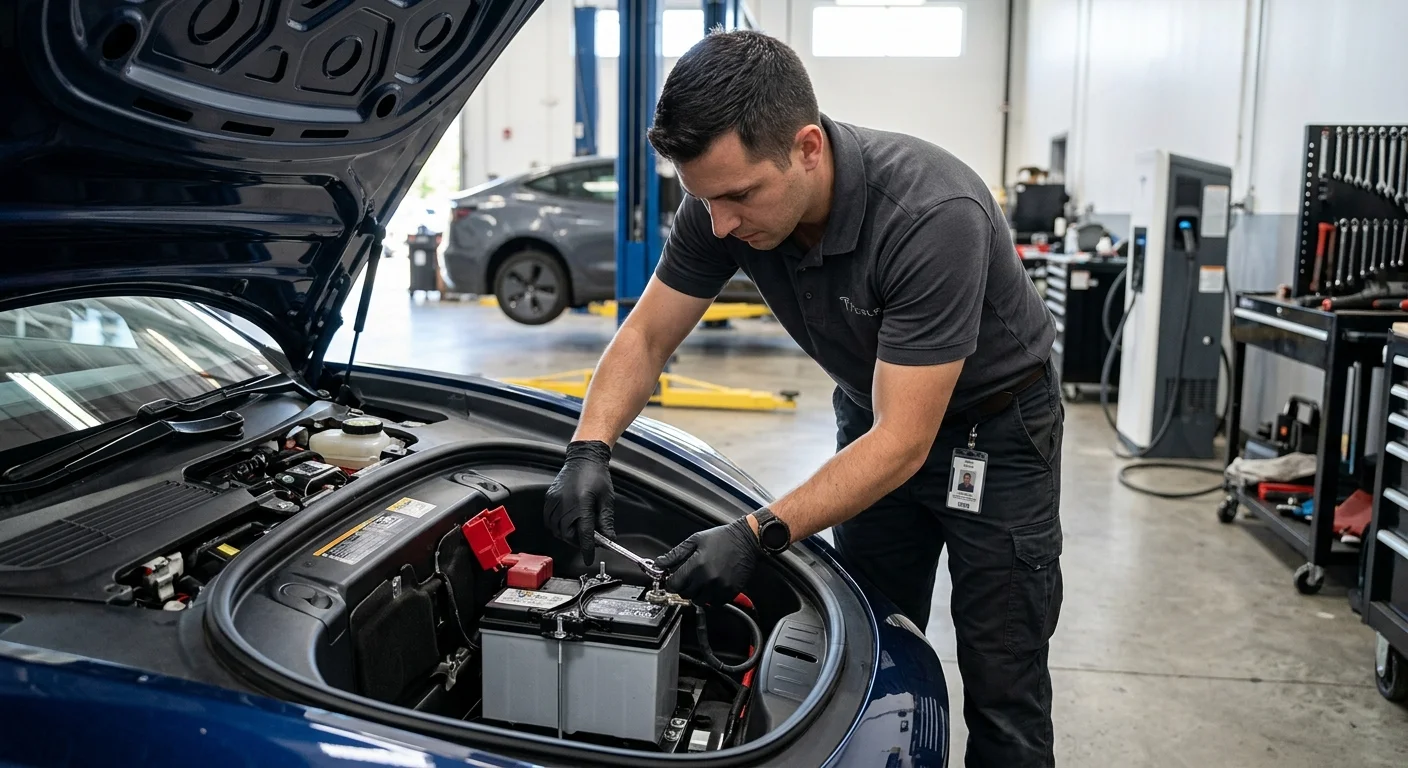
The 12-volt battery isn’t the one that moves the car
The big pack under the floor turns the motors. The small 12V battery does a different job. It feeds the computers, screens, and door latches. It also closes the contactors that connect the high-voltage pack. No 12-volt power means those contactors stay open. The traction pack can still hold a charge. The car just never gets permission to use it.
That’s why EV 12V battery replacement is a real search. Owners see a healthy percentage on the last app reading. Then the fob does nothing and the screen stays black. Charge ports won’t open. Manual door releases can be hard to find in the dark. It feels like the main battery failed. It usually didn’t. For that brick-car pattern, read when an EV 12V dies.
A jump can wake the computers long enough to drive. It doesn’t repair a battery that won’t hold a charge. If the cell is worn out, you need a new one. That swap can happen at a shop. It can also happen in a driveway or a parking structure. Operators in this network bring jump gear. They can replace a dead 12V on site. That includes Tesla and other major EV brands.
Why this county’s parking habits wear a 12V down
Los Angeles County isn’t one parking pattern. Coastal lots, valley driveways, and high-desert garages all sit cars differently. The 12V still supports alarms and wake events the whole time. A car that rarely moves still draws a small load. Heat in the Antelope Valley stresses that small battery. Cold nights in Lancaster and Palmdale do the same. The 12V fails from sitting, short trips, and wear.
Housing age is a local clue. In the city of Los Angeles, 71.0% of housing predates 1980. That’s the ACS 2019-2023 figure from the Census Bureau. East Los Angeles sits at 86.2% pre-1980 housing. Whittier is 88.9%, and Lakewood is 88.8%. Those older streets mean enclosed garages and alley parking. Cars rest for days between short hops. If you’re sitting in East Los Angeles, older garages are the usual backdrop.
Stevenson Ranch sits at the other end of that range. Only 3.4% of its housing predates 1980. Castaic is 7.7%, Palmdale is 19.7%, and Santa Clarita is 30.4%. Newer garages still host long travel sits. They just look different from a 1960s Eastside driveway.
Airport parking is the other classic 12V trap. Los Angeles International is run by Los Angeles World Airports. Terminal structures P1 through P7 offer Level 2 and DC fast charging. The Economy Parking garage has more than 4,000 stalls. It also has 514 active EV chargers. Those plugs keep a traction pack from sitting empty. They don’t keep a weak 12V alive. You can fly out for a week. You can come home to a charged pack. The car still may not wake. The same after-a-trip pattern shows up at Hollywood Burbank Airport. It also shows up at Long Beach Airport and Van Nuys. Parking-charger counts at those three weren’t verified here. Treat the 12V sit as the risk.
Campus and event structures add the same sit. UCLA in Westwood fills garages for class days. USC near Downtown does it for games and lectures. A long Inglewood stadium sit can do it too. The parked-car version is in EV dead after a SoFi Stadium event. Griffith Observatory parking has the same story. You come back and the car won’t unlock.
Your electric utility doesn’t change the 12V chemistry. LADWP serves the City of Los Angeles. Southern California Edison delivers power across most of the rest of the county. Clean Power Alliance buys generation in some cities, and SCE still runs the wires. None of that replaces a 12V.
Signs it’s the 12V, not an empty pack
Start with how the car actually behaves. Don’t start with the last range number. A dying 12V usually shows up as access trouble. The key fob is late or dead. Door handles stay flush on the body. Interior lights are dim or they flicker. The center screen boots slowly, then freezes. You press the brake and the car never enters drive. Some models throw a stack of unrelated faults. Control modules are starved for stable power.
Dash wording varies by brand and model year. Tesla and several others name the 12-volt system in a warning. That happens when diagnostics catch a weak battery. Don’t wait for that message if the fob already feels flaky. Tesla-specific alerts are covered in Tesla 12V battery failure: the signs. Other makes use different wording on the dash. Low-voltage systems act sick while the traction percentage still looks fine.
If the car won’t unlock, don’t pry on electronic handles. Look up the mechanical release in the owner’s manual. A locked EV in a structure is a safety issue. If you’re on a freeway shoulder, stay out of the lanes. California’s move-over rule is Vehicle Code 21809. Other drivers must change lanes or slow. That applies when a tow or service vehicle shows flashing lights.
Skip folk timelines about a set number of years. A published year-by-year 12V life figure wasn’t confirmed here. That includes Tesla, Rivian, and the Mach-E. Battery chemistry also differs by model year. Some EVs still use an AGM 12-volt battery. Newer Teslas and other makes use a small lithium 12V. You can’t read age off the paint. You read behavior, then you test.
Jump first, then decide on replacement
A jump is the right first move when the car is a brick. Many EVs have dedicated 12-volt jump points. They’re often behind a small cover up front. That cover can sit in the bumper, the tow-eye area, or the frunk. Use a 12-volt jump pack on those points. Never try to backfeed the high-voltage pack. The owner’s manual names the posts for your model. If you don’t have that page, stop. A wrong clamp on an EV can damage modules.
Can roadside assistance jump-start an EV, or only the 12V? is the short version of that limit. The high-voltage system isn’t a jumper-cable job. The 12V is the only jump you should attempt. Once the computers boot, the car can often recharge its own 12V. It draws that charge from the traction pack. Or it at least lets you shift into drive. That’s a bridge, not an EV 12V battery replacement.
If the same car dies again after a short sit, the battery is done. EV battery dies again after a jump covers that repeat failure. At that point, more jumps only buy hours. Replace the unit instead of stacking jumps. Operators we send can jump Tesla and non-Tesla EVs. They can also swap a dead 12V on site. That depends on the part and the car. They quote you before they start. They bill you directly for the visit. Charge Pro LA doesn’t own the truck. We don’t do the work. For a Tesla that won’t wake, start with Tesla 12V battery jump. That’s the service page for an on-site wake-up.
A shop visit still makes sense in some cases. The battery may sit in a tight location. The car may need a software reset. Tesla Service, a brand dealer, or an EV shop can install an OEM part. No parts price could be confirmed from manufacturer pages in this research. No labor rate could be confirmed either. Ask the service writer for a current quote. Don’t plan around a number you saw on a forum.
If you’re thinking about doing the swap yourself
Some owners can change a 12V. Many shouldn’t. EV layouts hide the battery. It may sit under frunk trim, under a rear seat, or behind a panel. Torque specs, terminal order, and service mode live in the owner’s manual. A generic blog checklist isn’t that manual. If that already feels like too much, call a tech.
Wrong chemistry is a real failure mode. An AGM part in a lithium 12V tray can fail. The reverse can fail too. Aftermarket labels can look close and still be wrong. Match the part to the VIN or to the unit you pulled. Wear eye protection. If you don’t know how your model wants the battery disconnected, don’t guess.
This network is a referral line, not a parts counter. We don’t sell batteries. We don’t walk you through a live repair. The value of a mobile visit is the operator. They bring the right jump gear. They can replace the 12V on the curb when that’s the safe path. If they look at it and send you to a shop, that’s still a good outcome. Don’t improvise on a live high-voltage car.
Freeway sits, private lots, and who won’t replace a 12V
If the car dies on a Los Angeles County freeway, stay put if it’s safe. Vehicle Code 21718 generally bans stopping on the freeway. A disabled vehicle that has already summoned help is an exception. Call for assistance. Stay out of traffic.
Metro’s Freeway Service Patrol is a joint program. Caltrans, the California Highway Patrol, and LA Metro run it. It’s free to motorists on congested freeways. A driver can get a gallon of gas. A patrol can refill a radiator or change a tire. They can tow you to a CHP-chosen safe spot. Dial 511 and say “Motorist Aid.” FSP’s published help list doesn’t name mobile EV charging or a 12V jump. An empty pack or a dead 12V is outside what that flyer describes. The exception is the free tow to a safe location. Don’t wait on a patrol truck to bring a lithium 12V.
CHP can remove a vehicle that sits too long. Vehicle Code 22651 lists the removal cases. A freeway sit of four hours or more is one of them. If you’re in a private garage, Vehicle Code 22658 controls the tow. Lots need the required 17-by-22-inch entrance signs and written authorization. They must release the car if you return before it leaves the lot. A specific statewide dollar cap wasn’t verified here. If a lot is circling your dead EV, get an operator there. Do that before a hook shows up.
Metro ExpressLanes run on the I-10 through El Monte. They also run on the I-110 Harbor Freeway. A published disabled-vehicle procedure for those lanes wasn’t confirmed. Don’t start a battery swap in live traffic.
What to do in the driveway tonight
If the car still wakes, drive it only as far as you must. Then park where you can wait. If it won’t wake, don’t keep cycling the fob. That just drains whatever is left. A plugged-in Level 1 cord that never latched is a charging story. A black screen plus a dead fob is the 12V story.
Then pick a path. You can try a 12-volt jump pack if you have the manual. You need the right posts too. You can call Tesla roadside, Rivian Highway Assist, or your insurer. Those programs don’t always send someone who’ll replace a 12V. That matters in a Westside garage. It matters in a San Gabriel Valley driveway too. You can also call Charge Pro LA. We match you with an independent local operator. They handle Tesla and every major EV brand. For a 12V, the job is a jump or a replacement on site.
If the traction pack is also low, a Level 2 mobile boost is a separate service. Operators typically add 10 to 20 miles of range. That takes 15 to 30 minutes of charging time. That’s charging time. It isn’t a promise of when someone arrives. We don’t publish arrival times. We don’t set prices. The operator quotes before work starts.
When you’re ready to call
Charge Pro LA is a referral line for Los Angeles County. We don’t hold a contractor license for this work. We don’t run a yard or a fleet. The pros we connect you with are licensed and insured. We connect stranded drivers with independent mobile rescue operators. If you want an EV 12V battery replacement in the driveway, that’s the call. If you want a jump so you can roll to a shop, that’s the call too. Reach us at (858) 925-5546. Tell the operator where the car sits, the make, and whether it will unlock. They quote you before they start. They bill you directly.