A jump can wake an EV when the 12V battery is dead. It can’t refill an empty drive pack on the freeway. That split matters on Los Angeles County freeways. Metro Freeway Service Patrol’s list names gas, coolant, and a tire change. It doesn’t name a pack charge anywhere on that list.
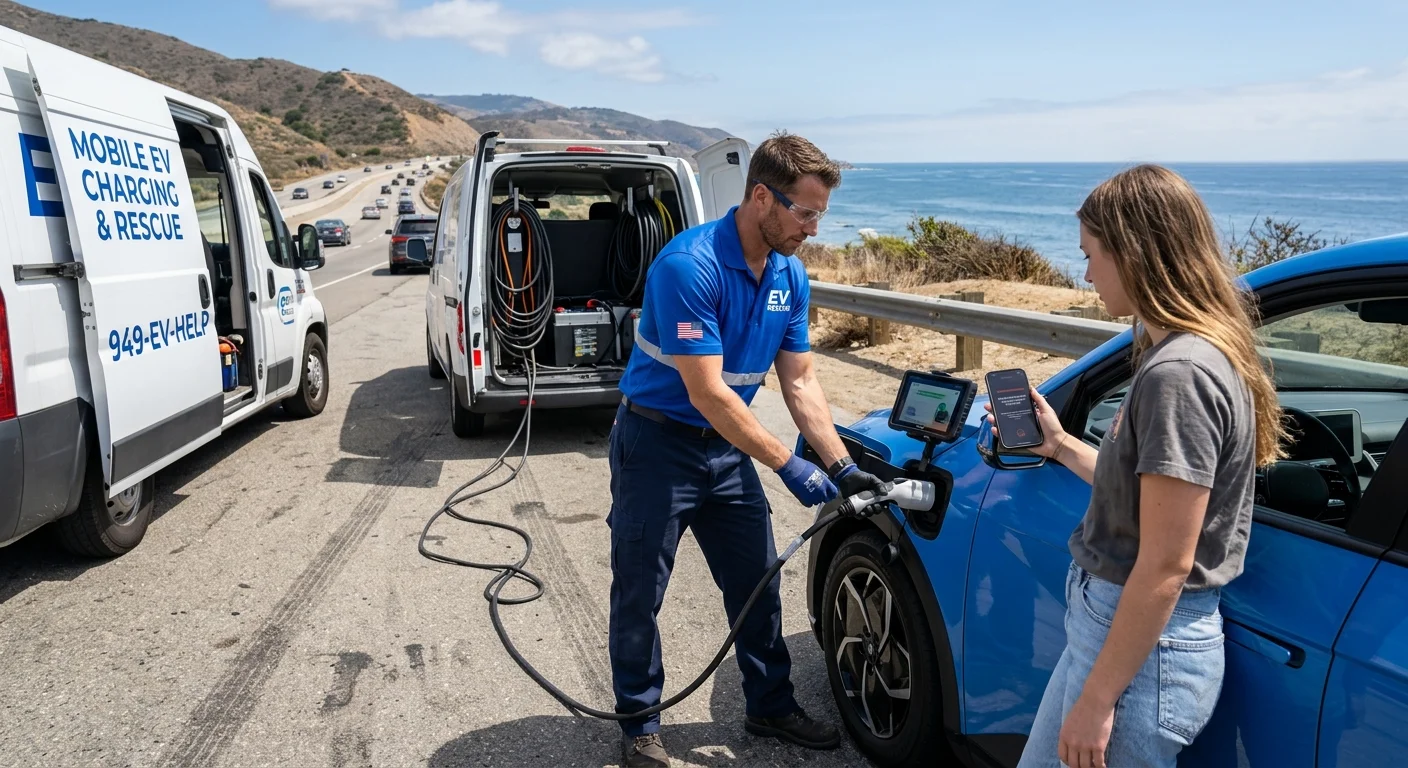
Freeway patrol lists gas, coolant, and a tire
Metro Freeway Service Patrol is a joint program. Caltrans, the California Highway Patrol, and LA Metro run it. The service is free to motorists on those freeways. Trucks roam congested Los Angeles County freeways to clear incidents.
What they publish is written for gasoline cars. They’ll offer a gallon of gas if you run dry. They’ll refill a radiator and tape hoses. They’ll change a flat, then tow a disabled vehicle at no charge. CHP picks the safe pre-designated drop.
None of that is a Level 2 charge. That gap is an observed absence on metro.net and chp.ca.gov, read 2026-09-18. Their motorist-aid list doesn’t include mobile EV charging. An empty EV can still get that free tow to a designated location. A 12V jump is a different job, and it isn’t on that list.
Hours are typically Monday through Friday during peak commute windows. Coverage also runs all day in designated construction zones. Metro says midday and weekend coverage is expanding on the busiest corridors. Confirm current hours on metro.net before you count on a patrol truck.
For Motorist Aid, dial 511 and say those two words. That’s the published contact path. It still doesn’t turn FSP into an EV charging service.
California Vehicle Code 21718 generally bars stopping on a freeway. A disabled vehicle that’s already summoned help is an exception. CVC 21809 is the move-over law. Other drivers must change lanes if it’s safe. If they can’t, they must slow to a reasonable speed. That rule covers a stopped emergency vehicle, tow truck, or Caltrans unit with flashing lights. CVC 22651 lets an officer remove a vehicle left unattended on a freeway for four hours or more. Stay with the car if you can, and keep the help request documented.
Every EV has two batteries, and only one takes a jump
The search “can you jump start an EV” sounds binary. On the freeway shoulder it’s a diagnosis first.
The 12V battery wakes computers, locks, lights, and the contactors that connect the pack. When that battery sags, the car can sit like a brick. Screens stay dark, doors may not unlock, and Drive never engages. A model-appropriate jump can sometimes restore that low-voltage system. That’s the first check on a Tesla 12V jump request.
The drive pack is the tank that moves the car. Jumping the 12V doesn’t put miles back into it. If the last screen you saw was at zero, you’re looking at out-of-charge recovery or a tow. Jumper cables won’t fix an empty pack.
Drivers say dead for both failures. That word doesn’t help the operator at all. Say what the car did and what the display showed. Say whether you still had driving range when it quit.
Make, model, and year matter. Clamp points and approved steps aren’t the same on every EV. Follow the owner’s manual for your car. Our guide to jumping an electric car safely is extra context. It doesn’t replace the book in the glovebox.
You can also read what happens when an EV 12V dies. The U.S. Department of Energy keeps general owner pages if you want the federal overview.
Tell the operator the model, the message, and the last percent
Don’t diagnose the pack from the curb. Report what you can see.
Start with the last charge percentage the car showed. Then read every warning exactly as it’s written. If the screen is blank, say the screen is blank. Don’t relabel an electrical-system alert as a dead battery.
Describe the start attempt in plain facts. Say whether the display lights. Say whether the key is recognized. Say whether it enters Drive.
Location in this county has to be specific. ACS 2019-2023 puts the City of Los Angeles near 3.86 million people. The city name alone isn’t a pin. Name the freeway, exit, structure, or landmark. A stall in LAX terminal parking isn’t a shoulder on the 10 through El Monte. A driveway in Santa Clarita isn’t a studio lot in Burbank.
Access changes the job. A gated alley, a low garage, a tight Westside structure, or a freeway shoulder all constrain equipment. Metro ExpressLanes run on the I-10 through El Monte and the I-110 Harbor Freeway. A FasTrak transponder is required to enter those lanes. Their published FAQ doesn’t spell out a disabled-vehicle procedure inside the ExpressLanes. Tell the operator if you’re in a regular lane, on a shoulder, or in a paid lane.
For non-Tesla cars, start at non-Tesla EV rescue. The matched operator still checks the exact model before they clip anything.
Skip the jump when the pack is empty
If the traction battery is at zero, ask for a charge or a tow. A jump won’t refill it. That’s the same reason FSP’s gas can doesn’t help an EV.
A jump can also be the wrong tool when the warnings don’t point at the 12V. An unfamiliar message, a wet charge port, smoke, heat, or a recent collision all change the review. Tell the operator those facts. Don’t turn them into your own diagnosis.
Parking after a trip is a common 12V trap. LAX terminal structures P1 through P7 offer Level 2 and DC fast charging. The Economy Parking garage lists more than 4,000 stalls and 514 active EV chargers. A car that sat a week can still refuse to wake. A dead 12V isn’t an empty pack. Chargers in the same garage don’t revive a failed 12-volt battery. Hollywood Burbank Airport and Long Beach Airport weren’t confirmed here for stall counts. The same 12V-after-a-trip pattern still applies.
The same sit-and-drain pattern shows up after long sits at home. About 71 percent of City of Los Angeles housing was built before 1980. East Los Angeles, Whittier, and Lakewood sit higher on that pre-1980 share. Whether a given building has a dedicated EV circuit couldn’t be confirmed from those Census tables. Check the panel or ask the property owner. If you don’t have a home plug, the roadside 12V-versus-pack choice still stands.
Heat and cabin load cut real range below the window sticker. Recurrent Auto’s published work ties climate control to that loss. Antelope Valley summers in Lancaster and Palmdale, plus the long I-5 climb north of Castaic toward the Grapevine, are the county versions of that load. Sepulveda Pass on the 405 is the climb between the Westside and the San Fernando Valley. Don’t treat a low pack after a hot climb as a 12V story. If the last reading was near empty, say so.
Club roadside programs vary by plan. Compare that fork in AAA or a mobile charge.
How Charge Pro LA refers the call
Charge Pro LA is a referral line. We match stranded EV drivers with independent local mobile rescue operators. We don’t hold a trade license. We don’t own trucks. We don’t employ technicians. We don’t set prices or promise an arrival time.
The operators we connect you with are licensed and insured. They bring a 240V Level 2 source to the car. Tesla cars take a native NACS plug. Other EVs use a CCS or J1772 adapter. That boost typically adds 10 to 20 miles of range in 15 to 30 minutes of charging time. Charging time isn’t an arrival time. They can also jump or replace a dead 12V on site. They handle Tesla and every major EV brand.
You get a quote from the operator before work starts. The operator bills you directly. Ask about the proposed service and the terms before you approve.
We serve cities across Los Angeles County. Westside beach cities, the San Fernando Valley, the San Gabriel Valley, the Gateway Cities, the South Bay, Santa Clarita, and the Antelope Valley are all in the service area.
When you call, have the make, model, year, warning text, last charge shown, and a precise pin. An EV roadside assistance request that names those details is easier to match.
If the car won’t wake
Call when the EV won’t start and you need an on-site review. A jump, a Level 2 boost, or a tow may fit. The operator decides after they hear the symptoms.
Call (858) 925-5546 and we’ll connect you with a local operator.