A dead 12V after LAX or a downtown garage is the usual jump. The traction pack can still show range. The car still won’t wake. That small 12-volt battery runs the locks, screens, and contactors. Jump it the wrong way and you can hurt the DC-DC converter. Jump it the right way and the car comes back without a tow.
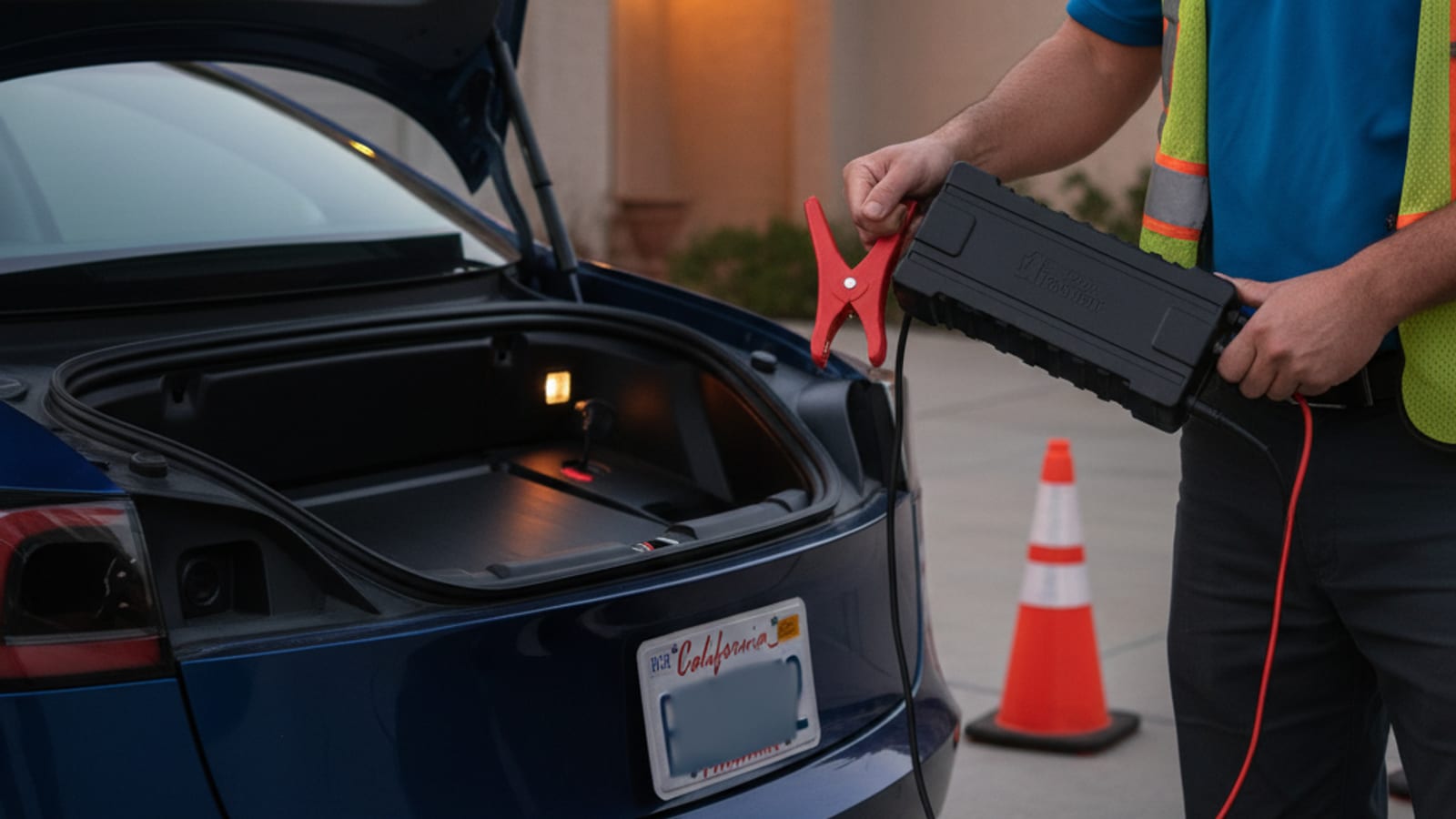
A dark dash is usually the 12V, not an empty pack
Los Angeles International is where this failure hides. Terminal parking in structures P1 through P7 includes Level 2 and DC fast charging. The Economy Parking garage has more than 4,000 stalls, including 514 active EV chargers. Those plugs don’t wake a failed 12V. You can park for a week and return to a dead handle.
Downtown Los Angeles structures strand the same way. So do studio lots in Burbank and long stays in El Segundo. Hollywood Burbank, Long Beach Airport, and Van Nuys see the same 12V hangover after a trip. If the car is awake and range reads zero, you need a charge. If nothing powers up, start with the 12V. What happens when an EV 12V battery dies walks through that split.
Older central-city housing makes DIY access harder. In the City of Los Angeles, 71.0% of housing was built before 1980. East Los Angeles sits at 86.2%, which often means tight underground stalls. Santa Clarita is the contrast: only 30.4% pre-1980 housing, and more driveway room.
Don’t jump from another car
A running gas car doesn’t feed a calm 12 volts. Alternator output swings, and jumper cables pass spikes. Gas 12V systems were built to take that abuse. EV 12V circuits feed a DC-DC converter, body modules, and a battery management system. A spike or a reversed clamp can damage those parts.
Tesla tells owners not to jump from another vehicle. Rivian, Ford, and Hyundai service manuals say the same thing.
Polarity is the other hard line. Red goes to the marked positive. Black goes to the marked ground. Don’t clamp black to a random metal edge. Don’t use the 12V negative post unless the manual names it as ground.
Use a lithium jump pack, not borrowed cables
A lithium jump pack is a portable 12V battery with leads. It supplies a controlled voltage at a moderate current. That’s enough to wake a dead 12V. It isn’t an alternator surge. Any pack built for 12V jump starting, with reverse-polarity protection, is the right tool. Keep it in the frunk or the trunk. Charge it every few months so it isn’t dead when you need it. Check its charge lights before you clip on.
Hookup order, then a short wait
The posts move by brand. The clip order stays put.
- Get the car somewhere legal and stay with it.
- Find the marked jump points in the manual.
- Connect red first, to the positive terminal or the red pigtail.
- Connect black to the marked ground point.
- Wait a short beat so voltage can settle.
- Try a door handle, the app, or the driver’s door.
- Once it wakes, leave the pack connected so the DC-DC can take over.
- Disconnect black first, then red.
On a freeway, California Vehicle Code 21718 bars stopping on the roadway. A disabled EV that’s called for help fits the exception. You can also stop to avoid injury or damage.
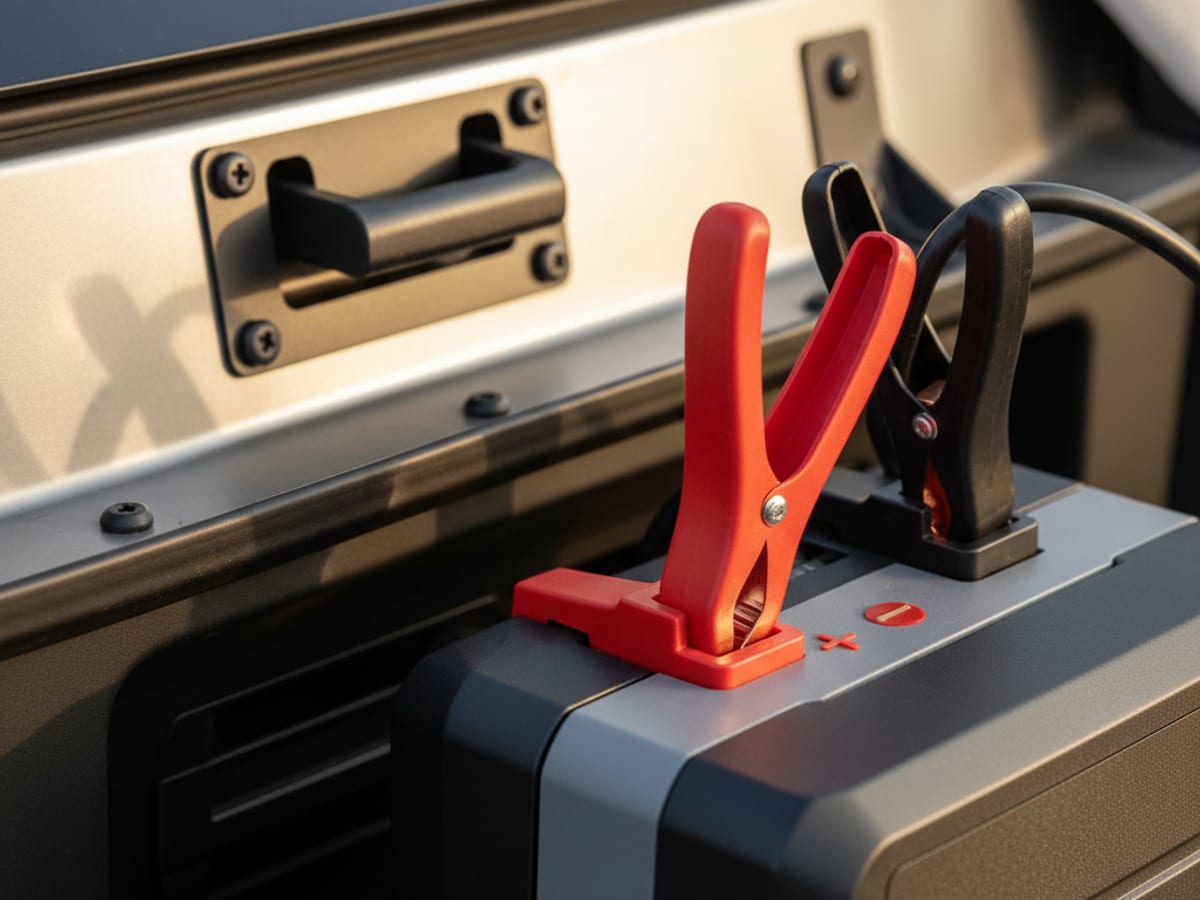
Never reverse the leads. Newer packs refuse a backwards hookup. Old packs and loose cables won’t. Reverse polarity is how people ruin a converter. CVC 22651 allows removal after four hours unattended on a freeway. Stay with the car once you’ve called for help.
Where the jump points sit on common EVs
Tesla Model 3, Y, S, and X
On a Model 3 or Y, pop the driver’s-side tow-eye cover on the front bumper. Two pigtails sit there: red positive and black ground. Clip the pack there. When the frunk releases, open it and finish on the real 12V.
On a 2021 or newer Model S or X, use the front door manual releases. Pull the frunk release under the carpet. Jump on the 12V terminals inside the frunk. Older Model S and X cars use the tow-eye access, like the 3 and Y. How to jump a Tesla Model 3, Y, S, or X maps those points.
Rivian and the F-150 Lightning
A dead 12V kills the powered frunk release. On an R1T or R1S, pull the manual cord behind the grille. You reach it by taking off a small cover plate with a Phillips screwdriver. The 12V sits under a panel on the passenger side. Jump the positive post and a marked ground stud.
On a Lightning, the mechanical release is a small loop under the front bumper. The 12V is on the driver’s side once the frunk is open.
Hyundai, Kia, Chevy, Polestar, and Mach-E
Ioniq 5, EV6, and EV9 cars hide the 12V under the rear cargo floor. Jump from the front posts instead. Use the red positive post and the marked ground bolt. A Chevrolet Bolt uses front jump terminals for a rear 12V.
A Polestar 2 keeps the 12V in the frunk. If the lid won’t open, a manual release cable sits behind the driver-side headlight housing. A Mustang Mach-E stores the 12V in back, with labeled jump posts in the frunk. Open the frunk from the app if it still responds. If it doesn’t, a manual cable sits behind a driver’s-side kickplate.
A local operator who does non-Tesla EV rescue already knows those posts.
What to do once it starts
Drive the car or plug it in. Either path lets the main pack’s DC-DC refill the 12V. A jump is a wake-up, not a repair. If the 12V dies again within a day, plan on replacement. The battery was already failing.
Watch for the early signs while the car still wakes:
- A dash message that the 12V needs service
- A slower wake from sleep than you’re used to
- Brief infotainment resets
- The app dropping the car while it sits
Replace the 12V when those show up.
Freeway patrol won’t jump an EV for you
Metro Freeway Service Patrol is free on congested Los Angeles County freeways. It’s a joint program of Caltrans, CHP, and LA Metro. Published help covers gas, a radiator refill, and a tire change. It also tows to a CHP-chosen safe spot. The list doesn’t include a 12V jump or mobile EV charging. Dial 511 and say Motorist Aid if you need that patrol. Treat a dead 12V as outside that list, other than the tow to a safer place.
If you’re on the shoulder, California Vehicle Code 21809 is the move-over law. Other drivers must change to a non-adjacent lane when they can, or slow down.
Private garages are a different risk. Under CVC 22658, a lot can tow only with required 17x22-inch entrance signage and written authorization. If you get back before the car leaves the lot, they have to release it. Storage charges can’t exceed the rates law enforcement has approved. Confirm the lot’s posted rules before you pay. The City of Los Angeles uses Official Police Garages for impounds. Specific fees and release steps weren’t confirmed here. Check lapdonline.org or lacity.gov for the current process.
EV roadside assistance in El Segundo covers the LAX-adjacent version of this stall. Mobile EV charging in downtown Los Angeles covers the garage version when the pack is empty.
When a local operator should do the jump
Skip the DIY clip if you can’t reach the posts. Skip it if you have no jump pack. Skip it if the 12V won’t hold after a jump. Skip it if the traction pack is low and the car also needs a charge.
Charge Pro LA is a referral line. It matches you with independent local mobile rescue operators. It doesn’t own trucks and it doesn’t do the work. The operator quotes you before starting and bills you directly. Those pros can jump or replace a dead 12V on site. They can also bring a 240V Level 2 source. It uses a native NACS plug, or a CCS or J1772 adapter. That boost typically adds 10 to 20 miles of range. Expect 15 to 30 minutes of charging. That’s charging time, not an arrival time.
For a Tesla that won’t wake, start with Tesla 12V battery jump. For any brand on a dark dash, EV roadside assistance is the broader call.
If you need that match in Los Angeles County, call (858) 925-5546. Tell the operator your location, the make, and whether the car is dark.