You left the car in LAX parking for a week. You came back to a brick. The doors won’t unlock, and the screens stay black. Terminal lots P1 through P7 have Level 2 and DC fast charging. The Economy garage has more than 4,000 stalls, including 514 active EV chargers. None of that wakes a dead 12-volt battery. El Segundo sits next to that trip, on Imperial Highway and the 105. EV roadside assistance in El Segundo starts with the 12V. A mobile Level 2 boost is next only if the pack is empty.
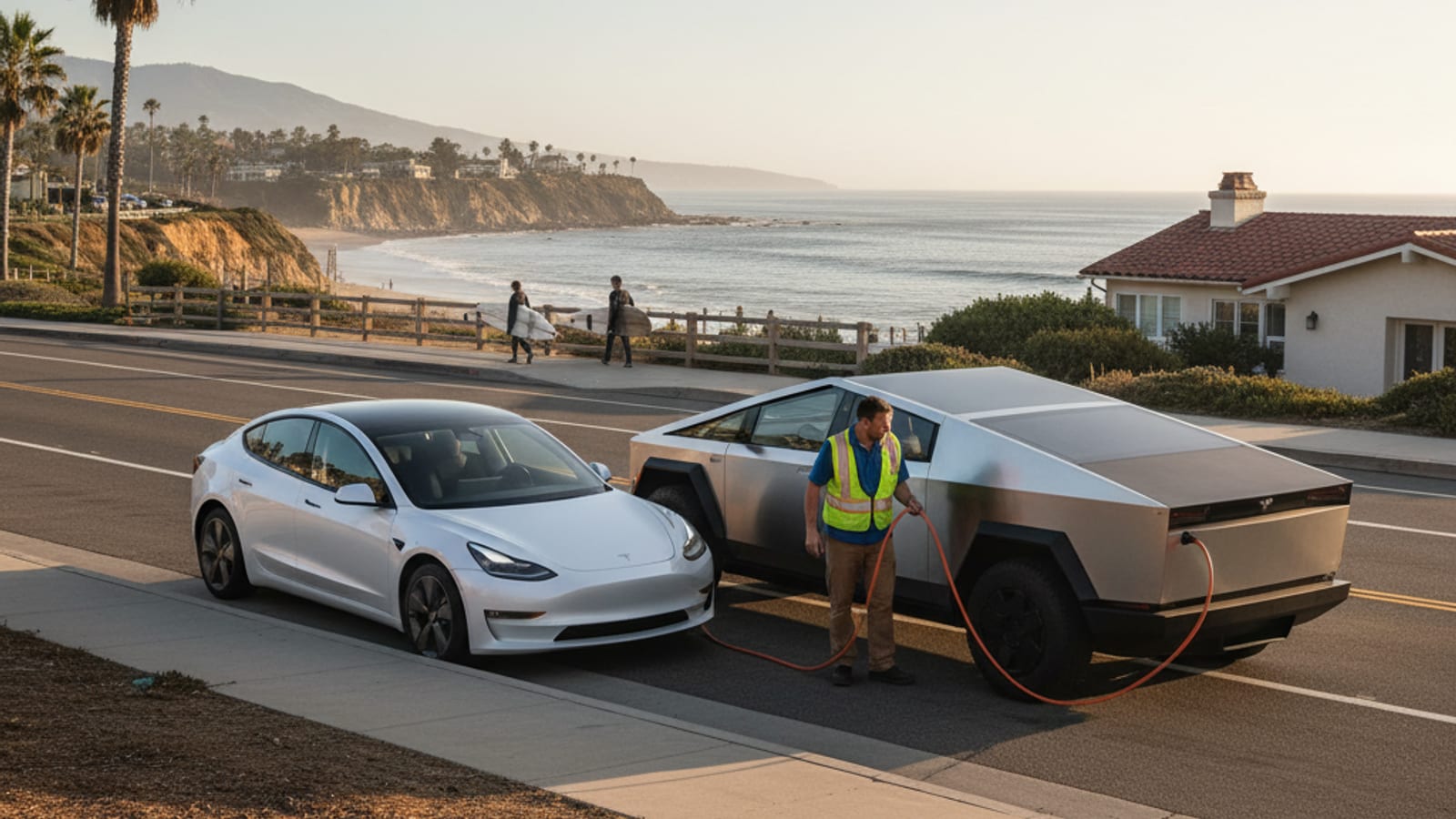
A week at rest can kill the 12V, not the pack
The traction battery and the 12-volt battery are different systems. The pack moves the wheels, and the 12V wakes computers, locks, and contactors. Park for days and the 12V can drain. The pack can still hold plenty of miles. Sentry Mode, cabin overheat protection, and scheduled preconditioning all sip that small battery. A traveler who lands at Los Angeles International often meets a silent car. It isn’t an empty one.
Los Angeles World Airports runs those garages. Chargers in the stall don’t keep the 12V healthy on their own. You have to plug in, and the car has to accept the session. A dead 12V won’t start that handshake. The car looks like it has no power. It may have plenty.
Hotel lots off Sepulveda show the same stall. Campus garages in the aerospace belt do too. El Segundo’s workday is full of parked EVs. Tech and aerospace campuses sit minutes from the airport approach. Cars sit through long meetings, red-eyes, and weekend trips. The pack can be fine, and the 12V isn’t.
Census figures put 16,863 people in El Segundo on the latest ACS. The 2024 estimate is 16,544. It’s a small Westside beach city of 5.449 square miles. About 74.3 percent of housing was built before 1980. That older stock matters when you talk about a home charger later. It doesn’t change what dies in a garage after a week away.
If the car is dark and the app won’t connect, start with the 12V. Read our guide on what happens when an EV 12V battery dies. It walks through that failure without the rumor mill.
Chargers in the garage don’t replace a jump
People assume a Level 2 post in the next stall is the fix. It isn’t, if the 12V is dead. The car can’t authorize a charge without that small battery. Tesla and most other EVs need the 12V alive first. The high-voltage contactors won’t close until it is. Plug a NACS or J1772 handle into a brick and nothing happens.
LAX Economy Parking lists 514 active EV chargers. Terminal structures P1 through P7 offer Level 2 and DC fast charging. Those stalls are reservation or first come. They’re real, published posts. They help when the car can wake and take a session. They don’t jump a 12V. They don’t replace a mobile operator who can.
If you plugged in before the trip, confirm the session actually ran. A stalled public charger can leave you lower than you planned. A kicked cable can too. A car that stopped at a random percent is a pack problem. That isn’t a 12V problem. The two feel identical from the curb, and they aren’t.
Use a Tesla 12V battery jump on site when the car is silent. If the dash comes back and the pack is at zero, the operator switches. That’s a 240-volt Level 2 boost at the bumper.
El Segundo sits on the LAX approach
This city isn’t a beach name swapped onto a generic page. The I-105 Century Freeway ends here. Imperial Highway runs the airport’s south edge. The I-405 cuts the east side. SR-1 is Sepulveda Boulevard through town. It isn’t a quiet coastal two-lane here. Rosecrans Avenue ties El Segundo to Hawthorne and the inland South Bay.
Downtown El Segundo and the Grand Avenue corridor are short blocks. Smoky Hollow holds older industrial buildings now used as offices. Aerospace and tech campuses fill much of the rest. That mix means two stranded-driver types. Travelers coming off LAX parking are one. Commuters leaving a campus garage after a long shift are the other.
May Gray and June Gloom keep summers cool and damp. Range loss here isn’t desert heat. Stop-and-go beach traffic on Sepulveda and the 405 is the drain. Cabin climate still costs miles. The marine layer itself is mild. Recurrent Auto’s published tests still matter if you then drive inland. Heat and AC cut real range below the sticker. The coast isn’t the hard climate.
Nearby cities share the same airport trip. Manhattan Beach is the next coastal city south. Hawthorne sits inland across the 405. Redondo Beach and Torrance continue down the South Bay. Inglewood sits east along the 105. The SoFi garage pattern matches this 12V stall. Read EV dead in the garage after a SoFi Stadium event.
ZIP codes 90245 and 90266 cover the city. 90266 also reaches into Manhattan Beach. If you parked near the airport, you may be in El Segundo proper. You may be in Westchester in the City of Los Angeles. You may be in Hawthorne. Say the garage name when you call. Operators need a gate code, a level, and a stall.
What to try while you still have a phone
Stay with the car if you’re in a structure. Don’t wander the ramps looking for another stall. A dead 12V won’t take a public charge anyway.
Try the app first. Tesla’s app can show pack percent if the modem is still up. Most other brands can too. Some apps show 12V health as well. If the app can’t reach the car, treat it as a 12V failure. Keep that as the working theory until the dash proves otherwise. A key card or fob on the B-pillar is the next Tesla step. Other brands vary. Check the manual for the 12V jump points before you pop a frunk.
If doors open and the dash boots, look at the pack percent. Double digits usually means you don’t need a mobile charge. You need the 12V sorted. A turtle warning or a zero on the gauge is a pack problem. Then a mobile EV charging visit makes sense.
Don’t keep sending unlock commands if nothing responds. That can drain a dying 12V faster. Don’t accept a random jump from a gas car without the right procedure. EV 12V jump points aren’t always under the hood in the old place. Wrong clamps can damage modules.
If you’re on a freeway shoulder, stay in the vehicle when it’s unsafe outside. California Vehicle Code 21718 bans stopping on a freeway, with listed exceptions. A disabled vehicle is one of them, when help is on the way. A dead EV that has called for assistance fits that exception. CVC 21809 is the move-over law. Other drivers must change lanes or slow for a stopped service vehicle with lights on.
Metro Freeway Service Patrol roams congested LA County freeways at no charge to the motorist. Caltrans, CHP, and LA Metro run it. Published help includes a gallon of gas and a radiator refill. It also covers a tire change. It can tow you to a CHP-chosen safe spot at no charge. The published list doesn’t include mobile EV charging. It doesn’t list an out-of-charge boost. Dial 511 and say Motorist Aid if you need that freeway patrol. Don’t expect them to charge the pack.
Jump, Level 2 boost, or a tow
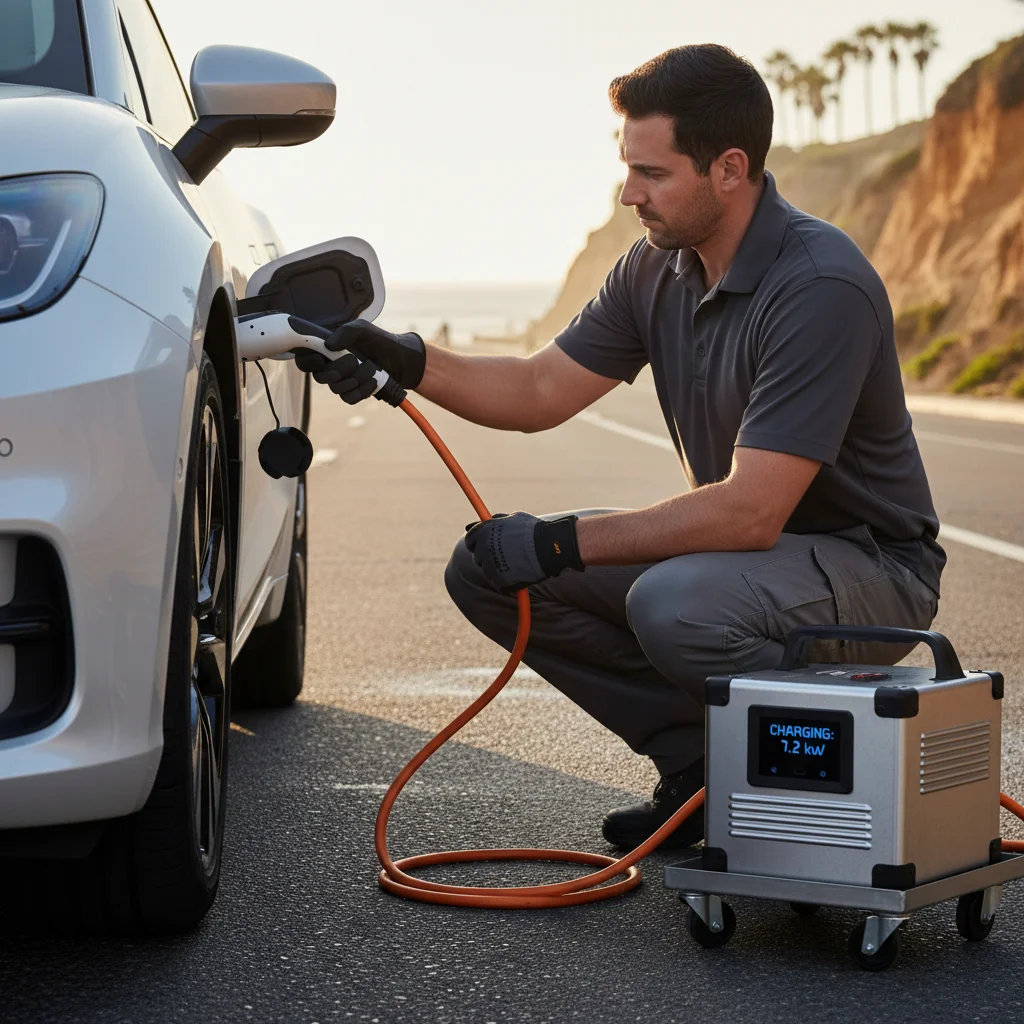
Three failures get mixed up in El Segundo parking. Sort yours before anyone hooks a winch.
A dead 12V with a healthy pack is first. The car is a brick. A jump, or a 12V replacement on site, is the path. Once the computers wake, you can drive. Plug in at home or at a public stall when you can. You didn’t empty the pack.
A truly empty pack is second. The 12V may still work. Lights come on, but the car won’t propel. A 240-volt Level 2 source at the bumper is the path. Operators we connect you with bring a native NACS plug for Tesla. They carry CCS or J1772 adapters for other brands. Typical charging time is 15 to 30 minutes. That window is charging time. It isn’t a promise of when someone arrives. It usually adds about 10 to 20 miles. That’s enough to leave the garage and reach a stall you choose.
A car that won’t take a charge is third, even with a live 12V. Port latches, faulted inlets, and thermal limits are shop issues. Roadside charging won’t clear a hardware fault. An operator can tell you if the inlet is live. They can’t rebuild a charge port on the ramp.
Towing is the last call for a lot of EVs. Many need a flatbed so all four wheels are off the ground. A wheel-lift on an AWD EV can damage the drive units. Private-lot tows in California fall under CVC 22658. Required entrance signage, written authorization, and notice to the owner all apply. Local law enforcement also gets notice within one hour. If you return before the car leaves the lot, they must release it. Confirm current tow and storage rules with the lot. Confirm them with local police too. California doesn’t publish one statewide dollar cap. Don’t pay a number you can’t tie to posted, lawful rates.
On a freeway, CHP can rotate a tow. CVC 22651 lists when an officer may remove a vehicle. Traffic obstruction is on that list. Long unattended freeway stops are too. Ask where the car is going before it hooks. A tow to a random yard doesn’t include a charge.
Read why towing a dead EV in Los Angeles County is the last call.
Campus gates, hotel ramps, and Grand Avenue
El Segundo parking isn’t one kind of stall. Airport-adjacent hotels use gated ramps. Aerospace campuses use badging. Downtown street parking along Grand Avenue is shorter dwell. Smoky Hollow lots can be tight. Low clearances and after-hours gates are common there.
Tell the operator the access rule. A call box, a garage height, and a loading dock all change the job. An after-hours vendor sign does too. Charge Pro LA doesn’t own trucks and doesn’t roll a fleet. Independent local operators do the work. They quote you before they start. They bill you directly. Give them the real constraint. A map pin without a gate code isn’t enough.
If the car is in LAX Economy, say Economy, the level, and the stall. If it’s in P1 through P7, say the structure number. Those names are how Los Angeles World Airports labels the Central Terminal Area. A driver who says the airport lot sends the operator on a hunt.
An aerospace campus lot may need an escort. Security won’t always badge a rescue vehicle without a ticket number. Start that conversation while you wait. Don’t treat any wait as a promised arrival. Traffic on the 405 and the 105 is the variable.
Home charging in an older El Segundo house
About 74.3 percent of homes here were built before 1980. Older panels and shared driveways are common on this 5.449-square-mile grid. That’s why some owners still rely on workplace or public charging. Then a week at LAX surprises them. Southern California Edison delivers power across most of the county outside Los Angeles city. A handful of cities run municipal utilities. El Segundo isn’t on Clean Power Alliance’s published member list for this county. Confirm the generation line on your own bill. Confirm the delivery line too. Don’t assume a rebate. Don’t assume a time-of-use EV rate. Check the utility that serves the meter.
LADWP programs don’t apply inside El Segundo. Those are City of Los Angeles programs. Westchester, next door, sits on a different utility map. If you live in El Segundo and work in Los Angeles, the utilities can differ. None of that changes a roadside jump.
A mobile Level 2 boost isn’t a home charger. It’s enough range to leave. It isn’t an overnight fill.
What Charge Pro LA does, and what it doesn’t
Charge Pro LA is a referral line for Los Angeles County. It matches stranded EV drivers with independent local mobile rescue operators. It doesn’t hold a license. It employs no technicians. It owns no trucks, no warehouse, and no parts inventory. It sets no prices. It promises no arrival time. It publishes no business hours. The pros we connect you with are licensed and insured.
What the operators do is specific. They bring a 240-volt Level 2 source to the car. They jump or replace a dead 12V on site. They handle Tesla and every major EV brand. Native NACS for Tesla. CCS or J1772 adapters for the rest. You get a quote before work starts. You pay the operator.
Call for EV roadside assistance when the car won’t move. That covers El Segundo, LAX, and the rest of the county. We serve every city in Los Angeles County. The El Segundo charging page is the local hub. Use it for the city context in one place.
Don’t expect the brand to warranty a 12V. Don’t expect a shop diagnosis on the curb. If the 12V dies again after a jump, that’s a replacement conversation with a shop. It isn’t another guess on the ramp.
Corridors that strand El Segundo drivers
The 105 terminus dumps airport traffic onto local streets. Imperial Highway is stop-and-go even when the pack looks fine. The 405 through this stretch is dense. Sepulveda mixes airport shuttles, beach traffic, and campus left turns. Rosecrans takes you toward Hawthorne and the inland grid.
If the pack hits zero on those roads, stay out of live lanes. Use hazard lights, and use a shoulder if one is there, then call. An empty pack needs a charge in place, not a 12V jump. A 12V jump won’t add traction miles.
Loyola Marymount sits in Westchester, next to this airport edge. Campus event parking produces the same silent-car return as a flight. Treat it like LAX: check the 12V first, then the pack.
The useful local facts are the roads, the airport lots, and the campus gates.
When the map says El Segundo and you aren’t in town
Travelers mix up this map. Manhattan Beach is the next coastal city south. Hawthorne sits inland across the 405. Inglewood is east, toward the 105. Redondo Beach and Torrance are farther down the South Bay. A pin that says El Segundo can still be a LAWA lot inside airport property. Describe the garage, the hotel, or the campus. The city label can wait.
After the car wakes, don’t assume the rest of the day is easy. Sepulveda toward the beach is slow. The 405 toward the Westside is slower. If you only took a 10 to 20 mile boost, pick a reachable stall. Don’t spend the boost sitting in airport loop traffic. Leave the structure, then charge with a plan.
If you’re headed inland after the airport, range math changes. The marine layer stays on the coast. Heat and AC load show up once you leave it. Recurrent Auto’s published work puts cold-weather range well below sticker. Heat and heavy air conditioning cut range too. Take that seriously on a long inland slog after a jump.
Frequently asked questions
Why did the EV die at LAX if the garage has chargers?
Level 2 and DC posts can’t wake a dead 12-volt battery. Los Angeles World Airports publishes chargers in P1 through P7. Economy Parking lists 514 active EV chargers. Your car still needs the 12V alive to start a session. A week of rest can drain that small battery while the pack holds range. Sentry Mode and cabin features add to the drain. Jump the 12V first. Plug in after the car can authorize a charge.
Do the operators help non-Tesla EVs in El Segundo?
Yes, the operators we connect you with bring a native NACS plug for Tesla. They carry CCS or J1772 adapters for other brands. Ford, Hyundai, Kia, Rivian, Chevy, and BMW are in that set. Other major EVs are too. The quote is for your plug and your failure, 12V or pack. Charge Pro LA doesn’t perform the work. The operator on site does, after you accept the quote.
Can Metro’s freeway patrol charge my EV on the 105?
Not on the published motorist-assistance list. Metro Freeway Service Patrol offers a gallon of gas and a radiator refill. It also changes a tire. It can tow you to a CHP-chosen safe spot at no charge. Mobile EV charging isn’t on that list. Dial 511 and say Motorist Aid for FSP. For a jump or Level 2 boost in El Segundo, call an EV operator.
If you’re still in the garage and the car won’t wake, start with the 12V. If the pack is at zero, ask for a mobile charge. Call Charge Pro LA at (858) 925-5546 for EV roadside assistance in El Segundo. The operator quotes you before anything starts, then bills you directly.