Your wrap ran long on a Media District lot, and the car won’t wake. That’s the usual Burbank split. It’s a dead 12-volt battery, an empty pack, or a needed tow. Jump, charge, or tow is the whole decision. Studio commutes and Valley heat pull range here. They show up on the 5, the 134, and the 170. A week in Hollywood Burbank Airport parking often kills the 12V instead. Charge Pro LA connects you with independent local operators. They quote before they start, and they bill you directly.
First tell a dead 12V from an empty pack
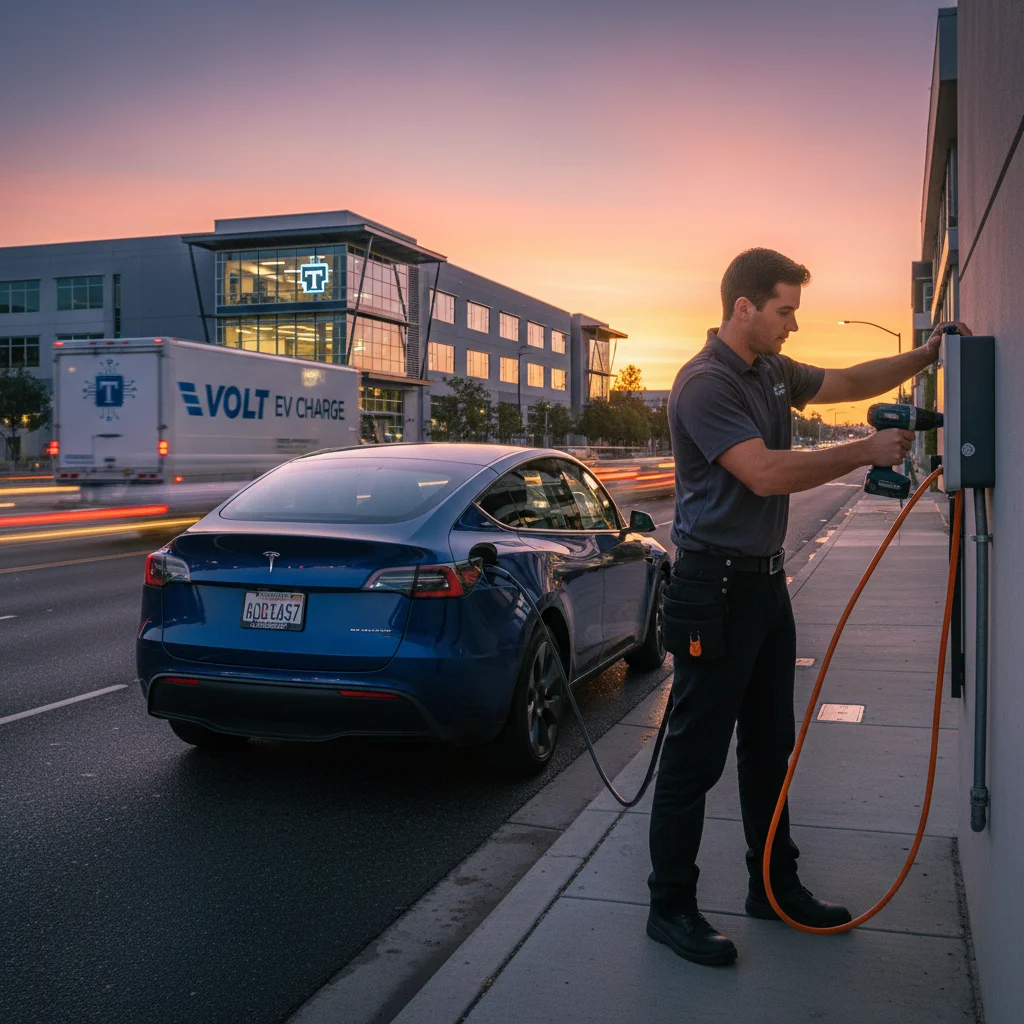
If the screens are dark and the doors won’t unlock, start with the 12V. The high-voltage pack can still hold miles. The small battery just stopped waking the car’s computers. That’s why a dead-looking EV often isn’t empty. Operators who jump a Tesla 12V can jump or replace it at the stall. They handle Tesla and every major EV brand.
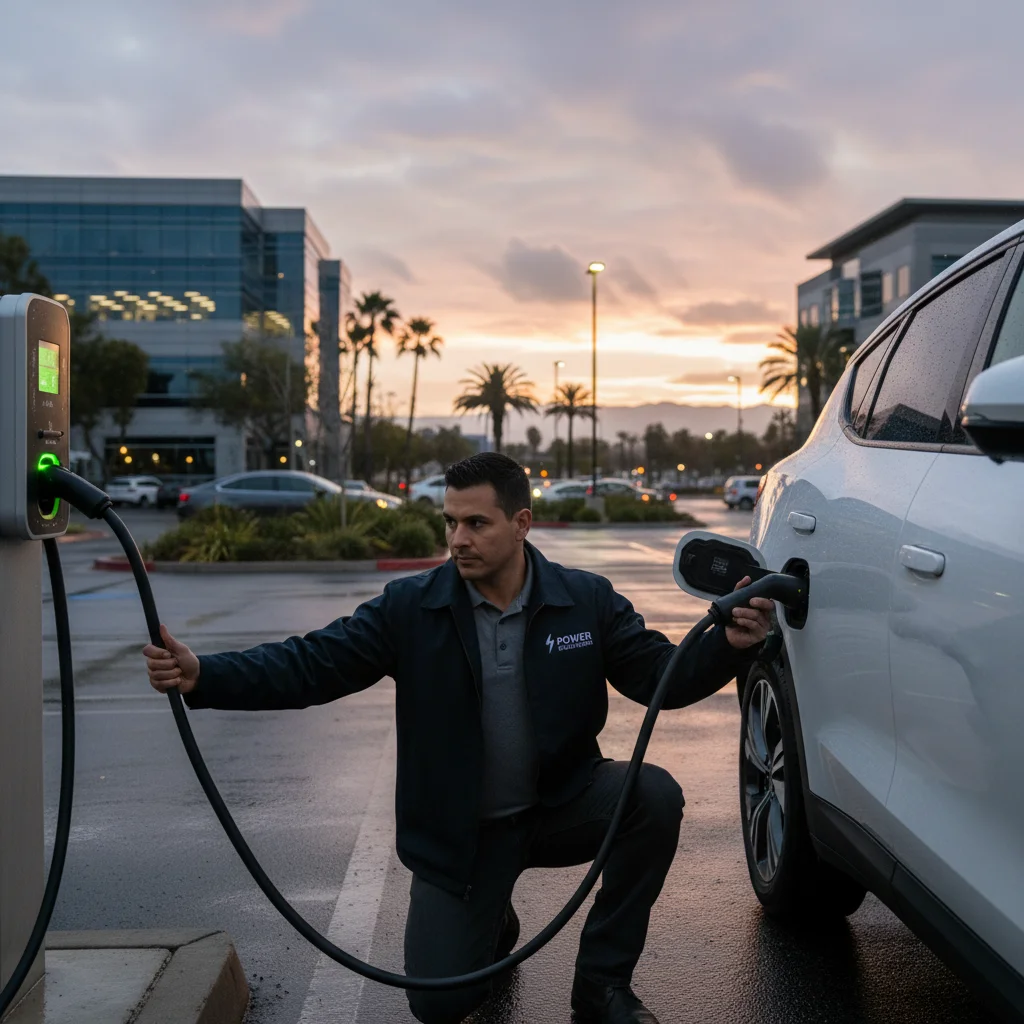
If the dash is awake and the range is gone, the pack is empty. A jump won’t add miles. You need energy in the drive battery, or a flatbed. Mobile EV charging brings a 240V Level 2 source to the car. Native NACS covers Tesla. CCS or J1772 adapters cover the rest. Fifteen to thirty minutes of charging typically adds 10 to 20 miles. That’s charging time on the car. It’s never an arrival time for the truck.
A tow is the last tool, not the first. Use it when you’re in a live lane and can’t sit. Use it when the pack is damaged. Use it when a charger can’t reach a safe spot. For the fuller tree, see charge it, jump the 12V, or tow it. Tell the operator what the dash shows. Don’t treat every brick the same.
Hazard lights with a locked drive still point at 12V a lot of the time. A low percentage you can actually read points at the pack. If you’re not sure, say both symptoms when you call. The operator will confirm the connector and the job before they start.
Studio heat and the Burbank commute
Burbank sits in the San Fernando Valley. It’s hotter than the coast and cooler than the desert. Census ACS 2019-2023 puts the city at 105,165 people. The 2024 Census estimate is 103,533. Valley summers run well above the basin. Cabin AC is a real range factor. Foothill edges add short grades after a long studio day.
The workday pattern is local. Cars sit for hours in the Media District. They sit in the studio district near the airport too. Then they hit the 5, the 134, or the 170 in the crush. Olive Avenue, San Fernando Boulevard, and Alameda Avenue carry the surface grind. Magnolia Park, Downtown Burbank, and Rancho fill driveways overnight. A pack that looked fine at lunch can come up short heading home.
This isn’t a marine-layer commute. Cooling runs harder here. Stop-and-go on those freeways cuts regenerative braking. You accelerate more than you coast. Remaining miles vanish without a long trip on the map. Nearby EV roadside assistance in Glendale follows the same Valley heat. Burbank adds the studio-lot sit and the airport week.
About 72.8% of Burbank housing was built before 1980, per ACS. Older homes often predate a dedicated Level 2 circuit. Burbank Water and Power runs the city’s own grid. This piece couldn’t confirm a current residential EV rebate by name. It also couldn’t confirm a named EV rate on the utility’s public pages. Confirm any home-charger program with Burbank Water and Power before you budget for one. Charge Pro LA doesn’t install home gear. A licensed electrician handles that work.
Lots, garages, and a private-property tow
Studio lots and airport garages are private property. A car that sits too long can get tagged. California Vehicle Code 22658 sets those tow rules. Entrances need the required 17-by-22-inch signs. The owner or agent has to authorize the tow in writing. If you return before the car leaves the lot, they have to release it. You may still owe at most half the tow charge. That’s if the car is coupled but not yet moved. Storage rates can’t exceed law-enforcement or CHP-approved rates. California doesn’t set one statewide tow price. Confirm the lot’s posted rules, and get the operator’s quote, before you pay.
An operator can work in a stall. You don’t have to push the car to a charger. They pull up next to the EV and plug in. That’s the point of EV roadside assistance here. You stay with the car. You skip a flatbed in a tight structure.
Hollywood Burbank Airport long-term parking is a 12V pattern. Travelers come back after a week to a brick. That’s often the 12V, not an empty pack. Charging maps for BUR lots were not confirmed for this piece. Check hollywoodburbankairport.com if you need a plug before you fly. A dead 12V still needs a jump. That’s true even if a charger sits in the same garage.
If you’re in a structure at Universal Studios instead, see dead EV at Universal Studios.
The 5, the 134, and the 170 when you’re already low
Out-of-charge stops show up on Burbank’s freeway grid. The Golden State Freeway (I-5) cuts through town. SR-134 runs east-west. SR-170 is the Hollywood Freeway leg. Get as far right as you can. Set your hazards. Stay with the car only if it’s safe.
California Vehicle Code 21718 bans stopping on a freeway, with exceptions. A disabled vehicle that’s already summoned help fits that exception. CVC 21809 is the move-over law. Other drivers must change lanes or slow for a stopped service vehicle with flashing lights. CVC 22651 lets an officer remove a vehicle left unattended on a freeway. Four hours is the freeway threshold in that section. Don’t walk away from a stalled EV on the 5 and assume it’ll wait.
Metro Freeway Service Patrol is free to motorists. It’s a joint program of Caltrans, the California Highway Patrol, and LA Metro. Dial 511 and say Motorist Aid. Published help includes a gallon of gas, a radiator refill, and a tire change. It also includes a free tow to a CHP-chosen safe spot. The published list does not include mobile EV charging. An empty pack sits outside that list. The free tow to a safe spot is the exception. That’s an observed absence from their materials. It isn’t a claim about a hidden policy.
Hours on FSP are typically weekday peak commute times. Coverage expands on some congested corridors and in construction zones. Confirm current hours through 511. Don’t plan an EV rescue around a gas-can patrol.
A Level 2 boost versus a flatbed
A flatbed solves a mechanical failure. An empty pack isn’t that failure. Loading a low-clearance EV in a crowded Media District structure is slow. You still have to get from the drop-off to home. If the 12V is the problem, skip the flatbed. A jump would have woken the car.
The operator brings energy to the stall instead. Ten to 20 miles is usually enough to keep driving. That’s a public DC stall or a home plug under your own power. Charge Pro LA doesn’t set prices. Ask for the quote before they start. They bill you directly.
For local context in this city, see EV charging in Burbank. Charge Pro LA serves every city in Los Angeles County. The brand doesn’t own trucks and doesn’t hold a trade license. The pros we connect you with are licensed and insured. West Hollywood, Beverly Hills, San Fernando, and Pasadena sit on the same county map. The Valley heat is Burbank’s version of the problem.
When to call Charge Pro LA
Call when the car won’t wake or the pack is empty. Call when you’re stuck on the 5, the 134, or the 170. Call from a Media District stall, a Magnolia Park driveway, or airport parking. We’ll match you with a local operator. They quote before they start, and they bill you directly. Call us at (858) 925-5546. We’ll connect you with a local EV rescue operator.