Tesla roadside, AAA, and Metro’s freeway patrol will all take a call from a stalled Glendale Tesla. They usually send a tow. A local mobile operator can add 10 to 20 miles on a 240-volt Level 2 lead, or jump a dead 12-volt, without hauling the car to a shop. That’s the split for Valley commuters who stall on the 2, the 134, Sepulveda Pass, or a hillside street in Verdugo Woodlands.
Glendale sits on the east edge of the San Fernando Valley. Census figures put the city at 192,270 people in the latest ACS count, and 187,823 in the 2024 estimate. About 70.7 percent of the housing stock went up before 1980. Glendale Water and Power runs the local grid. Southern California Edison doesn’t. That mix of older panels, foothill streets, and a three-freeway knot is why a Tesla can look fine at breakfast and refuse to move after work.
Why Valley Tesla commutes stall in Glendale
This city is hotter than the coast and cooler than the high desert. San Fernando Valley summers still run well above the basin. Cabin AC becomes a range cost, not a luxury. Recurrent Auto’s published tests show heat and heavy air-conditioning cut the miles you actually get. You feel that on Glenoaks and Central Avenue in July, not only on a mountain highway.
Grades finish the job. Adams Hill and Verdugo Woodlands sit above Downtown Glendale. Montrose and the La Crescenta edge keep climbing. A Model Y that left Burbank with a comfortable buffer can arrive on a hillside street with much less left. The 2/134/5 interchange stacks that drain onto short merges. You’re in stop-and-go while the pack is already working.
Westside jobs add Sepulveda Pass on the 405. That climb sits between the Westside and the Valley. You pay for it twice on a round trip. You drop toward the 134 with less left than you planned. The last miles home were already spent on the pass. If that’s where the warning hits, read Out of charge on the 405 at Sepulveda Pass: what to do before you sit in a live lane.
The Americana at Brand pulls heavy traffic on weeknights and weekends. Brand Boulevard crawls. A Tesla sitting in that idle still cools the cabin and runs computers. That’s when a weak 12-volt starts to fail. The main pack can still show a healthy percent. The car won’t unlock, won’t shift, and won’t take a charge command.
Empty pack or dead 12-volt
An out-of-charge Tesla is a high-voltage problem. The drive battery has nothing left to give. You need energy added at the car, or a proper flatbed. A jump pack on the 12-volt won’t refill a zeroed main battery. A neighbor with jumper cables can’t push enough energy through those clamps to move you.
A dead 12-volt is the opposite trap. The big pack may be half full. The small battery that wakes computers, latches, and contactors has dropped out. Teslas still use a 12-volt battery. Newer Model 3 and Model Y cars often use a lithium 12-volt instead of a lead-acid unit. Either way, a dead 12-volt makes the car act like a brick. Screens stay dark. Doors may not release the usual way. The charge port may not open.
Tell the dispatcher which one you’re looking at. A car at 0 percent on the last screen you saw needs a charge. A car that went dark in a garage after a long sit needs the 12-volt checked first. That split decides whether the operator brings a Level 2 lead or a jump.
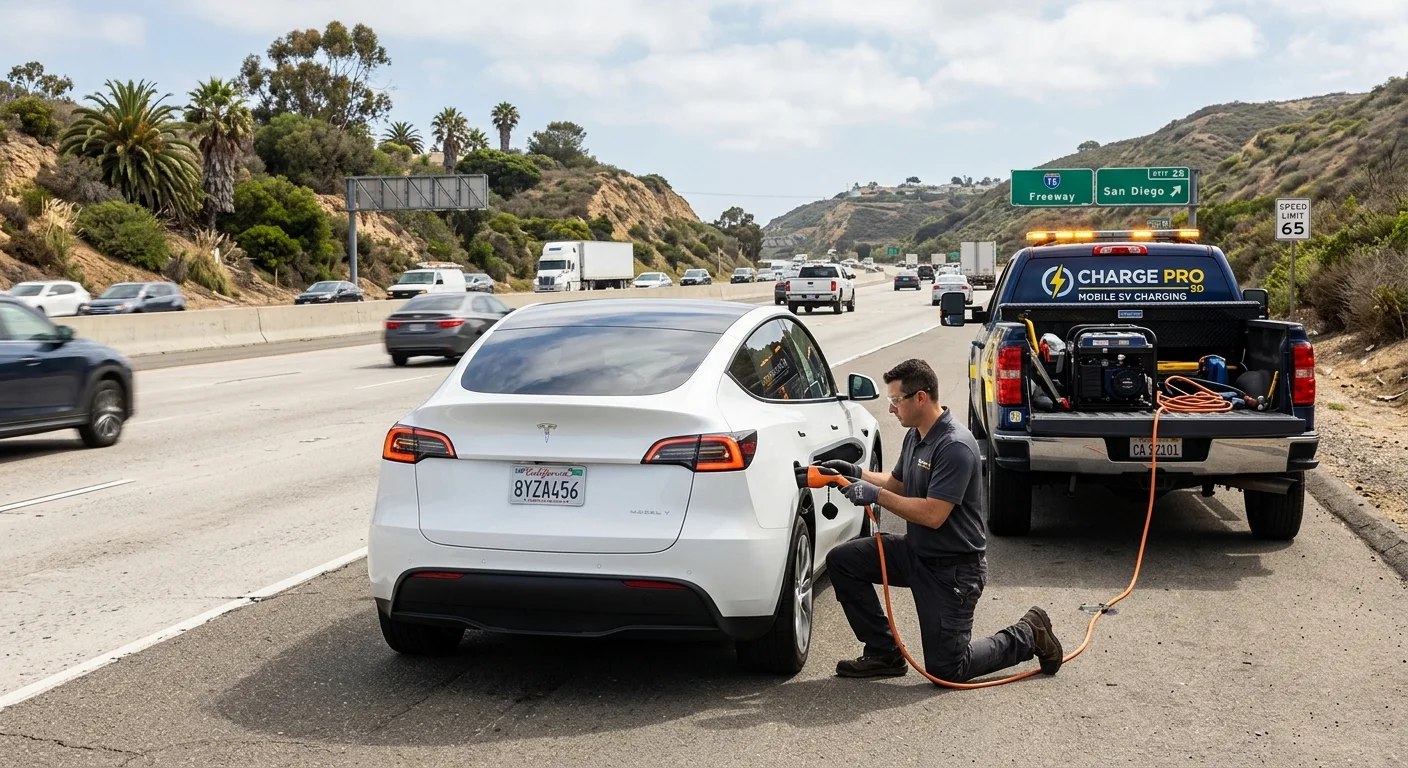
Operators the referral line sends can do both. They bring a 240-volt Level 2 source to the car. Teslas take a native NACS plug. Other EVs use a CCS or J1772 adapter. A typical on-site charge adds about 10 to 20 miles of range in 15 to 30 minutes of charging time. That’s charging time. It’s not a promise about when anyone arrives. They can also jump or replace a dead 12-volt on site. Tesla and every major EV brand are in scope.
What Tesla’s own roadside usually sends
Most owners tap Tesla roadside in the app first. That’s the official path. Tesla publishes the program as part of ownership. Coverage can be included for a stretch, then billed later, depending on the car and the plan. We don’t invent those terms here. Check the app and Tesla’s own policy for your VIN.
What the program tends to send is a contractor. The common outcome for a car that won’t move is a tow toward a Tesla Service Center. That can be the right call after a crash or a mechanical failure. It’s the wrong tool when the only problem is a 12-volt on Brand Boulevard. A short Level 2 boost is a different job.
A tow from Downtown Glendale or a 134 shoulder still has to load the car the right way. Teslas need a flatbed. Drive wheels can’t sit on a dolly the wrong way. Until the truck is actually loading, stay with the car if you can do it safely. Tesla roadside isn’t the same product as a mobile charge. Some dispatches end in a tow even when a boost would have been enough. That’s a coverage choice, not a verdict on your driving.
For a plain comparison of Tesla, AAA, and a local mobile rescue, see Tesla, AAA, or a local mobile rescue: how the three actually differ.
AAA and Metro Freeway Service Patrol
AAA still matters in Glendale. Plenty of Valley households keep the membership for tires, locks, and gas-car tows. An EV call is a different script. Many AAA contractors can jump a 12-volt. Fewer arrive with a 240-volt source and a NACS handle. If the contractor can’t charge the pack, the default is a tow. Ask what the truck is carrying before you accept the dispatch. AAA or a mobile charge: what actually gets an empty EV moving walks through that choice without the membership pitch.
On the freeway itself, Metro Freeway Service Patrol is the free truck you already see. Caltrans, the California Highway Patrol, and LA Metro run it. You reach it by dialing 511 and saying Motorist Aid. Published help is a gallon of gas, a radiator refill, a taped hose, a tire change, and a free tow to a CHP-chosen safe spot. Hours are typically weekday peak commute periods. Confirm current coverage on metro.net.
The motorist-assistance list doesn’t name mobile EV charging or an out-of-charge boost. An empty Tesla on the Glendale Freeway or the 5 can get moved off the lanes. It won’t get a Level 2 session from that patrol. That’s an observed absence in the published materials, not a knock on the program. FSP is built to clear gasoline incidents. Your EV still benefits from the free tow to safer ground if you’re blocking a lane. Once you’re off the freeway, you still need a charge or a 12-volt fix.
Glendale Water and Power and the older house problem
Most of Los Angeles County sits on Southern California Edison lines. Glendale doesn’t. Glendale Water and Power is the municipal utility. Burbank Water and Power and Pasadena Water and Power sit next door, each on their own grid. That doesn’t change who can rescue a stranded car. It does change how you think about plugging in after you get moving.
About 70.7 percent of Glendale housing was built before 1980. Many of those panels were never laid out for a dedicated EV circuit. Hillside homes in Verdugo Woodlands and Adams Hill add long runs and older subpanels. The car can die in the driveway when last night’s charge never started. That’s a house problem and a car problem at once. A mobile operator can still add enough range to reach a public stall. The operator doesn’t rewire your garage.
We don’t publish Glendale Water and Power rebate names or EV rates here. Confirm current programs on the utility’s own pages at glendaleca.gov/gwp. A stranded driver on Glenoaks doesn’t need a rebate form. They need the car to wake. City-level context lives on our Glendale EV charging page.
Where Glendale Teslas actually stop
Downtown Glendale and the Americana district fill parking structures. A Tesla can sit through dinner, a movie, and a valet line. The 12-volt can die even with range on the display. Heat in a closed garage makes that more likely. If the car won’t unlock, don’t force the charge door. Start with the 12-volt, then decide on a jump.
Brand Boulevard, Central Avenue, and Glenoaks are surface streets with real traffic. If you stall in a lane, hazards on, and get out on the safe side. California Vehicle Code 21809 is the move-over law. Other drivers must move over or slow for a stopped service vehicle with lights. You still shouldn’t stand in a live lane.
The 2, the 134, and I-5 are the freeway problem. California Vehicle Code 21718 bans stopping on a freeway except in defined cases. A disabled vehicle that’s already summoned help is one of those exceptions. Call first. Then stay as far right as you can. If CHP or Metro FSP offers a free tow to a designated spot, take the safer ground. You can still call for a mobile charge once you’re off the travel lanes.
Officers can remove a vehicle under CVC 22651 when it obstructs traffic or sits unattended on a freeway for four hours or more. Don’t leave a dark Tesla on the 134 overnight and assume it’ll be there in the morning. Private lots around the Americana can tow under CVC 22658. Read the entrance sign before you leave the car.
Hillside streets in Adams Hill, Verdugo Woodlands, Montrose, and the La Crescenta edge are a different kind of stuck. Grades drain the pack on the way up. Tight streets and private driveways make a flatbed awkward. A Level 2 boost at the curb is often the cleaner path when the only issue is range.
What a mobile Level 2 rescue actually is
Charge Pro LA is a referral line for Los Angeles County. We don’t own the truck. We don’t employ the technician. We don’t set the price. We match you with an independent local mobile rescue operator. That operator quotes you before any work starts and bills you directly.
The truck that shows up is a mobile Level 2 source, not a Supercharger on wheels. Superchargers are Tesla’s DC fast network. A roadside boost is 240-volt AC. It’s enough to get you to a public stall or home. It’s not a full charge for a weekend trip.
If the 12-volt is the failure, the operator can jump it on site. A jump that dies again on the next errand is a replacement conversation, not another jump. Repeated 12-volt failures mean the battery is at end of life, or something in the car is draining it. Get the car to a shop after you’re mobile.
Non-Tesla EVs in the same driveway get CCS or J1772. Glendale isn’t Tesla-only, even if this post is written for Tesla commuters. The same operator set handles both. For Tesla-specific dispatch, use Tesla roadside rescue. For a car that won’t wake, use Tesla 12V battery jump. For an empty pack on a Glendale street, mobile EV charging is the direct page.
If you’re already on the shoulder
Stay out of traffic. Put the hazards on. If you’re on the 2, the 134, or the 5, treat it as a disabled-vehicle stop under CVC 21718. Dial 511 for Motorist Aid if you need the free patrol tow off a live lane. Then decide whether you need a 12-volt jump, a Level 2 boost, or a flatbed.
Don’t accept a wheel-lift tow for a Tesla. Ask for a flatbed. Don’t let a well-meaning driver try to jump the high-voltage pack. You can’t charge one EV from another in any useful way with the cables in a trunk. That myth wastes time on Glenoaks.
Call (858) 925-5546 when you want the referral line to connect you. The operator quotes before starting. No one here can promise when the truck arrives. Traffic on the 134 at the Americana is its own weather. What we can do is put a local EV operator on the problem instead of a gas-can patrol that was never built for your car.