Three numbers sit in a Tesla owner’s phone in Los Angeles County. Tesla’s own roadside, AAA, and a local mobile rescue aren’t the same job. Treating them as one plan is how you sit on the 405. The car still won’t move.
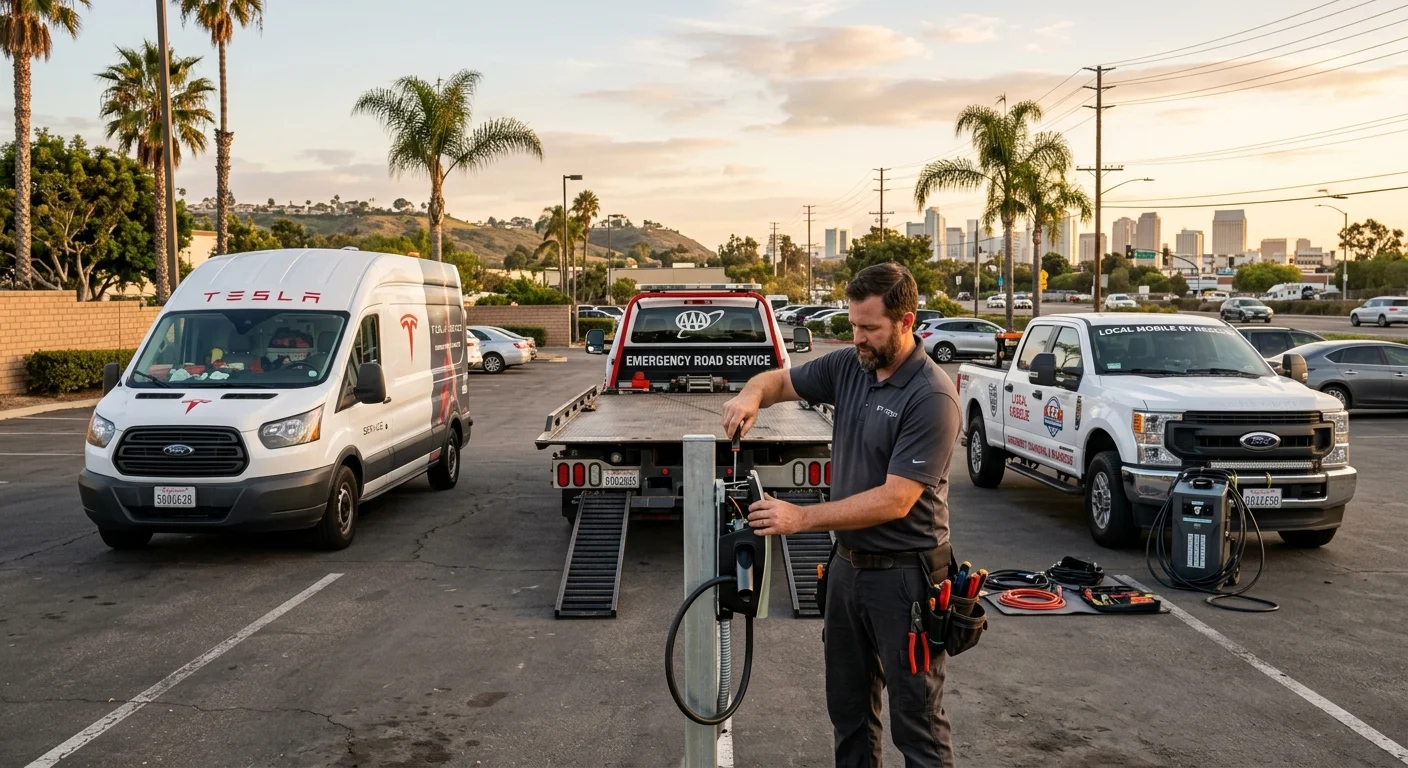
The query “best roadside assistance for Tesla” wants a single winner. There isn’t one. Tesla’s program knows the car. AAA knows long tows. A local mobile operator brings 240-volt Level 2 power to the bumper. Charge Pro LA is a referral line. We match you with an independent operator. That operator quotes you before any work starts, then bills you directly. Hold that split in mind as you read.
Name the stall before you name the company
A Model Y that won’t wake in a Santa Monica garage is often the 12V. The drive pack can still be full. A Model 3 can hit zero on the 5 north of Santa Clarita. That’s an empty pack, not a 12V. A tire off the rim on PCH in Malibu needs a different truck.
Call the wrong program and you get the wrong tool. Tesla may route you toward a Supercharger tow. AAA may send a contracted truck built around gas cars. Metro’s Freeway Service Patrol will hand a gasoline driver a gallon of fuel. It won’t charge an EV. That’s an observed absence on Metro’s published motorist list, not a guess.
Name the failure first, then pick the number.
Tesla factory roadside: factory knowledge, factory path
Tesla’s factory roadside comes with a new car. It runs with the warranty window. The people on that line know Tesla diagnostics. They can walk you through a 12V, a lockout, or a tire. If the car can’t be fixed on the spot, they arrange a tow. That tow heads toward a Tesla service center.
That help is real. It’s also a factory program, not a Los Angeles County dispatch desk. It doesn’t live on the 405, the 10, or the Grapevine north of Castaic.
For an empty pack, Tesla’s common path is a tow to a Supercharger. It’s not a mobile Level 2 boost at the bumper. You leave the shoulder and sit at a stall. Coverage is time-limited or mileage-limited on older cars. Once that window closes, Tesla roadside is a paid add-on, or it’s gone.
Factory knowledge is the strength. Miles delivered at the car isn’t. For what the program actually includes, read What Tesla roadside assistance covers when you stall. A lockout or a warranty diagnostic is a good Tesla call. An empty pack on Sepulveda Pass is a weaker fit. The car needs energy where it sits.
AAA: the tow network, with an EV add-on
AAA is a membership and a contractor network. Premier towing distance is why people keep the card. If a Tesla has to leave Los Angeles County for a shop, that network is the point. A local Level 2 truck won’t replace a long flatbed.
The EV add-on is AAA’s answer to empty packs and 12V failures. In many areas it can dispatch a mobile charge instead of only a tow. Training on EV 12V systems has improved. The person who shows up is still often a contracted provider. They’re not an AAA employee. EV skill follows that contractor.
AAA is the wide net. It’s not a promise that a Level 2 truck is waiting where you’re sitting. For the empty-pack fork, see AAA or a mobile charge: what actually gets an empty EV moving. Keep AAA if you want prepaid towing muscle. Don’t keep it as your only plan for a pack at zero. A tow to a charger is still a tow.
A local mobile rescue: power at the bumper
A local mobile rescue is a truck with a 240-volt Level 2 source. The operator comes to the car. Native NACS for Tesla. CCS or J1772 adapters for other EVs. Typical on-site charging adds 10 to 20 miles of range. That takes 15 to 30 minutes of plug time. That’s charging time, not a claim about when the truck arrives.
The same operator can jump or replace a dead 12V on site. That stall looks like a dead pack. It often isn’t. Doors won’t unlatch and the app goes mute. The high-voltage battery can still have range left.
Charge Pro LA doesn’t own that truck. We don’t employ the technician. We don’t set the price. We connect you with an independent local operator. The operator quotes you before starting. The operator bills you directly. That’s how Tesla roadside rescue works in this county.
The limit is scope. This isn’t a long-haul tow across three counties. If the car needs a flatbed after a hit, start with AAA or Tesla’s tow path. If the car needs enough range to leave a shoulder, a Level 2 boost is the tool. Operators in this network handle Tesla and every major EV brand.
Free freeway patrol won’t charge a Tesla
Metro Freeway Service Patrol roams congested Los Angeles County freeways. Caltrans, CHP, and LA Metro run it. It’s free. Dial 511 and say Motorist Aid.
What they publish is built for gasoline cars. A gallon of gas, a radiator refill, a taped hose, a tire change. They’ll also tow you free to a CHP-chosen safe spot. Hours are typically weekday peak commute, plus construction zones. Midday and weekend coverage is expanding on the busiest corridors.
What they don’t list is mobile EV charging, or any out-of-charge battery help. An empty Tesla on the 110 sits outside that list. FSP can still move you off the lanes. It won’t put miles back in the pack.
If you’re already on a freeway, Vehicle Code 21718 lets a disabled car stay put. The condition is that you’ve already summoned help. Vehicle Code 21809 is the move-over law. Other drivers must change lanes or slow for flashing lights on a stopped service vehicle. Put your hazards on. Stay out of the travel lanes. CHP can still remove a car left unattended on a freeway for four hours or more. That’s Vehicle Code 22651. Call before that clock becomes the story.
Metro ExpressLanes on the 10 and the 110 need a funded FasTrak account. A stall inside those lanes is a bad place to wait. Don’t assume a patrol truck will charge you there.
This county isn’t one commute
A dead Tesla in Santa Monica is often a garage 12V, not a mountain grade. Parking structures still kill 12V batteries that sit for days.
A dead Tesla in Lancaster is heat, cold, and a long run on the 14. Cabin climate control is what eats range. Recurrent Auto tested 30-plus models. EVs kept about 78 percent of range at 32F, and about 70 percent at 20F. Cabin heat is the main driver. Antelope Valley nights get near freezing. Summer air conditioning cuts range the other way. Those are fleet averages, not Tesla-specific numbers.
The Grapevine north of Castaic is the county’s defining grade. Sepulveda Pass on the 405 is the daily climb between the Westside and the Valley. An empty pack on either is a different call. A 12V that died after a week in LAX parking is another. Los Angeles World Airports publishes Level 2 and DC fast charging in terminal structures P1 through P7. The Economy garage lists 514 active EV chargers. A 12V still dies in the dark. Chargers in the garage don’t wake a car that won’t unlock.
Downtown, the Eastside, Long Beach, and the San Fernando Valley don’t share one utility or one grade. LADWP serves the City of Los Angeles. Most of the rest of the county is Southern California Edison territory. Glendale, Burbank, Pasadena, and Azusa run municipal power. None of that changes who you call from the shoulder.
For the county-wide sequence, start with EV roadside assistance in Los Angeles when AAA isn’t enough.
Who quotes you, and who you pay
This is the part membership cards hide. Tesla roadside, while you’re in the included window, is Tesla’s program. You’re not negotiating a curb quote with a stranger. AAA is prepaid membership, and you still may meet a contractor. The EV add-on isn’t a blank check for every job.
A local mobile rescue through Charge Pro LA is a job quote. The operator tells you the quote before any clamp goes on. You accept or you don’t. They bill you. We don’t. That’s why how mobile EV charging gets quoted in Los Angeles County matters more than a slogan about coverage.
If you only want one number
Keep Tesla’s line for warranty diagnostics, lockouts, and a tow to a Tesla shop. Keep AAA if you want a long tow inside the membership. Keep a local mobile rescue number for an empty pack or a dead 12V. That last pair is what actually strands most Teslas in this county.
You don’t need all three on one stall. You need to know which failure you have. If the screen is dark and the app can’t wake the car, start with the 12V. If the car still drives but the range hit zero, you need energy at the bumper. You don’t need a jump. If a tire is shredded, Tesla or AAA may be the cleaner path.
Tesla-only means factory knowledge and a likely Supercharger tow when you’re empty. AAA-only means towing muscle and a contractor whose EV truck may or may not be next. Local-mobile-only means on-site Level 2 and 12V help inside Los Angeles County. You pay the operator for that job. None of those three is a shop repair.
Make the call from the shoulder
Hazards on. Out of the travel lane if you can. Vehicle Code 21718 covers a disabled car that has already asked for help. Don’t walk the 405.
Then say the true thing to whoever picks up. Empty pack, dead 12V, tire, or the car needs a shop. If you need a mobile Level 2 boost or a 12V jump in Los Angeles County, call (858) 925-5546. We connect you with a local operator. That operator quotes you before starting, and bills you directly.