When your electric car died on a Los Angeles County freeway, law comes first. California Vehicle Code 21718 already covers a disabled EV waiting for summoned help. That’s an exception to the freeway stopping ban. You call for assistance, then you stay put. After that you still pick a charge, a 12V jump, or a tow.
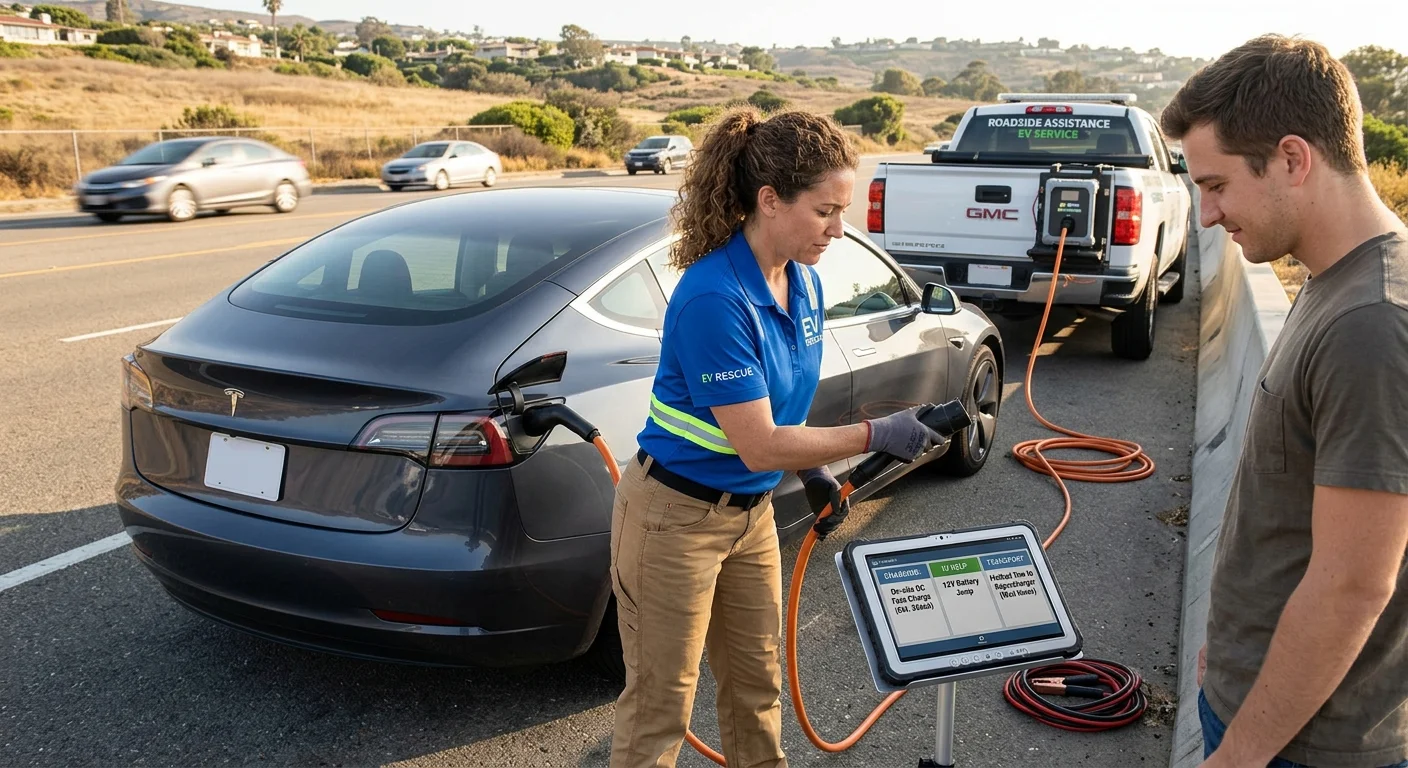
Call for help before you start diagnosing
CVC 21718 bans ordinary stopping, parking, or leaving a vehicle standing on a freeway. The disabled-vehicle exception is the one that applies here. It fits when another vehicle has been summoned to render assistance. It also covers avoiding injury or damage, and a stop a peace officer directs.
Call first, then wait in a protected spot if you can reach one. Don’t push the car into a live lane. Don’t pull battery covers from a forum post.
CVC 21809 is the move-over law. Drivers must change lanes or slow for a stopped emergency vehicle. The same rule covers a tow truck or Caltrans vehicle with lights on. That rule protects you on the shoulder.
CVC 22651 lets an officer remove a car left unattended on a freeway for four hours or more. Stay with the car if you can do that safely. Don’t treat the shoulder as overnight storage.
What Metro’s freeway patrol will actually do
Metro Freeway Service Patrol is run by Caltrans, CHP, and LA Metro. It’s free to motorists on congested county freeways. Hours are typically weekday peaks, with extra coverage on some corridors. You reach it by dialing 511 and saying Motorist Aid.
The published FSP list is written for gasoline cars. It names a gallon of gas, a radiator refill, and a taped hose. It also names a tire change and a free tow to a CHP-chosen safe spot. It doesn’t name mobile EV charging or an empty-pack boost. If the traction battery is at zero, FSP can still clear you off the freeway. The materials we checked on metro.net and chp.ca.gov don’t offer a charge. That’s a different job from an independent mobile operator.
Read the screens before you pick a service
“Died” is a symptom, not a diagnosis. An empty drive battery and a dead 12V can look alike from the curb. An unknown fault can look the same, and they need different help.
Start with the displays, not with a theory. Read every warning word for word. Note whether the cluster, cabin lights, locks, phone app, or charge port still respond. If a percent or range figure is showing, report it as shown. Say whether the car quit while moving or refused to wake after a park.
A clear empty-pack warning supports talking about out-of-charge recovery. Dark glass and dead locks push the conversation toward the 12V. That still isn’t a green light to jump it yourself. Access points and approved steps change by make, model, and year.
Use the owner’s manual for this exact vehicle. Check the roadside, 12V, towing, and charging chapters. If you don’t have the manual, say so before anyone connects a lead. Our 12V failure guide helps you describe the symptoms. It can’t name which battery failed in your car. The operator and the manual decide the work.
Put the stop on a real county map
A useful pin is specific. “Northbound 5 approaching Santa Clarita” beats “somewhere up the Valley.” The same goes for the 405 at Sepulveda Pass. Name the 10 through El Monte or the 110 Harbor Freeway. The East LA Interchange needs the same precision. Name the direction and the nearest exit or cross street.
If you’re in Santa Clarita before the Grapevine, say so. The same goes for PCH in Malibu or the 210 in Pasadena. If you stopped in Metro ExpressLanes on I-10 or I-110, say that too.
Describe the setting without walking into traffic. Lane, shoulder, surface lot, driveway, curb, or garage all change the plan. Mention gates, height limits, tight ramps, or a security booth. The operator needs to know whether a service vehicle can legally reach you. If CHP or FSP is already managing the scene, their directions outrank phone troubleshooting.
LAX terminal structures P1 through P7 offer Level 2 and DC fast charging. The Economy Parking garage has more than 4,000 stalls, including 514 active EV chargers. A dead 12V isn’t an empty pack, even in a lot that has chargers.
Three branches after the car is safe
“My electric car died” is a starting point, not a work order. The right branch depends on confirmed symptoms and the manual. It also depends on whether a truck can reach the car.
Charge when the traction pack looks empty
Talk charging when the drive battery looks depleted and the car is otherwise intact. Give the displayed percent, warning text, make, model, year, and port state. The operator then checks whether mobile EV charging can happen at that stop.
Don’t assume the plug. Tesla cars often take a native NACS lead. Many other brands need CCS or J1772. The operator quotes you before starting and bills you directly.
A Level 2 boost typically adds 10 to 20 miles of range. That usually takes 15 to 30 minutes of charging. That’s charging time, never an arrival time. It can be enough to reach a public stall. It isn’t a full recharge.
Charging isn’t always the fit. The car may not accept power. The shoulder or garage may be unreachable. The fault may have nothing to do with stored energy. Weigh that fork in on-site EV charging or a tow. Heat, grades, and cabin climate all spend pack on Antelope Valley and Grapevine runs.
Jump only after the 12V is in play
Discuss a jump only after low-voltage trouble is actually on the table. Dark screens and silent locks are clues, not proof. The operator should match those clues to the manufacturer’s steps.
Don’t copy a jump sequence from another model. Don’t lift a floor panel because a forum said to. Read whether roadside help can jump an EV. Then follow the operator and the manual.
The 12V runs computers, contactors, and door hardware. The big pack can still hold plenty of energy. The car can still act like a brick. That’s common after a long sit, including airport parking. It’s a different job from filling an empty traction battery.
Tow when the curb isn’t the right shop
Transport belongs in the first talk when on-site work doesn’t fit. That includes an unknown cause or a truck that can’t reach the car. Some manufacturer messages require a flatbed, not a curb-side boost.
Don’t coach a tow driver on dollies or parking pawls. Don’t invent a release procedure unless the manual says so. Hand them the towing chapter. CHP can dispatch a rotation-list tow for a disabled freeway vehicle. City of Los Angeles impounds run through Official Police Garages. Confirm release steps with LAPD or the garage before you pay.
California doesn’t publish one statewide tow-price cap we could verify. Non-consensual private-property tows are constrained by CVC 22658. Confirm the current figure with the company on scene.
What to put on the first call
Lead with make, model, year, and the exact dash text. Then say what happened right before the car quit. Parked, plugged in, or rolling on a named freeway are all useful. Stick to what you saw. If you see impact, smoke, or unusual heat, call emergency services first.
Gated buildings, underground ramps, paid lots, and workplace security change the plan. Say whether you have the keys. Say whether someone who can authorize service is standing there.
Charge Pro LA’s a referral line. We match stranded drivers with independent local mobile rescue operators. We don’t hold a contractor license, own trucks, or perform the work. The pros we connect you with are licensed and insured. They quote before they start.
Our EV roadside assistance page covers the referral when a car won’t move. We serve every city in the county. The customer contracts with the operator and pays that operator directly. We don’t set the price or promise when someone arrives. Ask the operator to confirm scope, current price, and payment terms. Confirm credentials and any warranty before you authorize work.
If the cause is still unknown, say that. If the first service can’t finish, ask what the manufacturer wants next. Don’t authorize a second battery procedure from a generic article.
Call (858) 925-5546 when the car has stopped or won’t wake. Call if it shows a message you can’t classify. We’ll connect you with a local operator. That operator decides whether a charge, a 12V jump, or a tow fits.