A mobile EV charger truck carries 240V Level 2 power to a stranded EV. The operator brings a native NACS plug for Tesla. CCS or J1772 adapters cover the other major EV brands. They quote the job on site before they start charging. Typically it adds 10 to 20 miles in 15 to 30 minutes of charging. That window is charging time, never an arrival time.
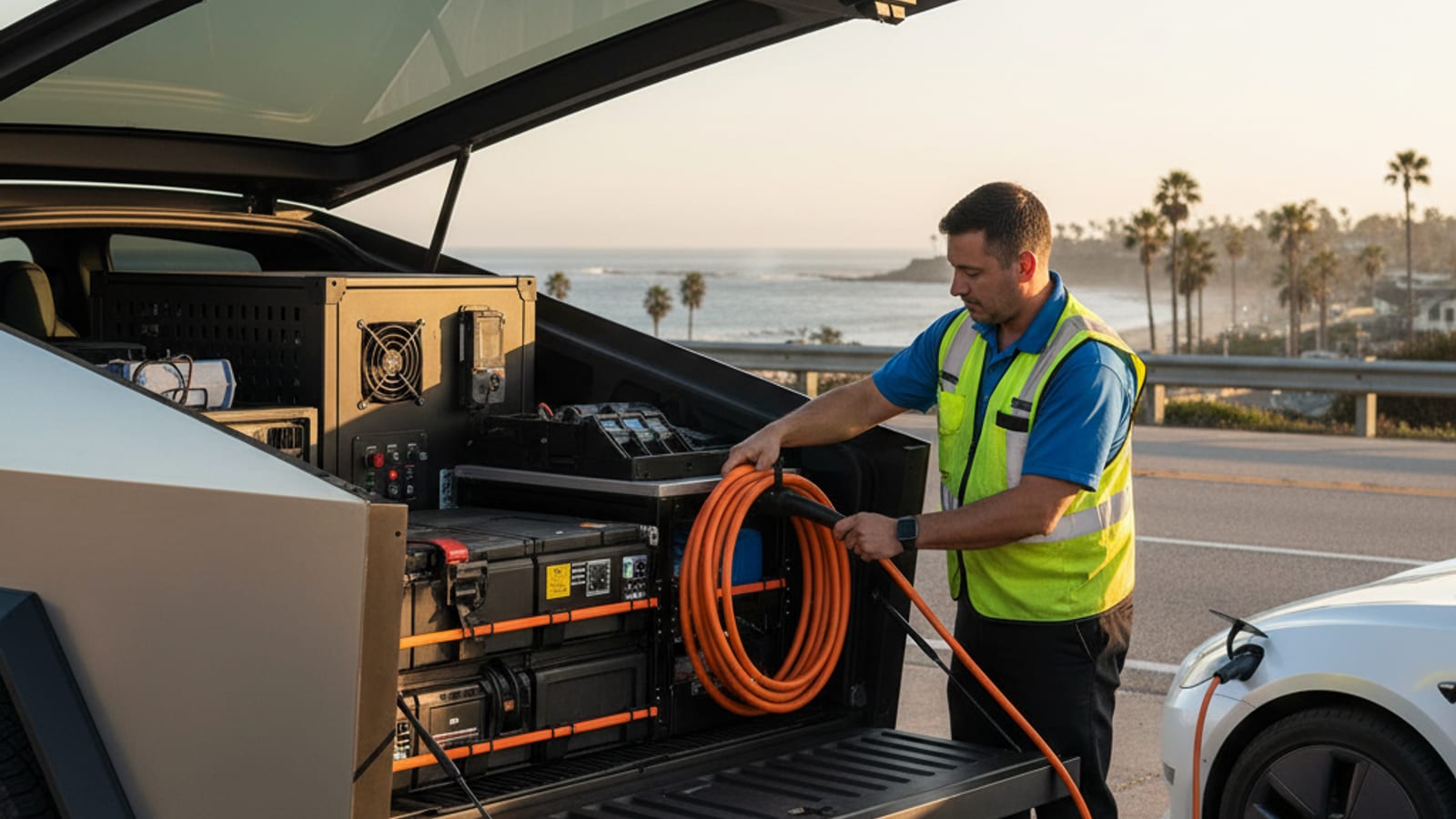
What’s actually sitting in the bed
Most people picture a generator and a random cord. The working kit is narrower than that. The operator’s vehicle holds a 240V Level 2 source in the bed. That’s the same voltage class as a home wall unit. It isn’t a household 120V outlet. Cable, adapters, and 12V jump gear ride with it. Cones and warning lights ride too, because this work happens on live pavement.
The truck doesn’t replace a Supercharger. It doesn’t refill a pack for a weekend trip. It exists to put enough energy back so you can leave the shoulder. After that, you pick a public stall on your own terms.
Plugs, adapters, and what they fit
Tesla charge inlets take NACS. Most other EVs take CCS or J1772. The operators we connect you with carry all three. The stop isn’t a brand guess. A Model 3 or Model Y on the 405 uses the native NACS plug. A Hyundai, Kia, Ford, Chevrolet, or Rivian uses the matching adapter. You don’t need to own that adapter. The operator brings it and confirms the inlet before the cable locks.
Port doors stick after rain, heat, or a weak 12V. A 12V that’s already weak won’t release the pin. If the port won’t open, say so on the call. Charging can’t start until the door and latch behave. Keep the key fob close and try the in-car release. Use the car’s manual release if you know the location. Then let the operator look at it with you on scene.
The 12V kit riding next to the charger
A lot of “dead EV” calls aren’t an empty drive pack. The 12-volt battery runs computers, locks, and lights. It also closes the contactors that wake the high-voltage pack. When that small battery fails, the car acts like a brick. The main pack can still hold plenty of energy. The operator checks which failure you actually have. They do that before they reach for the charge cable.
That mix shows up hard at airports. Los Angeles International’s terminal structures P1 through P7 offer Level 2 and DC fast charging. The Economy Parking garage has 514 active EV chargers. That garage holds more than 4,000 stalls in total. A traveler can still return to a car that won’t wake. Days of sitting can kill the 12V. That happens even when chargers sit in the same structure. The truck’s job that afternoon is often a 12V jump, not a pack fill.
The same pattern hits studio lots in Burbank. Event parking in Inglewood does it too. So do long stays at Universal Studios Hollywood. Griffith Observatory parking adds a hill on the way back down. If the dash is dark, start with the 12V story. If the dash is on and the pack reads zero, start with Level 2.
How the stop actually runs
Charge Pro LA is a referral line. We match stranded drivers with independent local mobile rescue operators. We don’t own the truck or the equipment on it. We don’t employ technicians and we run no fleet. We don’t set prices and we don’t publish an arrival window. The operator who comes to you quotes the work, then bills you directly.
Lights, the shoulder, and the quote
If you’re on a freeway, stay belted in the car when that’s safer. California Vehicle Code 21718 covers a disabled vehicle on a freeway. The exception applies when you’ve already summoned help. CVC 21809 is the move-over rule. Other drivers must move to a non-adjacent lane if they can. If they can’t, they must slow to a reasonable speed. The operator still works as if nobody will move over. Expect an amber light bar and cones.
Then comes the step people skip in their heads. The operator quotes the job on site. You accept the quote, or you don’t. How quotes get built in this county is its own walkthrough. We published that as how mobile EV charging gets quoted in Los Angeles County.
Private lots have their own tow rules. CVC 22658 covers removal from private property. The owner can reclaim the car before it leaves the lot. A charging stop in a garage is still your car sitting in someone else’s stall. If a lot attendant is already circling, tell the operator as soon as they arrive.
What the cable actually delivers
Once you agree, they connect 240V Level 2. This isn’t DC fast charging. It won’t refill a long-trip pack on the shoulder. It’s a rescue boost, not a full fill. Most stops add about 10 to 20 miles of range. That takes 15 to 30 minutes of charging. That’s usually enough to leave the freeway. It can also reach a public stall you already meant to use.
Heat, cabin climate, and a climb spend that boost faster than a flat cruise. Recurrent Auto’s published testing is the source here. EVs keep about 78% of range at 32F, on average. Cabin heat is the main drain in the cold. Air conditioning in summer cuts range too. The Antelope Valley runs hotter than the coast in summer and colder in winter. The San Fernando and San Gabriel Valleys run hotter than Santa Monica or Redondo Beach. Plan the next plug with that in mind, not with the window sticker.
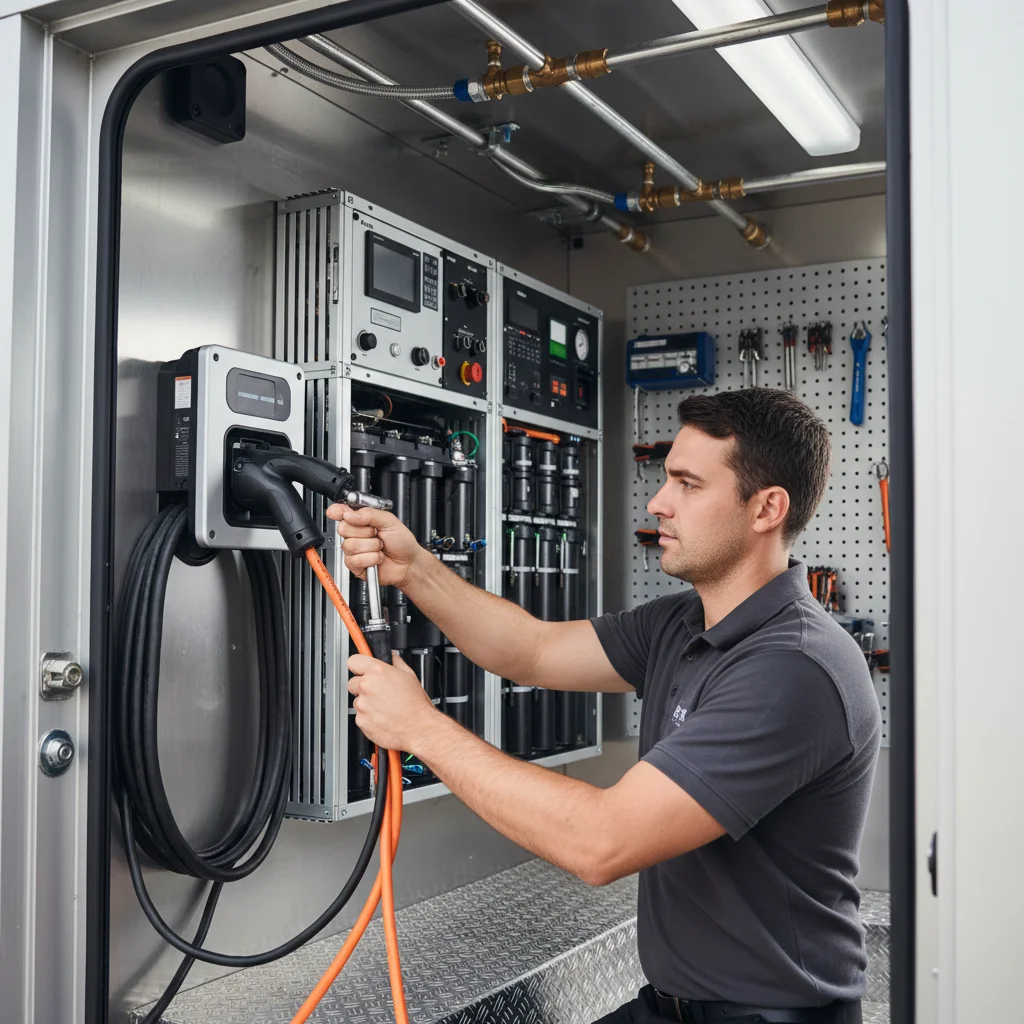
Where these trucks get used in Los Angeles County
The county isn’t one commute with a city name swapped. Coastal Westside traffic spends a pack one way. Valley grades and heat spend it another way. San Gabriel Valley heat is its own drain. Gateway City surface streets add stops and idling. High-desert miles in Lancaster and Palmdale spend range in the heat. A mobile EV charger truck shows up in all of those settings. That’s because the car stopped there. It isn’t a claim that the map is empty of plugs.
Grades, passes, and the long north climb
The I-405 climb through Sepulveda Pass sits between the Westside and the San Fernando Valley. A pack that felt fine in Santa Monica can sag on the way up. Culver City drivers see the same fade on that climb. The I-5 grade north of Castaic is the Grapevine. It’s the county’s long EV-range corridor. Drivers leaving Santa Clarita or Stevenson Ranch feel that pull in the first miles. The 14 toward Acton, Palmdale, and Lancaster stacks heat and elevation on top of distance. PCH through Malibu adds slow traffic. There are few places to pull over when you’re already low.
None of that is a claim about missing stations. It’s a claim about physics. Grade and climate control spend the last miles fast. A late merge can take them before you wanted them gone. The truck meets you on that shoulder. A wrecker doesn’t have to be the first tool. For the pass itself, read out of charge on the 405 at Sepulveda Pass. The Grapevine case is empty pack on the Grapevine north of Castaic.
Metro ExpressLanes run on the I-10 and the I-110. A FasTrak transponder tied to a funded account is how those lanes work. A stalled EV in a toll lane is a traffic problem first. Get to a safe spot if you can, then call. Don’t sit in a live express lane hoping the pack recovers.
Garages, harbor streets, and older panels at home
Downtown structures, West Hollywood street parking, and Culver City office garages hide a parking problem. You can’t always occupy a public stall until the car is ready to roll. Harbor streets in Long Beach and Carson add another wrinkle. So do industrial blocks in Commerce and the Eastside. Delivery windows and yard gates don’t wait on a public charger queue.
Housing age changes the home side of the same story. In the City of Los Angeles, about 71% of housing was built before 1980. East Los Angeles is higher, at about 86%. Whittier and Lakewood sit near 89%. A lot of those panels were never set up for a home Level 2 circuit. Owners in those neighborhoods often charge at work or at a mall. Some don’t charge at home at all, then stall on a weeknight.
LADWP serves the City of Los Angeles. It’s the largest municipal utility in the United States. It publishes EV charger rebate and time-of-use programs on ladwp.com. Southern California Edison delivers power across most of the rest of the county. It publishes its own home-charger and used-EV rebate pages. Glendale, Burbank, Pasadena, and Azusa each run a municipal utility. Those cities have their own grids and their own programs. Clean Power Alliance buys generation for many member cities. That list includes Santa Monica, Culver City, and Beverly Hills. West Hollywood, Calabasas, and Agoura Hills are on it too. SCE still delivers the electrons and reads the meter. None of that billing split changes a roadside rescue. It does explain why home charging isn’t a plan on every street.
What Metro’s freeway patrol actually brings
Metro Freeway Service Patrol roams congested Los Angeles County freeways. It’s a joint program of Caltrans, the California Highway Patrol, and LA Metro. The help is free to motorists. You reach it by dialing 511 and saying “Motorist Aid.” Published assistance includes a gallon of gas. It also covers a radiator refill, a taped hose, and a tire change. The patrol can tow you free to a CHP-chosen safe spot. Coverage is typically weekday commute peaks. Hours expand on the most congested corridors and in construction zones.
FSP’s published motorist list doesn’t name mobile EV charging or an empty-pack boost. An EV sitting at zero is outside that menu. The exception is the free tow to a safe location. That’s an observed absence from the published materials. It isn’t a guess about a hidden policy. That’s why drivers call a mobile EV charger truck. A gallon of fuel can’t go in the car. If a tow is truly the safer call, start with that comparison. We laid it out in when a stalled EV needs a charge instead of a tow.
CHP can also rotate a tow for a disabled vehicle on the freeway. CVC 22651 lists when an officer may remove a vehicle. A freeway sit that lasts more than four hours is on that list. Calling for help early isn’t just comfort. It’s how you stay inside the disabled-vehicle exception instead of becoming a removal.
What a mobile EV charger truck is not
It’s not a tow truck, even when it has lights and a bed. Towing an EV the wrong way can stress the drive unit. Charging in place avoids that move. It isn’t a shop repair. A failed onboard charger won’t be fixed on the shoulder. Neither will a damaged inlet or a pack fault. The operator will tell you if the car won’t take current.
It isn’t the suitcase Level 1 unit in a trunk. A 120V travel charger trickles through a wall outlet over many hours. It isn’t a tool for a live freeway shoulder. It won’t add range on a useful clock. The operator’s 240V Level 2 source is a different class of equipment. For the voltage math, EV charging levels for stranded drivers is the straight walkthrough. The broader explainer is what’s an EV charging truck.
The operators we connect you with do mobile EV charging as the core job. They also handle Tesla and non-Tesla 12V no-starts when that’s the real fault. They don’t speak for Tesla roadside, AAA, or your insurer. Those programs have their own dispatch rules and their own limits.
What to tell the operator when you call
Have the make, model, and approximate year. Say whether the dash is dark or the pack percentage is sitting at zero. Share the nearest freeway, exit, or cross street. A downtown garage is one staging problem. The East LA Interchange is another. A Long Beach harbor street is a third. A Malibu PCH pull-out is a fourth. If you’re in a structure, name the level. Give the nearest stall number you can see. If you’re on the 10, the 60, or the 57, say your direction. Do the same on the 110 or the 405.
Don’t sit in a live lane to “save the battery.” Keep hazards on, as far right as you can get. If CHP or a patrol truck arrives first, tell them. Say you’ve already called for EV help. CVC 21718 is on your side once assistance is on the way. They may still want the car moved. Cooperate, and pass the new pin to the operator.
Charge Pro LA serves Los Angeles County. Independent operators cover the cities on our map. That runs from Santa Monica and Manhattan Beach to Pomona. Lancaster, Palmdale, Glendale, Pasadena, and Long Beach are on it too. When you’re ready, call (858) 925-5546. The operator quotes on site. You decide before the cable goes in.
Frequently asked questions
What plugs does a mobile EV charger truck bring?
Operators bring 240V Level 2 with a native NACS plug. CCS or J1772 adapters cover non-Tesla EVs. You don’t supply the adapter. Tesla, Rivian, Ford, Hyundai, and Kia are in that mix.
How much range does the boost add?
Typical charging adds about 10 to 20 miles in 15 to 30 minutes. That’s charging time on scene, not a travel estimate. Heat, hills, and climate control can spend it faster.
Is this the same as Metro freeway patrol?
No, it isn’t the same service. Freeway Service Patrol is free and built around gas, tires, and a short tow. Its published list doesn’t include EV charging. A mobile EV charger truck is a separate, quoted stop.