Your EV roadside assistance in Culver City starts on the curb. It doesn’t start at a shop. If the car dies on the 405, the 10, or SR-90, stay put. You need energy brought to the vehicle. Culver City sits on the south side of the Sepulveda Pass approach. A pack that looks fine on Washington Blvd can fail on that climb.
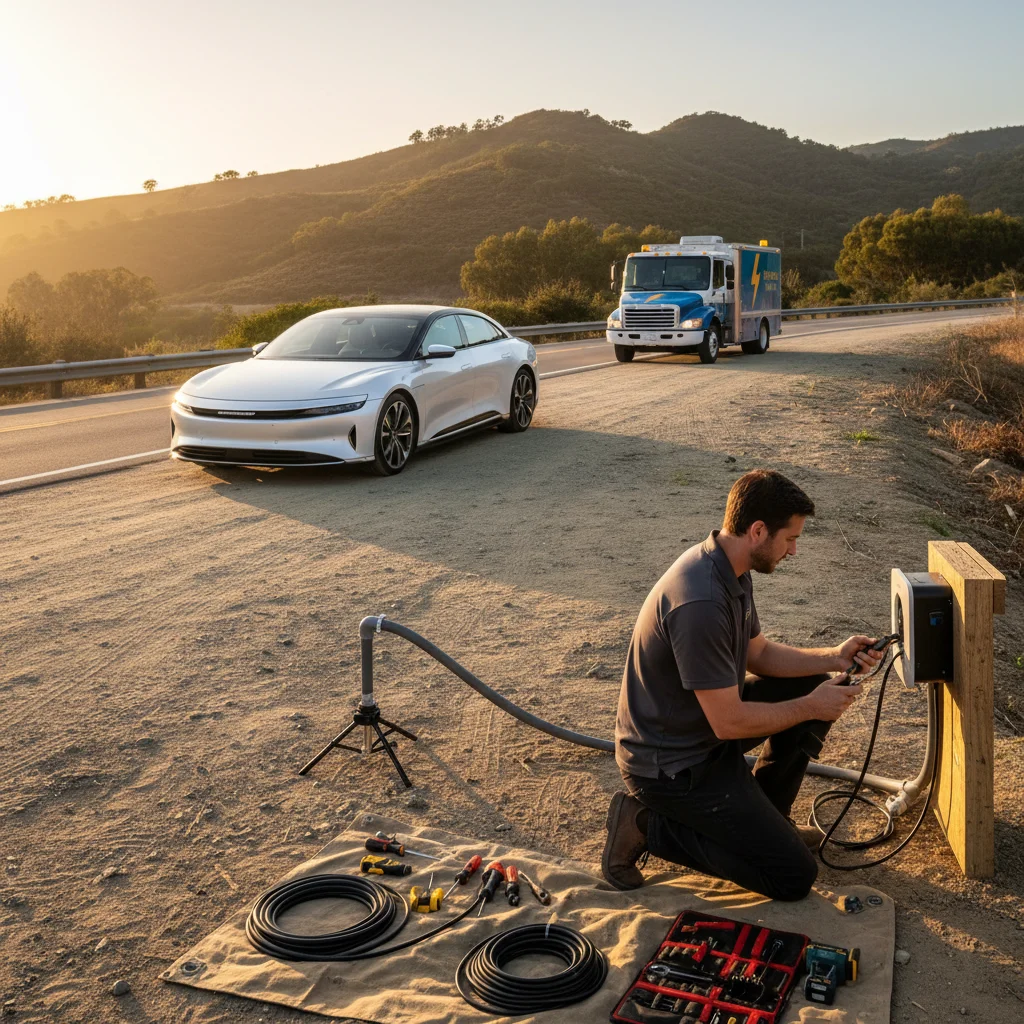
The 405 starts taking range before the pass
Culver City covers just over five square miles on the Westside and the Beaches. Census ACS 2019-2023 counted 39,993 people, with a 2024 estimate of 39,883. The city is small, but the freeways through it are not. I-405, I-10, and SR-90, the Marina Freeway, all cut this grid. Sepulveda Blvd, Washington Blvd, and Jefferson Blvd feed those ramps.
Studio and tech-campus commuting is the local pattern. Drivers leave lots in Hayden Tract or Downtown Culver City with a thin buffer. Fox Hills apartments sit against the 405. The next move is often north, toward the San Fernando Valley. That northbound move is the Sepulveda Pass approach. You don’t have to reach the crest for the dash to drop. The on-ramp and the crawl can finish a low pack.
Hot, dry basin summers add air-conditioning load on 90F-plus days. Recurrent Auto’s published research ties summer heat to lower real range. Heavy A/C use makes that loss worse. Culver City winters stay mild, so cabin heat is rarely the story. Freeway crawl plus cooling does the damage here.
See out of charge on the 405 at Sepulveda Pass for the crest itself. This page is the Culver City side of that same corridor.
The 10 and the Marina Freeway catch low packs too
The 10 is the east-west cut through town. It carries Westside traffic toward downtown Los Angeles, or back toward Santa Monica. Culver City is the hinge between those trips. A low pack in stop-and-go on the 10 fails without a hill. You sit with climate control still on. Displayed miles fall while the car barely moves.
SR-90 looks too short to worry about, and that’s the trap. The Marina Freeway is a brief connector off the 405. Drivers use it between Sepulveda, Jefferson, and the west edge of town. A car that read fine in the Arts District can still hit zero. The hop onto SR-90 is where it happens. The run is short, and traffic doesn’t give you a long warning.
Surface streets still strand people. Washington Blvd through Downtown Culver City stacks up at lights. Sepulveda Blvd behaves like frontage for the 405. Jefferson Blvd runs the studio and campus edge. If the car will still roll, get it out of a travel lane. A curb, a lot, or a driveway is safer than a through lane.
Empty pack or dead 12-volt: pick the right help
Two failures look the same from the sidewalk. The dash is dark, and handles may not pop. Drive mode won’t engage, and they’re not the same job.
An empty traction pack needs kilowatt-hours at the charge port. The independent operators Charge Pro LA connects you with bring a 240-volt Level 2 source. Teslas use a native NACS plug. Other EVs use CCS or J1772 with an adapter. A typical session adds 10 to 20 miles of range. That takes 15 to 30 minutes of charging. That interval is charging time, never an arrival time.
A dead 12-volt battery is the other stall. The main pack can still hold energy. The computers never wake, so the car acts like a brick. Operators can jump or replace that 12-volt battery on site. Tesla and every major EV brand still depend on that small battery to boot. Sitting all day in a Hayden Tract lot is a classic 12-volt setup. So is a car left in a Fox Hills garage for a long weekend.
Before you call, check what still works. See if the charge port door opens. See if the phone app still finds the car. See if interior lights flash at the fob. Share those details so the operator can quote the right visit. It’s on your electric car died: charge it, jump the 12V, or tow it?.
What freeway patrol will and won’t do
California Vehicle Code 21718 bans stopping on a freeway, with listed exceptions. A disabled vehicle is one of them when you’ve summoned help. It also applies when you must stop to avoid injury or damage. Make the call first, then stay out of the lanes.
Metro Freeway Service Patrol is free to motorists on congested Los Angeles County freeways. Caltrans, CHP, and LA Metro run it. Dial 511 and say Motorist Aid. Hours are typically weekday peak commute periods. Coverage also runs all day in designated construction zones. Midday and weekend patrols expand on the most congested corridors. Confirm current hours on metro.net. Don’t treat FSP as an EV charging truck.
Published FSP help includes a gallon of gas. It includes a radiator refill and a tire change. It will tow you to a safe spot CHP designates, at no charge. The published list doesn’t include mobile EV charging or an out-of-charge boost. An empty EV can get a tow to a safe drop. It doesn’t get a charge from that program, based on those materials.
Vehicle Code 21809 is the move-over rule. Drivers must move over for a stopped service vehicle with flashing lights. Use a non-adjacent lane if that change is safe. If they can’t change lanes, they must slow to a reasonable speed. Keep your doors closed on the traffic side. Wait for a quoted job before anyone connects a cable.
CHP can also order a rotation tow. Vehicle Code 22651 lists when an officer may remove a vehicle. That list includes a freeway stop left unattended too long. Don’t wait so long that the car becomes an impound problem. EV roadside assistance is how you try to leave under your own power.
Fox Hills density, old housing, and the home plug
Fox Hills, Blair Hills, Clarkdale, and Hayden Tract are not the same neighborhood. The Arts District and Downtown Culver City aren’t interchangeable either. Fox Hills is apartment-dense against the 405. Hayden Tract is the studio and office edge. Blair Hills sits up off the basin floor. Downtown and the Arts District hold the Washington Blvd core.
Census ACS 2019-2023 figures put 85.5 percent of Culver City housing before 1980. Older stock often means garages without a dedicated 240-volt circuit. Fox Hills apartment density plus the Sepulveda Pass approach is the local stranding pattern. Packs drain before drivers get back to a plug they control. That’s a commute-and-housing fact, not a claim about public stall counts.
Culver City buys generation through the Clean Power Alliance. Southern California Edison still delivers the power, keeps the lines, and reads the meter. Two line items can show on a home bill. That split doesn’t change a roadside rescue. It does mean you should confirm home-charger rebates on cleanpoweralliance.org and sce.com. Don’t assume a single-utility flyer still applies.
Santa Monica drivers face a coastal version of the same Westside map. See EV roadside assistance in Santa Monica if that’s your usual corridor. Inglewood sits just south of Fox Hills. Beverly Hills and West Hollywood sit north of Washington.
What the operator brings, and what this brand doesn’t
Charge Pro LA is a referral line. It matches stranded EV drivers with independent local mobile rescue operators. It performs no work and owns no trucks or equipment. It employs no technicians and sets no prices. It promises no arrival time and publishes no business hours. It holds no license of its own. The operator quotes you before starting and bills you directly. The pros we connect you with are licensed and insured.
The work those operators do is consistent. They bring 240-volt Level 2 charging to the car. They carry a native NACS plug. They carry CCS or J1772 adapters for non-Tesla EVs. They typically add 10 to 20 miles in 15 to 30 minutes of charging. They jump or replace a dead 12-volt battery on site. They handle Tesla and every major EV brand.
That visit is mobile EV charging, not a shop repair. You’re buying enough range to leave a shoulder. That includes a Fox Hills garage or a Hayden Tract curb. You’re not buying a full pack from a DC stall. After the boost, pick a destination you can actually reach. Confirm a working stall in your own charging app before you roll.
Tow only after a charge or a jump has failed
A tow feels like the default from a gas-car habit. For an EV on the 405, it’s usually the last tool. All-wheel-drive EVs should ride a flatbed. Drive wheels on the pavement can damage motors. The right bed isn’t always the first truck that answers a freeway radio.
Private property adds another layer. Vehicle Code 22658 sets rules for lot tows. Those rules include entrance signage and a release if you return before the car leaves. Storage rates on those tows can’t exceed law-enforcement-approved rates. California doesn’t publish a single statewide tow cap we can cite here. Confirm any lot’s posted terms on the ground.
A mobile charge leaves the car where it sits. You keep the keys and you keep the trip. Read why towing a dead EV in Los Angeles County is the last call. If you’re weighing a bed against a plug, start there. If the 12-volt is the failure, a tow doesn’t wake the car. You’d still need a jump at the other end.
Call while the car is still yours to move
Call when the traction pack can’t cover the next stop you actually trust. Call when the car won’t wake. Call when you’re already on the 405, the 10, or SR-90.
Charge Pro LA serves every city in Los Angeles County, including Culver City. The local landing page is EV charging in Culver City.
The number to call is (858) 925-5546. An independent operator quotes the work before a cable goes in. You pay that operator directly.