The pack hits zero in Santa Monica after a cross-town crawl on the 10. You’re a renter in Ocean Park, and the building has no plug. Or you came off a canyon grade and the last miles disappeared. The car won’t move, and you need a charge where it sits.
Why this city burns the last miles
Santa Monica is Westside and the Beaches, not a valley suburb. The I-10, called the Santa Monica Freeway, ends at PCH. SR-1 runs through town as PCH and Lincoln Blvd. Ocean Ave, Wilshire, and Montana Ave fill the rest of the grid. Downtown Santa Monica and the Third Street Promenade sit on that coast pattern. Ocean Park, Mid-City, Sunset Park, Pico, and Wilshire-Montana share the same tight blocks. The city’s land area is 8.409 square miles. The ZIPs run 90401 through 90405.
Census ACS 2019-2023 counts 91,535 residents. The 2024 population estimate is 90,729. Three quarters of the housing stock predates 1980. The Census share is 75.0 percent. That older stock is why so many Westside renters live on public stations. Ocean Park apartments rarely have home charging. You plug in at a stall you can find, then you drive on a timer.
Mild marine air isn’t the range killer here. May Gray and June Gloom keep summers cool and damp. Stop-and-go beach traffic is what spends the pack. Drivers finish a cross-town run on the 10 and arrive at the coast already thin. Then they sit in sand-lot traffic on Ocean Ave.
Canyon climbs spend whatever is left. Topanga Canyon Blvd, SR-27, links the Valley to PCH. Malibu Canyon and Kanan Dume drop toward the same coast. Low-speed grades pull range hard. You can look fine at the ridge and empty at Lincoln. For the local layout, start with EV charging in Santa Monica.
Turtle mode versus a car that won’t wake
A low pack still drives, slowly. Turtle mode, or limp mode, cuts power so you can limp. Warnings stack on the dash. That’s the moment to pick a stall and stop guessing. EV running low: what to do before you stall is the playbook for that stage.
A truly empty high-voltage pack is different. The car may not creep. It may not shift to neutral. If the 12V is also down, doors, hazards, and screens can fail. The heavy object in the lane is then a brick.
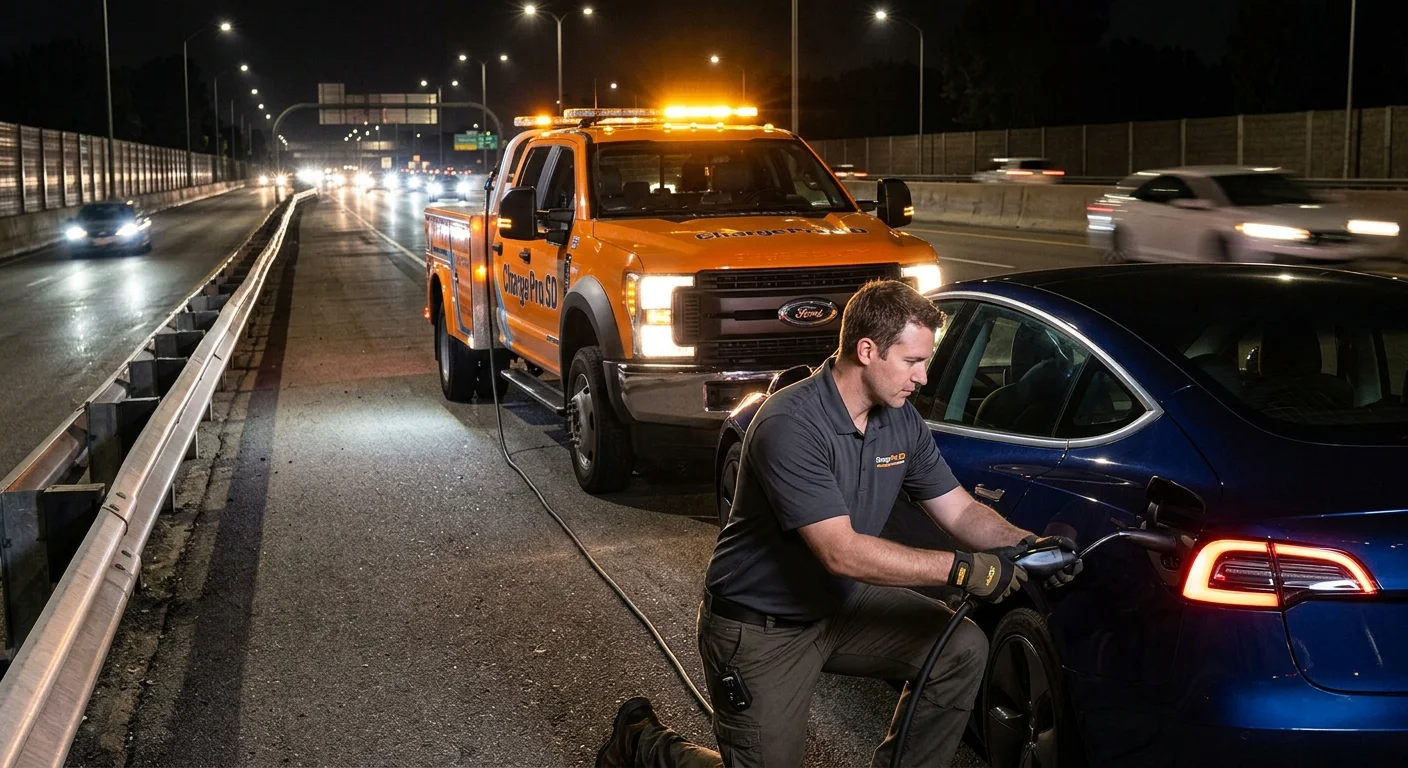
Don’t assume the big battery is empty because the car is dark. The 12V runs the computers. The drive pack moves the wheels. A 12V failure mimics a dead pack. Operators we connect you with jump or replace that 12V on site. They also bring a 240-volt Level 2 source when the drive pack is the problem. Tesla uses a native NACS plug. Other brands use CCS or J1772 with an adapter. The same visit covers both.
Shoulder, curb, and the codes that apply
If the car still rolls, coast to a shoulder, a curb cut, or a lot. Turn on the hazards while they respond. On the I-10 at the coast, stay belted inside if traffic is tight. Night, fog, and the marine layer all cut visibility. The cabin beats the pavement.
Don’t push an EV. The pack adds a lot of weight. You won’t muscle it out of a travel lane.
Blocking the freeway is a 911 call. California Vehicle Code 21718 bars stopping on a freeway. A disabled vehicle that has summoned help is an exception. Your call for assistance is that summons. California Vehicle Code 21809 makes other drivers move over or slow for a stopped vehicle showing lights.
Metro Freeway Service Patrol is free on congested LA County freeways. Caltrans, CHP, and LA Metro run it. Dial 511 and say Motorist Aid. The published help list names a gallon of gas. It also covers a radiator refill, a taped hose, and a tire change. It will tow a disabled vehicle free to a CHP-chosen safe spot. It doesn’t list mobile EV charging or an empty-pack boost. An EV at zero is outside that list, except for the tow.
A Promenade-area lot can still call a private tow. California Vehicle Code 22658 sets those rules. Look for the required entrance signage. The owner or agent must authorize the tow in writing. You can still recover the car if you return before it leaves the lot. Confirm posted rules on site. Don’t guess a storage rate. Non-consensual storage charges are tied to CHP-approved amounts. A single statewide cap figure isn’t published in a form we can cite.
Santa Monica buys generation through the Clean Power Alliance. Southern California Edison still delivers the power. That split doesn’t change a roadside rescue. It only matters when you read a home bill later.
When the canyon is what emptied you
Santa Monica is where mountain roads dump onto the coast. From Topanga you reach PCH and Lincoln with a pack that just worked a sustained grade. From Malibu you can arrive the same way after Malibu Canyon or Kanan Dume. The city then adds beach traffic. That’s two drains in one trip.
The reverse happens to renters. You leave a public stall in Pico or Sunset Park thinking the buffer is enough. You climb toward the Santa Monica Mountains and the estimate falls. Traffic on Lincoln won’t give those miles back.
We treat that as a car that needs energy where it already is. EV roadside assistance in Topanga covers the grade. Beach-lot dead EV on the Westside coast covers the sand and PCH pattern. Culver City, Beverly Hills, El Segundo, and the City of Los Angeles sit on this same Westside mix.
What a mobile Level 2 visit actually is
Charge Pro LA is a referral line. We don’t own trucks or equipment. We don’t employ technicians. We don’t set prices. We match you with an independent local operator. That operator quotes you before starting. They bill you directly.
They bring 240-volt Level 2 charging to the car. The session typically adds 10 to 20 miles of range in 15 to 30 minutes of charging time. That clock is the charge, never an arrival window. The goal is enough range to reach a station you choose, or home if you have a plug. We won’t name a closest charger for you. Open the app you already use and pick a working stall.
A tow is the fallback when the car can’t sit safely. It’s also the call when a shop visit is the real need. A dead 12V can block neutral. A rushed hook can damage the drive unit. Read when a stalled EV needs a charge instead of a tow before you wave down the first truck. For an empty pack, start with out-of-charge recovery. For the wider stall, use EV roadside assistance.
The operators in this network handle Tesla and every major EV brand. They’re licensed and insured. They do the work. We make the match.
What to tell the operator
Give a pin, a cross street, or a garage level. Ocean Ave and the Promenade structures get confusing after dark. Say the make, the model, and whether the screens are alive. If the 12V is suspect, say that. Leave a callback number.
The operator checks that the car is in a safe spot. Then they connect to the charge port. You don’t need to know the adapter map. You do need to stay clear of traffic while they work. When the session is done, you drive on the new buffer. You don’t wait for a full charge on the curb.
If the car is a brick in Santa Monica
Call when it won’t move and you can’t plug in yourself. Call from the I-10 shoulder at the PCH end. Call from an Ocean Park curb. Call after a canyon run leaves you dead on Lincoln.
Don’t wait on FSP for a charge they don’t list. Don’t push the car. Don’t assume a standard club truck carries Level 2 gear.
Charge Pro LA serves Santa Monica and the rest of Los Angeles County. Call (858) 925-5546. We’ll connect you with a local operator who quotes you before starting.