A dead EV in a Santa Monica beach lot is usually one of two failures. The pack arrived near empty after a cross-town run on the 10. Or the 12V quit while the car sat through a long lunch. Either way, stay with the vehicle. Sort which battery failed. Then get power to the stall. Skip the wait for a tow from a crowded Westside lot.
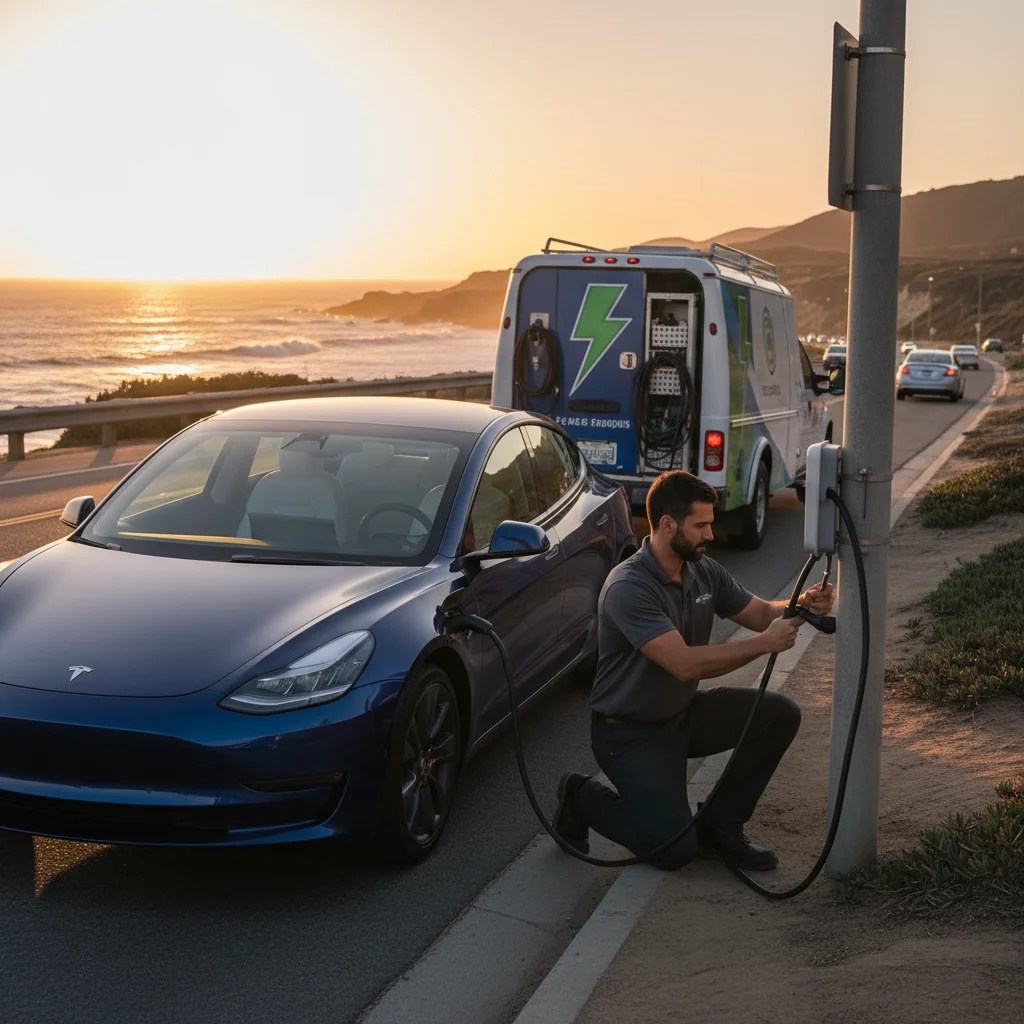
The drain starts inland, not at the sand
Santa Monica covers 8.409 square miles on the Westside. The 10 still pours the basin onto that small footprint. Drivers leave Los Angeles, Culver City, or Beverly Hills with a thin buffer. They meet the Santa Monica Freeway terminus at PCH. Then Lincoln Blvd, Ocean Avenue, and Wilshire take over. The last miles turn into idle time.
May Gray and June Gloom keep this coast cool and damp. Heat isn’t the range story here. Recurrent Auto’s published work ties big range cuts to cold, heat, and cabin climate. On this waterfront, the load is stop-and-go beach traffic. You circle Downtown and Ocean Park looking for a stall. The number on the dash falls while the car barely moves.
Census figures show 75.0 percent of Santa Monica housing was built before 1980. Ocean Park apartments rarely have home charging. Renters leave with whatever overnight plug they could find, if they found one. A Promenade stop plus a beach lot can finish a thin pack.
Santa Monica is a Clean Power Alliance member. CPA buys the generation. Southern California Edison still delivers the power and reads the meter. That split doesn’t wake a stranded car. A home charger rebate won’t reach a beach stall. Rescue is a separate call from the utility bill.
This is EV roadside assistance on the Westside beaches. UCLA sits in Westwood, just inland of this grid. Campus traffic feeds the same crawl toward Ocean Avenue. The pack that looked fine on Wilshire can be empty in the beach lot.
Downtown, Ocean Park, and Wilshire-Montana
Downtown Santa Monica and the Third Street Promenade fill with visitors off the 10. They park, walk the Promenade, and return to a car that won’t wake. Sometimes the high-voltage pack is at zero. Sometimes the 12V sat with the climate or the stereo pulling it down. Those are different jobs. A rollback doesn’t diagnose them.
Ocean Park sits south of that core. It is rental housing on older lots. Residents often have no assigned charger. Friends driving in from Mid-City Los Angeles or Culver City arrive already low. Saturday street parking then burns the buffer. The last miles go to circling, not to the water.
Wilshire-Montana runs a slower errand pattern. Montana Avenue shopping and older walk-ups keep cars on the curb for hours. Mid-City, Sunset Park, and Pico see more local trips. The rhyme is the same. Pre-1980 buildings. Scarce home plugs. A short hop that turns into a long idle.
Ocean Avenue is the beachfront crawl. Lincoln and PCH carry the north-south flow. None of that tells you a public stall is missing. App listings change. Confirm a live charger in the app you already use. If the car can’t roll to it, you need power at the bumper. That is out-of-charge recovery, not a scavenger hunt on Ocean Avenue.
West Hollywood, Beverly Hills, and Culver City sit inland on the same Westside belt. El Segundo sits south toward the airport. A pack that looked fine inland can be empty on Ocean Avenue. For the Santa Monica call pattern itself, start with EV roadside assistance in Santa Monica.
When the 10, Lincoln, or PCH takes the last bar
The Santa Monica Freeway ends at PCH. That is where inland range math meets beach traffic. If you stall on the freeway, California Vehicle Code 21718 generally bars stopping there. A disabled vehicle that has already summoned help is an exception. Hazards on. Get out of live lanes if you can do it safely.
Metro Freeway Service Patrol covers congested LA County freeways at no charge to the motorist. Caltrans, CHP, and LA Metro run it together. Dial 511 and say Motorist Aid. The published help list includes a gallon of gas and a radiator refill. It also covers a tire change. It will tow you free to a CHP-chosen safe spot. It doesn’t list mobile EV charging or an empty-pack boost. An EV at zero sits outside that published list. The exception is the tow off the freeway.
A beach parking lot isn’t a freeway. FSP won’t meet you between the stalls. Private-lot towing follows California Vehicle Code 22658. The lot needs the required 17-by-22-inch signs. It needs written authorization. It has to notify local law enforcement within one hour. If you return before the car leaves the lot, they have to release it. If it is coupled and not yet moved, they collect at most half the tow charge. Storage can’t exceed the law-enforcement approved schedule. A single statewide cap couldn’t be confirmed on the California legislative site. Ask the lot and the city what they actually post.
CVC 21809 is the move-over rule. Drivers must move over for flashing lights on a tow, Caltrans, or emergency truck. If a lane change isn’t safe, they have to slow. That protects you on a Lincoln shoulder or on the 10. It doesn’t put energy in the pack.
SR-1 through town is PCH and Lincoln Blvd. People also drop in from Topanga Canyon Blvd. That is SR-27. The grade runs between the Valley and the coast. That canyon is a climb, not a beach stall. If you emptied on that side, you’re still in a coastal rescue. You’re just farther from Downtown.
Empty pack, or a 12V that won’t wake
An EV that won’t move isn’t always out of charge. The 12-volt battery runs the computers, the locks, and the contactors. When it dies, the car acts like a brick. Miles may still have shown on the last screen. A long sit in a structure after a Promenade walk can do that. The 12V failure is the same whether you parked for lunch or overnight.
Try the app, the screen, and the door handles once. If nothing wakes, treat it as a 12V job first. The operators we connect you with can jump a dead 12V on site. They can replace it too. They handle Tesla and every major EV brand. See Your electric car died: charge it, jump the 12V, or tow it for that split.
If the high-voltage pack is truly at zero, skip the 12V jump. It won’t add range. You need energy at the charge port. Operators bring a 240-volt Level 2 source. Teslas take a native NACS plug. Other EVs use a CCS or J1772 adapter. Typical charging time is 15 to 30 minutes. That usually adds about 10 to 20 miles of range. That is plug time. It is never an arrival time.
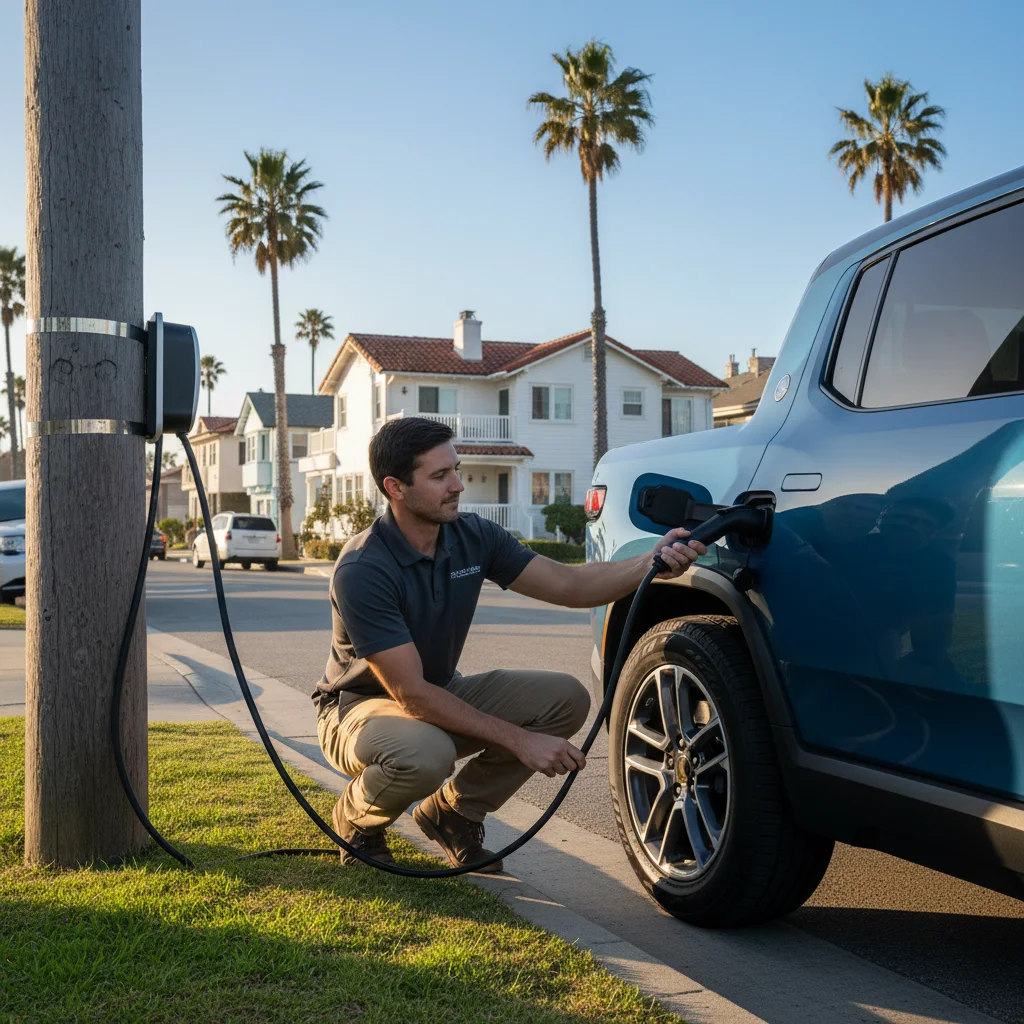
Don’t count on another EV to share charge in a beach stall. That isn’t a reliable roadside method. A mobile EV charging truck is the tool for an empty pack.
Charge in the stall, or tow out of the lot
Towing an EV from a packed Westside lot is the last good option. It shouldn’t be the first. Narrow aisles and pedestrians slow a rollback. Some EVs need a specific tow method. That protects the drive unit. A mobile Level 2 boost lets you leave under your own power.
A tow still makes sense for a mechanical failure or a damaged port. It also makes sense if the charging truck can’t reach the stall, or if lot security already started a removal. Ask the operator on site. They quote you before they start. They bill you directly. Charge Pro LA doesn’t set that price, and we don’t publish one.
If you’re still on the 10, FSP can tow you to a safe spot. That is often the cleanest way off the freeway. You’ll still need a charge after that. Make the second call while you wait. When a stalled EV needs a charge instead of a tow walks through that split.
Santa Monica’s city page is the local landing spot for this coast. Use EV charging in Santa Monica for that hub.
Who shows up, and who we are
Charge Pro LA is a referral line for Los Angeles County. We match stranded EV drivers with independent local mobile rescue operators. We don’t hold a trade license. We don’t own trucks, yards, or parts. We don’t employ technicians. We don’t publish hours or arrival times. The operator who takes the job quotes before starting and bills you directly.
The pros we connect you with are licensed and insured. They bring Level 2 charging to the car. They jump or replace a dead 12V. They cover Tesla and non-Tesla EVs. We serve Santa Monica and every other city in the county. That includes Culver City, Beverly Hills, and El Segundo. It also includes Manhattan Beach and Redondo Beach.
Give a clear pin and the vehicle make. Add the lot name if you have it. Say whether the car is at zero or won’t unlock. That is enough to send the right plug. Stay with the car if a private lot is in play. CVC 22658 assumes you’re there when a tow tries to leave.
If you’re already in the stall
Hazards on if you’re on Ocean Avenue or Lincoln. Stay out of traffic. Don’t stand between the car and moving lanes. On a freeway shoulder, CVC 21809 is what slows other drivers. In a garage, watch for lot staff and the posted tow warnings.
Don’t keep cycling the car. A weak 12V gets worse with repeated attempts. A pack at zero doesn’t gain miles from more button presses. Call for EV roadside assistance or a 12V jump, then wait with the vehicle.
Charge Pro LA matches you with a local operator at (858) 925-5546. The operator quotes the job before any cable goes in. Confirm the figure they give you. We don’t promise a clock. What you get is an independent pro who works this coast. They bring a Level 2 source. They can jump a 12V on the truck.