If your EV stalls in Redondo Beach, you need a charger brought to the car. A gas can won’t move an empty pack. Charge Pro LA connects you with independent mobile rescue operators. That’s EV roadside assistance in Redondo Beach. The brand doesn’t perform the work. The operator quotes you first, then bills you directly.
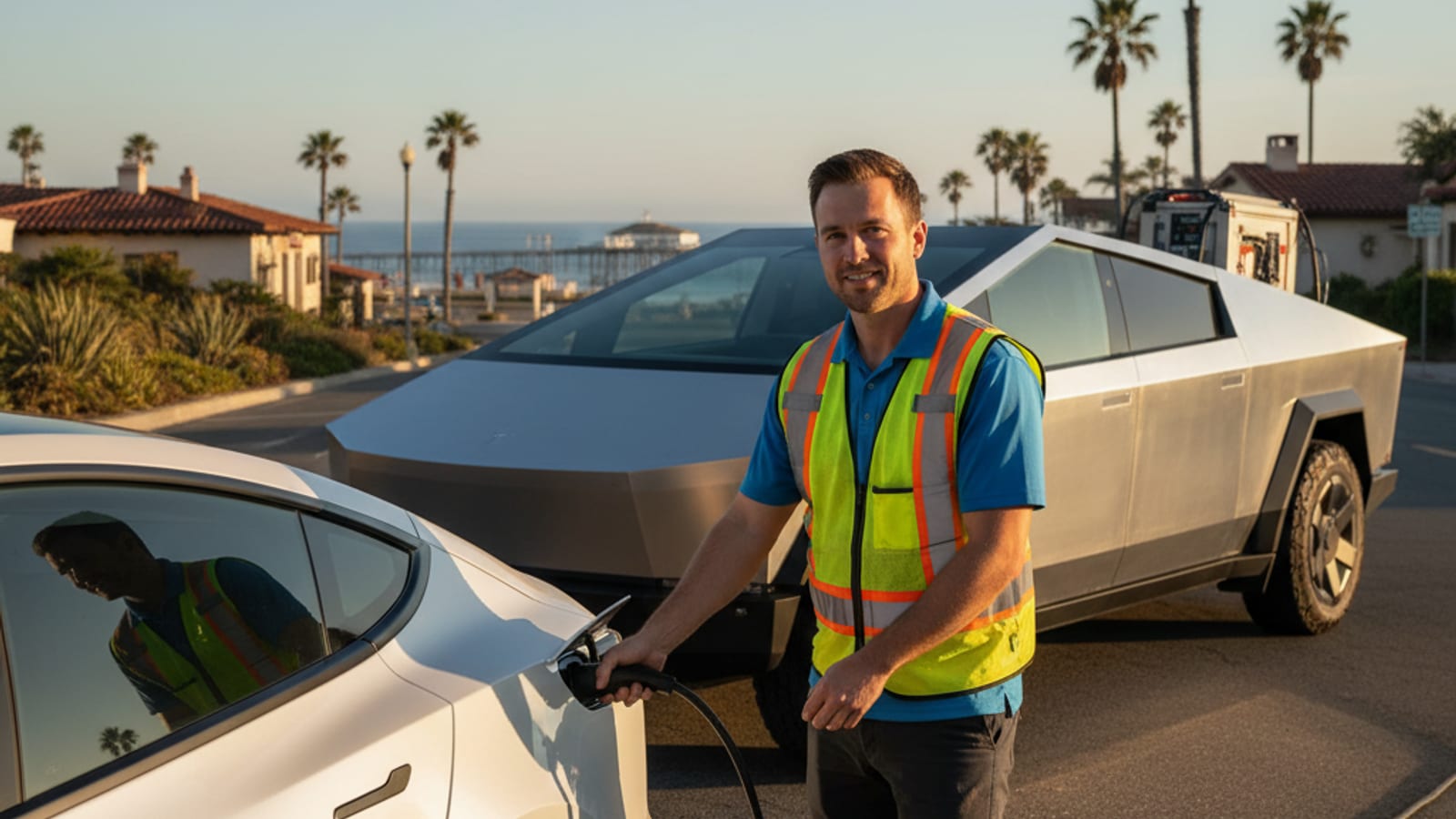
Weekend traffic toward King Harbor can spend range you meant to keep. The pier does the same. Many beach-city drivers charge at home or at work, nowhere near the water. Then they roll down PCH, park, and idle in stop-and-go. Golden Hills adds a climb after that harbor stop. Westside beach cities stack public-station living with hillside grades. Redondo Beach is that stack in one place.
Beach traffic drains packs more than the weather
Redondo Beach sits in the Westside and the Beaches region. Census ACS 2019-2023 counts 69,814 residents in the city. The 2024 Census population estimate is 68,075. Redondo Beach covers 6.198 square miles of land. That’s a compact city with heavy weekend demand.
The climate is mild marine weather. May Gray and June Gloom keep summers cool and damp. Cabin heat isn’t the main range hit here. Stop-and-go beach traffic is the real tax. A crawl on SR-1 burns miles a highway cruise wouldn’t. Locals call that road PCH. Torrance Boulevard slows the same way when lots fill. Aviation Boulevard and Artesia Boulevard do it on commute days.
You can feel fine leaving North Redondo. You can feel empty after the Esplanade loop. Those are different driving days in the same city.
North Redondo, South Redondo, and Golden Hills
North Redondo sits closer to the 405. Commutes there mix Aviation Boulevard with freeway ramps. South Redondo faces the water, the Esplanade, and King Harbor. Riviera Village pulls dinner traffic onto tight streets. Golden Hills sits above the flats. Short grades there cost energy you’d counted on.
A driver who charged overnight in North Redondo can still stall after a harbor afternoon. The pack didn’t fail. The day stacked idle time, hills, and a slow PCH return. That’s the local pattern, not a mystery battery fault.
Give the operator a neighborhood name when you call. North Redondo, South Redondo, Riviera Village, the Esplanade, and Golden Hills dispatch differently. ZIPs here are 90254, 90277, and 90278. A cross street helps more than a venue nickname.
Artesia Boulevard is the east-west cut toward the 405. Aviation Boulevard runs the airport-adjacent commute. Torrance Boulevard ties South Redondo to inland Torrance. A low pack on any of those three can stall you short of a planned plug. Don’t try to limp across all three.
If you want a city-level charging overview, open the Redondo Beach charging page. This article is about the stall itself.
What mobile rescue actually does on this coast
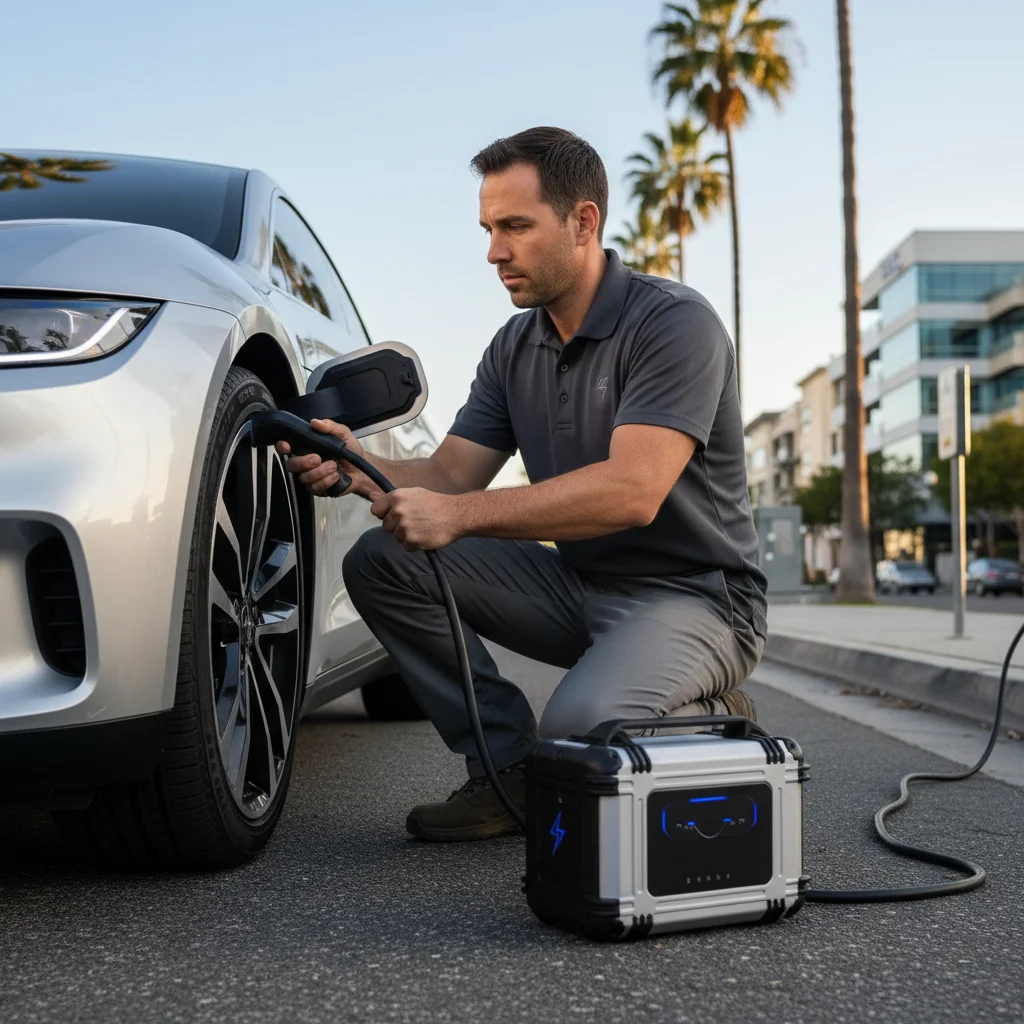
Mobile EV charging means an operator brings a 240V Level 2 source to your car. Tesla drivers get a native NACS plug. Other EVs use a CCS or J1772 adapter. Typical charging time adds about 10 to 20 miles of range. That window is 15 to 30 minutes of charging. It’s charging time, never an arrival time. Nobody here can promise when a truck shows up.
Charge Pro LA owns no trucks and no equipment. It employs no technicians. It holds no trade license. Independent local operators do the work. We match you with one. They quote before they start. They bill you directly.
Out-of-charge recovery is for a pack at or near zero. You don’t need a full charge on the curb. You need enough range to roll to your next planned plug. That plug might be home. It might be a public stall already in your app. The operator doesn’t pick your destination. You do.
Operators handle Tesla and every major EV brand. A Model Y on the Esplanade is in scope. So is an Ioniq 5 in a Riviera Village garage. So is a Rivian, a Mach-E, a Bolt, or a Lucid. The plug changes. The job doesn’t.
A 240V Level 2 boost isn’t a DC fast stall. It won’t fill a large pack in a few minutes. It will usually put back the miles that get you off the curb. That’s the point of a roadside charge. You’re buying movement, not a full pack.
Empty pack or a dead 12V
An EV that won’t wake isn’t always empty. The 12V battery runs locks, computers, and the contactors that connect the drive pack. If that small battery is dead, the car can look bricked. The high-voltage pack can still be full.
This shows up after a long park. A long dinner near the pier can flatten a weak 12V. Hazard lights left on will do it faster. So will a car that sat with systems half awake. Redondo drivers who fly out of LAX see the same pattern after a trip. Terminal structures P1 through P7 offer Level 2 and DC fast charging. The Economy Parking garage has 514 active EV chargers. A week on a charger still won’t save a failed 12V. That small battery isn’t the drive pack.
The operators in the network can jump or replace a dead 12V on site. For Tesla owners, that’s a Tesla 12V battery jump. Non-Tesla EVs need the same diagnosis. Don’t assume the drive pack is empty because the screen is dark.
If doors won’t open, don’t force the handles. Tell the operator the make, model, and what the car won’t do. A jump is a different job from a Level 2 boost. The quote should match the job.
King Harbor, the pier, and a stall on PCH
King Harbor and the pier draw weekend traffic onto PCH. Cars stack. They idle. They hunt for parking. Range estimates drop in that crawl. They drop again when you climb away from the water. If you stall on PCH, get out of the travel lane if you can. Hazards on. Stay with the car if the shoulder is tight.
Metro Freeway Service Patrol is a freeway program. It isn’t a PCH or Riviera Village service. If you’re on SR-1, Artesia Boulevard, or the Esplanade, call a mobile operator. Save 511 Motorist Aid for the 405 or the 110.
California Vehicle Code 21718 bars stopping on a freeway except in listed cases. A disabled vehicle that’s summoned help is one of those cases. PCH here is SR-1. It isn’t the 405. The practical rule is still simple. Don’t leave a dead EV sitting in a live lane.
California Vehicle Code 21809 is the move-over law. Other drivers must change lanes or slow for a stopped emergency or tow vehicle with flashing lights. That law protects you on the shoulder. It doesn’t charge the car.
If you stall in a private lot by the harbor, read the signs. California Vehicle Code 22658 sets rules for private-property tows. Required entrance signage is 17 by 22 inches. The lot needs written authorization. They must notify local law enforcement within one hour. If you return before the car leaves the lot, they have to release it. At most they’ll collect half the tow charge if it’s coupled but not yet moved. Storage rates can’t exceed law-enforcement or CHP-approved rates. A single statewide cap figure wasn’t confirmed in the sources used here. Confirm the lot’s posted rules on the sign in front of you.
If the car dies on the 405 or the 110
Redondo Beach sits near I-405 and I-110. A North Redondo commute can put you on those ramps with a thin buffer. Metro ExpressLanes run on I-110, the Harbor Freeway. A FasTrak transponder tied to a funded account is required to enter. Without one, Metro bills by plate under Pay-As-You-Go. Motorcycles are exempt. Disabled-vehicle rules inside those lanes aren’t spelled out in Metro’s published FAQ. Don’t assume a wide shoulder. If you can reach a regular lane or a marked safe spot, do that.
Metro Freeway Service Patrol is free on congested LA County freeways. It’s a joint program of Caltrans, CHP, and LA Metro. FSP can give a gallon of gas and refill a radiator. It can tape a hose, change a tire, and tow a disabled vehicle to a CHP-chosen safe spot. Dial 511 and say Motorist Aid. Coverage is typically weekday peak hours, plus all day in some construction zones. Metro also notes expanding midday and weekend coverage on the busiest corridors. Confirm current hours through 511. FSP’s published list doesn’t include mobile EV charging. An empty pack sits outside that list, other than a free tow to a safe spot.
CHP can also dispatch a rotation tow for a disabled vehicle on the freeway. Details of the local rotation list weren’t confirmed in the research used for this page. Ask CHP or 511 what they can send from where you sit.
CVC 22651 lists when an officer may remove a vehicle. That includes traffic obstruction and a car left unattended on a freeway for four or more hours. Don’t walk away from a dead EV on the 405. Stay with it, or you can come back to an empty space and an impound path.
Older housing, SCE lines, and a missed overnight plug
About 66.7 percent of Redondo Beach housing was built before 1980. That’s Census table B25034, not a guess. Older buildings are common along this coast. Many EV owners here still charge away from the water. If you skip a night, the next beach day starts thin.
Redondo Beach is a Clean Power Alliance community. CPA buys the generation. Southern California Edison still delivers the power, maintains the lines, and reads the meter. You may see two line items on the bill. That split doesn’t change a roadside rescue. It does change how you talk about “your utility” when you plan home charging.
SCE publishes Charge Ready Home, a rebate toward Level 2 home charger installation. It also publishes a Pre-Owned EV Rebate. Confirm current program rules and any amounts on sce.com before you rely on them. Dollar figures aren’t listed here because they change. This brand also doesn’t sell power or install equipment. LADWP programs don’t apply in Redondo Beach. LADWP serves the City of Los Angeles.
A home plug still can’t rescue you on PCH. If the car’s already dead, you need an operator on site. There’s a local companion piece for the hours after a stall. It covers what to do after an EV stall in Redondo Beach.
Next cities along the same coast
Manhattan Beach is the next beach city north. El Segundo sits beyond that, toward LAX. Torrance borders Redondo inland. Hawthorne and Gardena sit farther toward the 405 freight belt. A stall can start in Riviera Village and end with a planned plug in Torrance. The operator still works the car where it sits.
Charge Pro LA serves every city in Los Angeles County. The Westside coast has its own mix of beach lots, PCH crawls, and hillside streets. For that wider corridor, read beach-lot dead EV help on the Westside coast.
Regenerative braking on the way down from Golden Hills doesn’t fully pay back the climb. You spent more going up than you’ll recover coming down. Keep a buffer before you point the car at the harbor.
What to do in the first minutes
Pull out of the travel lane if the car will still roll. Hazards on. If you’re on a freeway, stay in the vehicle unless you’re in immediate danger. If you’re on a quiet block in South Redondo, you can wait outside the car. Use judgment.
Don’t keep crawling on a zero-mile estimate. You can block a lane. You can also complicate a later tow. Check whether the car is silent because the pack is empty or because the 12V died. A dark screen isn’t a diagnosis. Note the last range you saw. Note whether doors and lights still work.
Then call Charge Pro LA and give a precise pin. Riviera Village, the Esplanade, Golden Hills, and an Aviation Boulevard shoulder are different dispatches. Give the make and model. Say whether you need a charge or a 12V jump. The operator quotes the job before starting.
Stay where you said you’d be. If CHP or FSP arrives first on a freeway, tell them you’ve already summoned help. That keeps you inside the disabled-vehicle exception under CVC 21718.
When a tow is still the right call
A Level 2 boost won’t fix a failed drive unit. It won’t fix a charge port that won’t latch. It won’t wake a car with a deeper electrical fault. If the operator can’t put energy into the pack, a tow may be the remaining path.
Many EVs need a flatbed so the motors don’t spin. Confirm that with the tow company before they hook the car. On a freeway, FSP’s free tow is only to a CHP-chosen safe location. That spot may not be your charger. A private tow from there is a separate decision. This brand doesn’t set tow rates. California doesn’t publish one statewide cap. Non-consensual private-property tows are constrained by CVC 22658. Freeway rotation tows follow CHP agreements. Ask for the rate before the hook goes on.
Don’t treat a tow as the first move only because a club dispatcher answers. Ask whether they’ll charge the car or only drag it. An empty pack often needs power more than a winch.
Keep a buffer before the next harbor day
Plug in the night before a King Harbor day. Don’t treat a “should make it” estimate as a plan. Beach traffic is the range tax in this climate, not freezing cold. Recurrent Auto’s published testing shows EVs keep about 78 percent of range at 32F. They keep about 70 percent at 20F. Those numbers matter more in Lancaster or Palmdale than on the Esplanade. Here, AC in a crawl still costs energy. So does a Golden Hills climb with a low buffer.
Use your car’s nav if it can hold a reserve. Check a charging app before you leave home, not after the warning chimes. The U.S. Department of Energy’s Alternative Fuels Data Center at afdc.energy.gov explains range factors in plain terms. None of that replaces a buffer. Arrive with miles left. Don’t aim at zero.
If you live in pre-1980 housing, confirm what your panel can support. Don’t count on a new wall unit until that’s checked. That’s a home-electrical question, not a roadside one. SCE’s Charge Ready Home page is the place to read rebate rules. Amounts aren’t confirmed here.
Frequently asked questions
What EVs can an operator help in Redondo Beach?
Operators in the network bring a native NACS plug for Tesla. They carry CCS or J1772 adapters for other brands. That covers Tesla, Rivian, Ford, Hyundai, Kia, Chevrolet, BMW, Mercedes, and other major EVs. The operator confirms the plug when they quote. If a rare port needs a special adapter they don’t have, they’ll say so before they start.
How much charge do you get on the curb?
The Level 2 boost typically adds about 10 to 20 miles of range. Charging time is usually 15 to 30 minutes. That’s time on the plug, not a promise about when someone arrives. The goal is enough range to reach your next charger or your home plug. It isn’t a full pack on the street.
What if the car has range left but won’t start?
Treat that as a 12V problem until proven otherwise. The drive pack can be fine while the small battery is dead. An operator can jump or replace that 12V on site. Don’t keep trying to wake the car until the 12V is fully flat. Say what lights, locks, and screens still do when you call.
Call when the car has already stopped
A stalled EV in Redondo Beach is a local problem with a local pattern. Beach traffic, harbor parking, and Golden Hills grades stack faster than a sticker range expects. Charge Pro LA will match you with an independent operator who can charge the pack or jump the 12V. Call (858) 925-5546 and give your exact pin. The operator quotes before any cable goes on the car.