You parked a Tesla at LAX for a week. The car won’t wake. Yes, every Tesla has a 12V-class battery separate from the drive pack. Terminal structures P1 through P7 offer Level 2 and DC fast charging. Los Angeles World Airports lists more than 4,000 Economy stalls. That count includes 514 active EV chargers. Chargers in the lot don’t keep a dead 12V alive. That small battery is what wakes the computers, the handles, and the screen.
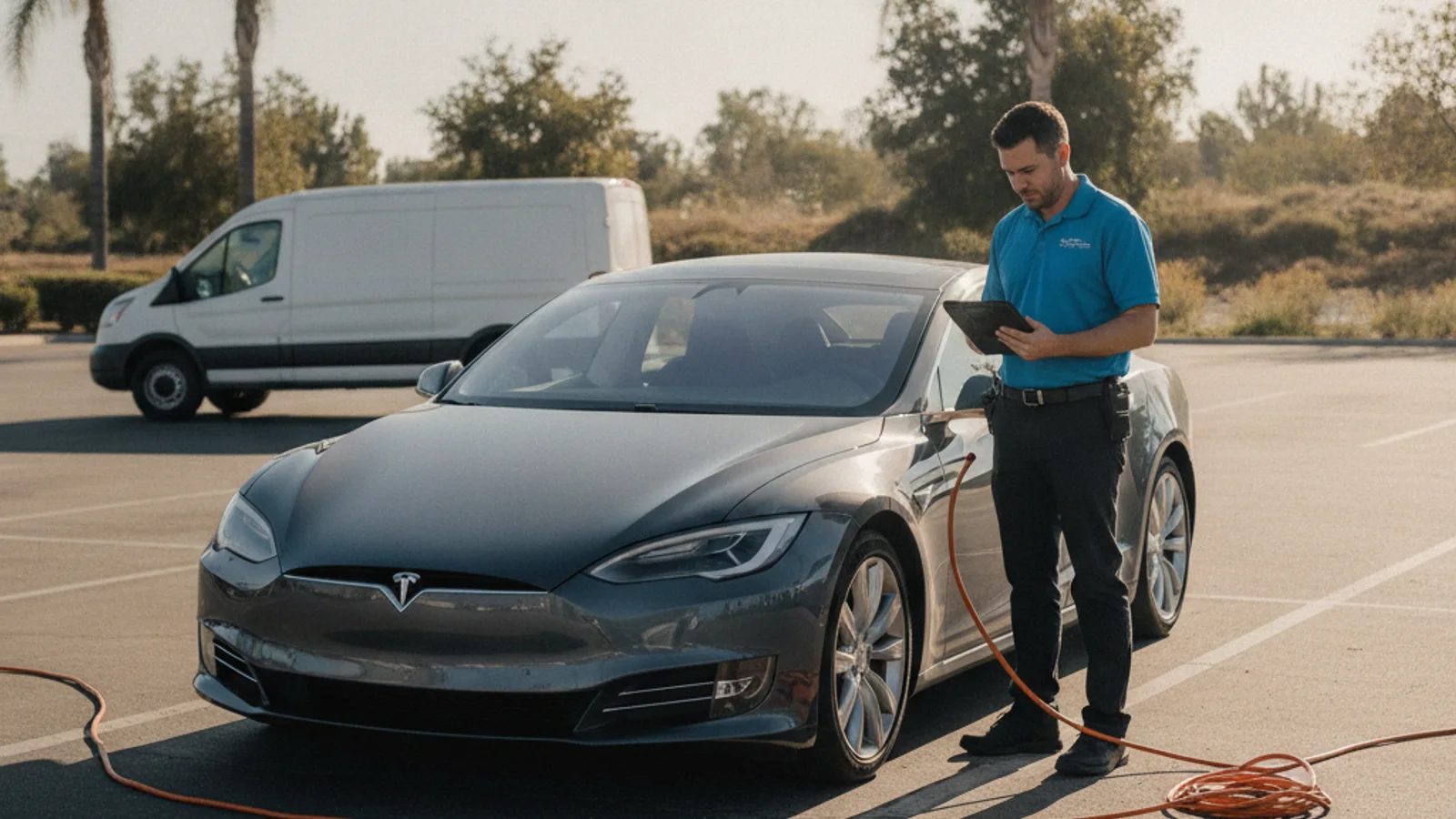
Yes, every Tesla has a 12V-class battery
Every Tesla carries two electrical systems, not one. The big traction pack turns the motors. It also sets the range on the window sticker. A much smaller low-voltage battery runs everything else. That means the screen, handles, cameras, and the wake computer.
Tesla sells the car as fully electric. The second battery still sits underneath that pitch. Owners then treat one pack as the whole story. It isn’t. Nearly every production EV sold today keeps a low-voltage battery beside the pack. Tesla isn’t a special case here.
When that small battery drops too far, the car goes dark. Handles stay flush. The app can’t reach the vehicle. The cabin stays silent. The traction pack can still hold a healthy charge. That mismatch is why this search is so common. It’s a car that “won’t start” with range left.
So the answer is yes for Model S, 3, X, and Y. It’s yes for Cybertruck too. It’s yes for the rest of the current Tesla lineup. Chemistry, location, and access still change by model and year. Those details are a different question. This guide keeps the two questions apart on purpose.
A week at LAX is the local test
A trip through Los Angeles International is the cleanest local proof. You park in the Central Terminal Area or the Economy garage. You fly for several days. You walk back expecting the car to unlock. A stall with a charger doesn’t keep a failing 12V alive by itself. A 12V failure isn’t an empty pack. The car can sit beside working Level 2 hardware all week. It can still refuse to wake.
The same pattern shows up after a flight through Hollywood Burbank Airport or Long Beach Airport. Van Nuys follows the same 12V-after-a-trip pattern. Charger counts at those airports weren’t confirmed for this piece. Check each airport’s own site before you count on a stall.
It also shows up in long-stay lots around El Segundo. A dark Tesla in an Inglewood stadium garage is the same fault. So is a car that slept through Sentry Mode in a West Hollywood garage. Universal Studios Hollywood parking can do it after a long day. The 12V question doesn’t change. How you reach the car does.
If the Tesla is dark on a freeway shoulder, Vehicle Code 21718 still applies. Stopping on a freeway isn’t allowed except in listed cases. A disabled vehicle that’s already called for help is one of those exceptions. Other drivers must move over or slow under Vehicle Code 21809. That applies when warning lights are flashing.
Metro’s Freeway Service Patrol is free on congested LA County freeways. Caltrans, CHP, and LA Metro run it together. Dial 511 and say “Motorist Aid.” Its published list names gas, a tire change, and a free tow to a CHP-chosen safe spot. It doesn’t list mobile EV charging or 12V help. A dark Tesla is outside that list. A free tow off the lane is the exception.
Private garage tows follow Vehicle Code 22658, including the entrance-sign rules. Confirm current garage policy with the lot before you wait there.
Why the car still needs that small battery
The traction pack runs at several hundred volts. That voltage is for the motors. It isn’t what you want on door locks, cabin lights, or airbag modules. Those parts are built around ordinary automotive low-voltage hardware.
Tesla, like other makers, keeps the high-voltage pack behind contactors. Contactors are large relays. They need low-voltage power to open and close. That small battery wakes the computers and closes those contactors. Only then can the pack do any work.
That’s the order-of-operations problem. The high-voltage system can’t switch itself on. Closing its own contactors takes low-voltage current first. A gas car uses the same layered idea. It just uses a starter and an alternator instead. Tesla applies it to a car with no engine.
While the car is awake or plugged in, a DC-DC converter steps pack voltage down. That converter keeps the small battery topped off. Once the car is asleep, the small battery runs the background load alone. App pings, Sentry Mode, and always-on monitoring all draw from it. That’s why a parked Tesla at LAX can go dark. Nobody had to drive it.
Coastal days in Santa Monica stay milder than inland valleys. Lancaster and Palmdale swing from hard heat to cold nights. Cabin climate load also cuts drive-pack range below the sticker. Don’t treat a dark cabin as “out of charge” until the screen lights.
The U.S. Department of Energy publishes an overview of how electric vehicles work. It describes this two-system layout in general terms.
What changes by model and year
Generic advice online often skips this part. Tesla has changed the low-voltage battery’s chemistry more than once. It’s also moved the physical location. Access for a technician isn’t the same on a Model 3. It isn’t the same on a Model S either. Those changes don’t line up with one cutoff year across the whole lineup.
Some Teslas use a lead-acid low-voltage battery. Others use a lithium-based one. They age differently. They fail differently. They aren’t serviced the same way. On some cars a driver can picture where the battery sits. On others, reaching it means trim removal or working from below. That isn’t a job in a P4 structure at LAX.
This page won’t publish a year-by-year chemistry chart. Tesla runs mid-production changes. A stale table sends someone toward the wrong part. Newer Model 3 and Model Y cars may use a lithium 12V. Start with our guide to a lithium 12V that won’t wake. Your owner’s manual for that exact car still wins. Tesla’s current service documents beat any article, including this one.
If you aren’t sure which battery your car has, say so. Say it when you request help. Guessing the chemistry is how people pick the wrong jump procedure.
Dark and silent versus awake and empty
A failing 12V and a depleted drive pack don’t look the same. A dead 12V usually means the car won’t wake at all. The screen stays black. Handles don’t present. The phone app gets no reply. Drivers often say the car went to sleep and stayed there.
A depleted traction pack usually still wakes the car. The screen comes on. You see a range warning, not total silence. Dark and silent versus awake but empty is the fastest split. Read our guide on the 12V versus the high-voltage pack for that split. If you’re at the bumper, use the Tesla 12V diagnosis and jump guide.
Where you are parked still changes the call. A dark Model Y in a P3 structure at LAX is a garage problem. The same symptom on the 405 is a shoulder problem. A silent car in a Burbank studio lot is a private-property problem. A silent car on the 10 through El Monte is a freeway problem.
What to tell the operator first
Give the exact model, year, and trim. That’s what sets chemistry, location, and access. The owner’s manual for that VIN is the primary reference. Tesla’s published service information is the other. Both beat a video shot on a different year. If you’re unsure, say that out loud. The matched operator should confirm the low-voltage layout before touching it.
Charge Pro LA is a referral line. We connect Los Angeles County drivers with independent local operators. Those operators can jump a Tesla 12V on site and handle broader Tesla roadside rescue. They quote you before they start. They bill you directly. Charge Pro LA doesn’t perform the work. We don’t own trucks. We don’t set prices. We don’t promise an arrival time.
The operators we send also jump or replace a dead 12V on site. They cover Tesla and every major EV brand. If the pack is empty, they bring a 240V Level 2 source. That typically adds 10 to 20 miles of range in 15 to 30 minutes of charging time. That’s charging time, never an arrival time. A native NACS plug, plus CCS or J1772 adapters, handles non-Tesla cars. Your dark Tesla after a week at LAX is usually the 12V job.
When this is the call to make
Call when the Tesla has gone dark and won’t wake. Call even if the last range reading looked fine. That mismatch usually points to the low-voltage system. Call (858) 925-5546 and we’ll connect you with a local EV rescue operator.