Huntington Park packs more than 53,000 people into about three square miles. Most of the housing stock predates 1980. Tight Eastside lots and older panels mean many drivers never got a wall plug. When the pack hits zero on Pacific Blvd, you need help at the curb.
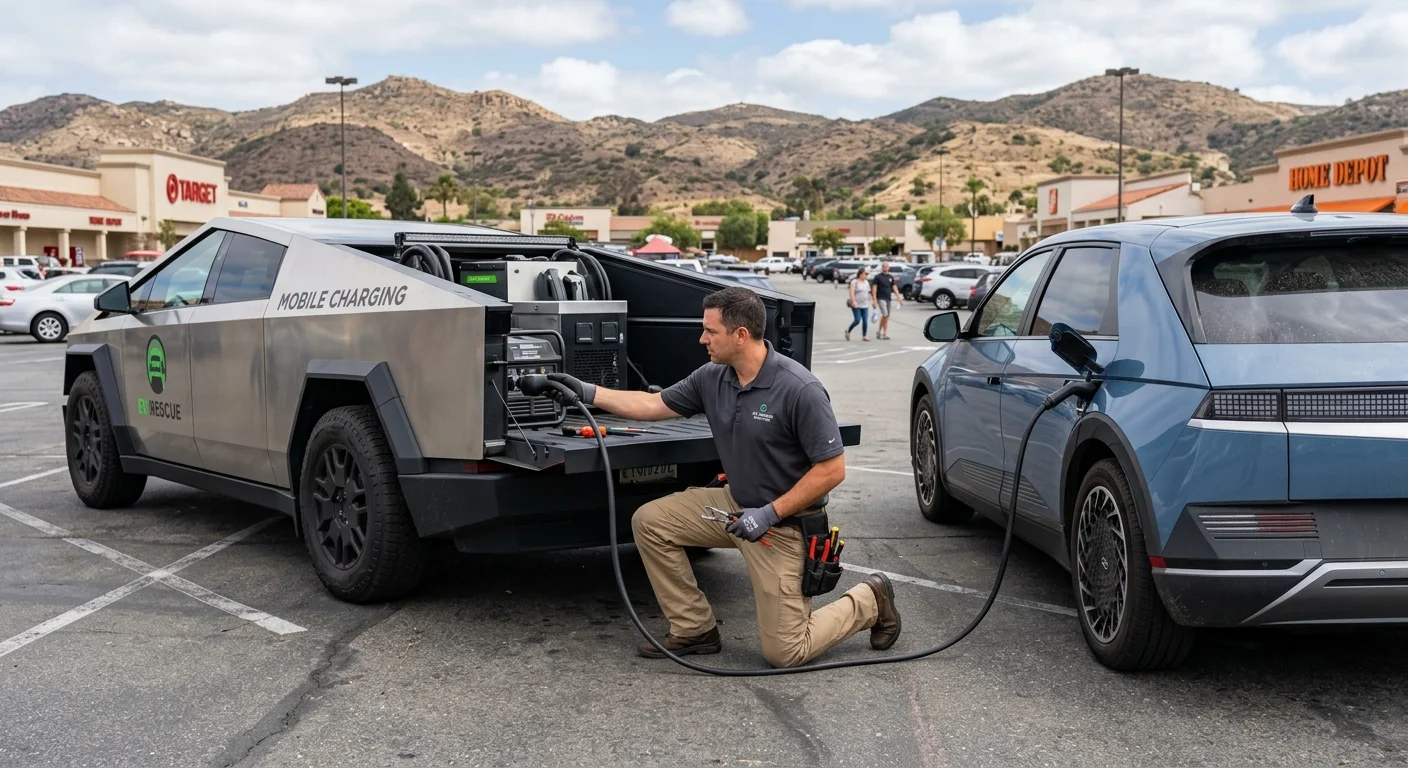
Charge Pro LA is a referral line. It matches stranded EV drivers with independent local operators. Those operators bring a 240-volt Level 2 source to the car. They don’t work for the brand. They quote you before they start, and they bill you directly.
Why Huntington Park EV drivers stall without a home plug
This city sits on the Eastside of the Los Angeles Basin. Downtown Pacific Blvd, the Slauson corridor, and the residential blocks between them are tight. The Census ACS count is 53,658 people. The 2024 estimate is 52,166. About 76.7 percent of the housing was built before 1980.
A pre-1980 bungalow was wired for lights, a fridge, and a stove. It wasn’t wired for a 240-volt EV charger. Many households here never had a Level 2 plug installed. Renters on small lots often can’t add one even when they want to. Public stalls still exist around the Eastside. The missing piece for a lot of drivers is a home circuit.
Hot, dry inland summers add a second drain. On 90-degree days the cabin AC pulls hard from the pack. Crawl on the I-710 or SR-110 burns range you thought you still had. Winters stay mild, so cold is rarely the issue. Heat and stop-and-go do the damage.
If you want the county version of the panel problem, read old electrical panel, no home charger. Huntington Park is one of the clearer Eastside cases.
What EV roadside assistance does on these blocks
EV roadside assistance for an empty pack isn’t a tow by default. It isn’t a gallon of gas either. An operator rolls up with a 240-volt Level 2 source. Teslas take a native NACS plug. Other brands take CCS or J1772 through an adapter. The operators we connect you with handle Tesla and every major EV brand.
A typical on-site session adds about 10 to 20 miles of range. That’s 15 to 30 minutes of charging time. It isn’t an arrival window. You use that range to reach a public stall or a work plug. Go home only if you have a circuit waiting.
A dead 12-volt battery is a different job. The car looks bricked even when the big pack is full. Locks, screens, and the high-voltage contactors all need that small battery. Operators can jump it on site. They can replace it when that’s what the car needs. Tesla, Hyundai, Kia, Ford, Chevy, Rivian, and the rest all keep a 12-volt system. The symptoms rhyme even when the badge doesn’t.
If the dash is dark and the car won’t unlock, start with the 12-volt. If you drove until the car coasted, you’re looking at the traction pack. Mixing those two up is how people wait on the wrong truck.
Heat, AC, and range on a short Eastside loop
You don’t need a mountain grade to empty a pack here. The drain is heat, density, and stop-and-go. Published tests from Recurrent Auto show cabin climate control is a real range cut. Heavy AC in summer heat lowers the miles you actually see. This city sits inland in the Basin, not under the coastal marine layer.
A short loop from Florence to Pacific Blvd with AC on high isn’t the sticker number. Freeway crawl on the 710 makes it worse. You sit, the compressor runs, and the estimated miles fall. Plan the return with a buffer. If the buffer is gone, don’t hunt stall after stall. Call for a curb boost while the car can still sit legally.
Pacific Blvd, Slauson, Florence, and the freeway edges
Pacific Blvd is the commercial spine. You park for an errand with the range already thin. The car then won’t ready when you come back. Slauson Ave and Florence Ave cut east-west through the same grid. Residential Huntington Park is a few turns off those corridors. Street parking is the norm on a lot of blocks. There’s no driveway charger waiting on those nights.
The I-710 and SR-110 sit on the edges of town. Heat, crawl, and a low state of charge add up there. If you stall on the freeway, stay put and call for help. Vehicle Code 21718 covers a disabled vehicle once help is on the way. Other drivers must move over or slow under Vehicle Code 21809 when flashing lights are on. Stay in the car if the shoulder is narrow. Don’t walk along the lane.
Metro Freeway Service Patrol roams congested LA County freeways for free. It can change a tire, offer a gallon of gas, or tow you to a CHP-chosen safe spot. Its published assistance list doesn’t include mobile EV charging. Dial 511 and say Motorist Aid for a freeway tow out of the lane. Call for a charge if the car still has to drive itself to a stall.
Parked on the street and the car won’t wake
A lot of Huntington Park parking is on the street. The car sits through a shift, a dinner, or a weekend visit. A weak 12-volt can drop while the traction pack still shows plenty. You come back, the app won’t connect, the handle won’t pop, and the screens stay black. That’s not an empty pack. That’s the small battery.
Don’t keep hammering the key fob. Don’t jump from a random gas car unless you know the EV’s 12-volt posts. Let the operator handle the jump. They work Tesla and non-Tesla 12-volt systems on site.
If the car drove this morning and died on Florence, check the display. A zero-mile reading means the big pack.
A mobile boost versus a tow
A tow makes sense when something is broken. A bent knuckle, a locked parking pawl, a pack that won’t take current. An empty battery isn’t broken. You need electrons at the bumper.
Loading an EV for a tow has its own rules. Many cars must go on a flatbed. Some need the drive wheels off the ground. You then sit at a stall and wait. That charge could have happened at the curb. For the out-of-charge case, out-of-charge recovery is the direct fix.
If you’re not sure which failure you have, start with charge it, jump the 12V, or tow it. A dark cabin with a full-looking range number is usually the 12-volt. A car that rolled to a stop on its own is usually the traction pack.
Private lots add a second risk. Vehicle Code 22658 sets the rules for a non-consensual tow from private property. The lot needs the required signage. The owner or agent has to authorize the hook. You can retrieve the car if you return before it leaves. An empty EV in a posted lot can still get towed. Calling for a charge is often the cleaner path. This site doesn’t publish tow or storage rates. Those figures aren’t ours to set. Confirm them with the yard if a hook has already started.
How the operator’s Level 2 setup works
The operator vehicle carries a self-contained 240-volt source. It isn’t a Supercharger on wheels. Level 2 is slower than a DC stall on purpose. The job is a short, safe boost, not a full pack.
The tech plugs in and confirms the car is taking current. When you have enough range to move, you unplug and go. That’s mobile EV charging in plain terms.
Charge Pro LA doesn’t own the truck. It doesn’t employ the technician. It doesn’t promise a clock time. The operator who takes the job quotes the work, then bills you. If the quote isn’t right, you can decline before anything starts.
Home charging, SCE, and the wall that never got a plug
Huntington Park is its own city. It isn’t inside Los Angeles city limits. LADWP isn’t the utility on most bills here. Southern California Edison delivers power across most independent cities in the county. Confirm the name on your own bill. Don’t assume a Los Angeles rebate applies.
SCE publishes Charge Ready Home for a Level 2 install path. It also publishes EV rate plans. Check sce.com before you count on any of it. A rebate doesn’t help tonight if the panel can’t take the circuit. It also doesn’t help if you rent and the owner won’t approve the work.
That’s why a mobile boost is the backup for so many Eastside drivers. It’s what you do when the house never got the plug.
Next door on the same Eastside grid
The same housing pattern shows up in the next city. South Gate, Commerce, East Los Angeles, Downey, and Compton share older Eastside and Gateway stock. If you stalled one city over, the play is the same. See EV roadside assistance in East Los Angeles if you’re closer to the East LA Interchange than to Pacific Blvd.
Huntington Park’s city overview lives at EV charging in Huntington Park. Use that page for the local map. Use this one when the car is already dead.
When to call, and what to do while you wait
Call when the traction pack is at zero. Call when you can’t reach a stall under your own power. Call when the 12-volt is dead and the car won’t unlock or ready. Call when a public stall failed and you don’t have the range to hunt for another.
Stay put if you’re on the freeway shoulder and help is already rolling. Get occupants behind a barrier if you can do it safely. Don’t wander across lanes.
A stuck charge cable is a third case. Forcing the latch can break the port. Tell the operator what the car is doing so they bring the right release method.
Don’t wait for a gas-can style fix. There isn’t one for an empty pack. Don’t assume AAA, Tesla roadside, or your insurer will send a charging truck. Ask what vehicle is actually coming.
What the operator will ask you
Give a location down to the cross street. Pacific and Florence is enough to start. Share make, model, and plug type if you know it. Say whether the car is dark, or it drove until it stopped. Say whether you’re on a city street, in a lot, or on a freeway shoulder.
The operator quotes before work starts. You hear the number, then you decide. Charge Pro LA doesn’t set the price. The person who does the work bills you.
If you’re on the I-710 or SR-110, say so up front. Shoulder space and CHP involvement change the job.
Getting the car moving again
Huntington Park is small on a map and heavy on the ground. Older houses and dense blocks leave a lot of EVs without a nightly plug. Hot Basin afternoons make the pack work harder. A mobile Level 2 session turns a dead car into a short drive.
Call (858) 925-5546 and we’ll connect you with a local operator. They quote before they start.