A dead Tesla on Pacific Coast Highway in Malibu needs EV roadside assistance at the car. The pack may be empty after a canyon climb. The 12V battery may have quit in a beach lot. Either way, you’re not filling a tank. Charge Pro LA is a referral line. We connect you with independent local operators. They bring a 240-volt Level 2 charge, or a 12V jump, to where you sit.
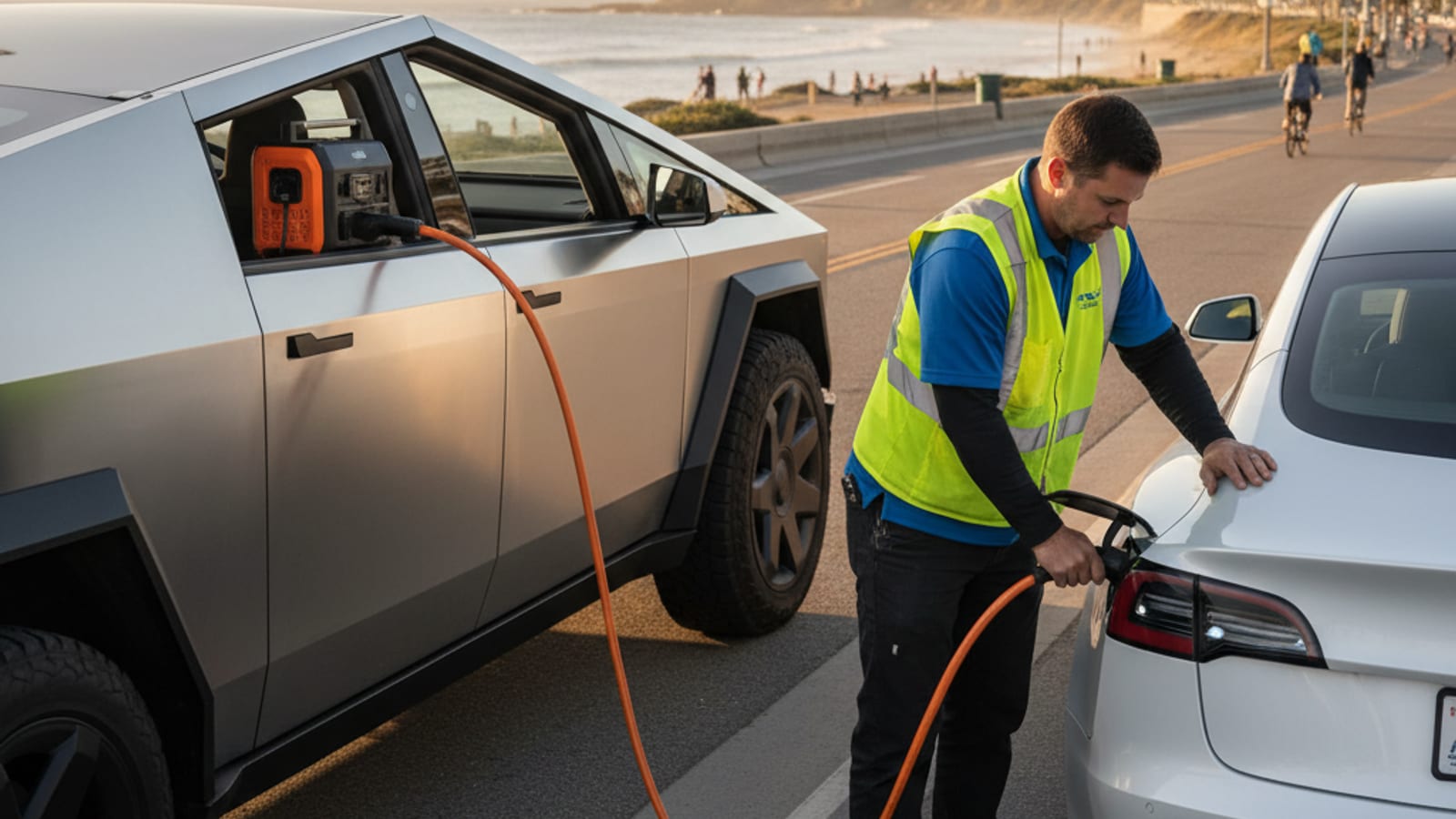
Malibu stretches farther than it looks
Malibu covers about 19.8 square miles against the Santa Monica Mountains. Census ACS figures for 2019 to 2023 put the population at 10,516. The 2024 estimate is 10,298. That’s a small city pulled thin along twenty-one miles of State Route 1. You’re not circling a downtown grid. You’re on an exposed coastal highway, then on steep grades inland.
Onshore wind and fog shape the drive more than inland heat. You crawl when the marine layer sits on PCH. Lights stay on. Climate control stays on. Range falls faster than a dry cruise at sticker speed. NWS Los Angeles/Oxnard describes that marine layer as May Gray and June Gloom. We don’t print a Malibu station temperature. Those normals weren’t attached in the research we used.
About 63.5 percent of Malibu housing was built before 1980. Those houses weren’t designed around a dedicated EV circuit. If you don’t have a working wall unit, you start on whatever the pack already holds. The first canyon is a thinner margin.
This city is affluent by Los Angeles County standards. Teslas and other EVs are common on PCH, in Malibu Colony, and around Pepperdine. A missed overnight charge still leaves you short on Kanan Dume.
ZIP codes 90263 and 90265 cover the city. An operator has to find you on the beach side or the mountain side. A city-only pin is too big.
Pacific Coast Highway, then the canyon climbs
State Route 1 is the spine. Cars stop near Big Rock, Paradise Cove, Point Dume, and the Pepperdine district. They stop at the Civic Center after an errand, with nothing left to get home. They stop in Malibu Park after a night at the house. They stop on Colony streets when the 12V has sat too long.
Almost no shoulder exists on long stretches of PCH. That’s pavement, not a charger map. If the car slows, you may have little room to sit. Put the hazards on. Stay with the vehicle if it’s safe. Don’t walk the travel lane to look around.
Malibu Canyon Road, also called Las Virgenes, climbs toward Calabasas. Kanan Dume Road climbs toward Agoura Hills. Decker Canyon is another steep cut through the mountains. Topanga Canyon Boulevard, State Route 27, drops from the 101 to the coast through Topanga.
Those grades are long and slow. Elevation change drains the pack. Cooler canyon air doesn’t cancel that. Some drivers leave Calabasas or Agoura Hills with a number they liked. They still meet a dead car on the way to the beach. The return climb can do the same.
Topanga is its own community on that grade. The ACS population is 8,781. About 65.9 percent of housing there predates 1980. Named areas include Topanga village, Fernwood, and Sylvan, plus the state park edge. Old Topanga Canyon Road and the SR-27 grade are where cars sit between the Valley and PCH.
For the canyon itself, read EV roadside assistance in Topanga. For the highway shoulder, read stalled on PCH in Malibu.
Empty pack or dead 12V
From the curb, both failures look like a car that won’t go. They’re not the same job.
The drive pack hit zero
You spent the last miles crawling through fog on PCH. You climbed Kanan Dume and never got the range back. You left a Pepperdine event and pointed west on a low charge. The car limits speed, then it stops. A gas can doesn’t help. You need a charge at the port.
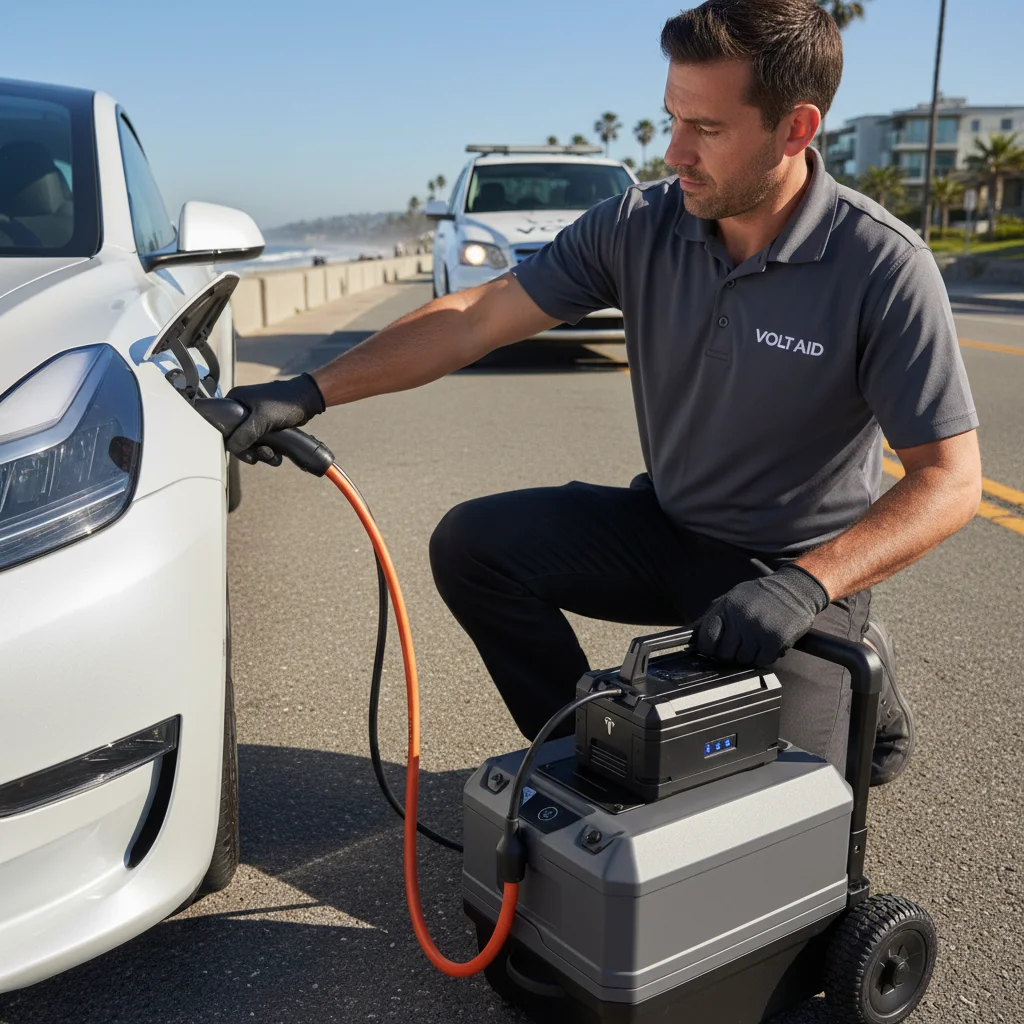
Operators we connect you with bring a 240-volt Level 2 source to the car. Teslas use a native NACS plug. Other EVs use CCS or a J1772 adapter. Charging time is typically 15 to 30 minutes. That’s time on the plug, never an arrival time. The boost is typically 10 to 20 miles of range. You pick the next stop. We couldn’t confirm a single nearest-charger mileage for every stretch of this coast. Check a live charging app. Confirm the stall is working before you treat it as a plan.
The 12V battery dropped out
Teslas still rely on a small 12-volt battery. It powers locks, screens, and the computers that close the high-voltage contactors. If that battery dies, the car can act like a brick. The main pack can still be full. A weekend in a Paradise Cove or Colony lot is a common setup. So is a car left all day in Pepperdine parking.
A jump or an on-site 12V replacement is the work. A tow to a Supercharger doesn’t wake a dead 12V by itself. Start with Tesla 12V battery jump if the screens are dark and the app can’t talk to the car. The operator quotes you before starting. They bill you directly.
What EV roadside assistance means in this city
Charge Pro LA doesn’t hold a contractor license for this work. We don’t own trucks, a yard, or charging gear. We don’t employ the technicians. We’re a match from stranded driver to independent local operator. Service area is Los Angeles County, and Malibu is inside it. The pros we connect you with are licensed and insured.
EV roadside assistance is the umbrella. Mobile EV charging is the empty-pack boost. Tesla roadside rescue is the Tesla mix of pack and 12V. Ask for the job you actually have. Don’t ask for a charge if the doors won’t unlatch.
Metro Freeway Service Patrol won’t fill an EV pack. FSP is free to motorists. It’s a joint program of Caltrans, the California Highway Patrol, and LA Metro. It roams congested Los Angeles County freeways. Published help includes a gallon of gas and a radiator refill. It also includes a taped hose, a tire change, and a free tow to a safe spot CHP chooses. You reach it by dialing 511 and saying Motorist Aid. We read metro.net and chp.ca.gov on 2026-09-18. The published list doesn’t include mobile EV charging or out-of-charge battery help. That’s an observed absence, not a rumor about secret policy. PCH through Malibu also isn’t that freeway beat. Don’t wait on a gallon-of-gas truck for a Tesla at zero.
CHP can still dispatch a rotation tow for a disabled vehicle on a freeway. If an officer orders a tow, you may not be choosing the company.
Shoulder rules you can actually look up
If you’re on a freeway, California Vehicle Code 21718 generally bans stopping, parking, or leaving a vehicle standing. Exceptions include a disabled vehicle when another vehicle has been summoned to help. They also include a stop to avoid injury or damage, or a peace officer’s direction. A stranded EV that’s already called for help fits the disabled-vehicle exception. Read the current section on leginfo.legislature.ca.gov. Don’t treat every mile of PCH as a freeway. Some stretches are a conventional state highway. The code section you need depends on the facility you’re on.
CVC 21809 is the move-over law. Drivers who approach a stopped emergency vehicle, tow truck, or Caltrans vehicle showing flashing lights must change lanes if it’s safe. If it isn’t safe, they must slow to a reasonable speed. That rule protects the operator once they’re working. It doesn’t invent a shoulder where the pavement is narrow.
CVC 22651 lists when an officer or authorized employee may remove a vehicle. Reasons include blocking traffic, or blocking a hydrant or driveway. They also include sitting unattended on a freeway for four hours or more, and sitting on a highway for 72 hours or more. Don’t lock a dead Tesla on PCH and walk away. Stay with it, or you can lose it.
Private property tows, including some Civic Center and beach lots, fall under CVC 22658. Removal requires the specified 17-by-22-inch entrance signs and written authorization from the owner or agent. It also requires immediate written notice to the registered owner, and notice to local law enforcement within one hour. If you return before the car leaves the lot, they have to release it. Storage rates can’t exceed law-enforcement or CHP-approved rates. We didn’t find a verified statewide dollar cap, so we don’t print one. Ask for the written authorization if a hook comes out.
Nobody at Charge Pro LA sets the rescue price. The operator on scene quotes it. You accept or you decline.
Power at the house still doesn’t help on PCH
Malibu belongs to the Clean Power Alliance. CPA has bought generation for member cities since 2017. Malibu is on the member list we checked on cleanpoweralliance.org on 2026-09-18. Southern California Edison still delivers the electricity, maintains the lines, and reads the meter. Two line items on the bill don’t change a dead car on Decker Canyon.
If you’re shopping a home charger, SCE publishes Charge Ready Home on sce.com. It also publishes a pre-owned EV rebate there. Confirm current program names and amounts on that site. We don’t reprint dollar figures. LADWP rebates are for the City of Los Angeles. They don’t apply in Malibu.
An older panel in a pre-1980 house can make a wall unit a separate construction job. That project doesn’t move the car on PCH tonight. The roadside call is about the vehicle in front of you.
Cities that share the coast and the mountains
Santa Monica sits east on PCH. Calabasas and Agoura Hills sit over the ridge. The City of Los Angeles sits farther east, past Santa Monica. West of that, Malibu carries the county’s coastal miles toward the Ventura County line. We serve every city in Los Angeles County. We don’t promise work past that line.
The same 12V brick shows up in a Fernwood driveway. The same empty pack shows up on a slow SR-27 climb. Nearby names from the research are Agoura Hills, Calabasas, Topanga, Santa Monica, and Los Angeles. Use the place name that matches the pavement you’re on when you call.
Steps that keep you safer than improvising
Get out of the travel lane if the car will still roll. On PCH that may be a turnout, a lot entrance, or as far right as the paint allows. Hazards on. Don’t stand in the lane.
Pin the location with a corridor and a named place. Westbound PCH at Big Rock is usable. Point Dume, Paradise Cove, the Civic Center, and Pepperdine are usable. A vague Malibu pin wastes the first minutes.
Separate pack from 12V. Dark screens, stubborn doors, and a silent app point to 12V. A car that drove to zero and then stopped points to an empty pack. If you’re unsure, say both so the operator brings the right gear.
Request a local match, not a gasoline patrol. Charge Pro LA connects you with an independent operator. Give make, model, plug type if you know it, and whether you need a charge or a 12V jump.
Stay with the car. Get the quote before work starts. The operator bills you.
Treat a tow as the last tool, not the first. Many EVs need a flatbed so the drivetrain isn’t damaged. Confirm that before anyone hooks the car. We have no verified Los Angeles County tow-rate schedule to quote. Don’t assume a tow is cheaper. Don’t assume it’s faster. If an officer says the car has to move, follow that order.
Tesla, and every other EV on this coast
Model 3, Y, S, X, and Cybertruck all show up on this corridor. Current Teslas use a native NACS plug. Ask the operator what they’ll bring. Don’t guess from a forum thread.
Rivian, Lucid, Porsche, Hyundai, Kia, Ford, Chevy, BMW, and Mercedes strand on the same fog and the same grades. CCS or J1772 is the usual answer. A Tesla-only cable doesn’t help a CCS port. Say the brand when you call.
A Supercharger doesn’t help if you can’t drive to it. It also doesn’t help a 12V brick. Mobile Level 2 is for the car that can’t make that last hop.
Flat tires still happen. Many EVs have no spare and odd jack points. That’s not a charging dispatch. Say it’s a tire so the wrong truck doesn’t roll.
A stuck charge latch or a wet port is another non-pack problem. Dry the port before anyone plugs in. Don’t force a locked cable.
What we can say about range here, and what we can’t
We couldn’t confirm how far you are from a working stall on this coast. Those figures weren’t verified for this page. Open a charging app, look at live status, and call the site if you can.
What is local and physical is the corridor. Twenty-one miles of PCH, almost no shoulder, onshore wind, fog, and the canyon roads over the Santa Monica Mountains. Low-speed crawling and sustained climbs are what drain the pack. That’s the Malibu problem, not a copied inland-heat story.
If you left home in Santa Monica with a comfortable number, the westbound run can still land you at zero. Add a canyon side trip and the margin gets thinner. If you left the 101 in Calabasas, the descent doesn’t always repay the next climb. Plan the day around the grades you already know, not a sticker range.
Frequently asked questions
Which EVs can get a mobile charge or a 12V jump in Malibu?
Operators in this network handle Tesla and every major EV brand. They bring a native NACS plug for Tesla. They bring CCS or J1772 adapters for everyone else. Confirm the plug when you request the match.
How much range does the mobile Level 2 boost add?
Typically 10 to 20 miles during 15 to 30 minutes of charging. That’s on-plug time. It isn’t a promise about when someone arrives. Vehicle efficiency and starting charge change the result. You’re buying a usable hop, not a full pack.
What if the Tesla won’t unlock and the main battery isn’t empty?
Treat it as a 12V failure until a test says otherwise. A jump or a replacement on site is the usual path. Towing to a charger doesn’t, by itself, wake a dead 12V.
When you’re ready to request a match, call Charge Pro LA at (858) 925-5546. Give the operator your spot on PCH or the canyon, the model, and whether the screens still work. They quote before they start. They bill you directly.