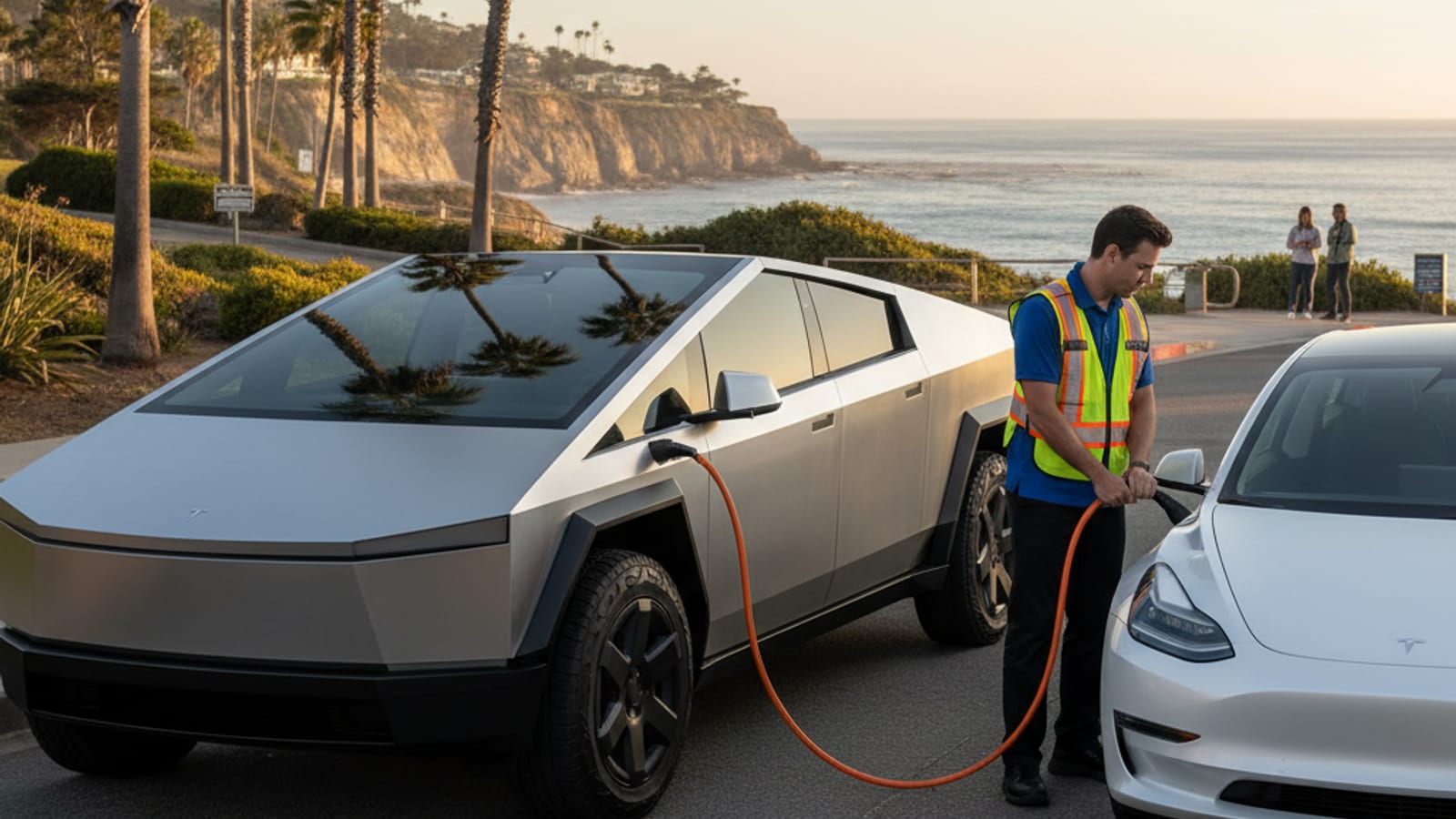
A Tesla can stall at a public post in downtown Manhattan Beach. The same car can empty out on the Hill Section. That happens after a long 405 crawl. Affluent coastal driving doesn’t add miles to the pack. You still need ev roadside assistance in Manhattan Beach when the car won’t roll. Charge Pro LA connects you with independent operators. They bring a 240V Level 2 source to your pin.
This city covers 3.934 square miles. ACS population is 34,584. The 2024 estimate is 33,453. ZIPs are 90254 and 90266. About 60.0 percent of housing went up before 1980. Hispanic or Latino residents are 7.6 percent of the city. Census income figures sit at the high end of Los Angeles County. We’re not printing a dollar median here. Check the Census tables if you need that number.
Charge Pro LA is a referral line for Los Angeles County. We match stranded EV drivers with independent mobile rescue operators. We don’t perform the work. We own no trucks and no equipment. We don’t employ technicians of our own. We set no prices and we publish no hours. We hold no contractor license for the charging itself. The operator quotes you before any cable goes in. They bill you directly. The pros we connect you with are licensed and insured. We serve every city in the county.
What those operators bring is a 240V Level 2 source. Teslas take a native NACS plug on this call. Other EVs use a CCS or J1772 adapter. A typical session adds 10 to 20 miles of range. That’s 15 to 30 minutes of charging time. It’s never an arrival time.
Beach traffic, not weather, is the range story
Manhattan Beach sits in the Westside and the Beaches belt. The climate is mild and marine. May Gray and June Gloom keep summers cool and damp. Cabin heat isn’t the daily drain it is in the high desert. Stop-and-go sand traffic is the local drain. You idle on Sepulveda Boulevard. That stretch is also SR-1 and PCH. You crawl Rosecrans Avenue toward the water. Marine Avenue stacks up on weekend afternoons. The car uses energy while the wheels barely turn.
Lancaster and Palmdale see a different pattern. Heat and cold cut range there. Recurrent Auto tested more than 30 models. That’s the range-loss source we use. EVs kept about 78 percent of range at 32°F. They kept about 70 percent of range at 20°F. Losses on individual models ran from about 16 percent to about 46 percent. Cabin heating drove most of it. AAA testing found about 10 to 12 percent loss at 20°F from cold alone. Climate control pushed the loss around 40 percent. Recurrent also notes summer heat and heavy A/C cut range. A heat pump helps in cold versus a resistive heater.
Those figures describe inland and mountain days more than this marine strip. They still matter if your day left the coast. A trip that included the Grapevine north of Castaic is a sustained grade. A trip that included Sepulveda Pass is the Westside-to-Valley climb. If you stacked that onto a beach evening, the buffer shrinks. The Hill Section is where it vanishes. Don’t pin those percentages on Tesla. They come from Recurrent and AAA.
Name the section when you call
Locals don’t say they’re merely near the water and stop. They name a section. The Sand Section sits closest to the water. Streets are tight in that grid. A rescue truck still needs a legal place to sit beside you. Leave a gap and stay with the car.
The Tree Section and downtown sit behind the sand. Downtown is where public posts see the most competition from shoppers and diners. A stall can be occupied. It can fail a handshake. It can be the wrong plug. A busy or failed post is still a stall. This research doesn’t inventory every public stall. It also doesn’t let us guess the distance to the next working one. If you can still roll, use your map and a charging app. If you’re at zero, you’re not hunting another post on foot.
East Manhattan sits toward the 405. That’s the inland edge of a very small city. Cars coming off the freeway often hit East Manhattan first. Then they still have the Hill Section if home is up the grade.
The Hill Section is the problem this ZIP keeps repeating. Cars come home from inland jobs with little margin after the 405. The last climb is short compared with a mountain highway. It’s still enough to strand a pack that’s already low. Affluent drivers stall here for that reason. We’re describing a commute plus a grade.
When you talk to a dispatcher, give the section, then a corridor. Use Sepulveda, Rosecrans, Marine, or the 405 edge. Add a cross street you can see. Don’t describe a landmark this research didn’t verify.
Older housing and a bill that won’t rescue you
Sixty percent of Manhattan Beach housing predates 1980. Many Sand Section and Tree Section garages weren’t built for a 240V EV circuit. Shared driveways and tight lots make a wall unit a project. Confirm panel capacity with a licensed electrician if you want home charging. Charge Pro LA doesn’t install equipment. We don’t stock parts. An empty pack tonight is a curb problem.
Power in this city isn’t LADWP. LADWP serves the City of Los Angeles. Manhattan Beach takes delivery from Southern California Edison. Clean Power Alliance buys the generation. CPA was founded in 2017 and serves 38 communities. Manhattan Beach is on that member list. So are Redondo Beach, Santa Monica, Culver City, and Hawthorne. Unincorporated county areas are on it too. SCE still maintains the wires and reads the meter. You may see two line items. That split doesn’t send a truck to your bumper.
SCE publishes Charge Ready Home on sce.com. It also publishes a pre-owned EV rebate. We’re not repeating dollar amounts from those pages. Confirm current figures on the utility site before you budget a wall box. CPA is a generation choice. It isn’t a mobile charger. Don’t tell a stranded spouse to call the power company for a boost.
Nearby cities on the same South Bay loop
El Segundo sits north, against airport and office traffic. Hawthorne and Inglewood sit inland of the 405. Redondo Beach is the next beach city south. Torrance sits deeper in the South Bay grid. A stall here is often the last ZIP of a South Bay day.
LAX is in that northward mix. Los Angeles World Airports runs terminal parking in structures P1 through P7. All of them offer Level 2 and DC fast charging. The Economy Parking garage has more than 4,000 stalls, including 514 active EV chargers. A traveler can still return to a dead 12V. Chargers in the garage don’t wake a car that won’t boot. The 12V failure isn’t an empty drive pack. You might roll south from that airport mess. If the car dies in Manhattan Beach, sort the symptom first. Don’t ask for a charge until you know it’s the pack.
We serve every city in Los Angeles County. The operator’s plug doesn’t change at the city limit. The street names do.
Empty pack versus a silent 12V
Sort the failure before anyone rolls. Three patterns cover most calls.
The drive pack is at zero, or so close the car has limited you. Screens still work. The charge port may open. Hazards still blink. That’s an out-of-charge recovery case. A Level 2 boost at the curb is the usual fix.
The car is a brick. Screens stay dark and handles may not present. The phone key does nothing useful. The high-voltage percentage might still be fine. The 12V battery wakes the computers. Teslas have one. So do the other major EV brands. A Tesla 12V battery jump is the on-site check. Operators can jump or replace that battery when that’s the failure.
The car is awake. The pack isn’t empty. A public post won’t start a session. That’s a station, cable, or handshake problem. Don’t keep forcing the connector. Try another stall only if you can still drive. If you can’t, you still want a mobile Level 2 source.
Phantom drain sits under all three. Sentry mode draws power. Cabin overheat protection draws power. Scheduled preconditioning draws power. A quiet Tree Section street can hide that for days. Then you pack the family and the car won’t wake. A week parked after a beach stay does the same thing. Check those settings before you leave the car for a long sit. Don’t jump the high-voltage pack. A neighbor with jumper cables can’t refill a drive battery. The 12V is the jumpable battery. The drive pack needs a charger.
What a mobile Level 2 session is
Mobile EV charging is a 240V source brought to your pin. It isn’t a Supercharger. A Supercharger is Tesla’s DC fast network. DC fast stalls from other networks do the same job for CCS cars. A mobile session is slower than DC fast. It’s much faster than a 120V wall outlet. Operators typically add 10 to 20 miles in 15 to 30 minutes of charging. You use those miles to reach home. Or you reach a DC stall you already trust.
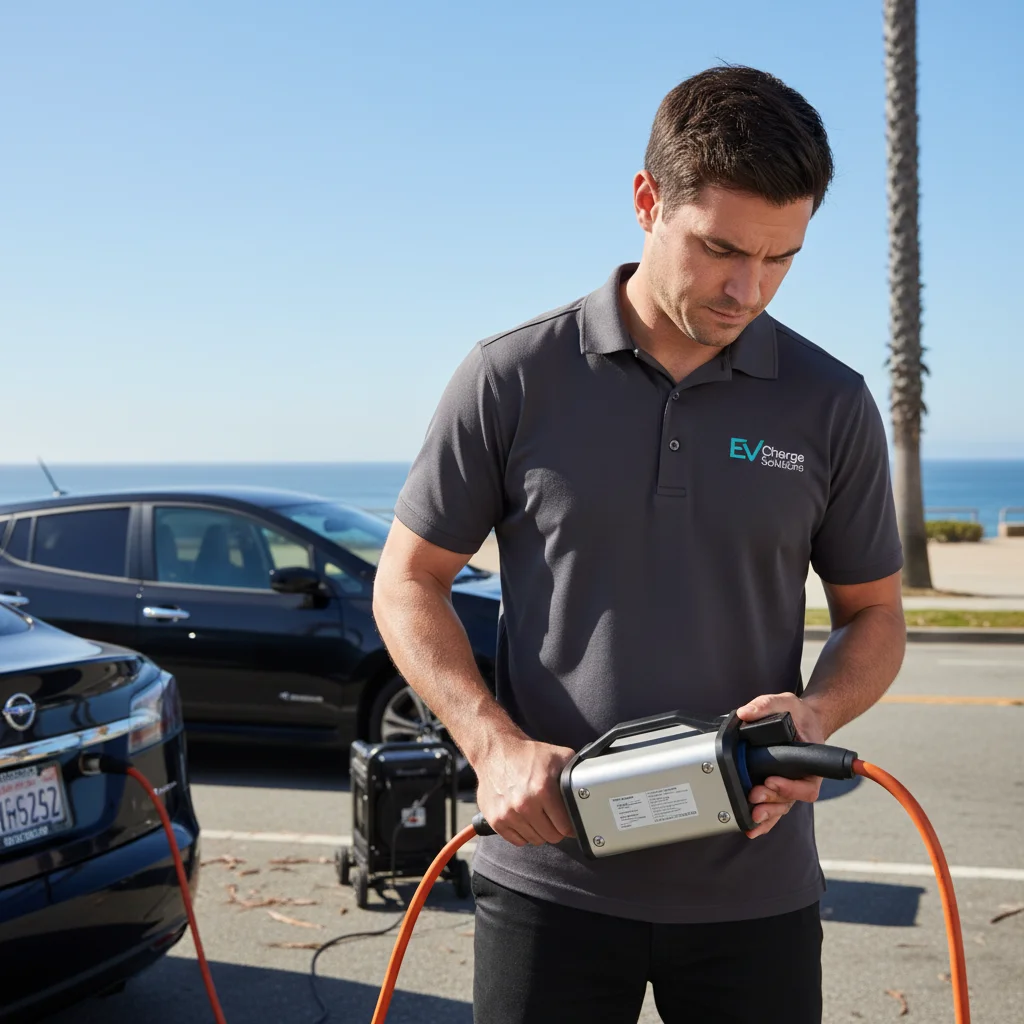
They carry a native NACS plug for Tesla. They carry CCS or J1772 adapters for everyone else. Ford, Chevy, Hyundai, Kia, and BMW still get a plug that fits. So do Mercedes, Rivian, Lucid, and the rest. Non-Tesla EV rescue is the same call pattern with a different adapter. Say the make, model, and year. The operator confirms hardware before they spend the trip. They quote first. You accept or you don’t. There’s no rate card on this site because we don’t set prices. Ask the operator. Approve the number. Then they plug in.
If you’re on the 405 edge or on Sepulveda
A stall on a Sand Section street is inconvenient. A stall on the 405 is a safety problem. California Vehicle Code 21718 generally bans stopping on a freeway. A disabled vehicle that has summoned help is an exception. Call, then stay with the car if it’s safe. Put your hazards on and stay visible. Exit the passenger side when traffic allows. Stand behind a barrier if one exists.
CVC 21809 is the move-over law. Drivers must move over for a stopped emergency vehicle with flashing lights. The same rule covers a tow truck or a Caltrans vehicle. Change to a non-adjacent lane if it’s safe. If they can’t, they must slow to a reasonable speed. That rule exists to protect anyone on the shoulder.
CVC 22651 lists when a peace officer may remove a vehicle. Obstructing traffic is on that list. So is a car left unattended on a freeway for four hours or more. Don’t lock up and walk toward Marine Avenue from the freeway shoulder. You can lose the car to a rotation tow.
Metro Freeway Service Patrol is free to motorists on congested Los Angeles County freeways. Caltrans, CHP, and LA Metro run it. Dial 511 and say Motorist Aid. Published help includes a gallon of gas. It also includes a radiator refill and a tire change. It includes a free tow to a safe spot CHP designates. Hours are typically Monday through Friday during peak commute periods. Coverage expands midday and on weekends on the most congested corridors. Construction zones can have all-day patrols. The published list doesn’t include mobile EV charging. An empty EV can get a tow to a safe location. It doesn’t get a Level 2 session from FSP on the materials we read. We read those materials on metro.net and chp.ca.gov. CHP also dispatches rotation tows for disabled freeway vehicles. Details of the local rotation list weren’t verified in this research. Don’t assume a rotation tow includes charging.
Private lots use a different statute. CVC 22658 requires 17-by-22-inch signage at entrances for a private-property tow. The owner or agent must authorize it in writing. Local law enforcement gets notice within one hour. If you return before the car leaves, they must release it. If it’s coupled but not yet moved, the cap is half the tow charge. Storage can’t exceed law-enforcement or CHP-approved rates. California doesn’t publish one verified statewide cap we can print. Ask the lot and the agency before you argue a number. We couldn’t confirm a single statewide figure.
Towing is the backup, not the default
Some cars need a flatbed. Collision damage can force it. A pack that won’t accept charge can force it. A pin that blocks all access can force it. An empty, undamaged EV on a quiet Hill Section street usually doesn’t. Many manufacturers forbid flat towing. Drive units can take damage if wheels spin without the right transport mode. A mobile boost keeps the car on its wheels. That’s why towing a dead EV in Los Angeles County is the last call for this failure.
A tow also creates a second stall. The yard may not have a compatible plug. Then the car sits. You still need energy. You’ve just changed the ZIP of the problem. If a tow is truly required, ask where the car will go. Ask whether that site can charge your port. We don’t publish tow fees. Confirm them before you approve a hook.
What to do in the first minutes
Get out of the travel lane if you can still creep a few feet. Put your hazards on. On the 405, use the passenger side. On Sepulveda, Rosecrans, or Marine, stay legal and visible. Read the car. Note the indicated miles or percent. Note any 12V or electrical warning. See if the charge port door opens. Try the phone key or card once. Repeated cycling doesn’t refill a pack.
If the car is awake and empty, ask for a Level 2 boost. If the car is dark, ask for a 12V check first. Tell the operator the section name. Sand, Tree, Hill, East Manhattan, or downtown is enough to start. Add the nearest listed corridor. Stay with the vehicle. A silent EV still looks abandoned. On private property, that can start a 22658 clock. On a freeway, it can start a 22651 removal.
Have a destination in mind for 10 to 20 miles. Home in the Hill Section may be enough. A DC stall you’ve used before may be better if home is uphill. We won’t invent a station name this research didn’t verify. Use your map. For city-level charging context, open the Manhattan Beach EV charging page. Treat app data as live. Treat this article as the rescue plan.
How a Charge Pro LA call actually runs
You describe the city, the section, the car, and the symptom. We refer that to an independent operator in this county network. They contact you with a quote. If you agree, they come to your pin. They bring Level 2 hardware and the right adapter. They connect, run a short session, then disconnect so you can drive.
We don’t promise a minute count for the drive to you. Beach traffic on a Saturday is real. A 405 backup is real. The operator’s window is their window. Your approval is what starts work.
Tesla roadside, club roadside, and insurer roadside are separate programs. They may send a tow. They may not send a charger. A local mobile session is a direct job with the operator. We don’t file an insurance claim for you. Keep EV roadside assistance as the service path for this search. The operators we connect you with handle Tesla and every major EV brand. They jump or replace a dead 12V on site when that’s the job. They don’t replace a Supercharger network. They get you off the curb.
Frequently asked questions
Do operators in Manhattan Beach help only Tesla, or every EV?
They help Tesla and every major EV brand. Native NACS covers Tesla ports. CCS or J1772 adapters cover non-Tesla ports. Give the make and model when you call. The operator then brings the right plug.
How many miles does a mobile Level 2 boost add?
Typical charging adds 10 to 20 miles of range. Plug-in time is usually 15 to 30 minutes. That’s charging time, not a promise of when someone arrives. It isn’t a full pack. It’s enough to reach home or a DC stall you already chose.
Who sets the price, and who does the work?
Charge Pro LA doesn’t set prices and doesn’t do the work. We’re a referral line. The independent operator quotes you. They perform the session or 12V service. They bill you directly. Approve the quote before they plug in.
If you’re stuck in Manhattan Beach now, call (858) 925-5546. We’ll connect you with a local operator. Ask for a Level 2 boost or a 12V jump. You leave on the car’s own power.