The sticker range on your EV is a lab figure. In Los Angeles County, Antelope Valley heat and cold cut real miles. Heavy AC on a Grapevine climb cuts them further below that sticker. Electric vehicle battery maintenance here starts with that gap.
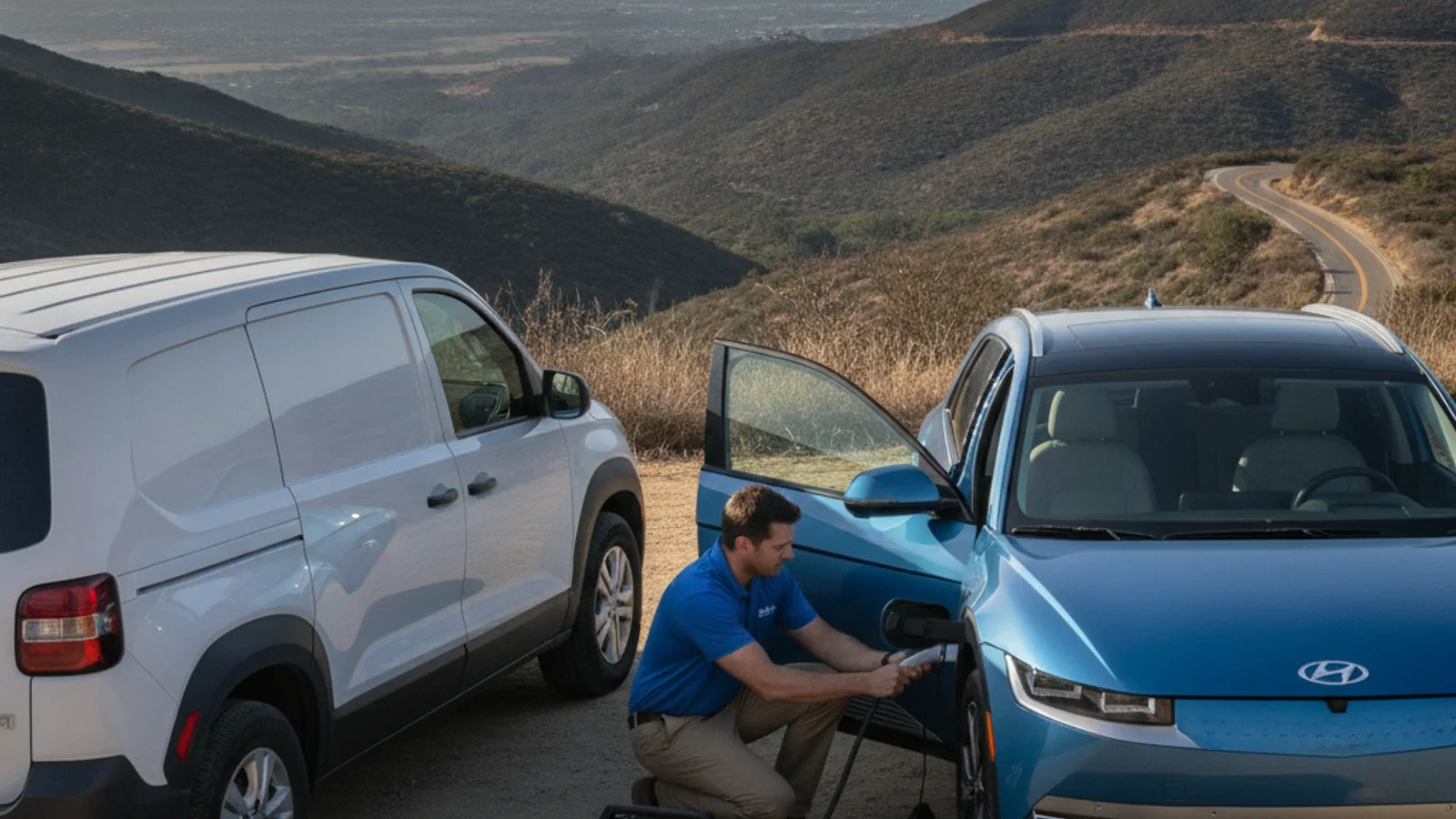
Heat and cold in this county aren’t one climate
A pack that lives in Lancaster doesn’t live a coastal life. Palmdale sits in the same high-desert basin. U.S. Census ACS 2019-2023 counts Lancaster at 170,013 residents. Palmdale’s count for that same period is 165,487. Both sit in the Antelope Valley, not on the marine layer. They see triple-digit summer heat and near-freezing winter nights.
Coastal cities sit in a different thermal world. Santa Monica, Redondo Beach, and Malibu get May Gray and June Gloom. NWS Los Angeles/Oxnard describes that marine layer for the coast. It also describes Santa Ana winds that shove inland heat west. The San Fernando and San Gabriel valleys run hotter than the beaches. We’re not publishing station normals on this page. Confirm current readings with NWS if you need a number for planning.
Recurrent Auto studied more than 30 models for temperature and range. At 32F, EVs kept about 78% of rated range on average. At 20F, that dropped to about 70%. Individual models lost about 16% to about 46%. Cabin heating was the main driver of that loss. Summer heat and heavy air-conditioning also reduce range. A heat pump helped at 32F versus a resistive heater. Recurrent put that cold-weather gain at roughly 10%. Read Recurrent’s current papers on recurrentauto.com before you quote a figure.
We can’t attribute those percentages to Tesla as a brand. tesla.com isn’t a source we can cite on this site. Your trip computer already blends recent hills, cabin load, and weather. Daily pack care in the desert is mostly load and heat. Cabin AC on a parked car still draws from the same battery. Shade helps the cabin, and it doesn’t replace a charge plan. Read how long Tesla batteries last in Los Angeles County heat for pack aging over years. This one covers the miles you thought you had today.
Grades spend range a sticker never promised
Tejon Pass, the Grapevine on I-5, is the county’s defining EV-range corridor. The long sustained grade north out of Castaic isn’t a short ramp. We couldn’t confirm a USGS summit elevation for this page. We won’t invent a summit number for you. Antelope Valley heat and cold cut real range. AC on a 100F Grapevine climb cuts it further below the sticker. Recurrent’s heat and AC research is the basis for that, not a roadside guess.
Santa Clarita’s the last large basin city before that northbound pull. Castaic and Stevenson Ranch sit on the I-5 approach. A day at Six Flags Magic Mountain still dumps you back onto that corridor. If you’re staging the climb, start with our Grapevine notes before you leave. Keep a reserve for the grade and the cabin, not a hope. The 14 through Acton’s the other desert gate. Sepulveda Pass on the 405’s the Westside-to-Valley climb. Angeles Crest Highway’s a high mountain road. Caltrans manages seasonal snow closures on that highway. Check the current status on dot.ca.gov before you go.
None of that’s a claim about missing chargers in any city. Inspect a station’s published level on the DOE Alternative Fuels Data Center. Do that before you roll, not after you’re already low. Actual speed still depends on your car, state of charge, and air temperature.
Follow the maker, not a county-wide percentage
Every EV maker publishes its own traction-battery guidance. Tesla’s owner support pages set charge limits for Tesla packs. Rivian’s current docs do the same for Rivian packs. Ford, Hyundai, Chevrolet, and Kia manuals each set their own limits too. They also set software update cadence and service intervals. Those figures differ by model and by battery chemistry.
We can’t confirm a single degradation rate for every EV in Los Angeles County. We can’t confirm one ideal charging window either. If a post hands you a specific percentage for heat or grade, it’s guessing. Your owner’s manual’s the document built for your car. So’s the maker’s app on your phone. Tire rotations, brake fluid, and cabin filters still have calendars. Those items aren’t the high-voltage traction pack. Our EV maintenance schedule for owners walks through those non-battery items.
Overnight charging at home’s still the gentlest habit most manuals describe. We won’t name a charge-limit percentage we couldn’t verify across brands. If your app offers daily and trip limits, use the maker’s labels.
The 12V can brick a car with a full pack
Owners mix up battery symptoms all the time. An EV has two systems, and they fail differently. The traction pack’s the one that powers the drive motors. It’s the big one behind the range estimate. When it runs low, you get a countdown. The car keeps moving until the pack can’t. That’s a charging problem, not a mystery brick.
The 12V battery is a much smaller pack. It runs door locks, the screen, and the computer that wakes the high-voltage system. When the 12V fails, the car can seem fully dead. The car won’t start in any normal sense. The traction pack can still be full. A week in an airport garage can do this. It can happen even when the lot has chargers. LAX terminal structures P1 through P7 offer Level 2 and DC fast charging. The Economy Parking garage has 514 active EV chargers. A dead 12V’s still a dead 12V. Charging stalls don’t jump that little battery for you.
If the range looked fine last time you parked, start with the 12V. Our Tesla 12V warning guide walks through the signs. A jump on site often wakes the car without touching the drive pack. The independent operator on scene decides what’s safe for your model.
Home power in this county isn’t one utility
There’s no single electric utility in Los Angeles County. LADWP serves the City of Los Angeles on its own grid. It’s the largest municipal utility in the United States. Most of the rest of the county’s Southern California Edison territory. Glendale, Burbank, Pasadena, and Azusa run municipal power utilities. Clean Power Alliance buys generation for many cities, including unincorporated county areas. SCE still delivers the power and reads the meter. Lancaster and Palmdale aren’t on CPA’s published member list we checked on cleanpoweralliance.org. Your bill’s the authority.
LADWP publishes a Residential EV Charger Rebate Program. It also publishes a dedicated EV time-of-use rate that requires a separate EV meter. SCE publishes Charge Ready Home and a Pre-Owned EV Rebate. We don’t publish dollar amounts on this site. Confirm the current offer on ladwp.com or sce.com before you budget. Overnight charging on a rate your utility actually offers counts as pack care.
A stranded driver’s rescue doesn’t change with CPA versus SCE generation. The operator still brings Level 2 to the car.
If you’re already low, pick the right kind of help
Metro Freeway Service Patrol’s free on congested LA County freeways. Caltrans, the California Highway Patrol, and LA Metro run it together. Dial 511 and say Motorist Aid for that patrol. Published help includes a gallon of gas and a radiator refill. It also covers a tire change and a free tow to a CHP-chosen safe spot. That list doesn’t name mobile EV charging or an out-of-charge boost. An empty pack sits outside that published menu, other than the tow.
California Vehicle Code 21718 bars stopping, parking, or leaving a vehicle standing on a freeway. Exceptions include a disabled vehicle when another vehicle has been summoned to help. If you’ve already called for rescue, that exception’s the one that applies. CVC 21809’s the move-over law. Approaching drivers must move to a non-adjacent lane if it’s safe. If they can’t, they have to slow to a reasonable speed. Stay with the car if you can do that safely. Don’t walk the shoulder.
If the traction pack’s depleted, out-of-charge recovery is the roadside option. That assumes you’re somewhere an operator can reach. The pros we connect you with are licensed and insured. They bring a 240V Level 2 source to the car. Teslas take a native NACS plug on site. Other EVs use a CCS or J1772 adapter. Typical charging adds 10 to 20 miles of range. That takes 15 to 30 minutes of charging, not travel time. The operator quotes you before starting and bills you directly. Charge Pro LA doesn’t own trucks, set prices, or promise a clock.
If the 12V’s the failure, a jump’s usually the on-site path. If the car charges, drives, and wakes, that’s not a roadside pack failure. A state-of-health reading belongs at a service center. A roadside operator’s job is getting you moving.
When to call
If the pack’s empty in Los Angeles County, that’s a roadside situation. It’s the same if the car won’t wake and you suspect the 12V. Call (858) 925-5546 when you’re in that spot. We’ll connect you with a local EV rescue operator.