An EV maintenance schedule in Los Angeles County is short. It’s not empty. After Sepulveda Pass and a desert commute, you still track tires, cabin filters, and the 12V. Oil changes are gone. Spark plugs are gone. Your owner’s manual still sets every interval for your VIN. Charge Pro LA doesn’t publish a county-wide calendar.
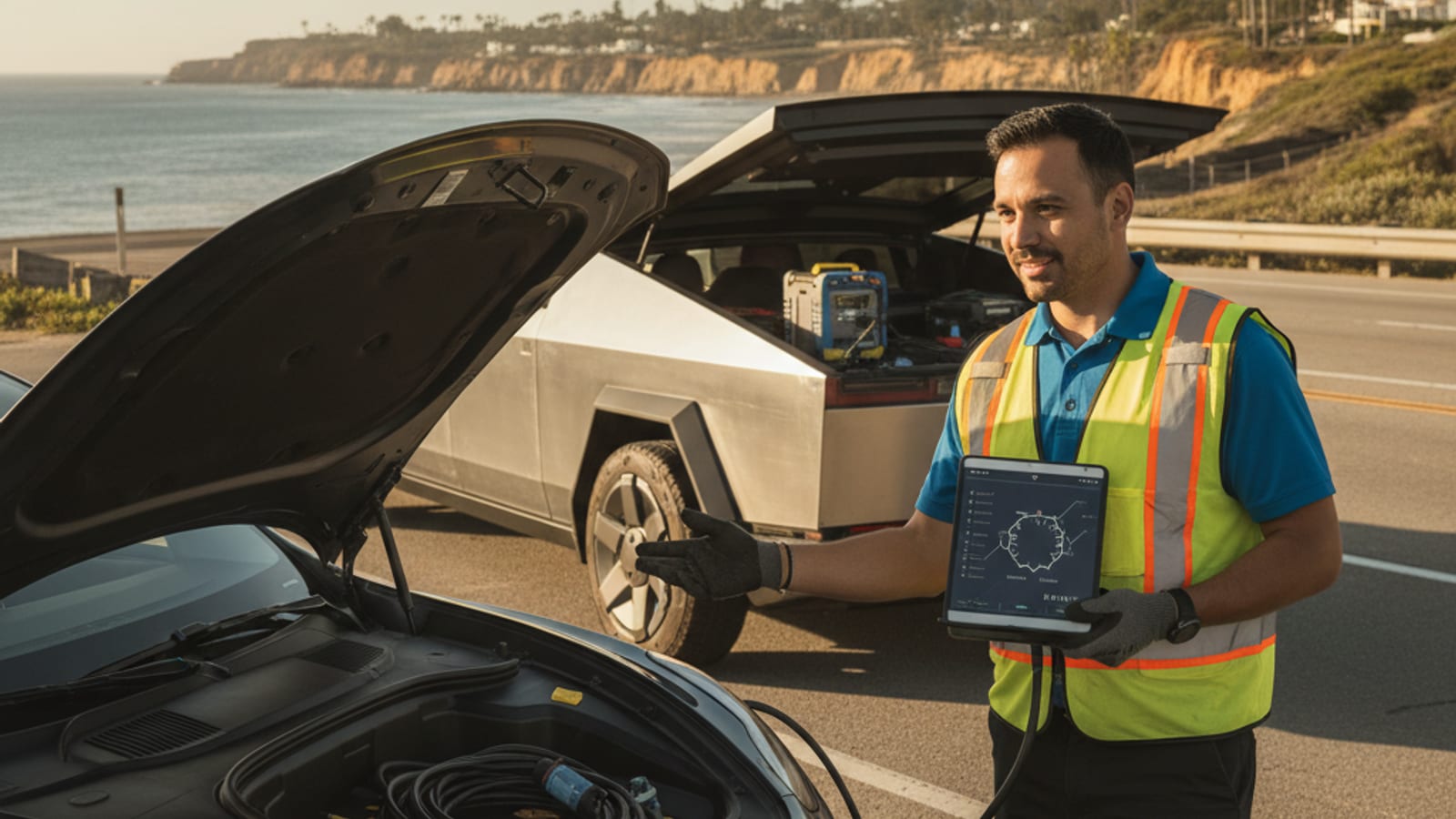
The three items that actually show up here
Los Angeles County isn’t one driving climate. A Lancaster commute isn’t a Santa Monica one. U.S. Census ACS 2019-2023 counts Lancaster at 170,013 people. Palmdale’s count for that period is 165,487. Both sit in the Antelope Valley. They see triple-digit summer heat and near-freezing winter nights. The coast gets May Gray and June Gloom. NWS Los Angeles/Oxnard describes that marine layer. It also describes Santa Ana winds that shove inland heat west. The San Fernando and San Gabriel valleys run hotter than the beaches.
Sepulveda Pass on the 405’s the Westside-to-Valley climb. The Grapevine on I-5’s the long grade north of Castaic. We couldn’t confirm a USGS summit figure for either pass. We won’t invent one. Instant torque and a heavy pack already load EV tires. A daily climb adds heat and wear on top. Cabin air still pulls dust after a desert run. The 12V still has to wake the car after a garage sit. Those three jobs remain after you delete oil from the list.
Tires after Sepulveda Pass and desert miles
EV tires wear for reasons a gas car already knows, plus a few it doesn’t. Full torque arrives at once. The traction pack adds mass. Many EVs ship with low-rolling-resistance rubber. That mix can chew tread faster if you skip rotation and pressure. Your book, not this page, sets the mile mark.
Check the sidewall for the cold-pressure number. Check it again after a hot Antelope Valley day. Heat raises the reading. Don’t bleed air to a cold spec on a hot tire. Recheck when the car has sat. We’re not publishing a target psi. The placard on your door’s the source.
Alignment matters more on a heavy EV. A curb on the 405 shoulder can knock it off. So can a pothole on an older Eastside street. East Los Angeles has 86.2% of housing built before 1980, per ACS 2019-2023. Whittier’s share is 88.9%. Lakewood’s is 88.8%. Stevenson Ranch sits at 3.4%. Older pavement and newer canyon cul-de-sacs aren’t the same ride. Have a shop inspect inner-edge wear after a season of grades.
Rancho Palos Verdes sits on peninsula grades. Calabasas and Agoura Hills sit on canyon roads. Malibu and Topanga sit on the coastal mountain side. None of that’s a claim about missing chargers. It’s a claim about load on rubber. Rotate on the interval in your manual. Replace when tread or damage says so.
If a tire fails on a congested freeway, Metro Freeway Service Patrol may change it. Caltrans, CHP, and LA Metro run that patrol together. It’s free to motorists. Hours are typically Monday through Friday during peak commutes. Dial 511 and say Motorist Aid. Published help includes a flat change and a gallon of gas. It also includes a radiator refill. It also covers a free tow to a CHP-chosen safe spot. That list doesn’t name a mobile EV charge. A shredded tire’s in their published menu. An empty pack isn’t, other than the tow.
Cabin filters after dust, not after oil
Cabin filters are easy to forget because the car still drives. Then the fan smells like a parking garage. Then the windshield fogs on a marine-layer morning. Santa Ana days push inland dust west. Desert miles into Palmdale and Acton pull grit through the intake. The coast’s milder. It isn’t dust-free.
ACS 2019-2023 puts Santa Clarita at 229,021 people. It’s the last large basin city before the I-5 north climb. Glendale’s count is 192,270. Burbank’s is 105,165. Those San Fernando Valley cities run hotter than the beaches. Pasadena’s count is 136,462. That city runs its own municipal grid. A filter that lasted a mild Westside year can clog sooner inland. We can’t publish a month count that fits every VIN. Tesla, Rivian, Ford, Hyundai, and Chevy each print their own. Read EV maintenance by brand for how to use each maker’s book. Then open the one that matches your year.
Replace the cabin filter when the manual says. Do it sooner if airflow drops. Don’t wait for a shop to bundle it with an oil change. You no longer need that oil change. There’s no oil change. This is the appointment now.
The 12V is the item that bricks the car
Every modern EV still has a low-voltage battery. It isn’t the traction pack. It runs locks, lights, and the screen. It also runs the computer that wakes the high-voltage system. If that small battery is dead, the car can act like a brick. The range display from last night doesn’t matter. The pack can be full.
Tesla’s current Model Y owner’s manual describes a lithium-ion low-voltage battery. Other models still use a conventional 12V. Either way, it’s a wear item. It’s often outside the traction-pack warranty. Tesla’s New Vehicle Limited Warranty covers the HV battery and drive unit. The PDF we logged is dated 2025/06/05. It applies to Model S, 3, X, and Y sold by Tesla. Model S and Model X get 8 years or 150,000 miles, whichever comes first. There’s a 70% capacity minimum on that coverage. Model 3 and Y Standard or Standard Range Plus get 8 years or 100,000 miles. Long Range or Performance on those two get 8 years or 120,000 miles. VIN terms in the Tesla app still control. That PDF doesn’t cover Cybertruck. It also doesn’t turn a dead 12V into a pack claim.
A week in airport parking is a classic 12V stall. Los Angeles International is operated by Los Angeles World Airports. Terminal structures P1 through P7 have chargers. Those lots offer Level 2 and DC fast charging. The Economy Parking garage has more than 4,000 stalls. That count includes 514 active EV chargers. A dead 12V is still a dead 12V. The stall doesn’t jump that little battery for you.
Cars that sit on the curb still drain the 12V. Cabin cameras and overheat protection, when your maker offers them, add load. We don’t have a verified drain figure to publish. If the car sits, check that the 12V still wakes it. Do that before you need a morning start.
Symptoms are quiet. Slow door handles. A dark screen. A car that won’t wake. Our Tesla 12V failure signs walk through that pattern. If you’re already stuck, the pros we connect you with can help. They can jump a Tesla 12V on site. They quote you before they start. They bill you directly. Charge Pro LA doesn’t own trucks or set a price.
Don’t treat a repeat 12V death as a fluke. Have a shop load-test it. Replacement intervals live in the manual for your year. We won’t invent a three-to-five-year rule.
What you can drop from the old gas list
You can stop hunting for oil-change coupons. There’s no engine oil. There are no spark plugs. There’s no fuel filter. There’s no timing belt. Many EVs use a single-speed drive unit. Some of those units never want a fluid service. Some do, at long mile marks. Only the book for your model settles that.
Electric motors are sealed. They don’t get a gas-car tune-up. Software updates do matter. Keep the car current when the maker pushes an update. Battery thermal management and charging logic live in that software. We’re not going to name a charge-limit percentage. We couldn’t verify one across brands. If your app offers daily and trip limits, use the maker’s labels. Read How to care for an EV battery through LA heat, cold, and grades. It covers pack load. This page covers the rest of the calendar.
Recurrent Auto studied more than 30 models for temperature and range. At 32F, EVs kept about 78% of rated range on average. Summer heat and heavy air-conditioning also reduce range. That matters on a Grapevine climb with the AC on.
Brakes, coolant, and the charge port still exist
Regenerative braking lets the motors slow the car. Friction pads work less often. They still rust. Calipers still seize if they sit. Long descents on Sepulveda Pass can still heat the friction brakes. So can the Grapevine and Palos Verdes grades, if regen is limited. Brake fluid still absorbs water. Most makers put a year or mile interval on a fluid change. Confirm yours. Don’t copy a neighbor’s Chevy interval onto a Rivian.
Battery and power-electronics loops use coolant. Some systems are sealed for life. Some aren’t. A shop that understands EVs should inspect reservoirs at the same visit as tires. We’re not publishing a flush mileage. Your manual’s the source.
The charge port is the connection you can’t skip. Look for debris, bent pins, and a door that won’t latch. Dry the port after rain before you plug in. If a cable won’t release, stop yanking. Use the car’s official release steps. Then call the stall’s network. A stuck cable isn’t a maintenance interval. It’s a don’t-force-it moment.
Suspension and steering take the pack’s extra weight. Have ball joints and bushings inspected when the tires come off. That’s more important on canyon grades than on a flat coastal mile. We aren’t publishing a mile number.
Home power isn’t one bill, and it isn’t a service interval
Los Angeles County has no single electric utility. LADWP serves the City of Los Angeles. It’s the largest municipal utility in the United States. Most of the rest of the county’s Southern California Edison territory. Glendale Water and Power runs the City of Glendale. Burbank Water and Power runs Burbank. Pasadena Water and Power runs Pasadena. Azusa Light and Water runs Azusa. Clean Power Alliance buys generation for many cities. SCE still delivers the power and reads the meter. Agoura Hills, Calabasas, Culver City, Malibu, Santa Monica, and West Hollywood sit on that CPA member list. We checked that list on cleanpoweralliance.org. Lancaster and Palmdale don’t appear on that published member list.
LADWP publishes a Residential EV Charger Rebate Program. It also publishes a dedicated EV time-of-use rate that needs a separate EV meter. SCE publishes Charge Ready Home and a Pre-Owned EV Rebate. We don’t publish dollar amounts. Confirm the live offer on ladwp.com or sce.com before you budget. Overnight charging on a rate your utility actually offers is pack care. It isn’t a substitute for tires, filters, or a 12V test.
A stranded driver’s rescue doesn’t change with CPA versus SCE generation. The operator still brings Level 2 to the car.
Your manual beats any blog table
Tesla, Rivian, Lucid, Ford, Hyundai, Kia, Chevrolet, BMW, and the rest print different calendars. Some want cabin filters by time. Some want them by miles. Some want a 12V test during a routine visit. You’d have called that a minor service in a gas car. None of those tables belong on this page as if they were law.
Open the owner’s manual for your exact year. Open the maker’s app if it shows service due. If a dealer printout disagrees with the book, ask which document controls the warranty. For Tesla HV coverage, the warranty PDF and the VIN record in the app control. For everyone else, the current warranty booklet for that VIN controls. Charge Pro LA doesn’t hold a shop license. We don’t inspect cars. We connect you with independent operators when you’re already stranded.
If a skipped item leaves you on the freeway
California Vehicle Code 21718 bars stopping, parking, or leaving a vehicle standing on a freeway. Exceptions include a disabled vehicle when another vehicle has been summoned to help. If you’ve already called for rescue, that exception’s the one that applies. That’s the move-over law under CVC 21809. Approaching drivers must move to a non-adjacent lane if it’s safe. If they can’t, they have to slow to a reasonable speed. Stay with the car if you can do that safely. Don’t walk the shoulder. If the car’s in a travel lane or another dangerous place, call 911. CHP also says metropolitan callers can dial 511 and request roadside assistance.
If the traction pack’s empty, out-of-charge recovery is the on-site option. That assumes an operator can reach you. The pros we connect you with are licensed and insured. They bring a 240V Level 2 source to the car. Teslas take a native NACS plug. Other EVs use a CCS or J1772 adapter. Typical charging adds 10 to 20 miles of range. That takes 15 to 30 minutes of charging, not travel time. For a Sepulveda Pass stall, start with our 405 notes. The operator quotes you before starting and bills you directly.
Charge Pro LA doesn’t own equipment. We don’t promise an arrival clock. We don’t publish hours.
If the car still drives, book the shop item you skipped. A cabin filter isn’t a rescue. A worn tire can become one. A weak 12V becomes one overnight.
When to call
If the pack’s empty in Los Angeles County, that’s a roadside situation. It’s the same if the car won’t wake and you suspect the 12V. Call (858) 925-5546 when you’re in that spot. We’ll connect you with a local EV rescue operator.