East Los Angeles still has a lot of pre-1980 garages. A Tesla that sat there all week can refuse to wake. Peninsula grades in Rancho Palos Verdes chew inner tire edges on a heavy Rivian. An EV maintenance schedule by brand here is those two jobs. The jobs are tire wear on canyon grades and 12V health after garage sits. Oil is gone, and Tesla, Rivian, Ford, Hyundai, and Chevy don’t share one calendar.
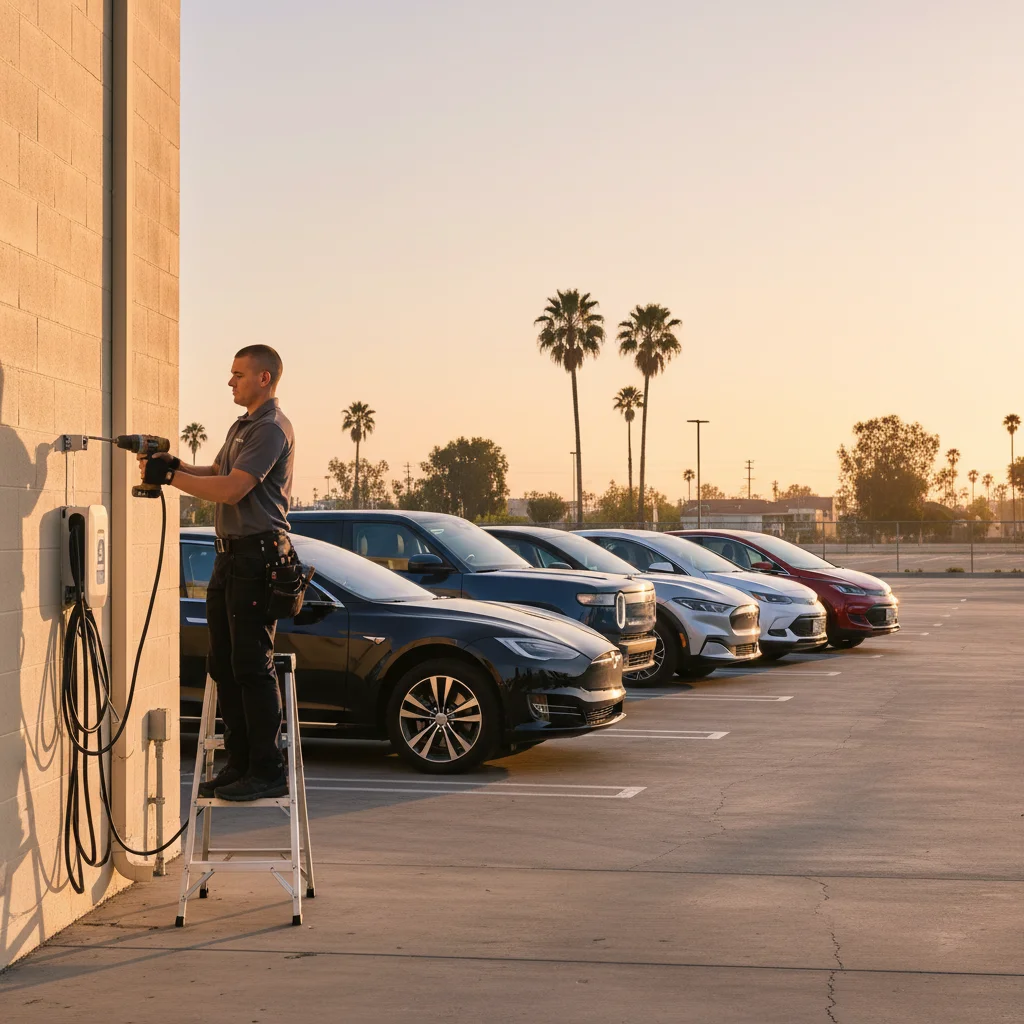
This county isn’t one climate or one housing stock. Westside cities sit in marine layer a lot of the year. The San Fernando Valley and the San Gabriel Valley run hotter. Lancaster and Palmdale sit in the Antelope Valley. They see hard summer heat and near-freezing nights. Recurrent Auto’s published tests show heat, cold, and cabin climate cut real range. That isn’t an oil sticker. It still changes how you treat tires, the 12V, and coolant. There’s a separate guide to EV battery care in LA County.
U.S. Census ACS 2019-2023 puts East Los Angeles housing built before 1980 at 86.2%. Whittier is 88.9%. Cars in those garages sit, often without a home plug. Santa Clarita, Palmdale, and Stevenson Ranch are much newer. The 12V still ages in a sit at LAX. It ages at Universal Studios Hollywood and on a Burbank lot too. LAX terminal structures P1 through P7 offer Level 2 and DC fast charging. The Economy Parking garage has 514 active EV chargers. A dead 12V after a week away is still a 12V failure. It isn’t an empty pack.
The shared list without brand splits is our EV maintenance schedule for owners. This page is the brand split, and the local why.
Shared items every book still tracks
Every maker still wants you watching five things. The miles and years live in that year’s owner’s manual. Charge Pro LA doesn’t freeze a universal table.
Tires take the abuse here. Instant torque plus curb weight plus grades will scrub tread. That’s Sepulveda Pass and PCH through Malibu. Topanga, Calabasas, and the I-5 climb north of Castaic do it too. Check pressure often, and rotate on the interval in your book. Get an alignment if a canyon day or an Eastside pothole leaves a pull.
The 12V is the other county-specific failure. It runs computers, locks, and wake-up. If it dies, a full drive pack won’t save you. Current Tesla Model Y books describe a lithium-ion low-voltage battery. That’s once the hood is open. Other brands use their own 12V chemistry. Test it when the manual says to. A quiet week in an older garage is the same pattern. So is a trip through LAX parking. See Tesla 12V battery failure signs.
Brakes last longer with regen. Fluid still ages. Rotors can rust if you almost never use friction brakes on a long downhill. Cabin filters load up with dust, pollen, and Santa Ana grit. Wipers and washer fluid still matter on a gray coastal morning.
None of that is oil. Skipping it still leaves you on a shoulder.
Tesla: the screen will not rotate your tires
Tesla moved many owners off a mandatory yearly visit. The car will nag you about some items. It won’t rotate tires after a week of Palos Verdes or Malibu grades.
Timed items recent Tesla books still list
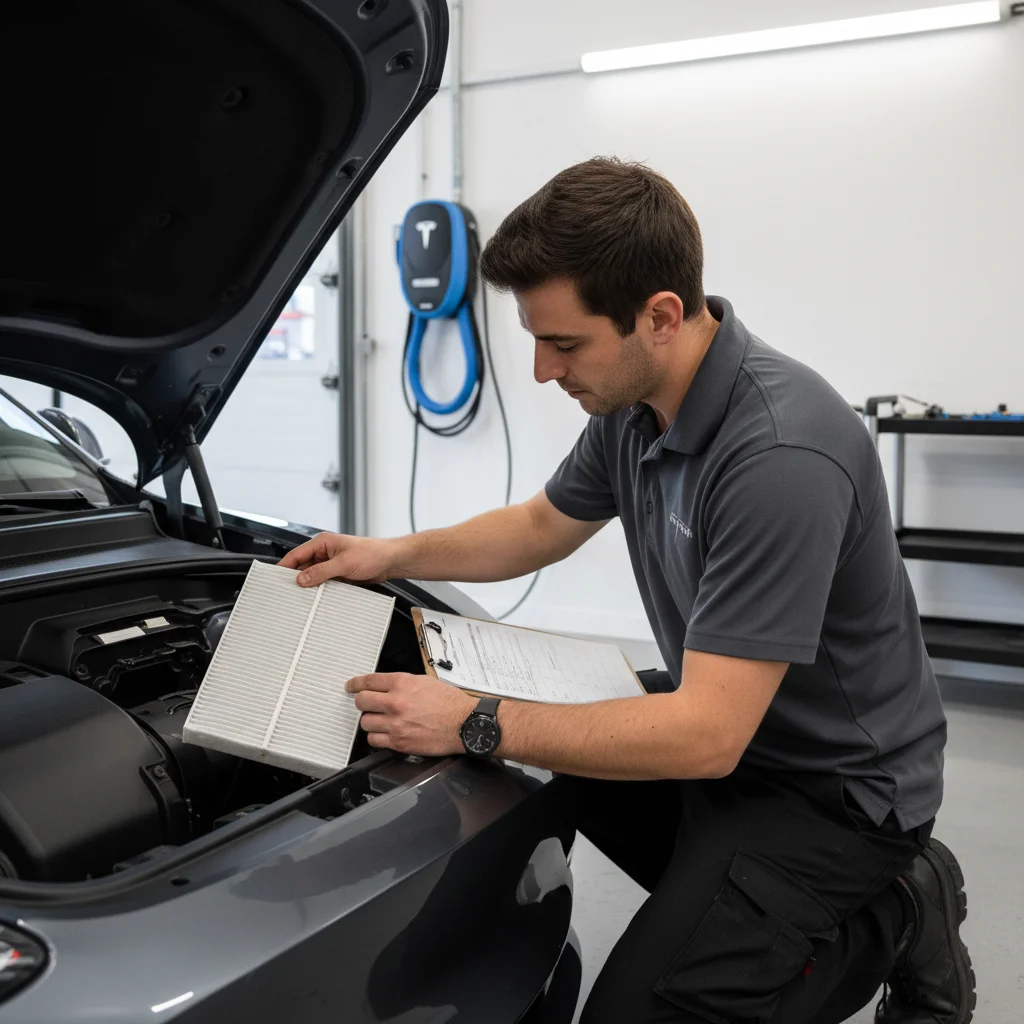
Confirm every line against the manual for your VIN. Recent Tesla service tables have pointed to tire rotation about every 6,250 miles. Do it sooner if tread differs by 2/32 inch or more between tires. They’ve also pointed to a brake-fluid health check about every 2 years. Replace the fluid if that test fails. Cabin filters have been listed about every 2 years. HEPA and carbon filters on equipped Model S and Model X are listed too. That interval has been about every 3 years. An A/C desiccant bag follows a model-year cadence. That’s often about every 4 years on Model 3 and Y. On 2012-2020 Model S it’s often about every 3 years.
Treat those miles as a map, not a promise. Tesla updates manuals, so open the one that matches your car.
Tires fail first on this road net. A Model 3 or Y on the 405 at Sepulveda Pass will show inner wear. That happens if rotation slips. A Model X that runs canyon roads will do the same. The drive pack warranty is a separate paper. VIN terms in the Tesla app still control. See Tesla battery warranty: what is actually covered. That warranty doesn’t rotate tires.
If the car is already a brick, start with Tesla 12V jump help. That’s roadside work, not a service-center visit.
Rivian R1T and R1S: weight, air springs, canyon miles
Rivian owners in Agoura Hills, Calabasas, Topanga, and Malibu use the travel. That’s the travel the truck was built for. The book reflects extra mass and air suspension.
Fluids and springs Rivian still schedules
Confirm every figure in the guide for your model year. Recent Rivian intervals have included tire rotation about every 7,000 miles. Alignment checks have been listed about every 14,000 miles, or sooner if wear looks uneven. Drive-unit fluid replacement has been listed around 140,000 miles. Air-suspension inspection has been listed about every 28,000 miles. The air-compressor filter has been listed around 56,000 miles. Cabin filters have been listed about every year or 14,000 miles. Brake fluid replacement has been listed about every 3 years.
Air springs and extra weight make peninsula roads matter. Grades in Rancho Palos Verdes show a lagged alignment fast. The drop toward PCH and canyon spurs do the same. A flat Torrance commute hides that longer. Drive-unit fluid is a long-interval shop item. Skipping tires and the 12V is what puts an R1T on the shoulder first.
Rivian’s roadside terms are a separate contract. They aren’t a local operator. If the truck won’t wake, an independent pro still has to match the port. They also have to follow that year’s 12V procedure.
Ford Mach-E and F-150 Lightning: a mileage checklist
Ford kept a shop-style list. That feels familiar if you came from a gas F-150. It still isn’t oil.
What Ford’s EV visit usually covers
Recent Ford EV manuals have built a multi-point inspection around 10,000 miles. Do it at least yearly if you drive less. That visit has typically included tire rotation and a brake look. It also covers cooling-hose checks, half-shaft boots, and steering and suspension joints.
Longer items in recent books have included a cabin filter around 20,000 miles. The all-wheel-drive Lightning has listed rear eAxle fluid around 150,000 miles. High-voltage battery coolant has been listed first around 100,000 miles. Later changes have been listed about every 50,000 miles.
A Lightning through Carson and Long Beach is a heavy truck. Tires and joints take that weight. A Mach-E that sits in older Norwalk or Downey housing still has a 12V. That 12V can fail after a quiet week. Coolant loops are shop work. A dead 12V on a curb isn’t.
Hyundai Ioniq 5 and Chevy Bolt: short inspection steps
Hyundai and Chevrolet both lean on inspections instead of a long fluid list. The cadence still differs. Always match the book for your year and trim.
Hyundai Ioniq 5
Recent Ioniq 5 tables have used 8,000-mile steps. Typical published items include tire rotation about every 8,000 miles. Brake, steering, and suspension inspection has been listed about every 16,000 miles. The cabin filter has been listed about every 24,000 miles. Battery-coolant inspection has been listed about every 40,000 miles. The first replacement has been listed around 120,000 miles. Repeats have been listed about every 40,000 miles after that. Brake-fluid flush has been listed about every 2 years.
Pack size and charge hardware differ by configuration. They don’t change the need to rotate tires. A Glendora or Azusa foothill week still wears them.
Chevy Bolt EV and Bolt EUV
Recent Bolt tables have used 7,500-mile steps. Typical published items include tire rotation and a multi-point inspection about every 7,500 miles. The cabin filter has been listed around 22,500 miles. Brake-fluid flush has been listed about every 5 years. A coolant drain-and-fill has been listed around 5 years or 150,000 miles. That covers the separate loops the book names. Those loops are the battery, power electronics, and cabin heater.
A Bolt in South Gate, Huntington Park, or Commerce may sit on older streets. Those streets often have no home Level 2. Sitting is a 12V problem. Valley heat is a pack-care problem.
What Metro’s freeway trucks will and will not do
Metro Freeway Service Patrol is a joint Caltrans, CHP, and LA Metro program. It’s free and it roams congested county freeways. Published help is a gallon of gas, a radiator refill, and hose tape. It also changes a tire and tows to a CHP-chosen safe spot. The published list doesn’t include mobile EV charging or an out-of-charge pack. A flat on the 10 or the 110 can be an FSP tire job. An empty pack isn’t. Dial 511 and say Motorist Aid on a covered freeway. Use that when a tire change or a tow is the help you need.
California Vehicle Code 21718 bars stopping on a freeway except in named cases. A disabled EV that has already summoned help fits the disabled-vehicle exception. Vehicle Code 21809 is the move-over rule. It covers stopped emergency, tow, and Caltrans vehicles with flashing lights. Stay out of a live lane. If the car is in a travel lane, call 911. CHP says the same for another dangerous place.
City of Los Angeles electric service is LADWP. Most other cities sit in Southern California Edison territory. Many buy generation through Clean Power Alliance while SCE still delivers. Glendale Water and Power and Burbank Water and Power run their own grids. Pasadena Water and Power and Azusa Light and Water do too. That split changes home charging programs, not tire or 12V intervals.
Shop work versus a rescue on the shoulder
Charge Pro LA is a referral line. It doesn’t hold a shop license or own a yard. It doesn’t perform the maintenance in this guide. Independent local operators are who show up for a stall. They can bring a 240V Level 2 source to the car. That’s a native NACS plug, plus CCS or J1772 adapters for non-Tesla EVs. Charging time is typically 15 to 30 minutes. That adds about 10 to 20 miles of range. That’s charging time, not an arrival clock. They can also jump or replace a dead 12V on site. That covers Tesla and other major EV brands.
A coolant flush, a desiccant bag, and an alignment rack belong at a shop. Drive-unit fluid belongs there too. A car that won’t unlock after a week in LAX Economy Parking is a rescue. So is a pack that hit zero on the Grapevine north of Castaic. For peninsula grades, see EV roadside assistance in Rancho Palos Verdes. For an empty pack, mobile EV charging is the on-site boost. The operator quotes you before work starts. You pay that operator directly.
If the car already will not move
Do the safe stop first. Then separate a dead 12V from an empty pack. A dark screen with a charged drive battery is usually the small battery. An honest zero on the range display is a charge problem.
If you need a local operator, call (858) 925-5546. Charge Pro LA connects you with an independent pro. That pro quotes you before starting and bills you directly. Nobody here can promise when a truck arrives.