You leave an estate in The Oaks with half a pack. Las Virgenes Road drops toward Malibu. The grade eats miles the dash didn’t show.
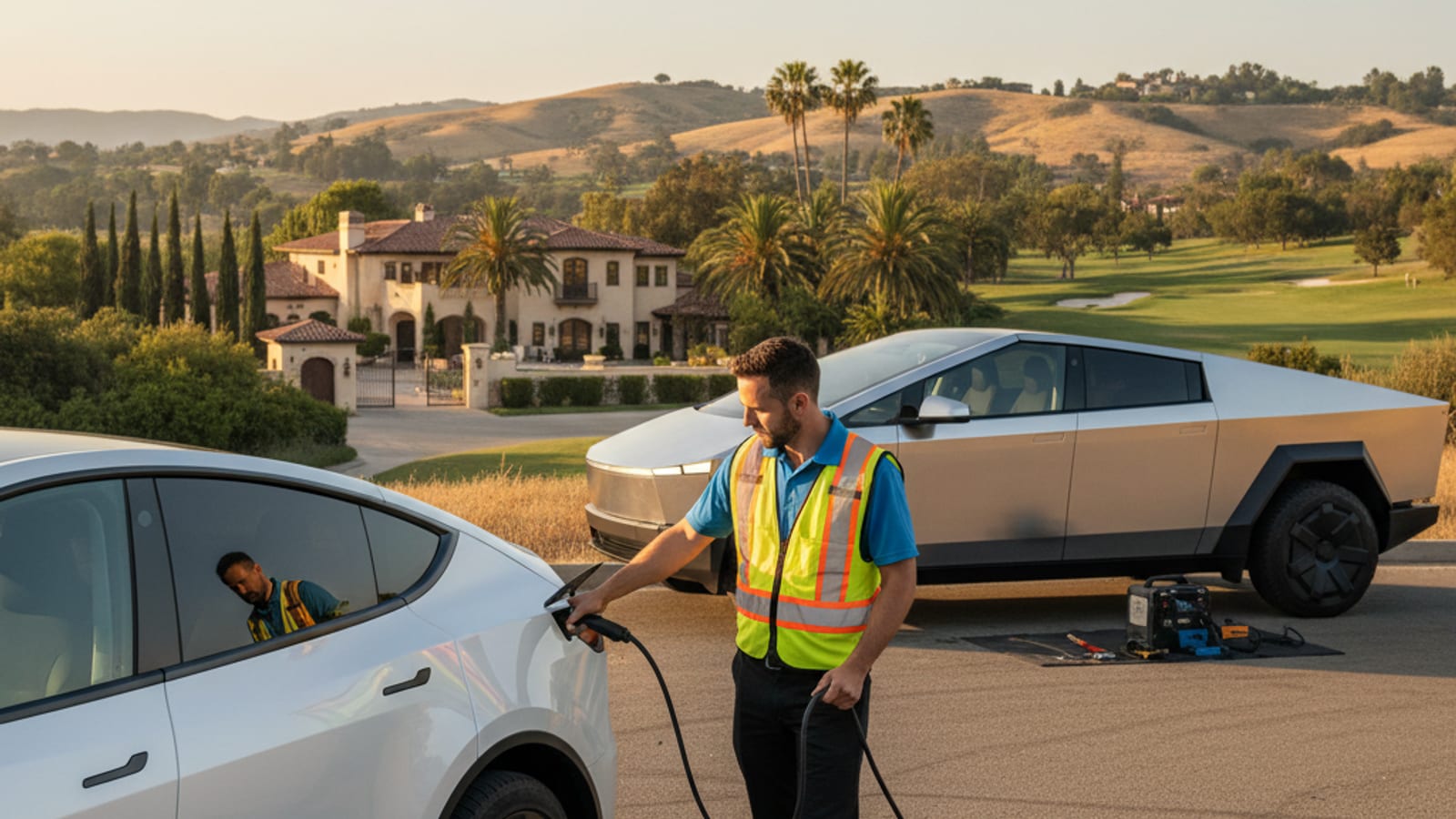
That’s the Calabasas pattern. You’re not circling a downtown garage. You’re on a canyon run, away from your wall plug. Heat and climb both pull on the battery. This EV charging guide for Calabasas starts on that grade. It doesn’t start with a generic county map.
Calabasas covers about 13.7 square miles on the Valley’s west edge. The ACS 2019 to 2023 count is 22,869 people. The 2024 estimate is 22,256. Neighborhoods sit on different terrain. The Oaks, Calabasas Hills, and Mountain View Estates sit above the freeway. The Old Topanga edge does too. Parkway Calabasas and the Commons district handle daily errands. The drive that surprises a pack is rarely that errand loop. It’s Las Virgenes, Mulholland, and the 101 in summer heat.
Why canyon grades set your range here
Calabasas is a hillside 101 city at the head of Malibu Canyon. US-101, the Ventura Freeway, is the spine. Las Virgenes Road is the cut through to the coast. Locals know that cut as Malibu Canyon. Mulholland Highway threads the Santa Monica Mountains. Parkway Calabasas is the in-town connector. None of those roads drive like a flat basin street.
They climb, then they drop, then they climb again. Motors work harder on the way up. Regenerative braking returns some energy on the way down. It doesn’t return what the climb just spent. Estate drivers feel this more than a short Valley hop. You leave a long driveway in Mountain View Estates. You drop toward the 101. Then you choose a direction.
Stay in the Valley toward Agoura Hills. Or take Las Virgenes toward Malibu. That second choice is the one that catches people. Sticker range assumed mixed city and highway miles. It didn’t assume a sustained canyon grade with the air on.
A page written for Santa Monica would talk about beach lots and marine air. This one has to talk about mountains. See the Calabasas city page for local service context. Calabasas runs hotter than the coast. It runs cooler than the high desert. Summer AC is a real range factor. Foothill climbs add to that load. You feel it on Las Virgenes more than on Parkway Calabasas.
From the Oaks to the 101 is a short drop. From the 101 to the coast isn’t. Malibu Canyon is a sustained grade with little room to linger. Mulholland is slower, twistier, and just as hungry. If you add a stop at Pepperdine, budget the climb home as its own trip. A beach lot needs the same honesty. The dash’s remaining-miles guess can look fine at the bottom. It can look tight once you point back up.
Heat, AC, and the miles the sticker skipped
San Fernando Valley summers run well above the basin. Calabasas sits in that valley climate. It doesn’t sit in the marine layer. Recurrent Auto published testing across more than 30 models. Packs kept about 78 percent of range at 32 F. They kept about 70 percent at 20 F. Cabin heat was the main drain in the cold. Heat works the other direction here. Summer heat and heavy air conditioning cut real miles below the window sticker. A heat pump helps in cold weather. It doesn’t cancel a long climb with AC blasting.
Speed spends pack too. The 101 through Calabasas isn’t jammed every hour. When lanes open, high speed burns energy fast. Hard launches out of a gated entry do the same. Smooth throttle and regen on the descents help, and that’s dull advice that works. It’s also how you roll into the Commons with a buffer left.
Cabin climate isn’t free. Precondition while you’re still plugged in at home. You leave with a cooled cabin and a conditioned pack. The first miles of Las Virgenes then go to the motors, not the vents. On a return climb from the coast, ease the AC a notch. Watch the predicted range, not just the percent. A roof box for a weekend adds load. So does extra weight from passengers heading to the coast. None of that shows on the window sticker. Check the energy app after a known canyon run. Learn what Las Virgenes actually costs your car. Then leave with that number in mind, not the brochure number.
Home charging on Calabasas lots
Most days, the wall at home is the whole plan. About 38 percent of Calabasas housing went up before 1980. That’s a smaller share than older basin cities. It still means many panels were never sized for a 240-volt EV circuit. Large lots in The Oaks and Mountain View Estates give you space. They don’t automatically give you amperage. A licensed electrician has to read the panel, the run, and the permit path. Charge Pro LA doesn’t install chargers. It’s a referral line for stranded drivers. The electrician is a separate trade.
Placement is a Calabasas-specific question. Garage, detached shop, or a covered court each change the wire run. Long driveways add copper, conduit, and trenching. We don’t publish those job prices. Ask the electrician for a written scope. Confirm permits with the city before anyone opens a wall.
Level 1 on a regular outlet
Every EV ships with a Level 1 cord. It plugs into a 120-volt household outlet. You get a slow overnight trickle. For a short errand day around the Commons, that can hold a buffer. For a large pack after a canyon day, a full refill takes a long time. Treat Level 1 as a hold. Don’t treat it as a recovery plan after Malibu.
Level 2 as the weekday habit
A Level 2 unit needs a 240-volt circuit, like a dryer. That’s the setup that makes estate driving practical. You plug in after the canyon run. You wake up with the buffer back. Scheduling for off-peak hours is a utility question. It isn’t a roadside question.
Calabasas is a Clean Power Alliance city. CPA buys the generation. Southern California Edison still delivers the power and reads the meter. Your bill can show two line items. A stranded car on Las Virgenes doesn’t care about that split. Confirm current EV rates on SCE and CPA pages. Confirm any home-charger rebate the same way. We don’t publish rates or rebate amounts.
SCE lists Charge Ready Home as a Level 2 install rebate program. Status and amounts change. Read sce.com before you plan around it. CPA’s own site lists member cities, including Calabasas. Generation choice isn’t a rescue plan.
What the utility split actually means
Drivers mix the names. SCE still owns the wires here. CPA is the generation choice. Home charging policy lives on those two sites. Rescue lives on a different call. If a neighbor quotes a rate from last year, treat it as stale. Pull the current tariff yourself. LADWP programs don’t apply in Calabasas. Those are City of Los Angeles programs. Don’t copy a Los Angeles rebate onto an SCE meter.
Before you drop into Malibu Canyon
Leave with a known buffer, not a hope. Check the energy graph from your last Las Virgenes run. If you haven’t done that run yet, assume the climb home costs more. The drop down is the cheap direction. Turn on the battery’s percent view, not only the miles-to-empty guess. Miles-to-empty lies on grades.
Apps help you see stalls you already use. They don’t move the car. If a stall is down, you still need a plan B. Mobile rescue is that plan B. It isn’t a scenic tour of the mountain.
If you stall on the 101 or in the canyon
Get out of the travel lane if you can. Turn the hazards on and stay visible. Stay with the car when walking the shoulder is worse.
California Vehicle Code 21718 bans stopping on a freeway. It makes an exception for a disabled vehicle once help is summoned. A stranded EV that has called for help fits that exception. Code 21809 is the move-over law. Other drivers must change lanes or slow for flashing lights on a stopped service vehicle. Code 22651 lists when an officer can have a vehicle removed. Sitting unattended for hours on a freeway is one of those paths. Call for help as soon as you’re stopped. Don’t wait for the pack to recover on its own.
On Las Virgenes the shoulder can be narrow. On Mulholland it can disappear around a bend. Put the car as far right as you can. Keep people away from the travel lane. If you can’t get off the pavement, stay inside with belts on. Wait there until help is with you.
Metro Freeway Service Patrol roams congested LA County freeways. It’s a joint program of Caltrans, the California Highway Patrol, and LA Metro. It’s free to motorists. Dial 511 and say Motorist Aid. What FSP publishes is written for gasoline cars. A gallon of gas. A radiator refill. A tape job on a hose. A tire change. A free tow to a CHP-chosen safe spot. The published list doesn’t name mobile EV charging. An empty pack sits outside what FSP lists, other than that free tow. Use FSP for a safe relocation. Don’t expect them to refill an EV.
FSP’s published hours are typically weekday peaks. There’s added coverage on some busy corridors and construction zones. It isn’t a substitute for a charging operator. Confirm current hours on metro.net if you’re deciding whether to wait.
On private property, towing rules sit in Vehicle Code 22658. Lots need the required 17 by 22 inch signage at entrances. The owner or agent must authorize the tow in writing. They must notice local law enforcement within one hour. If you return before the car leaves the lot, they have to release it. Storage charges can’t exceed the law-enforcement approved cap. We don’t publish that cap. Confirm it with the city or CHP if a lot is threatening a hook.
A Commons lot and a 101 shoulder are different scenes. Tell the operator which one you’re in. Access through a gate changes the job. A freeway shoulder changes it again. A tow is still a last resort for an EV. Use a flatbed. Follow the brand’s unpowered-tow steps. A charge in place is the other path. That’s the path most empty-pack drivers want.
Empty pack versus a dead 12V
Two failures look the same from the curb. The car is a brick. Screens stay dark. Handles may not pop.
An empty high-voltage pack means you drove the miles out. A mobile Level 2 boost matches that failure. A dead 12-volt battery is a different failure. Every EV still uses a small 12V to wake computers, locks, and contactors. If that 12V is dead, the main pack can still be full. The car still won’t start. Heat, long sits, and age wear that small battery. Estate cars that sit between canyon weekends see this often.
Don’t guess which one you have. Look at the dash if it will wake. A zero percent reading is an empty pack. A car that won’t unlock after a long sit is often the 12V. Operators in this network can jump a 12V on site. They can also bring a 240-volt source if the pack is the problem. Tesla owners can start with Tesla 12V battery jump. Other brands follow the same split. Wake the 12V first. Then decide if the pack needs miles.
A 12V that dies again after a jump is a replacement job, not another jump. Don’t keep jumping it in a hot garage. Get the small battery tested.
What a mobile Level 2 boost actually does
Charge Pro LA is a referral line. It matches stranded EV drivers with independent local mobile rescue operators. It holds no licence for the work. It owns no trucks. It employs no technicians. It sets no prices. It promises no arrival window. The operator quotes you before starting. The operator bills you directly.
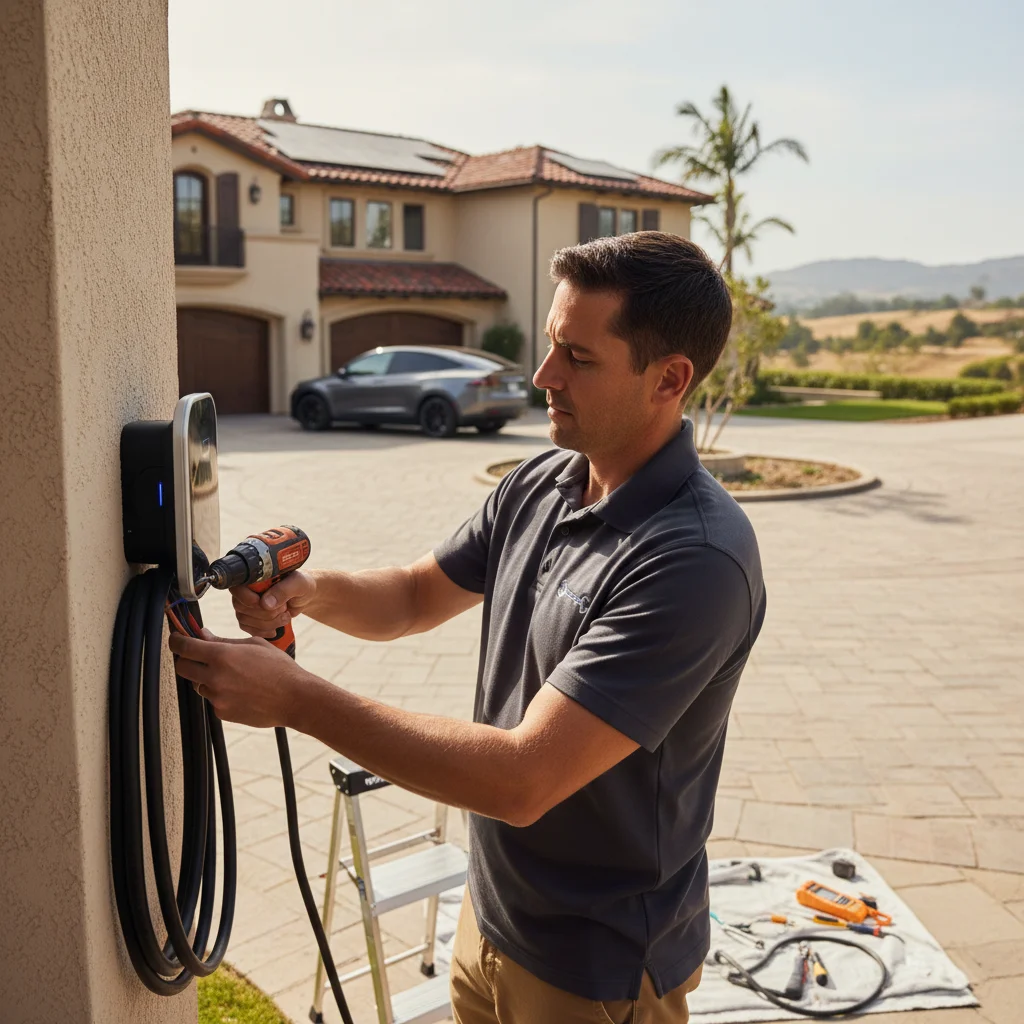
The operator brings a 240-volt Level 2 source to the car. Tesla drivers get a native NACS plug. Other brands get CCS or J1772 through an adapter. Typical charging time adds about 10 to 20 miles of range. That takes 15 to 30 minutes of charging. That number is charging time. It isn’t a dispatch clock. Ten to twenty miles is often enough to reach a stall you already use. It can also get you home to the wall.
Read mobile EV charging for how the truck side works. Read out-of-charge recovery if the pack is at zero. What moves the quote isn’t a hidden menu. Distance to you. Time of day. How much range you need. Shoulder versus a gated driveway. Traffic on the 101. The operator walks those with you before any cable goes in. We don’t publish a price. How mobile EV charging gets quoted in Los Angeles County explains the factors without inventing a number.
If the 12V is the failure, charging the pack won’t wake the car. Get the small battery jumped or replaced first. Then decide if the pack also needs a boost. Say both symptoms when you call. Dark screens plus a long sit. Or a zero percent reading after the canyon. Those are different jobs. The pros we connect you with are licensed and insured. They quote on site. They don’t start until you accept. If you decline, you’re not on the hook for work you didn’t approve.
Neighboring canyon towns on the same loop
Calabasas doesn’t sit alone on this ridge. Agoura Hills is the next 101 city west. Topanga sits on the Old Topanga edge. Malibu is the coast at the bottom of Las Virgenes. Santa Monica and Beverly Hills sit further in, on the other side of the mountains. Pepperdine is down that coastal side in Malibu. A weekend loop can touch several of those towns. You may not stop at your own wall in between.
Plan the return while you still have a buffer. Don’t plan it from the shoulder. Watch predicted range on the climb back up Las Virgenes. Valley heat on the return can be worse than the marine air at the beach. That swing is the local trap. You left in cooler air and you come home hot, uphill, with AC on. ZIPs here include 91302, plus overlap on 91301 and 90290. Those numbers don’t change the physics. The grade is what spends the pack.
Habits that protect range from this house
Keep tires at the door-sticker pressure. Soft tires waste miles on every grade. Keep software current. Brands push battery-management fixes in those updates. Don’t live at 100 percent or at empty. Daily charging into the 80s is the usual owner practice. Save a full charge for a known long day. Precondition while plugged in before a canyon morning.
A home battery backup isn’t an EV rescue. If the wall is dead, the car still needs a charge path. Agoura Hills neighbors hit the same canyon drain. Their backup-battery question is a separate piece.
Frequently asked questions
What should I plug in at a Calabasas home
Level 2 on 240 volts is the daily answer for most estate packs. Level 1 on 120 volts only holds a small buffer. A licensed electrician sizes the circuit and the panel. Confirm EV rates with SCE and Clean Power Alliance. Charge Pro LA doesn’t install home units.
What do I do if I stall on Las Virgenes or the 101
Get off the travel lane if you can. Turn the hazards on and stay visible. Call for help so you fit the disabled-vehicle rule. FSP can tow to a safe spot. They don’t publish EV charging as a service. A mobile Level 2 boost from an independent operator puts miles back in the pack. The operator quotes you before any work starts.
Do the operators only help Teslas
No, operators in this network handle Tesla and every major EV brand. They bring a native NACS plug for Tesla. They bring CCS or J1772 adapters for everyone else. A 12V jump is a different job from a pack boost. Say which symptoms you have when you call.
Calabasas EV driving is a canyon problem as much as a charging problem. Home Level 2 covers the weekday. The 101, Las Virgenes, Mulholland, and the heat still spend the pack. If you stall, Charge Pro LA can connect you with a local operator. Call (858) 925-5546. The operator quotes before starting and bills you directly.