A luxury EV that won’t wake in Beverly Hills is usually a dead 12V, not an empty pack. EV roadside assistance in Beverly Hills starts with that small battery after a long park on the street or in a garage. The car can still show range. The computers just never boot.
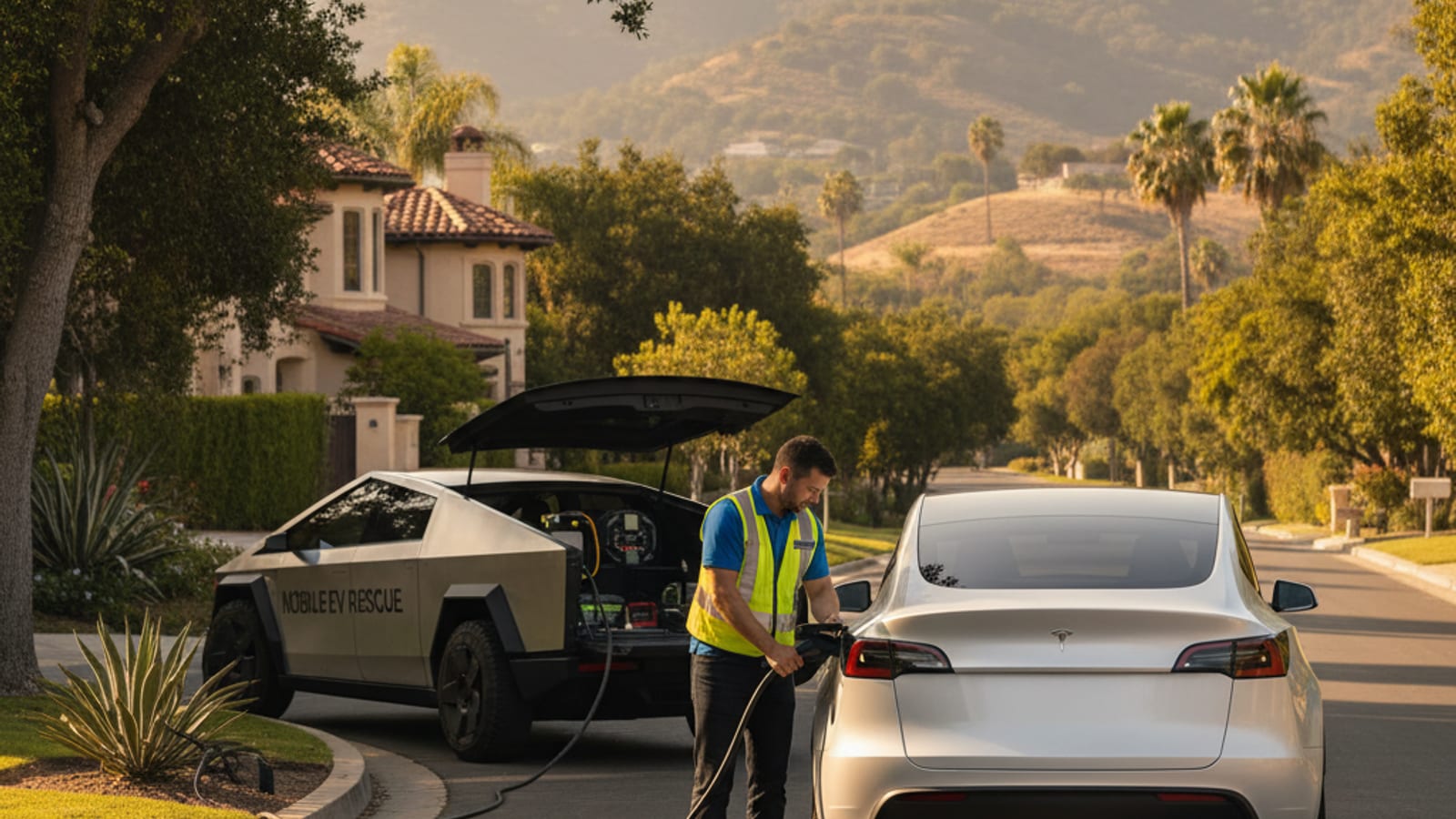
The stall is a silent cabin, not a zero on the dash
You parked in The Flats. You left a Taycan or a Model S for dinner. You came back to handles that never presented. The screen stayed black. The app spun and failed. That isn’t a Supercharger problem. That’s the 12V.
Every EV still has a low-voltage battery. It feeds the computers, latches, lights, and the contactors. Those contactors connect the high-voltage pack to the rest of the car. If the 12V is dead, the pack can be full and still useless. You can’t open the charge port. You can’t shift. You can’t enable tow mode on many models.
Luxury trim doesn’t skip this part. A Lucid Air, a Mercedes EQS, a Porsche Taycan, a Rivian, and a Tesla all boot from a 12V, or a small lithium 12V in newer Teslas. The badge on the nose doesn’t change the failure.
Charge Pro LA is a referral line. We match stranded drivers with independent local operators across Los Angeles County. We serve every city in the county, including this one. We don’t perform the work. We don’t own trucks or equipment. We don’t employ technicians. We don’t set prices. We don’t publish hours. We don’t promise an arrival. The operator quotes you before starting and bills you directly.
People call this a dead EV. It often isn’t. The drive pack can sit at 60 percent. The car still acts like a brick. That’s the 12V reality in a luxury market. The car looked fine when you parked. It doesn’t look fine now.
Why a long park in this city kills the 12V
The 12V is small. It’s always working. Sentry mode, scheduled cabin climate, overheat protection, and key listening all draw from it. A car that sits for a weekend keeps sipping. An aging cell can’t keep up. Then the car won’t wake.
Beverly Hills is a small Westside city. Census ACS 2019-2023 population is 31,955. The 2024 estimate is 31,027. Land area is 5.708 square miles. The ZIPs are 90210, 90211, and 90212. Housing built before 1980 is 78.1 percent. Hispanic or Latino share is 6.2 percent. Those are U.S. Census Bureau figures.
That older housing stock means original garages, long private drives, and a lot of street parking. Cars sit. They sit armed. They sit with cameras on. They sit through hot Basin afternoons. Then the owner returns and the cabin is dark.
This city has high EV ownership and canyon roads. Coldwater Canyon and Benedict Canyon climb toward the Valley. Those grades pull range when you’re driving. They aren’t why a parked car goes silent. The park is why. The 12V is why.
If you flew out of LAX and left the EV at home, the same pattern shows up. Los Angeles World Airports notes that terminal structures P1 through P7 offer Level 2 and DC fast charging. The Economy Parking garage has more than 4,000 stalls, including 514 active EV chargers. That doesn’t save a 12V. A traveler who parks for a week can return to a car that won’t wake, even in a lot with chargers. The same sits happen in a Beverly Hills garage. Chargers don’t close contactors on a dead 12V.
When the 12V has already died once, a second stall is a warning. A jump can wake the computers. It may not hold. See what happens when an EV 12V battery dies for that sequence.
Older garages in this housing stock weren’t built around a wall unit. Many cars still sit unplugged overnight. A 12V still drains whether you meant to charge or not. Plugging in only helps if the car actually wakes and takes current. Confirm how your model tops up the 12V in the owner’s manual. Don’t guess from a forum.
The Flats, the Triangle, and the hills are different stalls
Los Angeles County isn’t one place. This city is Westside and the Beaches. It isn’t the Harbor. It isn’t the Antelope Valley. The stall you have depends on where the car actually sits.
Street parks in The Flats and the Golden Triangle
The Flats sit on the flatter streets south of Sunset Boulevard. The Golden Triangle is the commercial core. Wilshire Boulevard, Santa Monica Boulevard, and the cross streets between them hold shops, offices, and restaurants. You leave the car at the curb. You’re gone two hours or five. You come back to a brick.
Private lots here post tow rules. California Vehicle Code 22658 governs private-property tows. It requires 17 by 22 inch signage at entrances. It requires written authorization from the owner or agent. It requires immediate written notice to the registered owner. Local law enforcement must be notified within one hour. If you return before the car leaves the lot, the operator must release it. Storage rates can’t exceed the law-enforcement approved schedule. A statewide dollar cap isn’t published here, because California doesn’t set one figure we could verify. Confirm any posted charge with the lot and with the city before you pay.
A 12V wake on the curb beats an argument at a yard. Once the car is hooked, you’re in storage rules, not a jump. Stay with the car if you can. Don’t wander off hoping it will boot later.
Trousdale, the Gates, Benedict, and Coldwater
Trousdale Estates sits in the hills. The Beverly Hills Gates mark older guarded streets. Benedict Canyon winds toward the Valley. Coldwater Canyon is the other climb. Driveways are long. Gates are real. Operators still have to reach the car. Have the code. Meet them at the street if the drive is narrow. We don’t promise a clock. The operator on your referral quotes the work first.
Hill driving is a range story, not a 12V story. Air-conditioning on 90F-plus Basin days and freeway crawl are the main drains once you’re moving. Winters are mild. If you watched the pack fall on the climb, that’s an empty-pack call. If the car sat in the garage all week, start with the 12V.
West Hollywood sits on the eastern edge of this same Westside belt. Culver City, Santa Monica, Burbank, and the City of Los Angeles wrap the rest. If the car is actually a few blocks into West Hollywood, the same checks apply. Read EV roadside assistance in West Hollywood.
A gated street doesn’t change the diagnosis. It only changes access. Tell the operator which gate. Stay reachable by phone. California is an all-party consent state for recording under Penal Code 632. You’ll hear a recording notice on a forwarding line. That’s required. It isn’t optional.
Heat, utilities, and what they don’t fix
Beverly Hills isn’t served by LADWP. Southern California Edison delivers the power. Clean Power Alliance buys the generation for this city, per cleanpoweralliance.org. You still see SCE on the delivery line. That split matters for a home charger rate. It doesn’t wake a dead 12V on Wilshire. Don’t sit in a dark cabin refreshing a rebate page.
SCE publishes Charge Ready Home and a pre-owned EV rebate on sce.com. LADWP programs don’t apply here. Dollar amounts from those pages aren’t reprinted on this site. Confirm current rebates with the utility if you’re shopping a wall unit later. Right now you need the car to boot.
Hot, dry inland summers in the LA Basin load the climate system once you drive. That’s a pack-range issue. Recurrent Auto’s published research ties cabin climate to range loss in heat and cold. A station-level temperature normal for this city couldn’t be confirmed in the sources used for this page. Check NWS Los Angeles/Oxnard if you want a station number. The qualitative point still stands. Heat and AC cut range on the road. Heat also ages a 12V that sits in a closed garage.
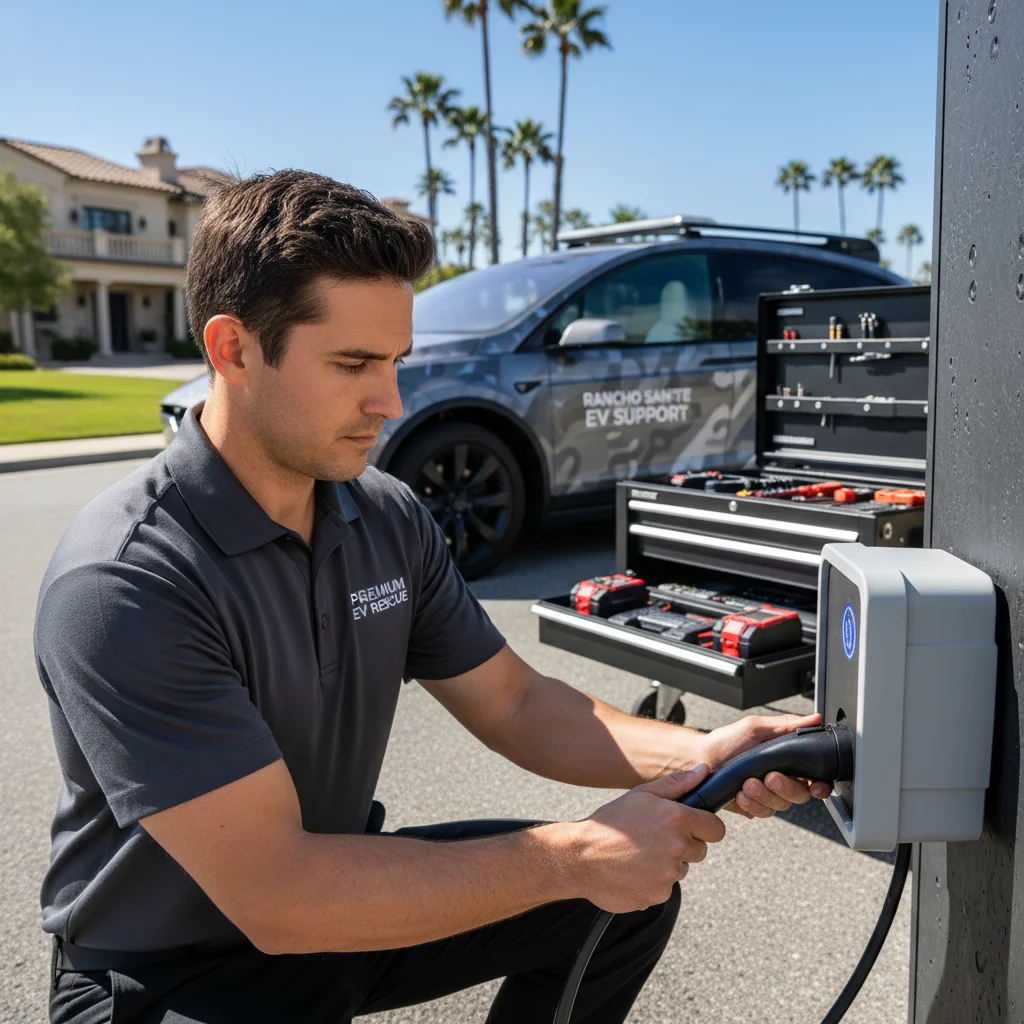
A Supercharger or a public Level 2 stall still needs a car that will wake. If the screen is black, walking to a stall doesn’t help. Towing to a stall doesn’t help either until the 12V is up. Get the boot battery alive first. Then decide if the pack needs a boost.
What the operator can do on site
The operators in this network bring a 240V Level 2 source to the car. They use a native NACS plug. They carry CCS or J1772 adapters for non-Tesla EVs. Typical charging adds about 10 to 20 miles of range in 15 to 30 minutes of charging. That number is charging time. It isn’t an arrival time.
They also jump or replace a dead 12V on site. They handle Tesla and every major EV brand. That’s the whole on-site menu we can state. We don’t claim tire programs, lockouts, or shop repairs. If the operator on your call offers more, that’s their quote, not a brand promise.
Sequence matters. If the car sat and won’t wake, do the 12V first. A Level 2 cable can’t talk to a car whose contactors never closed. If you watched the range hit zero on Sunset, do the Level 2 boost. Then roll to a stall you pick. City charging notes are on the Beverly Hills charging page.
For Tesla-specific 12V stalls, see Tesla 12V battery jump. Mercedes EQS owners hit a dark-cabin version of the same failure. Walk that in Mercedes EQS 12V battery dead on site. Porsche Taycan and Lucid Air owners see the same brick after a long sit. Brand roadside programs vary. They often start with a tow. Confirm what your program actually sends before you wait on it.
The operator bills you directly. Ask what the quote includes. Ask whether they have the right adapter for your port. Ask whether they can replace the 12V if a jump won’t hold. We don’t set those answers. They do, on the call.
Why AAA, FSP, and a random tow are the wrong first move
Most motor clubs were built for gasoline cars. They send fuel, a tire change, or a tow. An EV with a dead 12V doesn’t need a gallon of gas. An EV with an empty pack doesn’t always need a flatbed. It needs a wake or a boost.
Metro Freeway Service Patrol is free on congested Los Angeles County freeways. It’s a joint program of Caltrans, the California Highway Patrol, and LA Metro. Verified on metro.net and chp.ca.gov, the published help list is a gallon of gas, a radiator refill, taped hoses, a tire change, and a free tow to a CHP-chosen safe spot. Hours are typically Monday through Friday during peak commute periods, plus all day in some construction zones, with expanding midday and weekend coverage on the busiest corridors. Dial 511 and say Motorist Aid. The published list doesn’t include mobile EV charging or 12V jumps. A silent luxury EV is outside that list except for the free tow to a safe location. That’s an observed absence from the published materials.
If you’re already on a freeway shoulder, California Vehicle Code 21718 generally prohibits stopping on a freeway. A disabled vehicle that has summoned help fits an exception. Stay out of live lanes. California Vehicle Code 21809 requires other drivers to move over or slow for a stopped service vehicle with lights. California Vehicle Code 22651 lets an officer remove a vehicle, including after four hours unattended on a freeway. Don’t wait that long if a 12V jump can clear you.
CHP rotation tows come from a Tow Service Agreement list. Details of the Los Angeles area rotation weren’t verified here. City of Los Angeles Official Police Garages handle many City of L.A. impounds. Release steps and fee schedules weren’t verified on this page. Confirm on lapdonline.org if an officer already called that tow. Beverly Hills is its own city. Don’t assume Los Angeles OPG rules apply on a Beverly Hills street.
Incorrect towing can hurt motors and the pack. Many EVs need a flatbed. Some need a specific transport mode that a dead 12V won’t enable. Wake the car first when you can. Tow last.
Checks you can run on the curb
Try the cheap steps on the curb, then call.
Tap the fob and the app more than once. A sleeping car ignores the first request. Use the physical key path if your model has one. Look for any interior glow. Listen for a click in the frunk or under the hood. No click and no lights means 12V.
Think about how long it sat. Overnight with Sentry on is a classic drain. A week at LAX, or a week in a Trousdale garage, is the same drain. A drop to zero while climbing Coldwater is the pack, not the 12V.
Don’t clamp a gas-car jumper on random metal. EV 12V points are specific. Wrong points damage computers. Let the operator do the jump.
Don’t pry a charge-port door. The latch is electric. A dead 12V won’t release it.
Write the address, the gate, and the cross street. Santa Monica Boulevard, Wilshire, Sunset, and Coldwater are the corridors people already know. Benedict Canyon and Trousdale need extra precision.
How the referral actually works
You call. We connect you with an independent operator. They quote. You accept or you don’t. They bill you. That’s the product.
We don’t hold a contractor license. We don’t install home chargers. The pros we connect you with are licensed and insured. That claim is about the network, not about Charge Pro LA doing licensed work. First-person voice stays. The work language doesn’t. The operator jumps the 12V. The operator plugs in the Level 2 lead. We don’t.
If brand roadside, Tesla roadside, or an insurer is already rolling, you can still compare. Those programs often send a tow. Confirm what they actually dispatch. An on-site 12V wake is a different job.
For the broader rescue menu, use EV roadside assistance.
Nearby Westside pattern, not a copied city page
Santa Monica is coastal marine layer. This city sits more inland on the Basin side of the Westside. Culver City sits south toward the 405. Burbank sits over the hill in the Valley. The 405 climb through Sepulveda Pass is the Westside-to-Valley grade. A summit elevation for that pass couldn’t be confirmed against USGS in the sources used here. Check USGS if you need a number. The climb is still real, and it costs range once you’re moving. It still isn’t why a parked EQS in the Golden Triangle won’t boot.
UCLA in Westwood, Cedars-Sinai, and the Getty Center sit in the same daily orbit. A long appointment is just another long park. Come back. Check the 12V before you assume the pack.
Frequently asked questions
What if my luxury EV won’t wake after a long park in Beverly Hills?
Treat it as a 12V failure until proven otherwise. A full pack won’t help if the computers never boot. Call for a referral. The operator can jump or replace that 12V on site, then add a Level 2 boost if the pack is also empty.
Can an operator jump a Tesla 12V in this city?
Yes, the operators we connect you with jump Tesla 12V batteries in this city. Tesla still uses a 12V, including a lithium 12V in newer Model 3 and Model Y cars. They handle that jump on Tesla and on other brands. They quote before they start.
Do you only help Teslas, or other luxury EVs too?
The network covers Tesla and every major EV brand. Lucid, Mercedes, Porsche, Rivian, BMW, Cadillac, and the rest still boot from a 12V. Adapters cover NACS, CCS, and J1772 when a charge is the next step.
When the car is still dark, call (858) 925-5546. That’s the Charge Pro LA referral line for Los Angeles County. The operator, not the brand, does the work.