A Mercedes EQS that won’t wake often still has a charged high-voltage pack. The Hyperscreen stays dark, and the doors ignore the fob. Ready never arrives even when the pack shows a healthy percentage. That’s a dead 12V battery, not an empty drive pack. Independent operators in Los Angeles County can jump the underhood terminals on the spot. They can replace the 12V when a jump won’t hold.
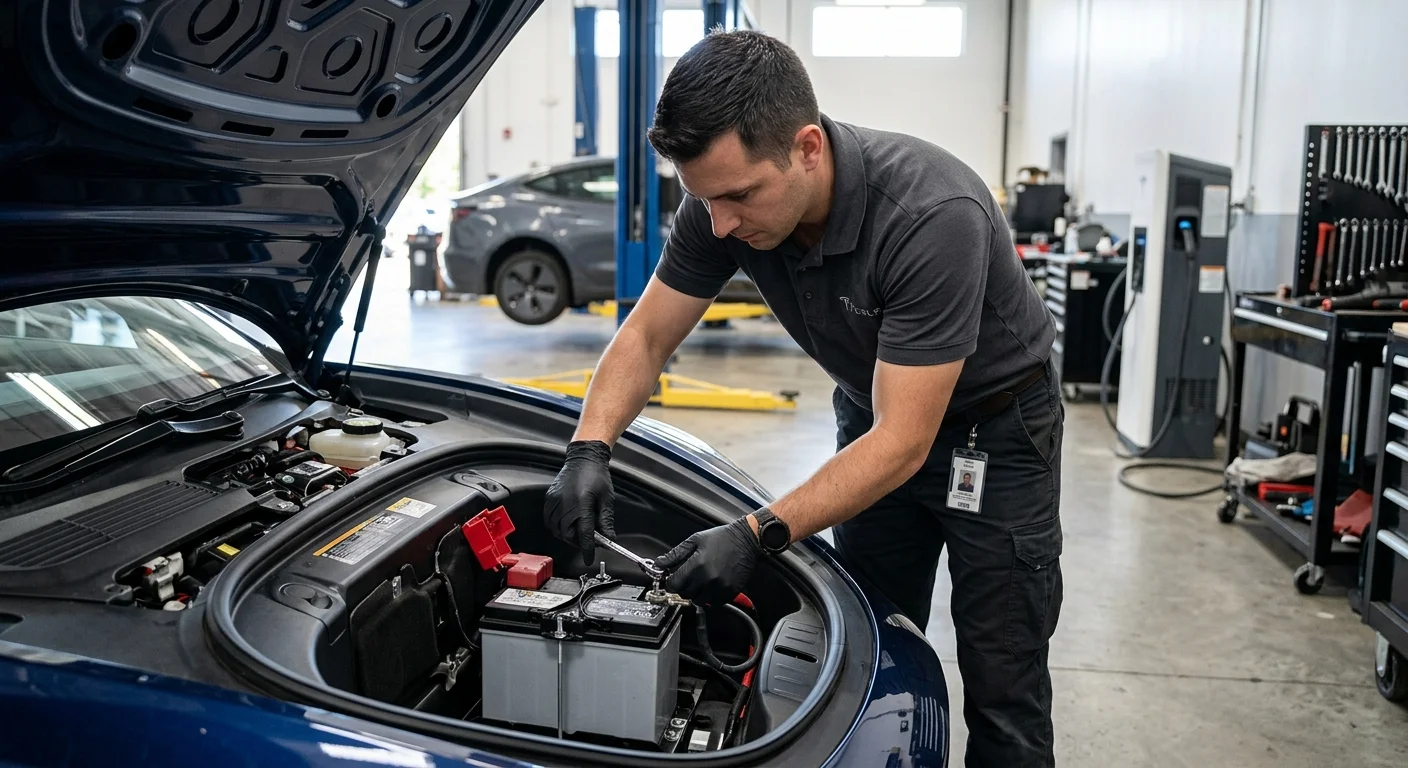
This is a 12V failure, not an empty pack
Owners often assume the big battery died. On an EQS, that guess is usually wrong. The drive pack feeds the motors. The small 12V battery feeds everything that has to boot first. That list includes door electronics, the MBUX Hyperscreen, and the air suspension. Digital mirrors draw from it too. So do the control units that connect the pack to the drivetrain. If the 12V can’t finish that handshake, the car stays dark. The pack percentage from your last drive doesn’t matter.
You’ll usually see one of three signatures.
The car is fully silent, with no dome light, lock click, or key response. The Hyperscreen starts, then dies, and a 12V warning may flash first. The display freezes on “vehicle being prepared, please wait.” The car has enough voltage to begin the boot. It doesn’t have enough to finish.
All three point at the same part. The 12V can’t hold the load the EQS asks for at startup. For the same failure across other brands, read when an EV 12V dies.
If you drive an EQE, the same 12V weakness shows up with a different layout. Use the Mercedes EQE 12V battery checks for that car. The EQB and EQA sit on another platform.
What drains an EQS 12V in this county
The EQS uses an AGM 12V battery in the trunk. It sits under the load floor on the driver’s side. It isn’t in the front bay. That battery runs a busy low-voltage network. Power-extending handles, the triple-screen Hyperscreen, and radar modules all draw from it. So do the connectivity gateway, ambient lighting, cabin pre-conditioning, and over-the-air update modules. Some of those modules stay awake after you lock the car.
Leave the EQS parked for two weeks without a drive. The 12V can sag too low to boot. Early 2022 and 2023 cars were known for heavy background draw. Dealers have issued software that quiets some of those modules. Patched cars still drain if they sit unplugged. A battery that has never been load-tested after a few summers is a weak point. That shows up on a parked EQS.
Los Angeles County adds its own load. Closed Westside garages hold heat on a parked EQS. Cabin pre-conditioning left on standby keeps polling the 12V. A week in airport parking does the same. The coastal marine layer keeps Santa Monica and Manhattan Beach milder than the valleys. Inland heat in Glendale and Burbank still cooks a parked luxury EV. The rest of the San Fernando Valley runs the same way. Antelope Valley heat around Lancaster and Palmdale is harder still. That holds even when the car is only passing through on the 14.
Utility territory doesn’t change the jump. LADWP serves the City of Los Angeles. Southern California Edison delivers power across most of the rest of the county. Clean Power Alliance buys generation for many Westside and canyon cities, including Santa Monica, Beverly Hills, West Hollywood, Culver City, Manhattan Beach, Calabasas, Agoura Hills, and Malibu. SCE still runs the wires in those CPA cities. None of that billing structure wakes a dead 12V.
Older housing does matter, because it changes whether the car sits plugged in. Census figures put pre-1980 housing at 75.0 percent in Santa Monica and 78.1 percent in Beverly Hills. West Hollywood is 80.5 percent, and Culver City is 85.5 percent. Many of those garages still have a household outlet, not a dedicated Level 2 circuit. If the EQS isn’t plugged in overnight, the 12V doesn’t get that trickle. A nightly charge would keep it topped up through the onboard charger.
How to jump the EQS without opening the trunk
You don’t jump this car at the battery. Mercedes put dedicated terminals under the hood for a dead 12V. The battery stays under the trunk floor. Connecting to it in a parking structure is the wrong move. A dead 12V often kills the powered tailgate anyway.
If the doors ignore the fob, slide the mechanical key out of the fob. Open the driver’s door with that key. The interior hood release is still a cable. Pull it, then raise the front lid.
Look at the driver’s side of the bay. You’ll see a black fuse and relay box. Lift that cover to reach the jump stud. Under it is a red-capped positive stud, and that’s the jump positive. For the negative, use an unpainted metal bolt or bracket on the chassis. Grounds near the strut towers work. Don’t clamp the negative lead to the trunk battery.
Connect positive to the EQS stud, then positive to the jump pack or donor. Negative to the donor, then negative to EQS chassis ground. Leave the clamps on for two full minutes. Then try Ready and watch the Hyperscreen boot. The Hyperscreen should run its sequence, and the car should wake.
That two-minute pause isn’t optional. The control units need stable voltage to finish the handshake. Pulling the clamps too early makes a good jump look like a failed one. Read how to jump start an electric car without damage for the clamp sequence.
| What you’re looking for | Mercedes EQS |
|---|---|
| 12V battery | Trunk, driver’s side under the load floor |
| Jump positive | Red-capped stud in the underhood fuse box |
| Jump negative | Chassis ground in the front bay, not the trunk |
| Typical battery type | 12V AGM |
| Frozen “please wait” screen | Low 12V voltage, not a dead drive pack |
| Lasting replacement | Trunk disassembly, often a shop visit |
Where EQS drivers actually get stuck
A common call is the airport return. You leave an EQS in a Los Angeles International structure for a week. You come back to a dark car. Terminal parking in structures P1 through P7 offers Level 2 and DC fast charging. The Economy Parking garage has more than 4,000 stalls, including 514 active EV chargers. Those stalls don’t fix a dead 12V. A 12V failure isn’t an empty pack. A public charger can’t complete the boot the car needs. The same after-a-trip pattern shows up at other county airports. Confirm each airport’s parking layout on that airport’s own site before you plan around a stall.
Valet lots and older garages on the Westside produce the same dark-car moment. Beverly Hills is a regular setting for a luxury EV that won’t wake. That happens after a dinner or a hotel stay. Santa Monica, West Hollywood, and Culver City add older buildings and tight structures. Calabasas and Agoura Hills add canyon homes where the car may sit between trips. Malibu adds coastal parking after a long PCH drive. None of those places need a missing charger for this failure. The car can sit on a healthy pack and still refuse to boot.
Attraction parking does it too. A long sit at the Getty, Griffith Observatory, or Universal Studios Hollywood can drop a weak 12V over the line. You return, the fob is mute, and the Hyperscreen never comes up.
If the car dies on a freeway, treat it as a disabled vehicle. California Vehicle Code 21718 bars stopping on a freeway. There’s an exception for a disabled vehicle when you’ve summoned help. Put on the hazards and stay out of traffic. California Vehicle Code 21809 is the move-over law. Other drivers must change lanes or slow when they see a stopped service vehicle with flashing lights.
Don’t wait for the Metro Freeway Service Patrol to charge the car. FSP is a free joint program of Caltrans, the California Highway Patrol, and LA Metro. Dial 511 and ask for Motorist Aid. Published help is a gallon of gas, a tire change, and a free tow to a CHP-chosen safe spot. The published list doesn’t include mobile EV charging or a 12V jump. A dark EQS only fits that list as a tow off the lanes. California Vehicle Code 22651 lets an officer remove a vehicle left unattended on a freeway after four hours. Call for help before that clock becomes the story.
What to do from the curb
Work the car in this order.
- See whether the doors answer the fob. If they don’t, use the mechanical key in the fob on the driver’s door.
- Look for any 12V sign: a dome light, hazard switch, or lock click. Silence means you need a jump.
- Pull the hood release. It’s still mechanical.
- Find the red-capped positive stud in the driver’s-side fuse box.
- Connect a jump pack or a donor with the order above. Wait two full minutes, then try Ready.
- If a 12V fault remains after a clean jump, the battery itself has failed. Plan on replacement.
If you don’t have a pack, don’t guess at the studs with random cables. The EQS wants that dedicated positive post and a chassis ground. Charge Pro LA is a referral line. It matches you with independent local operators who carry jump equipment for Mercedes EVs. That includes the EQS, EQE, and the rest of the EQ lineup. See non-Tesla EV rescue for how that dispatch works. The operator quotes you before any work starts and bills you directly. The pros we connect you with are licensed and insured.
A jump is the on-site wake-up. A lasting fix is a new 12V when the old one won’t hold a charge. Trunk access and battery registration often make a full replacement a shop job. Some operators can replace a 12V at the curb when parts and access allow. They’ll say which path you’re on before they start. This page doesn’t promise an arrival time.
Once the car is in Ready, drive it. The DC-DC converter should recharge the 12V from the high-voltage pack while you move. If the battery is internally failed, that charge won’t stick. You can be dark again in a few days. That repeat failure is the sign to book replacement, not another jump. EV 12V battery replacement covers the signs and the shop steps. For the county-wide stranded-driver sequence, use the Los Angeles County EV roadside help guide.
After the car wakes
Do a short test before you stack errands. Confirm Ready, the Hyperscreen, and the fob locks still work. If any of that flakes on the next start, treat the 12V as failed. Then get the battery load-tested. Mercedes dealers and independent EV shops can test it and register a replacement. Roadside help wakes the car. The shop makes it last.
Frequently asked questions
How do you jump start a Mercedes EQS?
Jump it at the underhood terminals, not at the trunk battery. The positive connection is the red-capped stud inside the driver’s-side fuse box. The negative connection is a chassis ground in the front bay. Wait two minutes after the clamps are on, then request Ready. The real 12V battery stays under the trunk floor, and it isn’t the parking-lot jump point.
What does “vehicle being prepared, please wait” mean on an EQS?
It means the control units can’t finish their startup handshake. Voltage from the 12V battery is almost always too low. The message shows up when the car has just enough power to start booting, and not enough to finish. Jumping the underhood terminals usually clears it. If the message returns on the next start, the battery needs replacement.
Can an operator replace the EQS 12V in a parking garage?
Sometimes the jump is the whole roadside job, and replacement waits for a shop. The battery is under the trunk load floor, and the liner has to come out. Many cars also need the new battery registered with a diagnostic tool. Independent operators can jump the EQS at the curb. When access and parts allow, some can replace the 12V on site. They quote that path before they start. If it has to go to a shop, the jump is still how you get there.
A dark Mercedes EQS in Los Angeles County is usually a 12V problem, not a tow. Call Charge Pro LA at (858) 925-5546 and an independent operator can quote a jump or a replacement before any work begins.