You’re stranded in Los Angeles County with an EV that won’t move. Call for help before you do anything else. Stay in the car if you’re on a freeway. Then decide if the pack is empty or the 12-volt is dead. Metro Freeway Service Patrol won’t charge the car. California Vehicle Code 21718 lets a disabled EV wait once you’ve summoned help.
That’s the short version of roadside assistance for an EV in this county. This page walks those steps with rules that only apply here. Drivers in the City of Los Angeles sit on LADWP power at home. Most other cities sit on Southern California Edison. That split changes your bill. It doesn’t change who can charge you on the shoulder.
Stay put, then call, then diagnose
Your first job isn’t a charger hunt. It’s keeping you and the car out of traffic. Hazard lights go on. If you can still roll, get fully onto the shoulder or into a lot. If you can’t, stay buckled in the cabin. Don’t walk a live freeway lane. Stay visible. Stay inside on high-speed roads. Wait for help rather than crossing traffic.
What CVC 21718 actually covers
California Vehicle Code section 21718 bans stopping on a freeway. It lists exceptions. A disabled vehicle is one of them, when you’ve summoned another vehicle to help. A dead EV that has already called for rescue fits that exception. You’re not parked. You’re disabled and waiting.
That doesn’t mean you can linger for hours. CVC 22651 lets an officer remove a vehicle left unattended on a freeway for four hours or more. Stay with the car. Keep the call active. If CHP or a Metro Freeway Service Patrol truck arrives, follow their direction.
CVC 21809 is the move-over law. Other drivers must change lanes or slow. That applies to a stopped emergency vehicle, tow truck, or Caltrans truck with flashing lights.
Lots, garages, and private property
A stall at LAX, a structure near USC, or a shopping-lot space is a different problem. CVC 22658 governs private-property tows. The lot needs the required 17-by-22-inch entrance signs. The owner or agent has to authorize the tow in writing. They also have to notify local law enforcement within one hour. If you return before the car leaves the lot, they have to release it. If it’s coupled but not yet moved, they can collect at most half the tow charge. California doesn’t set one statewide tow price. Confirm charges with the lot and the towing company before you pay.
City of Los Angeles impounds run through Official Police Garages. Confirm release steps on lapdonline.org or lacity.gov if your car was already taken.
Empty pack or dead 12-volt
An EV that won’t wake often looks the same from the curb. The screens are dark. The doors may not unlatch the usual way. The car won’t go into drive.
An empty high-voltage pack is a range problem. You used the last of the charge. Climate control, a long grade, or a wrong turn finished it. The car is a brick until electricity reaches the charge port.
A dead 12-volt battery is an accessory problem. The small battery wakes the computers and closes the contactors for the main pack. If it dies, a full pack won’t help you. The car still won’t start. This shows up after a long sit in a garage, and after a week at the airport. It isn’t the same as running out of range.
Do a fast check before you request a tow. A range estimator near zero points to the pack. A car that sat for days, then refused to unlock, points to the 12-volt. You can read the split in Your electric car died: charge it, jump the 12V, or tow it?.
If it’s the 12-volt, a jump or an on-site replacement is the fix. The operators we connect you with can jump or replace a dead 12-volt on site. They handle Tesla and every major EV brand. The pros we connect you with are licensed and insured. Don’t jump from another EV’s high-voltage pack. That isn’t how these cars share power.
Metro FSP won’t refill an empty pack
Metro Freeway Service Patrol is the free truck you already know from the 10, the 110, and the 405. It’s a joint program of Caltrans, the California Highway Patrol, and LA Metro. It’s free to motorists. It roams congested Los Angeles County freeways to clear incidents.
What it publishes is written for gasoline cars. FSP offers a gallon of gas if you run out. It refills a radiator and tapes hoses. It changes a flat. It tows a disabled vehicle at no charge to a safe spot that CHP chooses. Hours are typically Monday through Friday during peak commute periods. Coverage also runs all day in designated construction zones. Dial 511 and say “Motorist Aid” if you want that truck.
Here’s the limit that matters for an EV. FSP’s published motorist-assistance list doesn’t include mobile EV charging. It doesn’t list out-of-charge battery help. An empty pack is outside what those trucks provide, other than a free tow to a safe location. That’s an observed absence from metro.net and chp.ca.gov materials, read on 2026-09-18.
If you’re empty on the 5 near Santa Clarita, don’t wait for FSP to charge the pack. The same is true on the 405 at Sepulveda Pass. Ask for a Level 2 source at the car. Or accept FSP’s tow to a safe spot and charge from there.
Your home utility doesn’t dispatch the truck
Los Angeles County has no single electric utility. That’s the local fact most national roadside guides skip. It changes how you charge at home. It doesn’t change the rescue on the shoulder.
LADWP in the City of Los Angeles
The Los Angeles Department of Water and Power serves the City of Los Angeles and some adjacent areas. It’s the largest municipal utility in the United States. If you live in Los Angeles proper, your overnight charge runs on LADWP. LADWP publishes a Residential EV Charger Rebate Program. It covers a Level 2 home charger and a dedicated EV meter. It also publishes a Used Electric Vehicle Rebate Program and commercial charger rebates. There’s a dedicated EV time-of-use rate that requires a separate EV meter. Confirm current amounts on ladwp.com before you budget anything.
The City of Los Angeles had about 3.88 million people on the 2024 Census estimate. About 71 percent of its housing was built before 1980. Older panels are common in those buildings. That’s why some city drivers never got a home Level 2 circuit. They leave the house closer to empty.
SCE, Clean Power Alliance, and city-run power
Southern California Edison serves most of the county outside the municipal-utility cities. SCE publishes Charge Ready Home for Level 2 installation help. It also publishes a Pre-Owned EV Rebate. EV rate plans live on sce.com. Confirm every amount there. Don’t trust a third-party “Clean Fuel Reward” figure. That older point-of-sale program’s current status wasn’t verified for this page.
Clean Power Alliance is the community choice aggregator for much of this county. It was founded in 2017 and serves 38 communities. CPA buys the generation. SCE still delivers the power, maintains the lines, and reads the meter. You’ll see two line items on the bill. Member cities include Santa Monica, Culver City, Malibu, and Whittier. Unincorporated Los Angeles County is on the list too. See cleanpoweralliance.org for the rest. CPA doesn’t change a stranded driver’s rescue. If someone tells you to call your utility, don’t assume an SCE generation charge in a CPA city.
Some cities run their own grids. Glendale Water and Power serves Glendale. Burbank Water and Power serves Burbank. Pasadena Water and Power serves Pasadena. Azusa Light and Water serves Azusa. Name the utility if you live there. Don’t assume LADWP or SCE rebates apply. Specific EV program names for those four weren’t verified against each utility’s own site for this article. Check the utility’s site before you cite a city rebate.
What roadside assistance for an EV actually sends
Traditional clubs built their playbook around gasoline. They focus on fuel delivery, a 12-volt jump, and a tow. An empty EV needs electricity at the port. A wrong tow can also damage the drive unit.
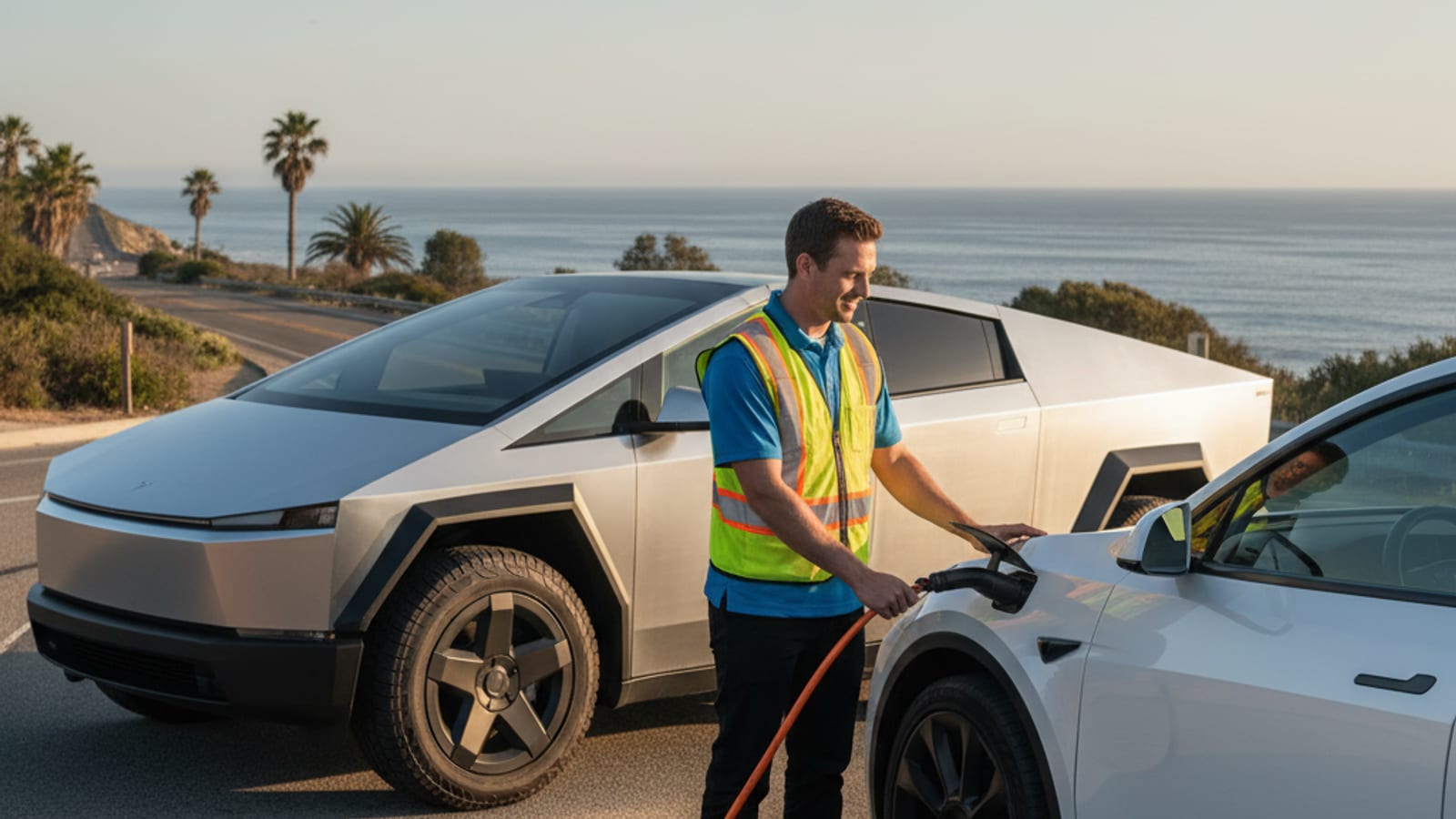
The operators we match you with bring a 240-volt Level 2 source to the car. Tesla and other NACS cars take a native NACS plug. Other EVs take a CCS or J1772 adapter. A typical rescue charge adds 10 to 20 miles of range. That’s 15 to 30 minutes of charging time, never an arrival time. Nobody here promises when a truck shows up. The operator quotes you before work starts. The operator bills you directly.
That boost is usually enough to reach a public DC fast stall or your own driveway. It’s mobile EV charging, not a fill-up to 100 percent. If you want the out-of-charge path spelled out, use out-of-charge recovery.
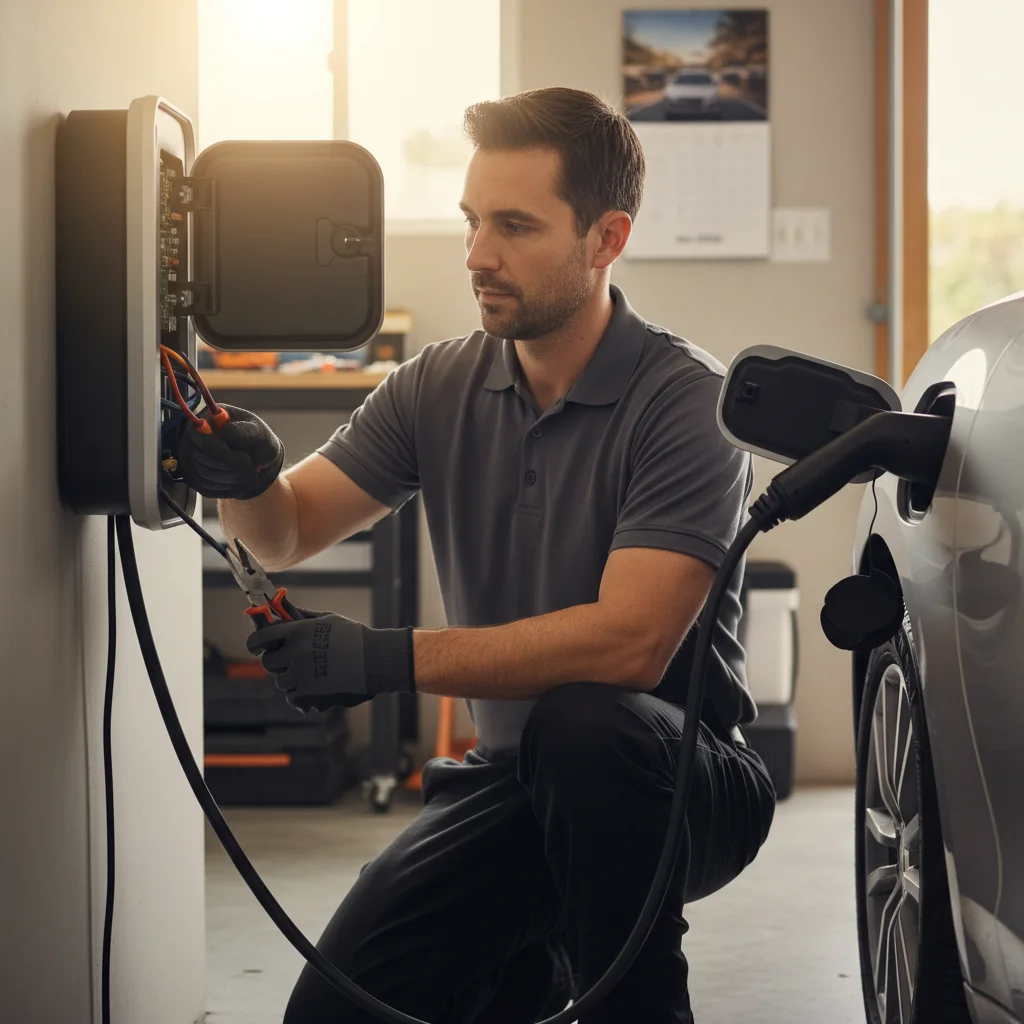
A flat tire is still a roadside job. Many EVs are heavy and skip a spare. A puncture repair or a compact kit can get you to a shop. If the tire can’t be saved, the car needs a flatbed. Don’t roll an EV on its drive wheels behind a hook truck.
If the car can’t take a charge and can’t wake, a flatbed is the honest call. Charge Pro LA doesn’t own tow trucks. It doesn’t perform licensed towing. If a flatbed is required, that’s a separate operator. Ask for a flatbed before anyone hooks the car.
Manufacturer programs are a separate layer. Tesla, Rivian, and others publish roadside benefits that often ride with the warranty. Coverage varies by brand and model year. Confirm the current terms on the maker’s own support pages. See Tesla, AAA, or a local mobile rescue: how the three actually differ.
Grades, heat, and why range drops here
Los Angeles County isn’t one climate. Coastal Westside cities sit in the marine layer. NWS Los Angeles/Oxnard describes that pattern as May Gray and June Gloom. Santa Ana winds are the other famous local weather. Inland, the San Fernando and San Gabriel Valleys run hotter than the coast. The Antelope Valley is another world. Lancaster, Palmdale, and Acton take summer heat and near-freezing winter nights.
Those swings cut real range below the window sticker. Recurrent Auto’s published testing across 30-plus models found EVs keep about 78 percent of range at 32°F. At 20°F that share is about 70 percent. Cabin heating is the main driver. AAA’s widely cited cold-weather tests found 20°F weather alone cut range about 10 to 12 percent. Running cabin climate control pushed the loss to around 40 percent. Summer heat and heavy air-conditioning load cut range too.
Station-by-station temperature normals for Lancaster or downtown weren’t attached from NWS/NOAA for this page. Don’t treat any single degree figure as a local official normal. Heat, cold, and climate load still shrink the buffer you thought you had.
The long grade north out of Castaic on I-5 is this county’s defining EV-range corridor. Drivers call it the Grapevine. It’s a sustained climb, not a short hill. Air-conditioning on that grade spends pack energy twice: once on the motors, once on the cabin. Sepulveda Pass on I-405 is the climb between the Westside and the San Fernando Valley. The local walkthrough is Out of charge on the 405 at Sepulveda Pass: what to do.
Metro ExpressLanes run on I-10 through El Monte and on I-110, the Harbor Freeway. LA Metro operates them. A FasTrak transponder tied to a funded account is required to enter. A vehicle without one is billed by plate under Pay-As-You-Go, with a processing fee. The published ExpressLanes FAQ doesn’t spell out a disabled-vehicle procedure. If you’re already low, stay out of those lanes until you know you can exit.
East Los Angeles has about 86 percent of housing built before 1980. Stevenson Ranch sits at about 3 percent. Older houses often mean older panels, so some drivers leave home closer to empty. Rancho Palos Verdes is defined by peninsula grades. Malibu and Topanga sit in the Santa Monica Mountains. A PCH pull-off isn’t a freeway shoulder. You still shouldn’t block a lane.
After a trip: a dead 12-volt at LAX
Los Angeles International is run by Los Angeles World Airports. Terminal parking is in structures P1 through P7 in the Central Terminal Area. All of those structures offer Level 2 and DC fast charging, by reservation or first-come. The LAX Economy Parking garage has more than 4,000 stalls, including 514 active EV chargers, with more planned.
Chargers in the garage don’t protect you from a dead 12-volt. A traveler who leaves an EV for a week can return to a car that won’t wake. The pack may still have range. The small battery sat unused and went flat. Parking and charger details at Hollywood Burbank, Long Beach Airport, and Van Nuys weren’t verified for this page. Confirm them on the airport’s own site.
If the screens stay dark in P3 after a flight, treat it as a 12-volt job first. Don’t assume you need a pack charge or a tow out of the structure. El Segundo sits next to the airport loop. The same check applies there.
What to tell the person who answers
Charge Pro LA is a referral line. It matches stranded EV drivers with independent local mobile rescue operators. It doesn’t hold a contractor license. It owns no trucks. It employs no technicians. It sets no prices and publishes no hours. The operator is the one who quotes, charges, and does the work.
When you call, give a location a driver can actually find. Freeway, direction, mile marker or exit. City and cross street if you’re on a surface street. Structure name and level at LAX, UCLA, or a studio lot in Burbank. Make and model. Tesla or not, because the plug changes. Whether the car shows zero miles or simply won’t wake. Whether you already called FSP, CHP, or a manufacturer line.
Stay with the vehicle. Turn off cabin climate if you still have a sliver of pack. Charge Pro LA serves every city in Los Angeles County. The Los Angeles EV charging hub maps city pages once you’re moving again.
Frequently asked questions
Will Metro Freeway Service Patrol charge my EV?
No. FSP’s published list covers a gallon of gas, fluids, and a tire change. It also covers a free tow to a CHP-chosen safe spot. It doesn’t list mobile EV charging or an empty-pack boost. Dial 511 and say “Motorist Aid” if you want that truck for a tire or a tow. Call a Level 2 operator if the pack is empty.
Can I stay on the freeway while I wait for help?
CVC 21718 bans stopping on a freeway, with exceptions. A disabled vehicle that’s summoned help is one of those exceptions. Stay with the car. Use hazards. CVC 22651 still allows removal after four hours unattended on a freeway. Follow CHP if they arrive.
How much range does a mobile Level 2 boost add?
The operators we connect you with typically add 10 to 20 miles. That’s 15 to 30 minutes of charging, not a clock on arrival. The operator quotes before starting and bills you directly. Confirm the current rate with that operator before they plug in.
If you’re stranded now, call Charge Pro LA at (858) 925-5546. You’ll be matched with a local operator. That operator can quote a Level 2 boost or a 12-volt jump. They can also tell you a flatbed is safer.