A Long Beach public stall can fail after the cable already clicks in. EV roadside assistance is the backup when you can’t confirm another reachable charger. Harbor traffic and downtown living make that call common.
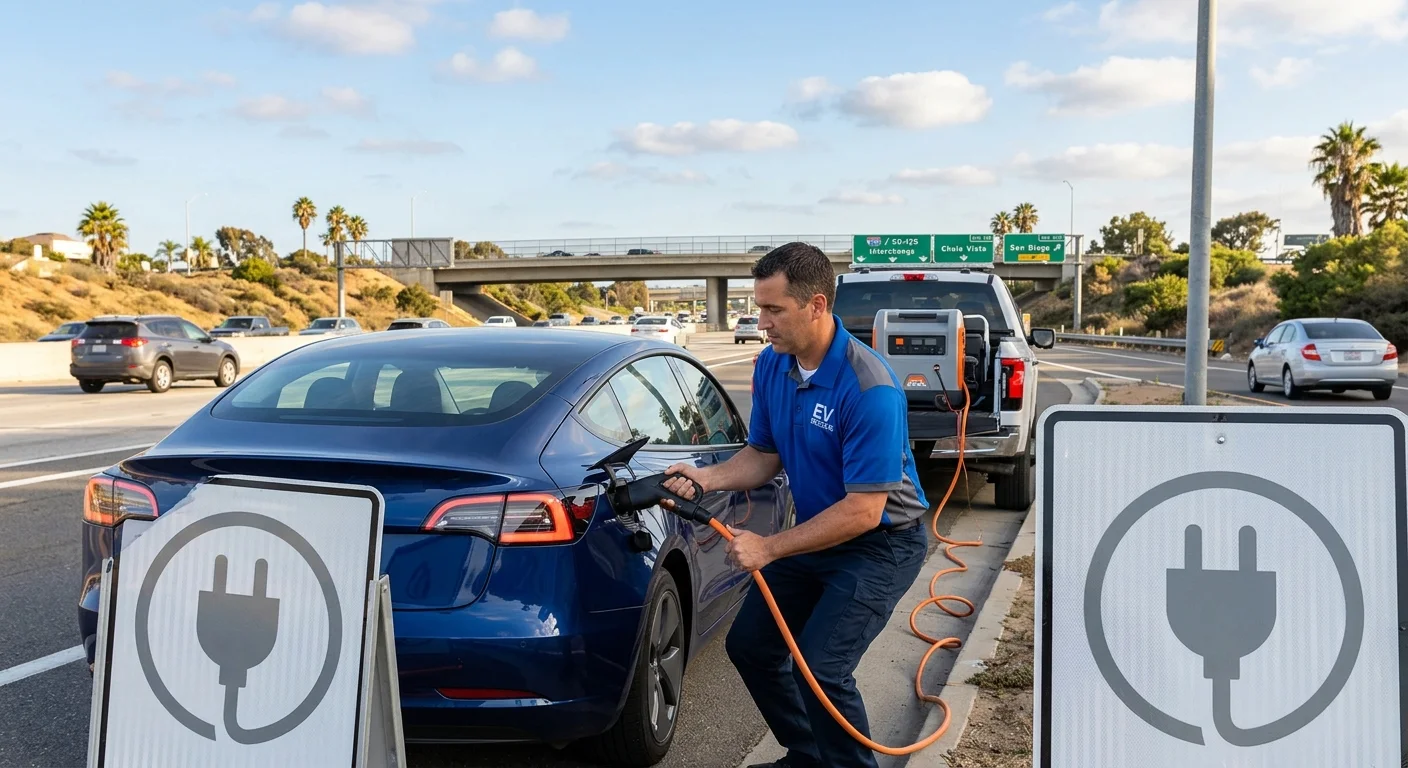
The stall failed. Stay with the car.
You’re parked off Ocean Blvd, downtown, or near the Port. The connector is seated, and the session never starts.
Don’t drive off on a pin you haven’t verified. Station status, access notes, and working hardware change. Charge Pro LA doesn’t operate public chargers or confirm Tesla’s live listings.
Open the current listing in your car or the network app. Read the whole screen, not only the station name. Match the property in front of you to that pin.
General charging background lives on the U.S. Department of Energy’s EV pages. Those pages won’t tell you if this stall works tonight. For the on-site checks, use our guide to a public EV charger that isn’t working.
Harbor charging can work, then stop
Long Beach is a South Bay and Harbor city of 50.7 square miles. ACS 2019-2023 counts 458,491 residents, and the 2024 Census estimate is 450,901. Housing built before 1980 is 79.6 percent of the stock.
That older stock shows up in downtown and East Village high-rises. Many of those buildings have no overnight home plug. Drivers depend on public stalls more than a house with a garage would.
The Port of Long Beach and the I-710 truck corridor slow everything down. The 405, 710, and 605 crush drains packs before you reach a plug. Stop-and-go on SR-1 and Ocean Blvd does the same.
May Gray and June Gloom keep summers cool and damp here. The real range hit is beach and port traffic, not temperature. Harbor-area public charging is uneven in day-to-day use.
Connectors break, sessions error out, and garages hide access rules until you arrive. That isn’t a claim that a neighborhood has no chargers. Keep a Level 2 truck as the backup when a stall fails.
Know which Long Beach you’re actually in
Downtown isn’t Belmont Shore, and Naples isn’t Bixby Knolls. North Long Beach sits closer to the 605 than to the water. The Port and the Signal Hill edge change your next exit.
Name your corridor before you pick a backup stall. I-405, I-710, I-605, SR-22, SR-47, PCH, and Ocean Blvd don’t share one entrance. A map pin without an entrance is only a guess.
If you’re already stopped, share direction of travel and the nearest exit. In a garage, share the visible property name and a dropped pin. That keeps an Ocean Blvd stall separate from a 710 shoulder.
Don’t treat Cal State Long Beach or Long Beach Memorial as a charging plan. Treat them as local landmarks, not as confirmed charging destinations. Only a current, compatible listing counts as a destination.
Long Beach Airport parking can leave a 12V dead after a trip. Stall counts and charger types at LGB were not verified in this research. Check the airport’s own site before you count on a plug there.
Checks at a stall that won’t start
Keep the car where it is if you’re legal and safe. Don’t force a bent connector into the port. Don’t hop to a neighboring stall and assume it’s yours.
Read the car screen, the charger screen, and the app. Copy the wording instead of turning it into a diagnosis. Then confirm you reached the intended property.
Compare the entrance, lot name, and equipment with the listing. Downtown and East Village structures often have height bars, gates, or valet-only decks. Those details decide whether a truck can even reach you.
If another stall on the same cabinet is free, follow the posted instructions. Stop if anything looks damaged or wet. Tesla owners should use Tesla’s current official tools for Supercharger faults. Other brands should use the network’s own support channel.
Tesla Superchargers go down or fill up like any other site. Our note on a Supercharger that’s down or full covers that next decision.
Write down the percentage the car still shows. Save the exact error text from every screen. Note whether the displays still wake, and whether the port opens. Note whether a cable is latched, and any blocked entrance.
Stop shopping new destinations when you can’t prove you can reach them. A local operator can talk through what you actually see. Charge Pro LA connects you with licensed, independent operators. We don’t run the stall, and we don’t do the roadside work.
A Level 2 truck versus another public pin
A second listing is only a backup if you can finish the drive. Compare the navigation route with remaining energy, including garage ramps and a wrong-entrance loop. If a missed turn would put you at zero, stay put. Searching until the pack dies makes recovery harder.
That’s when mobile EV charging belongs in the plan. An independent operator brings a 240-volt Level 2 source to the car. Tesla gets a native NACS plug on site. Other EVs use a CCS or J1772 adapter.
Operators typically add 10 to 20 miles of range. That’s 15 to 30 minutes of charging time. It isn’t an arrival time, and it isn’t a full fill. The goal is enough energy to reach a stall you’ve already verified.
Don’t guess the quote before the operator sees the scene. The operator sets the price after seeing the car, access, and work. Confirm scope and cost before they start, and the operator bills you directly.
If the car isn’t reachable, transport may fit better than charging in place. Out-of-charge recovery is the referral option for that case. EV roadside assistance is the broader Harbor-area path.
For a city-level overview of charging and rescue here, see EV charging in Long Beach.
Empty pack or a 12V that won’t wake
A car that sits like a brick isn’t always at zero. The 12-volt battery runs the computers that close the high-voltage contactors. If that small battery is dead, the drive pack can still hold energy. The car just won’t wake enough to use it.
Operators can jump or replace a 12V on site. They cover Tesla and every major EV brand. Say whether you see a percentage, a low-voltage warning, or nothing.
If the pack is empty, a Level 2 boost is the on-site energy option. A tow is the last call on Harbor freeways. Ask the operator which one fits after they review access and warnings.
What the freeway patrol can and can’t do
If you’re disabled on the 710, 405, or 605, Metro Freeway Service Patrol may roll up. FSP is a joint program of Caltrans, CHP, and LA Metro. It’s free to motorists, so dial 511 and say Motorist Aid.
Published FSP help is written for gasoline cars. It names a gallon of gas, a radiator refill, and a tire change. It also tows a disabled vehicle free to a CHP-chosen safe spot. It doesn’t list mobile EV charging or an out-of-charge boost. An empty EV is outside that published list, other than the tow.
Use FSP to get off a dangerous freeway lane. Don’t use it as your charging plan. Confirm current FSP hours on Metro’s page before you wait.
California Vehicle Code 21718 bars stopping on a freeway except in listed cases. A disabled vehicle that’s summoned help fits the exception. Stay as far from live lanes as you can.
CVC 21809 is the move-over rule for stopped service vehicles. Drivers must change lanes or slow for flashing lights.
Private-property tows follow CVC 22658, including entrance signs and release if you return in time. Confirm current details with local police or CHP. Don’t treat a CHP rotation tow as a charge. The Long Beach rotation list wasn’t verified here.
What to say when you request help
Start with the true location, not a copied charger address. A dropped pin beats an address pulled from a dead listing. On I-710, include northbound or southbound and the nearest exit. On PCH or Ocean Blvd, name the visible property.
Give the make, model, remaining percentage, and exact warning text. Say whether it powers on, whether the port opens, and whether everyone is safe.
Read what an EV charging truck actually does before you request one. Charge Pro LA is only the referral line.
Nearby cities that share the same crush
North Long Beach traffic spills toward Lakewood, Bellflower, Compton, Norwalk, and Carson. Verify a live listing there, or stay put and request a Level 2 boost. Long Beach isn’t named in this research as a municipal-power city. Confirm your utility on the bill before you chase a home-charger rebate.
Call when you can’t prove the next stall
Call when the stall in front of you won’t start, and you can’t confirm a reachable backup. We’ll connect you with a licensed, independent local operator. Reach Charge Pro LA at (858) 925-5546. Confirm price, access, and scope with the operator before work begins.