EV roadside assistance in Santa Clarita is an on-site charge or a 12V jump. It’s not an automatic flatbed. Charge Pro LA is a referral line for Los Angeles County. We match stranded drivers with independent local operators. Those operators bring a 240-volt Level 2 source to the vehicle. They quote you before they start. This valley is still flat. The Grapevine over Tejon Pass is the next northbound problem.
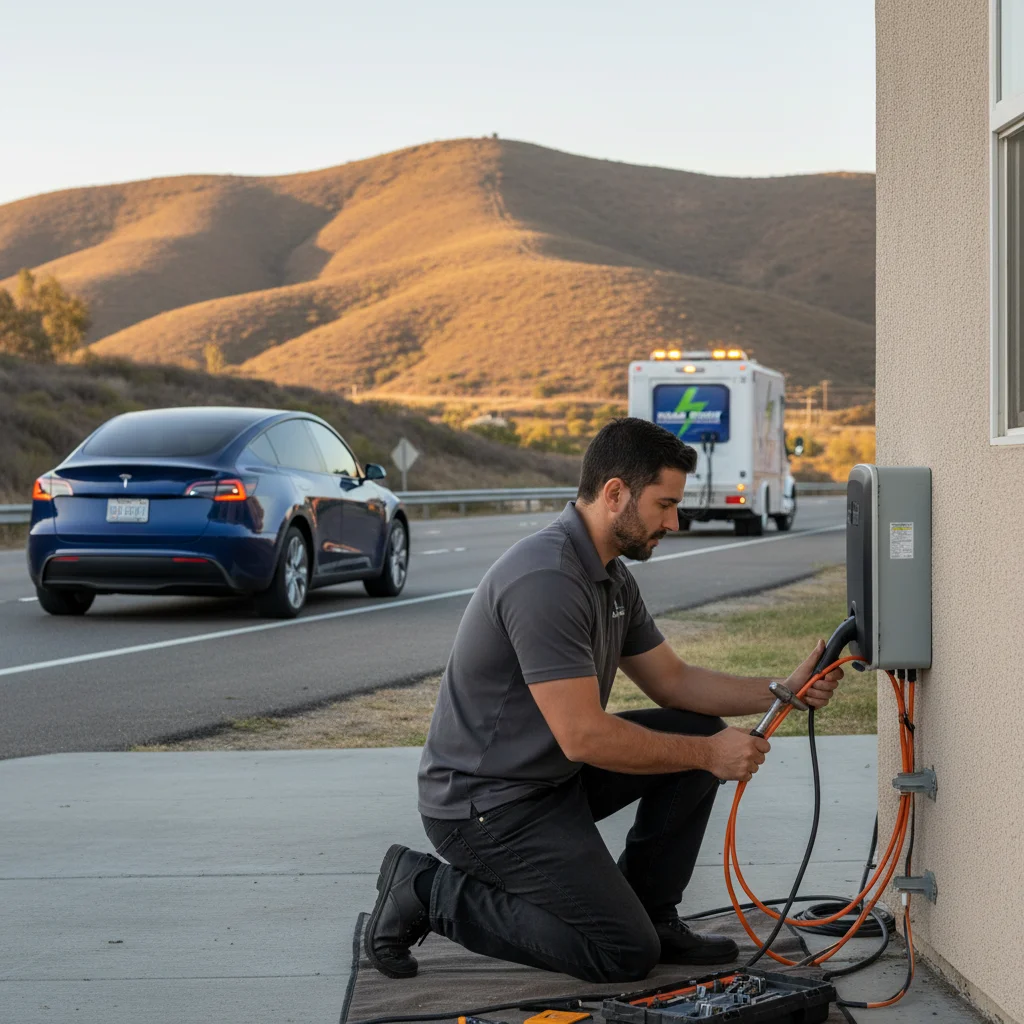
The last valley floor before the Grapevine
Santa Clarita sits at the I-5 launch point for the climb north. Census land area is 73.6 square miles of valley floor. The ACS population is 229,021. The 2024 estimate is 229,159. I-5, the Golden State Freeway, runs the west side. SR-14, the Antelope Valley Freeway, peels east. They meet at the Newhall Pass. Sierra Highway and Soledad Canyon Road cut through Canyon Country. McBean Parkway stitches Valencia to the freeway ramps. Newhall and Saugus feed the same grid.
Northbound, this is still valley pavement. South of the passes you’re in the Santa Clarita Valley climate. Summers are hot and dry. Cabin AC plus a grade wrecks a range number that looked safe in town. Castaic is the last town before the I-5 climb over Tejon Pass. That climb is the Grapevine. Eastbound, SR-14 rises toward Acton and the Antelope Valley. Range that looked fine in Valencia can fall on either grade. If you’re fading on the Golden State Freeway, stop in the valley. Our note on out of charge on the 5 near Santa Clarita covers that stretch. Don’t spend the last bars on the pass and hope.
Valencia traffic, Six Flags, and a commute that ran long
The Six Flags Magic Mountain district sits on this I-5 approach. A park day stacks heat, lot crawling, and a late merge. You leave with a thinner buffer than you planned. Then freeway load and climate control start eating them. People in Valencia or Saugus roll through Newhall Pass toward San Fernando or Burbank. That’s a long day on the Golden State Freeway. Get home tired, skip the plug, and morning starts with a thin margin.
Census data says 30.4 percent of Santa Clarita housing was built before 1980. Older Newhall and Canyon Country streets often lack a dedicated Level 2 circuit. Stevenson Ranch is the contrast. Only 3.4 percent of homes there predate 1980. The Pico Canyon district and Southern Oaks are newer hillside stock. Stevenson Ranch Parkway and The Old Road dump you onto the same northbound problem.
Southern California Edison delivers power across most of this valley. Santa Clarita isn’t a municipal-utility city. Confirm any home-charger rebate on sce.com. Unincorporated pockets may show Clean Power Alliance for generation. SCE still delivers the power. None of that charges a car on The Old Road.
Why the remaining-miles number lies on this approach
Your display assumes the next miles look like the last miles. Flat McBean Parkway isn’t Tejon Pass. It isn’t the SR-14 climb either. Heat and air-conditioning cut real range below the sticker. Recurrent Auto’s published work on heat and cabin load supports that. This page won’t invent a local temperature reading. You can feel the compressor running the whole way to Castaic.
Winter has a Grapevine problem of its own. Snow and chain controls can show up at the summit. A low pack plus a slow climb in cold air is a hard mix. Cabin heat eats miles the way AC does in July. Read empty pack on the Grapevine north of Castaic before you commit to the grade.
Shoulder rules, Metro patrols, and what they won’t plug in
California Vehicle Code 21718 bans stopping on a freeway in most cases. A disabled vehicle is an exception when you’ve summoned help. Put the hazards on. Stay out of live lanes if you can. Keep people behind a barrier when that’s safer. CVC 21809 is the move-over law. Other drivers must change lanes if they can, or slow to a reasonable speed. That rule protects you, CHP, and any service vehicle with lights on.
Metro Freeway Service Patrol is free on congested Los Angeles County freeways. Caltrans, the California Highway Patrol, and LA Metro run it together. Published help includes a gallon of gas, a radiator refill, and a tire change. It also includes a no-charge tow to a safe spot CHP chooses. Hours are typically weekday peaks. Dial 511 and say Motorist Aid. The published assistance list doesn’t name mobile EV charging. It doesn’t name an out-of-charge boost. An empty traction pack sits outside that list. FSP can still move you off the freeway. It won’t refill the drive battery.
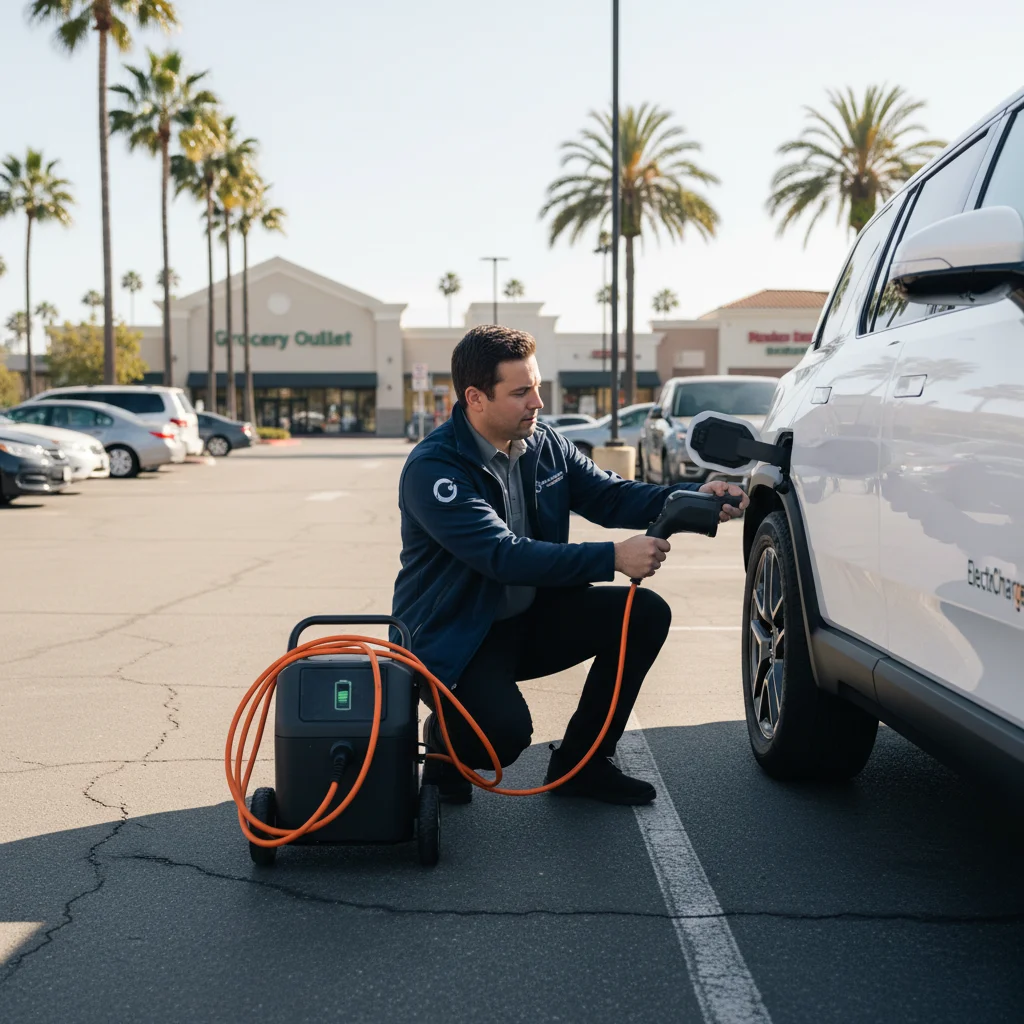
What a mobile rescue actually does here
Call Charge Pro LA and you’re asking for a match, not a company truck. We own no fleet. We employ no technicians. We set no prices. We publish no arrival window. The mobile EV charging operators we connect you with are licensed and insured. They roll a 240-volt Level 2 source to the car. Teslas take a native NACS plug. Other EVs use a CCS or J1772 adapter. Charging time is typically 15 to 30 minutes. That window is plug time, never a promise of when someone shows up. In that charging window they typically add 10 to 20 miles of range. That’s usually enough to leave the shoulder and reach a charger you choose. They also jump or replace a dead 12-volt battery on site. They handle Tesla and every major EV brand.
The operator quotes you before work starts. If the pack is empty, that’s out-of-charge recovery plus a Level 2 boost. If screens are dark and the pack still has bars, start with the 12V. EV roadside assistance in this valley is those two jobs. It’s not a gas can and it’s not a shop visit.
Charge on the spot, or wait on a flatbed
A zero pack doesn’t mean the car needs a shop. Towing is the last call for a reason. Many EVs need a flatbed so the motors aren’t dragged. After the hook you still need a working stall. Six Flags lots and valley parking structures add staging. CHP rotation tows handle disabled freeway vehicles. Details of the local rotation aren’t confirmed in our research. Don’t assume a rotation tow ends at a live DC stall.
California Vehicle Code 22651 lets an officer remove a vehicle that blocks traffic. It also covers a car left unattended on a freeway for four hours or more. Calling for help and staying with the car fits the CVC 21718 exception. For the same fork in plainer steps, read on-site charging or a tow. Mobile Level 2 doesn’t fill the pack. It buys enough miles to leave. You pick the next charger. You’re not stuck waiting on a stall that may not wake a dead 12V.
Stevenson Ranch, Castaic, and the same I-5 funnel
Santa Clarita is the city name on the sign. The stranding pattern includes the whole approach. Stevenson Ranch feeds I-5 at Pico Canyon and The Old Road. Castaic sits farther north by the truck-stop row and Hasley Canyon. The Castaic Lake district and Val Verde sit on that same edge. Parker Road and Lake Hughes Road dump onto that same freeway. If the estimate is already nervous in Valencia, don’t climb out of Castaic. San Fernando is the next basin south through the Newhall Pass. Acton, Palmdale, and Lancaster sit after the SR-14 climb.
Dead 12V or an empty drive pack
An empty high-voltage pack is the car that rolled until it didn’t. You watched the percentage fall. A dead 12V can look worse. The car acts like a brick even with miles still in the pack. After a Six Flags day, the small battery can sag. Overnight on a Canyon Country driveway does the same. Jumping the 12V is the first check. Charging the drive pack won’t wake a car whose 12V is out. Tell the operator which one you think you have. Lights, the range readout, and whether you drove there are the clues. They’ll still confirm on site.
If you’re stopped in Santa Clarita, Stevenson Ranch, or Castaic, call (858) 925-5546. We’ll connect you with a local operator. They quote before they start. They bill you directly. Stay with the car if it’s safe. Keep the hazards on.