You walk back to the lot at Griffith Observatory and the EV won’t wake. Handles don’t present. Screens stay black. The traction pack still showed range when you parked. That’s a dead 12V, not an empty drive battery. The small battery that runs the computers has dropped out. The pack never gets permission to connect. You’re not out of miles. The car just won’t boot.
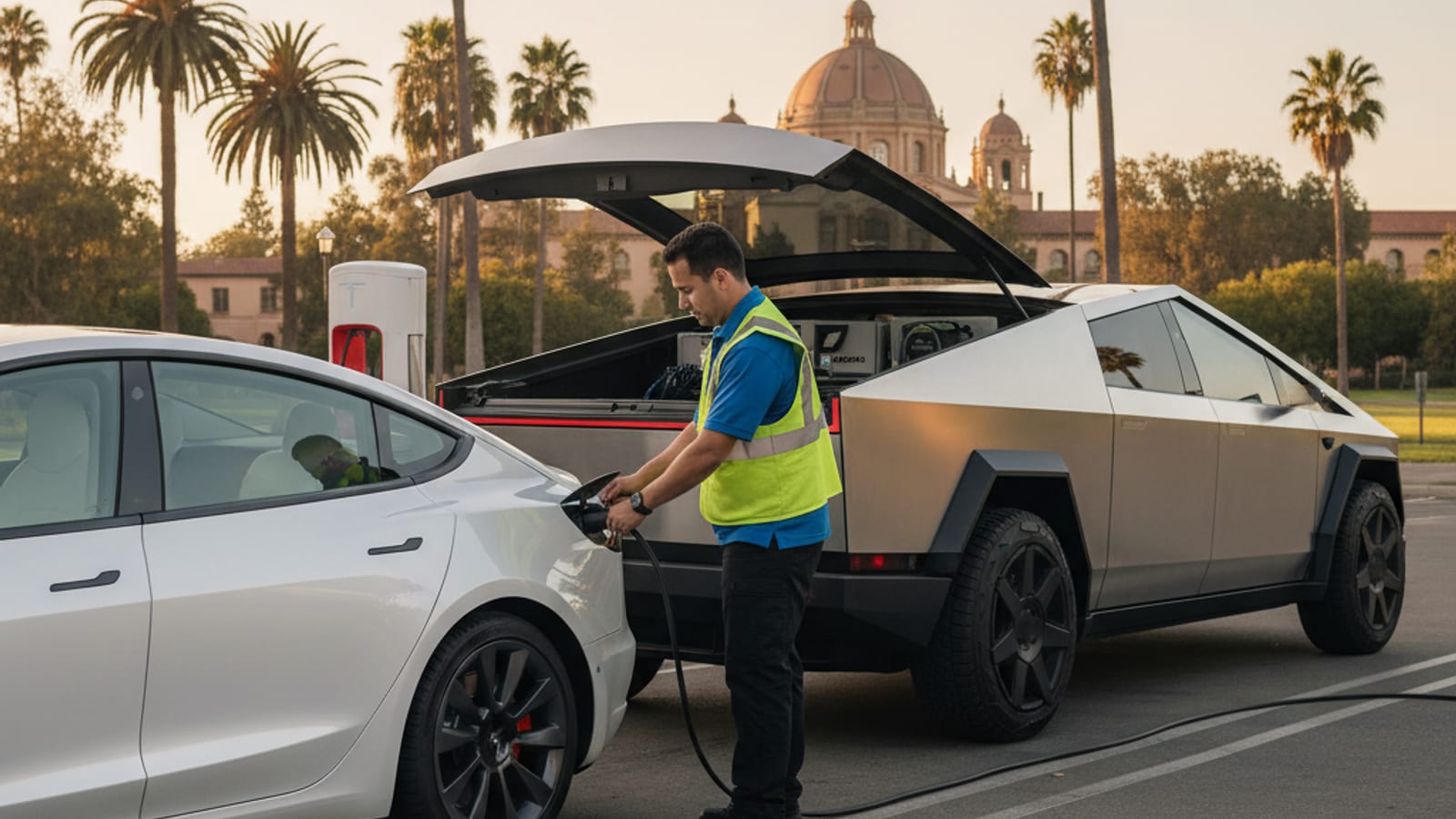
The pack can look fine while the car is a brick
Every modern EV still carries a low-voltage battery. On most models it’s a 12V unit. It runs locks, modules, lights, and the contactors. Those contactors close onto the high-voltage pack. If the small battery is flat, the pack can sit at 40 percent. The car still acts like a stone. Tesla owners see it often. Hyundai, Kia, Ford, Rivian, BMW, Audi, and Chevy drivers see it too. The badge doesn’t change the split. One battery moves the car. The other wakes the car.
A long park is how a weak 12V finally lets go. Cabin cameras and security modes keep modules sipping power. Scheduled climate does the same. A hot interior does too. You’re gone for a long visit. The 12V keeps working without a running car to replenish it. You come back with the last range number still in your head. That number was the pack. It wasn’t a health reading on the 12V.
What happens when an EV 12V dies is the electrical picture. The short version is blunt. No 12V, no boot. No boot, no drive. A public stall can’t handshake with a computer that’s off.
What a long Griffith Observatory park actually does
Griffith Observatory is in the City of Los Angeles. It’s one of the county’s durable landmarks. UCLA and USC sit in the same city. The City of Los Angeles had 3,857,897 residents in the ACS 2019-2023 count. The 2024 population estimate was 3,878,704. Drivers from all over the county make a day of it. They leave the car through exhibits and a slow walk back. That’s a long sit for a tired 12V.
This isn’t first an empty-pack story. It’s a sit-and-drain story. The same failure shows up after a week in an airport garage. Los Angeles International is run by Los Angeles World Airports. Terminal structures P1 through P7 list Level 2 and DC fast charging. Economy Parking has more than 4,000 stalls, including 514 active EV chargers, with more coming. That’s from parking.flylax.com as of 2026-09-18. Travelers still return to a car that won’t wake. Chargers in a lot don’t keep a failing 12V alive. The 12V isn’t the traction pack. Plug presence doesn’t change that.
A Griffith Observatory park is a shorter version of that airport pattern. You’re not gone a week. You’re gone long enough for a weak 12V to fall under what the computers need. App polling adds load. Cabin overheat logic adds load. Security monitoring adds load. If the 12V was already on its last months, this is where it shows.
People in Los Angeles often assume a public stall will save them. A stall helps an empty pack. It does nothing for a car that can’t close contactors. Unlock first. Then worry about miles.
Event parking writes the same lesson. After a SoFi night, EVs look dead in the structure for this 12V reason. See EV dead in the garage after a SoFi Stadium event. Universal Studios Hollywood parking does it too. Griffith Observatory is the daytime, long-visit version. Same small battery. Same brick of a car.
How to tell a dead 12V from an empty pack
Start with what the car does, not what you fear.
If the pack was truly at zero, you’d usually still get some response. A warning. A grim range number you already watched fall. Climate that worked until the car refused to move. An empty pack is a miles problem. A dead 12V is a boot problem.
Signs that point at the 12V:
- Door handles don’t present, and the app can’t wake the car.
- Interior screens stay black. There’s no startup chime.
- The charge port won’t open. The latch never gets a command.
- You shut it off with a comfortable range number.
- You may have had low-voltage warnings in the days before.
Signs that point at the pack:
- The car fully woke, then told you it was empty.
- You watched range fall on the drive in.
- Infotainment worked. Drive just wouldn’t engage for lack of energy.
If you’re unsure, treat it as 12V until proven otherwise. Jumping or replacing the 12V is the on-site fix operators use. Towing a car with a healthy pack because the 12V died is the wrong fork. Tesla won’t wake: is it the 12V or the main pack walks through that split. The same split applies to non-Tesla EVs. Don’t guess from one dark screen. A dark screen is the 12V’s calling card.
First checks in the lot, in order
Stay with the car. Don’t wander the lot hunting a stall while the vehicle’s a brick. A charger can’t talk to a module that’s asleep.
Try the owner steps you actually know. Use the physical key if your model has one. Try the app wake a couple of times, then stop. Repeated app pings keep a dying 12V in a worse state. Use a portable jump pack only if you know your model’s 12V jump post. If you don’t know the procedure, don’t improvise under the frunk. Wrong clamp points damage modules.
Can roadside assistance jump-start an EV, or only the 12V? is the limit. You’re not jump-starting the drive pack. You’re waking the small battery so the pack can connect. That’s the whole trick.
If the car’s a Tesla, the 12V sits in a different place by generation. Some newer cars use a low-voltage lithium unit instead. Don’t copy a random forum photo. If you’re not sure, wait for someone who does this on EVs. The pros we connect you with jump Tesla 12V batteries on site. They handle the other brands too.
Once the car wakes, don’t assume you’re finished. A 12V that died in a lot often dies again after a short drive. Get it tested. Plan a replacement if it’s old or if this is a repeat. The car may look normal for a day. Then it strands you at home or at work.
Keep kids and bags with you. A dark EV in a busy lot is easy to walk past. Stay by the vehicle.
Heat, security modes, and why the small battery quits
Los Angeles County weather is not one climate. The coast runs cooler under the marine layer. The San Fernando and San Gabriel Valleys run hotter. The Antelope Valley swings from hard summer heat to cold nights. Station-level normals for Griffith Observatory weren’t attached for this page. We won’t invent a temperature here. The published range research still applies in plain terms.
Recurrent Auto’s work found EVs keep about 78 percent of range at 32°F. They keep about 70 percent at 20°F across 30-plus models. Cabin heat is the big drain. AAA testing found 20°F weather alone cut range about 10 to 12 percent. Climate control pushed the loss around 40 percent. Heat and air conditioning cut range in summer too. A parked car in the sun still runs thermal logic. That logic needs the 12V.
You don’t need snow at Griffith Observatory for this to matter. A long sit with security features on is enough. A weak 12V fails in mild weather all the time. Heat just shortens the fuse. Cabin-overheat protection is a 12V load while the car looks off. Sentry-style cameras are a 12V load. Dashcams and scheduled preconditioning are 12V loads too. If you left those on for a long visit, that’s the mechanism.
If you’re heading back over Sepulveda Pass on the 405 after this, that’s extra pack load once you’re moving. The same is true north toward the Grapevine on the 5 near Castaic. Those corridors are the county’s known grade stories. They don’t cause the 12V failure in the lot. They matter after you wake the car and still have to get home.
If the lot wants the car moved
A dead EV in a busy lot becomes a parking problem fast. People need the stall. Staff want it gone. That’s when a tow gets offered as the default.
Pause before you accept a flatbed as the first move. If the 12V is the fault, a jump on site can make the car drive out under its own power. That’s kinder to the pack than a rushed hook. If you do need a tow, it has to be the EV-safe method for your brand. That usually means a flatbed. Don’t let someone roll it on drive wheels in a way that backfeeds the motor.
California Vehicle Code 22658 sets rules for towing from private property. Required entrance signage is 17 by 22 inches. The owner or agent has to authorize the tow in writing. The registered owner gets immediate written notice. Local law enforcement gets notice within one hour. If you return before the car leaves the lot, they have to release it. If it’s coupled but not yet moved, you pay at most half the tow charge. Storage rates can’t exceed law-enforcement or CHP-approved rates. Read the signs in front of you. Don’t assume every stall at Griffith Observatory is private property. City lots and private lots aren’t the same. The code above is the private-property path. Confirm what the posted signs actually say.
California doesn’t publish one statewide tow-rate cap we could verify. Don’t trust a number you heard in a garage. Ask what’s being charged, and who approved it, before you sign.
If an officer is involved, Vehicle Code 22651 lists when a vehicle can be removed. That includes obstruction, a blocked hydrant or driveway, more than four hours unattended on a freeway, and more than 72 hours on a highway. A lot at the observatory isn’t a freeway. A car that blocks a fire access can still be moved. Stay with it.
City of Los Angeles impounds go through Official Police Garages. Release needs proof of ownership, an LAPD release where that applies, and payment of tow and storage. The OPG fee schedule wasn’t verified for this page. Confirm on lapdonline.org or lacity.gov. Don’t pay a cash shortcut that isn’t on a receipt.
If you roll out and then stall on a freeway
Maybe you woke the car and left the lot. Then the pack was actually empty on a freeway. That’s a different problem from the 12V brick you had in the stall.
Metro Freeway Service Patrol is free. It’s a joint program of Caltrans, the California Highway Patrol, and LA Metro. It roams congested Los Angeles County freeways to clear incidents. You can dial 511 and say Motorist Aid. What FSP publishes is built around gasoline cars. It names a gallon of gas, a radiator refill, a flat tire, and a free tow to a safe CHP-chosen spot. The published list doesn’t include mobile EV charging or out-of-charge battery help. That’s an observed absence from metro.net and chp.ca.gov as of 2026-09-18. It isn’t a claim about an unpublished policy. An empty EV can get a free tow to a safe location. It doesn’t get a Level 2 boost from FSP based on those materials.
Vehicle Code 21718 bans stopping on a freeway, with exceptions. A disabled vehicle that’s summoned help is one of those exceptions. So is avoiding injury or damage, or following a peace officer. If you die on the 5, the 110, or the 405, stay out of live lanes. Call for help. You’re in the disabled-vehicle exception once you’ve summoned assistance.
Vehicle Code 21809 is the move-over law. Drivers approaching a stopped emergency vehicle, tow truck, or Caltrans vehicle with flashing lights must change lanes if it’s safe, or slow down. Keep your hazards on.
Don’t wait on FSP for a 12V jump in an observatory lot. That’s not what the patrol is for.
What a mobile operator actually does
Charge Pro LA is a referral line. We match stranded EV drivers with independent local mobile rescue operators across Los Angeles County. We don’t hold a contractor license. We don’t own trucks, yards, or chargers. We don’t employ the technician. We don’t set the price. We don’t promise an arrival time. We don’t publish hours. The operator quotes you before work starts and bills you directly.
The brand connects you. The pro does the work. The pros we connect you with are licensed and insured. Charge Pro LA is not the licensee on the job.
What those operators do on site is specific. They can jump or replace a dead 12V on the spot. They can also bring a 240V Level 2 source to the car if the pack is the problem. Native NACS for Teslas. CCS or J1772 adapters for everyone else. Typical charging time adds about 10 to 20 miles of range in 15 to 30 minutes of charging. That’s charging time, not a clock on when someone shows up.
If Griffith Observatory left you with a brick that still had pack range, you want the 12V path. If you truly hit zero on the way home, the Level 2 boost is the one that avoids a tow. Mobile EV charging is that second path.
The operator should confirm the quote while you’re still on the phone. If the 12V needs replacement, that’s a parts decision you hear before they start. If they only need a jump, you should hear that too. Repeat 12V failures mean the battery’s at end of life. A jump is a wake-up, not a repair.
Tell the operator the last range number you saw. Tell them the car won’t unlock, if that’s the case. Tell them you’re in a lot at Griffith Observatory, not on a freeway shoulder, unless you are. Lot access and a blocked stall change how they stage. A freeway disablement is a different problem under CVC 21718.
Tesla and every major EV brand show up in this county. The plug changes. The 12V logic doesn’t.
Power at home in the City of Los Angeles
Once the car drives, think about the next night, not the next overlook.
The City of Los Angeles is LADWP territory. LADWP is the largest municipal utility in the United States. It isn’t Southern California Edison. If you live in Los Angeles city limits, your bill and your EV programs come from LADWP. Confirmed programs on ladwp.com as of 2026-09-18 include a residential EV charger rebate toward a Level 2 home charger and a dedicated EV meter. There’s also a used electric vehicle rebate, a commercial charger rebate, and a dedicated EV time-of-use rate that needs a separate EV meter. We don’t publish dollar amounts. Confirm the current rebate and rate on LADWP’s own EV pages before you budget anything.
Most of the rest of Los Angeles County is Southern California Edison territory. SCE publishes a pre-owned EV rebate and Charge Ready Home, plus EV rate plans. Confirm amounts on sce.com. Treat third-party Clean Fuel Reward figures as not verified here.
Some SCE cities buy generation through Clean Power Alliance, founded in 2017. SCE still delivers the power. Santa Monica, West Hollywood, Beverly Hills, Culver City, and unincorporated LA County are among the verified members. The City of Los Angeles isn’t on that list. Your generation choice doesn’t change a lot rescue.
Glendale, Burbank, Pasadena, and Azusa run their own utilities. We haven’t verified those cities’ current EV rebate names on each utility’s own site. Ask your utility by name.
About 71 percent of housing in the City of Los Angeles was built before 1980. Older panels complicate a home Level 2 install. That’s separate from a lot rescue. A new wall charger doesn’t wake a car that can’t boot. Home overnight charging helps you arrive with pack range. It doesn’t prevent a 12V failure.
Mistakes that make a dead EV worse
Don’t keep mashing the app. Don’t borrow a gas-car jump from a stranger without knowing your EV’s 12V points. Don’t try to charge another EV from yours. Don’t assume a Tesla can jump a gas car as a favor. Those are good ways to damage both vehicles.
Don’t sit in a live travel lane if you’ve already left the lot. Don’t leave the car if a tow is already authorized on a private lot. You may still be the registered owner who can stop it under CVC 22658.
Don’t treat AAA, Tesla roadside, or an insurer as interchangeable. Each program sends what it contracted. That often means a tow, not a 12V tech or a Level 2 truck. Ask what they’re actually dispatching before you wait.
Don’t keep the car in a fire access while you argue on the phone. Move it a few feet if it will wake enough to creep. If it won’t, stay with it.
Once the screens light, confirm the pack percentage, the charge port, and Drive. Then leave without lingering in a fire lane.
If the pack is actually low, use your car’s map or a charging-network app. We won’t guess the nearest stall from here. Availability changes. Confirm your plug: NACS, CCS, or J1772. Confirm your car, not a rumor.
Public session prices weren’t verified for this page. If the 12V warning returns on the drive, get the small battery tested. Repeat death after a jump is a replacement conversation.
Who to call from the lot
We serve every city in Los Angeles County. If you’re still in the lot at Griffith Observatory with a car that won’t wake, that’s the call path. Tell the operator it’s a park-and-dead, not a freeway empty pack, unless it is. Give the exact lot description you can see. Stay with the vehicle.
Call (858) 925-5546 when you want us to connect you. That’s the number. It’s not a promise of when someone arrives. The operator quotes before they start.
Frequently asked questions
Why did the EV die at Griffith Observatory if the pack still had range?
Because the 12V likely dropped below what the computers need. The traction pack and the 12V are separate. A long park with accessories awake drains the small battery. Range on the last screen doesn’t keep the 12V alive. A stall doesn’t fix a battery that can’t close contactors.
Can an operator jump an EV in the lot, or is a tow required?
An EV jump is a 12V job, not a pack job. The pros we connect you with jump or replace that 12V on site when that’s the fault. A tow is the fallback if the car still won’t move. It’s also the fallback if the pack is truly empty and you choose not to charge in place. Confirm the plan and the quote before anyone hooks up. If the stall is on private property, CVC 22658 still governs a non-consensual tow. Read the signs.
If the jump works, do I still need a mobile charge?
Only if the pack is actually low. A successful 12V wake doesn’t add miles. It lets the car use the miles it already had. If you parked with plenty of range, drive out and replace the 12V soon. If you parked already near empty, ask for a Level 2 boost. That’s about 10 to 20 miles in 15 to 30 minutes of charging.