The pack hits zero on I-10 through the San Gabriel Valley. Get fully onto the right shoulder, switch on the hazards, and stay with the car. Then call 511 and say Motorist Aid. CHP and Metro’s Freeway Service Patrol need to know you’re disabled. After that, request a mobile Level 2 boost from an independent operator. If you stalled in the Metro ExpressLanes, the toll part is separate. A FasTrak account or a Pay-As-You-Go plate bill is Metro’s process. It doesn’t change the safety steps.
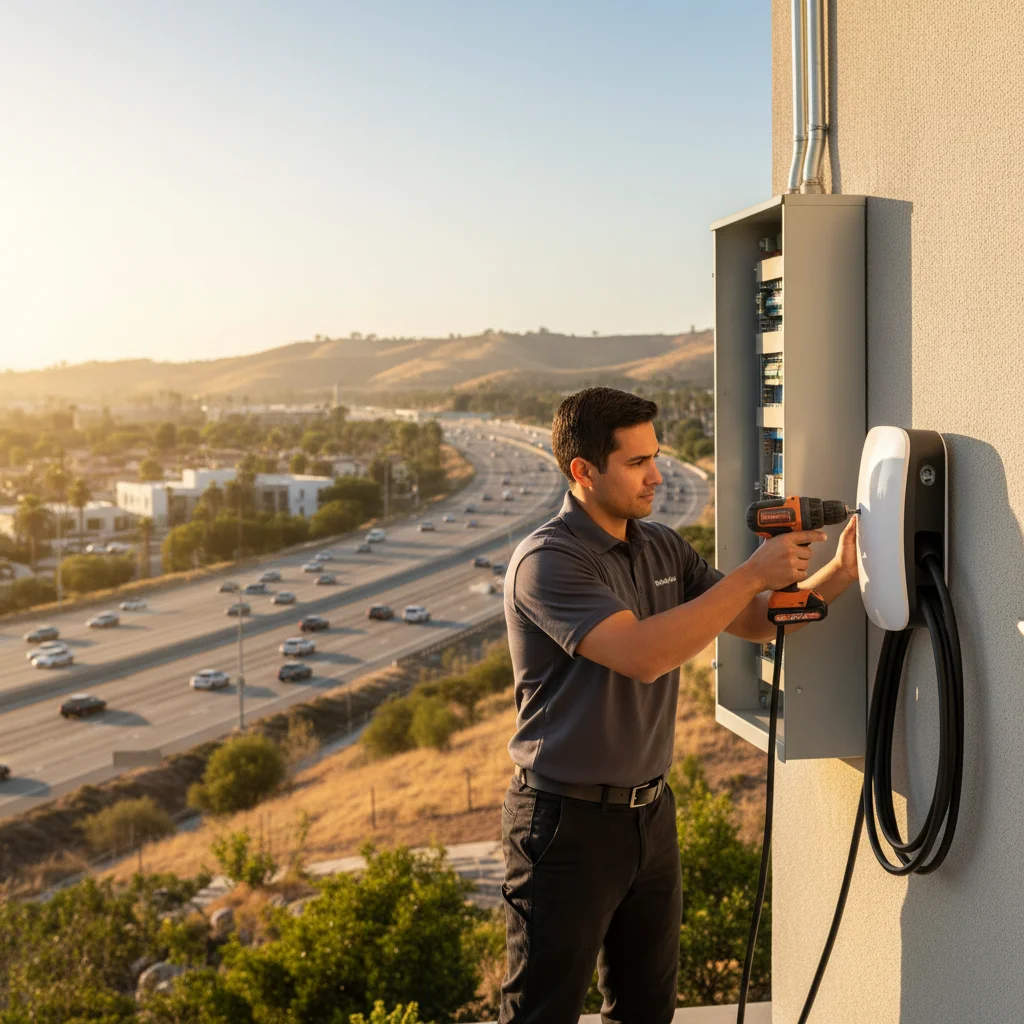
The 10 through the valley is a commute spine
I-10 on this stretch is the San Bernardino Freeway. Metro also labels the ExpressLanes segment as the El Monte corridor. East Los Angeles, El Monte, West Covina, and Pomona sit on that spine. El Monte’s ACS population is 107,066. West Covina is 107,436. Pomona is 148,391. East Los Angeles is 114,617. You’re in dense valley traffic, not open country.
About 69 percent of El Monte housing predates 1980. West Covina is about 76.5 percent pre-1980. East Los Angeles is about 86.2 percent. Many of those homes were wired before a dedicated EV circuit was normal. Drivers leave with a partial charge more often than people assume. That’s a house-wiring pattern. It isn’t a claim about plugs on the freeway.
Southern California Edison delivers power through most of this belt. Alhambra buys generation through Clean Power Alliance, and SCE still runs the wires. Pasadena Water and Power serves Pasadena. That’s a short hop north toward the 110 and the 210. Azusa Light and Water serves Azusa in the foothills. None of those utilities roll a rescue truck onto the 10. Your generation choice doesn’t change who can reach a stalled car.
San Gabriel Valley afternoons run hotter than the coast. Cabin AC eats range on a packed eastbound crawl. Recurrent Auto’s published research ties heat and air conditioning to real-world range loss. Don’t treat the window sticker as the miles left. The East LA Interchange is a bad place to learn that.
ExpressLanes add a toll problem to a dead pack
Metro ExpressLanes run on I-10 and on I-110. LA Metro operates both. A FasTrak transponder tied to a funded account is required to enter. A vehicle without one is billed by license plate under Pay-As-You-Go. Metro adds a processing fee on that path. Motorcycles are exempt. Those rules are on metroexpresslanes.net, read 2026-09-18.
Metro’s published ExpressLanes FAQ doesn’t spell out a disabled-vehicle procedure for an empty EV. It also doesn’t confirm whether every ExpressLanes segment has a usable shoulder. Treat any no-shoulder rumor as unconfirmed. Check Metro’s own site if you need the current wording. The statewide rule still holds. CVC 21718 lets a disabled vehicle stay on the freeway once help is coming.
If the car dies in a toll lane, stay in that lane. Don’t cut across general-purpose lanes on leftover power. Keep the hazards on. Tell 511 you’re in the ExpressLanes, and which way you’re pointed. Tell the mobile operator the same thing. A plate bill or a FasTrak charge is Metro paperwork. It isn’t a reason to walk the lane.
Other drivers must move over or slow when they see flashing lights. That duty covers a stopped emergency vehicle, tow truck, or Caltrans truck. That’s CVC 21809. You can’t make them do it. You can keep your body on the right side of the car.
The Harbor Freeway ExpressLanes are the other Metro pair. The stall pattern is similar if you die on the 110. Out of charge on the 110: what to do next is that corridor.
First moves that keep you legal
CVC 21718 bans stopping, parking, or leaving a vehicle standing on a freeway. The exceptions include a disabled vehicle after you’ve summoned help. An empty EV with a rescue call in progress fits the disabled case.
Hazards go on before you hunt for a signal. Get the car as far right as the remaining power allows. Leave the travel lanes clear. Don’t stop on an on-ramp gore if you can still roll forward.
Exit from the passenger side when you get out. The driver door opens toward traffic. Stand behind the right rear corner. Don’t stand between the car and the lanes. If staying inside feels safer, sit on the passenger side with the belt on.
Don’t walk the shoulder looking for a public stall. The 10 through El Monte and West Covina carries heavy truck and commute traffic. Stay with the vehicle. The safest wait is inside on the right, or outside at the right rear.
Call 511 and say Motorist Aid. Give direction of travel, the last exit you can name, and a short description. Eastbound past El Monte. Westbound before Pomona. White Model Y. That’s enough for CHP to log a disabled vehicle.
What Freeway Service Patrol can actually do
Metro Freeway Service Patrol is a joint program of Caltrans, CHP, and LA Metro. It’s free to motorists. It roams congested Los Angeles County freeways to clear incidents. Published help includes a gallon of gas, a radiator refill, a taped hose, and a tire change. It also includes a free tow to a safe spot that CHP picks.
The published motorist-assistance list is written for gasoline cars. It doesn’t list mobile EV charging. It doesn’t list an out-of-charge traction pack. That’s an observed absence from metro.net and chp.ca.gov as of 2026-09-18. It isn’t a claim about a hidden FSP policy. An FSP driver can still move you off the 10. They aren’t advertising a charge on the shoulder.
Confirm current FSP hours on metro.net. Don’t wait on the 10 for a charge their published menu doesn’t name.
CHP can send a rotation tow under its Tow Service Agreement. Details of the local rotation list weren’t verified here. A peace officer may also remove a vehicle that blocks traffic. Unattended freeway stops of four hours or more are in CVC 22651 too. Calling 511 early keeps you in the disabled column.
Empty pack versus a 12-volt brick
A traction pack at zero won’t take you to the next exit. Interior lights may still work. The car just won’t propel. A dead 12-volt battery can look identical from the curb. Screens stay black. Handles may not pop. The high-voltage pack can still hold plenty of energy.
Don’t assume the big battery is empty because the car won’t wake. If you watched the range fall through West Covina, you likely have an empty pack. If you parked and came back to a brick, start with the 12-volt. Heat-soaked valley lots and long sits both stress that small battery.
Operators in this referral network can jump or replace a failed 12-volt on site. They can also bring 240-volt Level 2 to a car that will accept charge. Teslas use a native NACS plug. Other EVs use a CCS or J1772 adapter. A typical boost adds about 10 to 20 miles of range. That takes 15 to 30 minutes of charging. That’s plug time. It isn’t an arrival time.
Charge Pro LA doesn’t own the truck. It doesn’t employ the technician. It matches stranded drivers with independent local operators. The operator quotes you before work starts. The operator bills you directly.
Cities on this stretch of the 10
El Monte sits where ExpressLanes and general lanes share a crowded right-of-way. About 65.1 percent of residents are Hispanic or Latino on the latest ACS figures. SCE delivers the power. If you can still roll one exit, a surface street is often calmer. If you can’t, stay put. Stopped on the 10 in El Monte: mobile rescue vs a tow is the local write-up.
West Covina is the next large valley city on the same freeway. About 53.2 percent of residents are Hispanic or Latino. The 10 and the 60 both cut through town. A low pack on one freeway can follow you onto the other. Stalled in West Covina on the 10 or the 60 covers that fork.
Pomona sits at the eastern county end of this commute. ACS population is 148,391. About 71.4 percent of residents are Hispanic or Latino. The 10, the 57, and the 60 meet near Cal Poly Pomona. A dying pack at that knot is a lane-choice problem first. Stalled in Pomona on the 10, the 57, or the 60 maps the junction.
East Los Angeles sits at the western mouth of the valley stretch. It’s hard against the East LA Interchange. That’s where the 10 meets the 5, the 101, and the 60. About 95.6 percent of residents are Hispanic or Latino. Empty pack near the East LA Interchange: what you should do is the companion.
If you still have miles and the gauge is falling, pick an exit on purpose. Don’t invent a long surface-street hunt. EV running low: what to do before you stall in Los Angeles County is the sequence while you can still steer.
What to tell the person who can charge the car
Direction of travel comes first. Eastbound or westbound. Then the last exit you’re sure about. El Monte. West Covina. Pomona. The East LA Interchange. Say whether you’re in the Metro ExpressLanes or the general lanes. Add the make, color, and a pack or 12-volt note.
Quotes happen before the plug goes in. This site doesn’t publish a countywide price. The operator sets the number. Confirm it before they start.
When a tow is the honest call
A mobile Level 2 boost is for a car that will accept charge and then drive. It’s the wrong tool after a crash. It’s the wrong tool if the drive unit failed. It’s the wrong tool if the pack won’t take current. It’s also the wrong tool if CHP needs the lane cleared now.
FSP’s free tow to a CHP-chosen safe location is the published freeway option when you can’t stay. A private freeway tow often comes from the CHP rotation. California doesn’t set one statewide tow rate in the materials we checked. Non-consensual private-property tows are constrained by CVC 22658. Storage rates can’t exceed CHP or law-enforcement approved rates. Confirm the current figure with the yard before you pay.
City of Los Angeles Official Police Garages handle many City of L.A. impounds. Specific OPG steps and fees weren’t verified here. East Los Angeles is unincorporated county. El Monte, West Covina, and Pomona are their own cities. Ask the officer which agency has the car.
If you want the county-wide fork between charge, jump, and tow, use Your electric car died: charge it, jump the 12V, or tow it?.
Frequently asked questions
What should I do first if the pack dies on I-10 in the San Gabriel Valley?
Pull as far right as you can. Turn on the hazards. Stay with the car. Call 511 and say Motorist Aid. Give your direction and the last exit you know. Then request a mobile Level 2 boost from an independent operator. If you’re in the Metro ExpressLanes, say that on both calls.
Does Metro publish a special ExpressLanes rule for a dead EV?
Not in the FAQ we read on metroexpresslanes.net on 2026-09-18. There’s no verified disabled-vehicle procedure there. Shoulder width inside the toll lanes also wasn’t confirmed. Follow CVC 21718, stay visible, and let 511 log the stop. Handle FasTrak or Pay-As-You-Go on Metro’s site after you’re safe.
Can an operator charge a Tesla and a non-Tesla on the 10?
The independent operators in this network bring a 240-volt Level 2 source. Teslas use native NACS. Other EVs use CCS or J1772 adapters. Typical charging time is 15 to 30 minutes. That usually adds about 10 to 20 miles of range. The operator quotes you first and bills you directly.
If the pack is at zero on I-10 through the valley, stay with the car. Use 511 first. Then call Charge Pro LA at (858) 925-5546. An independent operator quotes the job. They bring Level 2 to the bumper and bill you directly.