A Tesla charge lasts a full day only if remaining miles cover every stop. Heat, AC, and Los Angeles County pass climbs take a share first. Trust the estimate on your screen, not a published range.
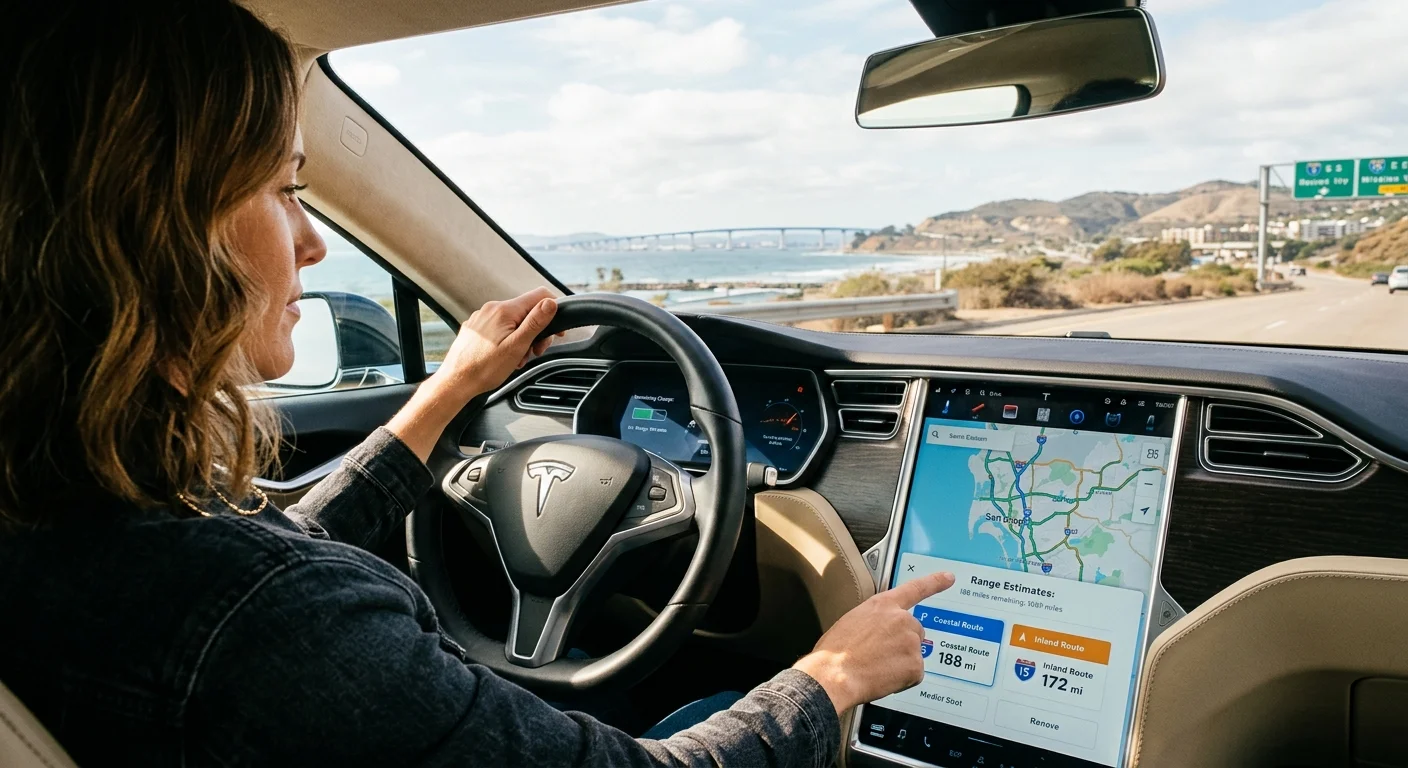
Heat and AC cut a day’s Tesla range before you notice
Los Angeles County isn’t one driving climate. Santa Monica and Manhattan Beach often sit under the marine layer. Locals know that stretch as May Gray and June Gloom. Inland valleys run hotter than the coast. Glendale, Burbank, Pasadena, and Pomona feel that difference by midafternoon. North of the mountains, Lancaster and Palmdale take triple-digit summer heat. Winter nights there can sit near freezing.
Cabin climate control is the quiet drain. Recurrent Auto studied 30-plus EV models. In the cold they kept about 78 percent of range at 32 F. At 20 F they kept about 70 percent. Individual models lost about 16 percent to about 46 percent. Cabin heating was the main driver. Summer heat and heavy AC load reduce range too.
AAA found 20 F weather alone cut range about 10 to 12 percent. Running the cabin climate control pushed that loss to around 40 percent. Those papers aren’t Tesla-only results. Don’t treat them as your private daily formula. A cool coastal morning isn’t the same charge as a hot Palmdale afternoon. Recurrent found about 10 percent more range at 32 F with a heat pump. Confirm your hardware in Tesla’s current documentation for that model. Don’t copy another owner’s setup.
Pass climbs take miles the sticker never counted
Grades do the rest of the work. Sepulveda Pass on the 405 sits between the Westside and the San Fernando Valley. A Santa Monica or Culver City start can still climb that pass toward Burbank. The estimate that looked fine on the Westside can drop on the grade.
Farther north, the Grapevine on I-5 is the county’s defining range corridor. That climb out of Castaic asks more than a flat 710 run. AC on that climb adds load while the motors work. Antelope Valley heat and cold cut real range well below the sticker. So does AC on a Grapevine climb.
Peninsula streets in Rancho Palos Verdes work the same way. So do canyon roads toward Malibu, Topanga, and Calabasas. Write the full loop, including the drive home. Regeneration on the descent doesn’t always return what the climb used. That’s especially true if the cabin is still cooling.
Don’t assign a fixed mile penalty to any pass. No verified figure in our research supports a universal traffic, weather, or elevation adjustment. Watch the in-car estimate as you climb. If it falls faster than you expected, change the plan early.
For corridor-specific steps, read out of charge on the 405 at Sepulveda Pass. Drivers on I-5 should keep empty pack on the Grapevine north of Castaic handy.
Start with the car in front of you
Begin with your Tesla, not a forum screenshot. Note the model, the percentage, and the estimated distance before you leave. Recheck that screen when you add a destination. Recheck it again after a major route change.
Treat the estimate as a planning input, not a promise. A number from a review may not match your pack. A different Tesla configuration can show a different day. If you need an exact spec, use Tesla’s current documentation for that model.
Then count the whole day, not just the first errand. Include the commute, errands, the return, and the last stretch to a charger. Overnight Level 2 in Pasadena isn’t street parking in East Los Angeles. A studio-lot day in Burbank isn’t a PCH day in Malibu.
The U.S. Department of Energy describes charging levels that refill the pack later. Level 1 uses 120-volt AC power. It adds about five miles of range per hour for a midsize EV. Level 2 at 240 volts adds about 25 miles per charging hour. Real speeds vary with pack size, state of charge, and temperature. Confirm the connector and the site with the network that runs it.
Those DOE figures explain overnight recovery. They don’t tell you how far you’ll get before dinner. City of Los Angeles homes sit on LADWP. Most of the rest of the county is Southern California Edison territory. Glendale, Burbank, Pasadena, and Azusa each run municipal power. None of that changes today’s remaining miles.
The search mixes two different clocks
The query how long does tesla battery last in a day mixes two clocks. One is today’s remaining drive. The other is how long the main pack stays useful over years of ownership.
For today, use the percentage and estimate on the screen. Long-term pack health is a separate subject. We cover heat and ownership in how long Tesla batteries last in Los Angeles County heat. A hot, short-range Tuesday doesn’t mean the pack is failing. A healthy pack won’t stretch a thin charge over a climb you skipped. Keep those questions apart when you plan.
Plan the corridor you’re actually on
Write every stop in order. Then pick a compatible charger near the route, plus a second option. Confirm current status with the operator of that site. Check access and plug type before you depend on the stall.
An estimate to UCLA in Westwood can shrink after a Glendale stop. The Sepulveda climb home can finish the rest. Don’t plan only to the farthest pin. The return trip counts, and so does the last driveway into the charging site.
Match the backup to the corridor you’re on. A Long Beach stall isn’t a useful backup for a Lancaster afternoon. Plan I-10 through El Monte, West Covina, and Pomona along that freeway. A 14 run through Acton toward Palmdale should stay on that highway. A charger across the county isn’t a plan just because a map shows it.
If the remaining estimate no longer covers the original loop, stop adding stops. Choose a charger the car can still reach. Account for the last streets and the parking entrance.
Our guide on what to do when an EV is running low lays out that decision. Don’t keep driving toward a stall you can no longer clearly reach.
Choose a stall, a mobile boost, or a tow
If usable charge still reaches a compatible stall, ordinary charging is often simplest. Confirm the location before you roll. Keep watching the estimate on the way.
If no stall is reachable, ask about a mobile Level 2 boost. Charge Pro LA is a referral line. We connect stranded EV drivers with independent local mobile rescue operators. We don’t perform the work, own trucks, or employ technicians. The matched operator quotes you before starting and bills you directly.
Operators typically bring a 240-volt Level 2 source to the car. They use a native NACS plug for Teslas. Non-Tesla EVs get a CCS or J1772 adapter. It typically adds 10 to 20 miles in 15 to 30 minutes of charging. That’s charging time, never an arrival time.
Share the Tesla model, the battery state, and the exact location. Note the road, direction, nearest exit, parking level, or a durable landmark. Griffith Observatory and Universal Studios Hollywood are useful names. Don’t stop somewhere unsafe just to make the description easier.
Out-of-charge recovery explains how we connect you with a local operator. Tesla drivers can also use the Tesla roadside rescue page.
A Tesla that won’t wake may be a 12-volt problem. That isn’t the same as an empty drive pack. Describe the exact warning and screen behavior. Let the operator sort a charge, a 12V jump, or transport. Transport may fit when mobile charging isn’t available or isn’t safe at that spot. Don’t attempt electrical or towing work yourself.
California Vehicle Code 21718 generally bars stopping on a freeway. A disabled vehicle is an exception once you’ve summoned help. It’s also an exception to avoid injury or damage. CVC 21809 is the move-over law. Other drivers must move over or slow for flashing emergency, tow, or Caltrans lights.
Metro Freeway Service Patrol is free on congested LA County freeways. It’s a joint program of Caltrans, CHP, and LA Metro. It can offer a gallon of gas, change a tire, or tow you to a CHP-chosen safe spot. Dial 511 and say Motorist Aid. The published list doesn’t include mobile EV charging. Don’t wait on FSP for a charge.
Before you authorize work, ask the operator to quote the service and the price. You pay that pro directly. Charge Pro LA doesn’t set prices or warranties. The pros we connect you with are licensed and insured.
When the day’s estimate no longer gets you there
Call when remaining miles no longer support a safe trip to a reachable charger. Call if you need an operator to weigh a mobile boost against a tow. Reach Charge Pro LA at (858) 925-5546. We’ll connect you with a local EV rescue operator.