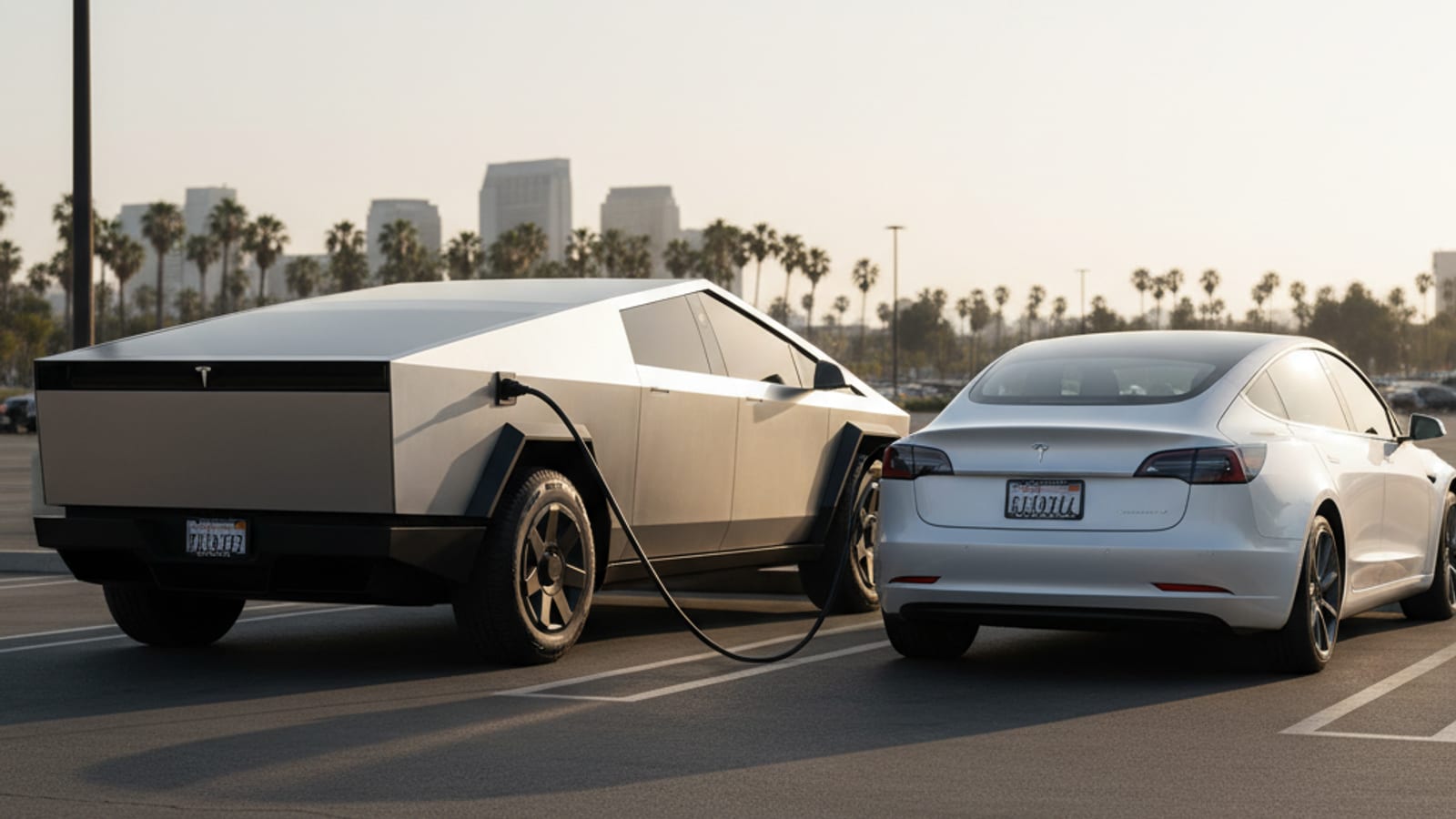
Two EVs sit on the I-5 shoulder north of Castaic. One traction pack is empty. The other still shows miles. The hope is that one EV can charge another. Most of the time, it can’t. A regular Tesla can’t charge another Tesla. A few trucks and V2L cars can export power. Everyone else needs a mobile Level 2 boost.
The Grapevine is why people ask this
The long grade north of Castaic eats range. It’s the county’s defining EV-range corridor. Cabin AC on a hot climb cuts real miles. Recurrent Auto’s tests across 30-plus models show climate load pulls range below the sticker. Cold nights in Lancaster and Palmdale cut range too. Drivers bound for Tejon Pass watch the percentage fall. Then they look at the EV next to them. That second car almost never has a usable outlet.
Santa Clarita sits at the south end of the climb. The ACS 2019-2023 population figure is 229,021. Castaic is a smaller community at the foot of the grade. Six Flags Magic Mountain is on this corridor. A long park day already uses a chunk of the pack.
The same hope shows up on the 405 at Sepulveda Pass. That’s the climb between the Westside and the San Fernando Valley. It’s shorter than the Grapevine. It still surprises drivers who left Santa Monica with a thin buffer.
Freeway help that won’t fill the pack
Metro’s Freeway Service Patrol is a joint program. Caltrans, the CHP, and LA Metro run it. It’s free to motorists. It roams congested Los Angeles County freeways. Coverage is typically weekday peak hours. A gasoline car can get a gallon of fuel. A flat can get a tire change. A disabled vehicle can get a free tow to a CHP-chosen safe spot. The published assistance list doesn’t name mobile EV charging. Dial 511 and say Motorist Aid if you need FSP. Don’t wait for that truck to feed a battery.
California Vehicle Code 21718 bars stopping on a freeway. A disabled EV that has summoned help fits a listed exception. Keep your hazards on. CVC 21809 is the move-over law. Other drivers must change lanes or slow when they see flashing lights.
If you can still roll, peel off toward Santa Clarita before the grade steepens. Once you’re stopped, treat it as a disabled-vehicle stop. Don’t wait on a neighbor’s charge port. If you’re already on that stretch, read Empty pack on the Grapevine north of Castaic.
Pack-to-pack isn’t a 12V jump
Every EV stores a lot of energy. Moving some of it into a second car sounds like a jump start. It isn’t. A 12V jump wakes computers, locks, and contactors. It doesn’t fill the drive battery.
To export pack power you need hardware most cars never got. You need an inverter that can run in reverse. You need an outlet or a V2L adapter on the car. You need a cable the empty car will accept. That’s NACS, CCS, or J1772, matching the port.
Most commuter EVs keep that energy sealed in. The onboard charger is a one-way door. It turns wall AC into pack DC. It isn’t a generator for the next lane.
Tesla’s Model 3, Y, S, and X follow that design. The 12V pigtail at the tow eye is 12 volts. It won’t charge a traction pack. Tesla has shown bidirectional demos. The cars in most driveways still can’t export. If the screens are dark, you may have a 12V failure. See Can a Tesla jump-start another car?.
Trucks and V2L cars that can export
Adventure trucks and a handful of Korean EVs ship a real outlet. Daily Teslas don’t.
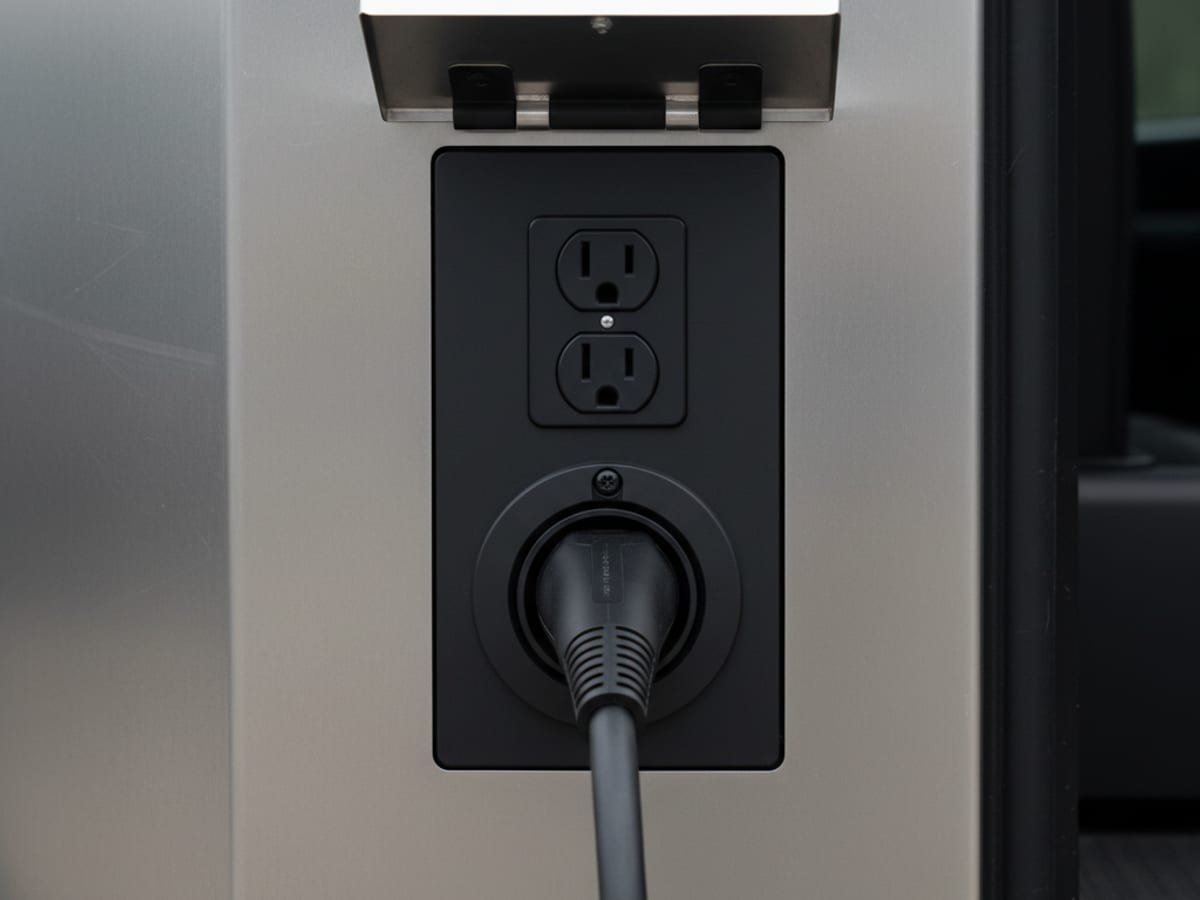
The Cybertruck’s Pro Power setup puts outlets in the bed and the frunk. The bed-wall outlet is a 240V NEMA 14-50. Tesla rates that outlet up to 9.6 kW continuous. That’s the same receptacle shape as a dryer plug. A portable Level 2 EVSE can plug in there. The stranded car then charges through its own onboard charger.
The Ford F-150 Lightning has Pro Power Onboard. Standard output is 2.4 kW. The extended kit is 9.6 kW. That’s the version that can mimic a Level 2 boost. Roadside limits are in Can an F-150 Lightning charge another EV on the roadside?.
Chevrolet’s Silverado EV lists Power Takeoff on some trims. Published output goes up to 10.2 kW. Confirm the kit on the window sticker.
Hyundai Ioniq 5, Kia EV6, and Kia EV9 use a V2L adapter. It converts the charge port into an outlet. Output is about 3.6 kW. It’s slow on a freeway shoulder.
Rivian R1T and R1S with the Camp Package get 120V bed outlets around 1.4 kW. That’s for a kettle, not a freeway rescue. Lucid Air, as shipped today, doesn’t export pack power.
What 240 volts actually buys you
A 240V outlet and a Level 2 truck sit in the same class. Both feed the stranded car’s onboard charger. Neither is a Supercharger. Superchargers are DC fast charging. They’re many times faster than any current EV-to-EV hookup.
The operators we connect you with bring a 240V Level 2 source. Teslas get a native NACS plug. Other brands get a CCS or J1772 adapter. In 15 to 30 minutes of charging, they typically add 10 to 20 miles. That’s charging time. It isn’t an arrival time. Those miles are meant to reach a stall you already picked. See mobile EV charging and what’s on an EV charging truck.
Charge Pro LA is a referral line. We don’t own the truck. We don’t set the price. The operator quotes you before work starts. They bill you directly.
A 3.6 kW V2L adapter crawls compared with that. If both cars in your group are Model Ys, there’s no export path. Stop looking at the charge ports. Call for a Level 2 boost.
Don’t build your own cable on the shoulder
A household dryer cord isn’t a vehicle-to-vehicle setup. Grounding, connector rating, and the car’s onboard charger all have to match. A melted plug is a bad outcome on I-5. Leave pack-to-pack work to an operator who brought the right EVSE.
If the live car is a Cybertruck, you have a narrow path. You still need a listed portable Level 2 unit. Most groups on the Grapevine don’t. They have two passenger Teslas and a fading percentage.
What to do instead of waiting on a second EV
If the car still rolls, get off the I-5 toward Castaic or Santa Clarita. Don’t start the Grapevine climb on a thin buffer. If you’re already on the shoulder, stay out of traffic. Hazards on. Call for help so the stop fits CVC 21718.
FSP can move you to a safe spot. It won’t charge the pack. A CHP rotation tow can move the car too. Towing a dead EV is the last tool, not the first. For an empty pack, out-of-charge recovery is the job you actually want.
Los Angeles County has no single electric utility. LADWP serves the City of Los Angeles. SCE serves most other cities. None of that puts an export outlet on a Model 3. Plan today’s trip around the hardware in your driveway. Most LA County EVs still can’t share pack power.
If you’re stranded now, call (858) 925-5546. We’ll connect you with an independent local operator. They handle Tesla and every major EV brand. They quote before they start.