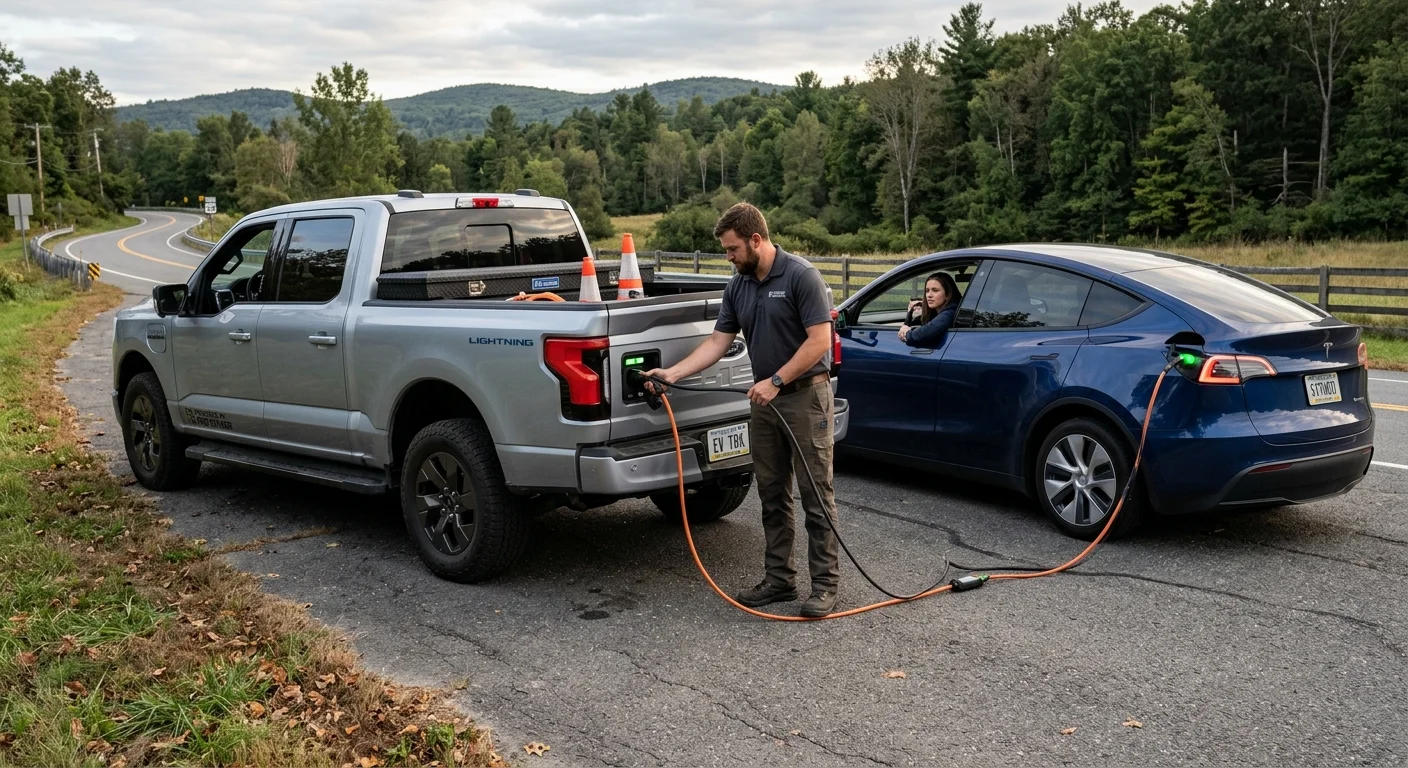
A Ford F-150 Lightning can charge another EV from its bed. You still need a portable 240-volt EVSE and the matching adapter. Harbor roads around Long Beach, Carson, and the 710 make that a live question. The truck feeds Level 2 power, not DC fast charging.
Why this question belongs on the 710
The 710 moves freight through Compton, Carson, and Long Beach. Commerce sits on the eastside industrial belt off that same corridor. Work trucks and commuter EVs share those streets all day. A Lightning with bed outlets looks like a charger on wheels. That’s why Harbor drivers ask if they can help a stalled neighbor.
Long Beach is the county’s second-largest city at 458,491 ACS residents. The 2024 estimate puts it at 450,901. About 79.6% of its housing predates 1980. Many of those buildings never got a 14-50 dryer outlet. A neighbor’s Lightning can look like a handy 240-volt outlet in a pinch. Carson counts 93,523 people in that same ACS file. Compton sits on the same 710 belt, with 93,525 ACS residents. Clean Power Alliance buys generation in Carson, and SCE still delivers. That billing split doesn’t change a roadside hookup.
Empty packs in Long Beach belong on EV roadside assistance in Long Beach. Carson drivers can use EV roadside assistance in Carson for the local next steps.
What Pro Power Onboard actually feeds
Ford built Pro Power Onboard for tools, campsites, and home backup. It’s a bank of AC outlets in the bed and cabin. It’s not the Lightning’s DC charge port running in reverse. The truck acts like a generator tied to its traction pack.
Ford publishes more than one Pro Power Onboard output. The base package is listed at 2.4 kW. Higher trims advertise 9.6 kW, with 240-volt outlets in the mix. Confirm your number on the window sticker or the in-truck power screen. Don’t guess from a screenshot in a comment thread.
The 2.4 kW package is household-circuit territory. The 9.6 kW package is Level 2 territory. Neither one is a Supercharger-style DC feed. Read our guide to charging one EV from another.
The kit that has to be in the bed
A Lightning outlet isn’t an EV charger by itself. You need EVSE, the box that talks to the other car. Most portable Level 2 units use a NEMA 14-50 plug. That plug matches the 240-volt receptacle on well-equipped Lightnings. Trucks with only 120-volt outlets stay on the slow 2.4 kW path.
Match the EVSE rating to the outlet you actually have. Look at the cable before you plug in. Cracked insulation or a loose 14-50 blade means you stop.
If the stranded car is a Tesla, a J1772 handle won’t seat in NACS. You need a J1772-to-NACS adapter on that Tesla. Chevy, Hyundai, Kia, and VW still take J1772. Some newer non-Tesla cars already use NACS. Always read the port, not the badge.
The operators Charge Pro LA connects you with bring a 240V Level 2 source. They use a native NACS plug, plus CCS or J1772 adapters. You don’t have to own that kit. That’s mobile EV charging as a dispatched job, not a favor.
How much range a bed outlet can add
Don’t plan on a quick fill from the bed. Pro Power Onboard is AC on every Lightning trim. On the high package it’s Level 2, not DC. Miles added depend on the receiving car, climate control, and your truck’s output. Ford doesn’t publish a miles-per-hour figure for charging someone else’s EV. You should treat forum range estimates as unconfirmed.
A 2.4 kW feed can take a long time to add usable range. A 9.6 kW feed is faster, and it’s still not a fast-charge stall. Our Lightning Level 2 charge-time explainer puts the truck’s own plug-in time in context.
Operators Charge Pro LA connects you with typically add 10 to 20 miles. That happens in 15 to 30 minutes of charging. That window is charging time, not an arrival time. The operator quotes you before starting and bills you directly.
A long Level 2 session on the 710 isn’t a campsite top-off. You’re occupying a shoulder while traffic moves at freeway speed.
If you’re the one stopped on the freeway
California Vehicle Code 21718 bars stopping on a freeway, with a disabled-vehicle exception. That exception covers a stranded EV once you’ve summoned help. California Vehicle Code 21809 is the move-over law. Drivers who see flashing lights on a stopped service vehicle must move over. If a lane change isn’t safe, they have to slow down.
Metro Freeway Service Patrol is free on congested LA County freeways. Caltrans, CHP, and LA Metro run it. FSP can offer a gallon of gas, tape a hose, or change a tire. It can also tow you to a CHP-chosen safe spot. The published help list doesn’t include mobile EV charging. An empty pack is outside that list, other than the free tow. You can dial 511 and say Motorist Aid.
FSP is typically out during weekday peak hours. Some busy corridors also get midday and weekend patrols. It won’t put electrons in your pack. Metro ExpressLanes run on the I-110 Harbor Freeway and the I-10. They need a FasTrak account or a plate bill. Their published FAQ doesn’t spell out a disabled-EV procedure.
When a Lightning top-off is the right call
A quiet yard in Commerce is calmer than the 710 shoulder. If a coworker is a few miles short, the Lightning can cover that. You’ve still got to keep the EVSE in the bed. Same story in a Long Beach driveway after work, when nobody’s blocking a lane.
It’s a poor fit when the other car is on a live freeway. It’s a poor fit when the EVSE isn’t in the bed. It’s a poor fit when you still need the Lightning’s own range. Drain your pack for a slow feed, and you can stall both trucks.
It’s also the wrong tool for a dead 12-volt battery. A car that won’t unlock or wake is often the 12V. That isn’t the same problem as an empty drive pack. Plugging into the charge port won’t fix that. Start with our guide to jumping an EV 12V.
When to connect with a mobile Level 2 operator
An empty car on the 710 or the 110 needs a dedicated source. A friend’s bed outlet is optional in that moment. Charge Pro LA is a referral line, not a shop. It matches stranded EV drivers with independent local mobile rescue operators. It doesn’t own trucks, employ technicians, or set prices.
Those operators bring a 240V Level 2 source to the car. They use native NACS, or a CCS or J1772 adapter. They typically add 10 to 20 miles of range. That’s 15 to 30 minutes of charging, not travel time. They handle Tesla and every major EV brand. They can also jump or replace a dead 12V on site.
Read what an EV charging truck carries if you want the gear list.
If you’re stranded in Los Angeles County, call (858) 925-5546. Use that number when a Lightning isn’t set up to help. Charge Pro LA will connect you with a local operator. That operator quotes you before starting and bills you directly.