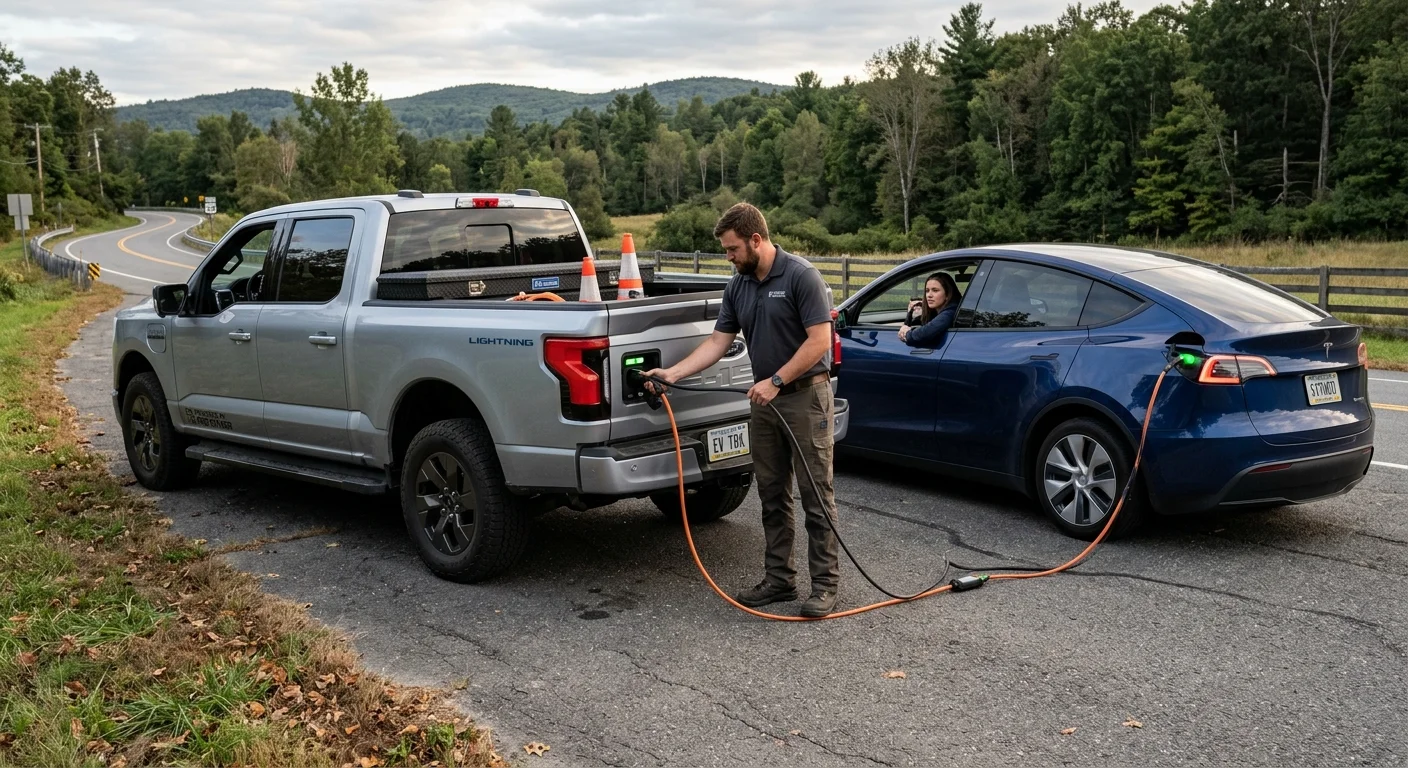
A roadside Lightning boost in this county is 240-volt Level 2. The operator brings that source to the truck. You typically gain 10 to 20 miles in 15 to 30 minutes of charging. That clock is charging time, not when someone arrives. It won’t refill an empty Extended Range pack on the shoulder.
Three clocks on the same Lightning
Searchers asking how long does it take to charge a Ford Lightning get three answers. Home overnight, a DC stall, and a mobile 240-volt boost aren’t the same job. Mixing those clocks is how a workday plan falls apart.
A driveway Level 2 fill is measured in hours. A DC stop on a trip is measured in tens of minutes. A county rescue is measured in those 10 to 20 miles. Know which clock you’re on before you lock a plan.
Ford sells two packs. The Standard Range pack is the smaller one. Ford lists about 98 kWh total and about 89.5 kWh usable. The Extended Range pack is the larger option. Ford lists about 131 kWh total and about 120 kWh usable. Confirm both numbers on Ford’s current spec sheet.
A bigger pack takes more hours to fill on Level 2. On DC the two packs can finish close together. Ford rates the larger pack for a higher peak draw. Size and session length don’t move in lockstep.
What a Level 2 boost adds on the curb
Independent operators in this referral network don’t bring a Supercharger-class cabinet. They bring a 240-volt Level 2 source to the curb. Tesla cars take a native NACS plug. A Lightning is a CCS truck. The operator uses the adapter path that fits it.
Fifteen to 30 minutes on that source gets you off the shoulder. It’s not a workday refill. Pick the next DC stall or your driveway before you pull out. That hop is the whole point of the visit.
The home 240-volt versus mobile piece walks the same voltage in plain terms. The charging-levels guide for stranded drivers spells out what a Level 2 boost adds.
On the I-5 through Santa Clarita, those miles decide whether you roll. The grade north of Castaic toward the Grapevine burns range fast. Recurrent Auto’s published testing shows heat, cold, and cabin climate cut real range. Antelope Valley summer heat in Lancaster and Palmdale does the same work. Heavy AC on a long climb does too.
We couldn’t confirm a station-level temperature normal for those cities in this research. Check NWS Los Angeles/Oxnard if you want a degree count. Don’t plan a Lightning day around a number this page doesn’t have.
Coastal nights in Santa Monica and Redondo Beach stay milder under the marine layer. The San Fernando and San Gabriel valleys run hotter than the coast. That split changes how far 10 to 20 miles will actually carry you. It doesn’t change the 15 to 30 minute charge window on the truck.
Sepulveda Pass on the 405 is the climb between the Westside and the Valley. A long run on the 10 through the San Gabriel Valley does too. The boost still lasts 15 to 30 minutes. The miles you get have to cover the next rise.
Home Level 2 is the overnight clock
Owners who can plug in at home live on this clock. A regular 120-volt outlet is Level 1. It’ll feed the Lightning. It won’t refill a pack this size before morning. From empty, Level 1 can run into multiple days.
Level 2 at 240 volts is the daily plan. Ford’s Charge Station Pro is the high-amp home unit Ford sells for this truck. Ford’s published home times put a full Extended Range charge around 8 to 10 hours. The Standard Range pack is listed closer to 6 to 8 hours. Those times assume a dedicated circuit and a pack near empty. A lower-amp wall unit stretches the same fill. Confirm the current home figure for your amps on Ford’s site.
City of Los Angeles homes sit on LADWP. LADWP publishes a Residential EV Charger Rebate Program. It also publishes a dedicated EV time-of-use rate that needs its own meter. Most of the rest of the county is Southern California Edison territory. SCE publishes Charge Ready Home for a Level 2 install rebate. We don’t publish rebate amounts. Confirm the current offer on ladwp.com or sce.com before you budget.
Several cities buy generation through Clean Power Alliance, founded in 2017. SCE still delivers the power and reads the meter. Agoura Hills, Santa Monica, Culver City, and Malibu sit on that list. A stranded Lightning doesn’t care which name is on the generation line.
Charge Pro LA doesn’t install wall units. The brand is a referral line for stranded drivers. It holds no contractor license and owns no trucks.
Older housing is common here. ACS 2019-2023 figures put pre-1980 housing at 71.0 percent in Los Angeles. Long Beach sits at 79.6 percent. East Los Angeles sits at 86.2 percent. A 1960s panel may not have room for a high-amp circuit. That’s an electrician’s call, not a Ford spec. If the wall unit isn’t in yet, mobile EV charging covers an empty pack.
DC fast charging is the trip clock
Ford publishes DC times for a stall that can feed the truck its rated power. A 15 to 80 percent session is around 41 minutes on the Extended Range pack. The Standard Range figure is around 44 minutes. Both assume a mild pack temperature and a cabinet that hits its rating.
Real stalls often run slower. The curve isn’t flat. The Lightning takes power fastest in the middle of the session. It tapers as the pack nears full. That’s why a trip stop targets 80 percent, not 100. The last fifth can eat as much clock as everything before it.
What pushes a session past the spec sheet
Pack temperature is the first drag. A cold pack accepts DC power more slowly. Antelope Valley winter nights get near freezing. Coastal May Gray and June Gloom stay milder. We couldn’t attach a station normal here, so skip any degree count from this page.
A busy public cabinet may output below its sign. Starting a DC session already high in the pack adds less range. A heavy tow or a long grade can leave the pack off Ford’s test curve. None of that is unique to the Lightning. A heavy truck just makes the swing easier to feel.
When the session isn’t moving at all
A pack that won’t accept current is a different problem. A Lightning that won’t start after a stop is often the 12-volt battery. Work through the Lightning 12-volt checks before you assume the drive pack failed.
Owners also ask whether Pro Power Onboard can feed another stranded EV. That’s not your charge-time question. The Lightning charging another EV piece covers that limit.
Empty on a county freeway, not in a driveway
Metro Freeway Service Patrol is free on congested Los Angeles County freeways. Caltrans, the California Highway Patrol, and LA Metro run it. Coverage is typically weekday peak hours on congested corridors. The published help list names a gallon of gas and a radiator refill. It also names a tire change and a free tow to a CHP safe spot. It doesn’t list mobile EV charging. Dial 511 and say Motorist Aid if you need FSP. An empty Lightning still needs Level 2 or a DC stall after that tow.
California Vehicle Code 21718 bars stopping on a freeway except in listed cases. A disabled vehicle that has already summoned help is one of those cases. Vehicle Code 21809 is the move-over law. Approaching drivers must change lanes or slow for flashing lights on a stopped service vehicle.
The I-5 through Santa Clarita is the last stretch before the Grapevine climb. The Santa Clarita I-5 out-of-charge guide is the local next-step list.
Charge Pro LA is a referral line. It matches you with an independent local operator through non-Tesla EV rescue. The brand owns no trucks and employs no technicians. It sets no prices and publishes no hours. The operator quotes you before work starts and bills you directly. CCS and J1772 paths are in the toolkit.
A zero pack in Santa Clarita or Palmdale uses that 15 to 30 minute window. A South Bay grade in Torrance uses the same clock. Call (858) 925-5546 and we’ll connect you. We don’t promise an arrival time.
Frequently asked questions
How long does a Ford Lightning take on a roadside Level 2 boost?
County roadside operators bring 240-volt Level 2, not a DC cabinet. Typical charging time is 15 to 30 minutes. That usually adds about 10 to 20 miles. It’s enough to leave the shoulder and reach a stall or home.
How long does home Level 2 take on a Lightning?
Ford’s published Charge Station Pro times run about 6 to 8 hours on Standard Range. Extended Range is listed around 8 to 10 hours from empty. A lower-amp wall unit takes longer. Confirm your charger’s rating on Ford’s current sheet.
How fast is a Ford Lightning on a DC fast charger?
Ford lists about 41 minutes from 15 to 80 percent on the Extended Range pack. Standard Range is listed around 44 minutes under ideal conditions. A weaker stall or a cold pack runs longer.