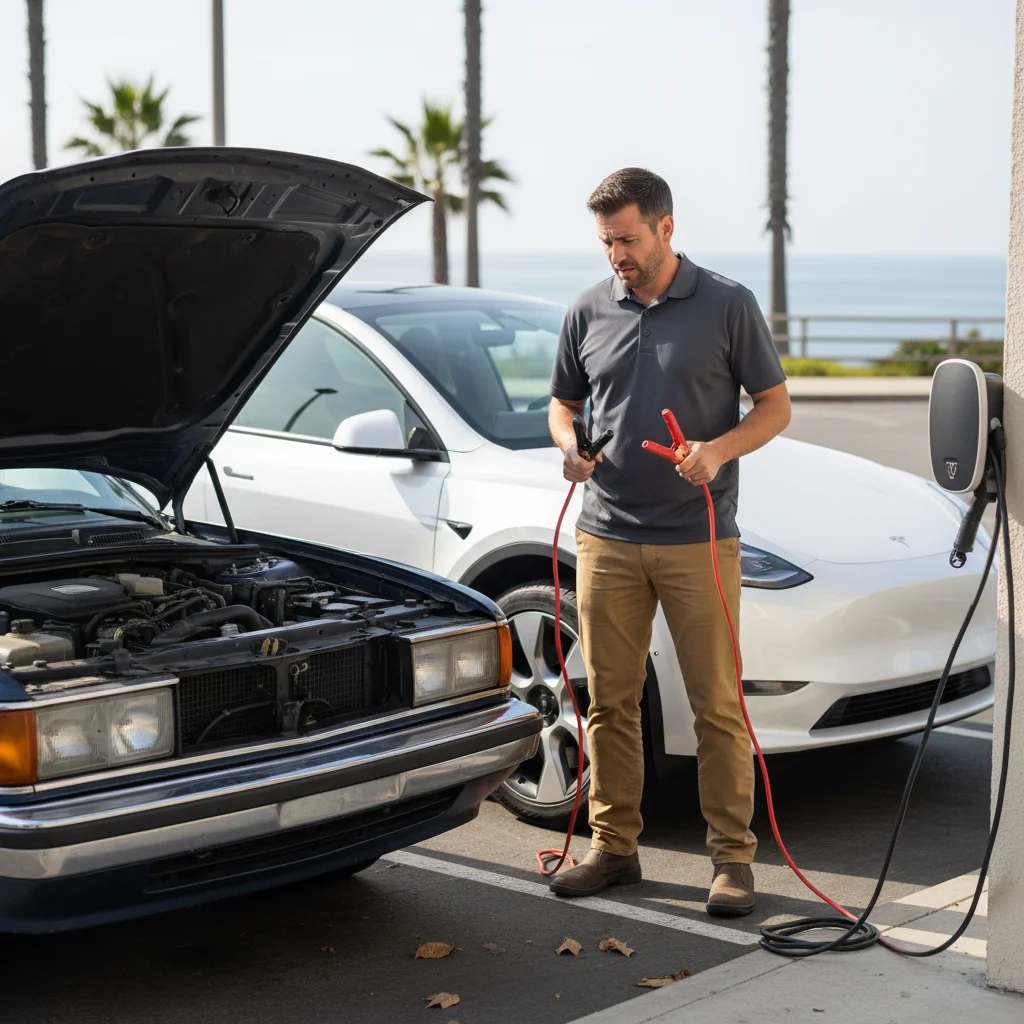
A neighbor stalls beside you on Pacific Coast Highway, hood up, hazards flashing. Your Tesla still has range, and cables sit in the frunk. It feels like a simple jump from a full car. A Tesla should not jump-start another car, gas or electric. The 12-volt battery is a gateway for computers, not a donor pack for cranking.
Why PCH owners still reach for the cables
You learned jumps on gas cars. Two clamps, two batteries, an engine that catches. That habit follows Tesla owners into Malibu turnouts and Santa Monica beach lots. Manhattan Beach and Redondo Beach lots produce the same scene. You walk back from the sand to a dead gas car. Your Model 3 looks like the nearest 12-volt source.
Pepperdine traffic and Getty Villa visitors add more of those curb pauses. Kindness still matters. Linking your Tesla’s posts to their starter does not.
Malibu is a small coastal city of about 10,516 people. Santa Monica holds about 91,535. Redondo Beach is about 69,814. Teslas and older gas cars share that strip. The electrical limit doesn’t change with the city name.
Leave the coast and the 12-volt limit still holds. Culver City sits on the 405 and the 90. Burbank and West Hollywood sit off the 101. Your posts still aren’t a donor on those streets.
The 12V in a Tesla is not a starter battery
A gas car’s 12-volt battery exists to crank. It dumps a heavy current into a starter motor. That motor turns a cold engine. Those lead-acid packs are built for that gulp.
A Tesla’s 12-volt battery doesn’t crank a motor. It wakes computers, locks, lights, and the screen. It also closes the contactors that tie the high-voltage pack to the drive unit. If that small battery is flat, the big pack can sit there unused.
Every Tesla still has that 12-volt battery. Do Teslas have a 12V battery? A model-by-model answer sorts lead-acid versus lithium by model. Older cars used lead-acid. Newer Model 3 and Model Y cars moved to lithium. Neither version is a donor for another vehicle. Lithium cells in that role still feed computers. They still aren’t a starter battery for the Civic in the next stall.
Tesla keeps the small battery topped off through a DC-to-DC converter. The high-voltage pack feeds that converter. The system expects a steady, modest draw. It doesn’t expect a starter’s surge.
Clamp your posts to a dead gas car and you reverse the job. You ask a low-capacity pack to act like a brute cranking battery. The converter that recharges it isn’t built for that reverse hit. Control modules can see a sag or a spike. Posts in the frunk don’t make your car a generator.
We cover the damage path in The risks of jump starting a gas car with a Tesla. The Tesla is the fragile side of those cables.
The rule holds if the other car is electric too. You still shouldn’t use your Tesla as the donor. Can an EV jump-start a gas car, or will you damage both? is the wider version of the same answer. Jumper cables won’t move energy from your drive pack into theirs.
What Tesla’s manuals actually forbid
Tesla’s owner’s manuals explain how to receive a 12-volt jump. They also tell you not to give one. Model 3, Model Y, Model S, and Model X carry the same idea. Tesla tells you not to jump-start another vehicle with your car. Doing so can result in damage.
That notice matches the hardware. Frunk posts are an inbound path. An external source can wake the low-voltage system. Once the contactors close, the high-voltage pack can work. Those terminals aren’t an outlet for a neighbor.
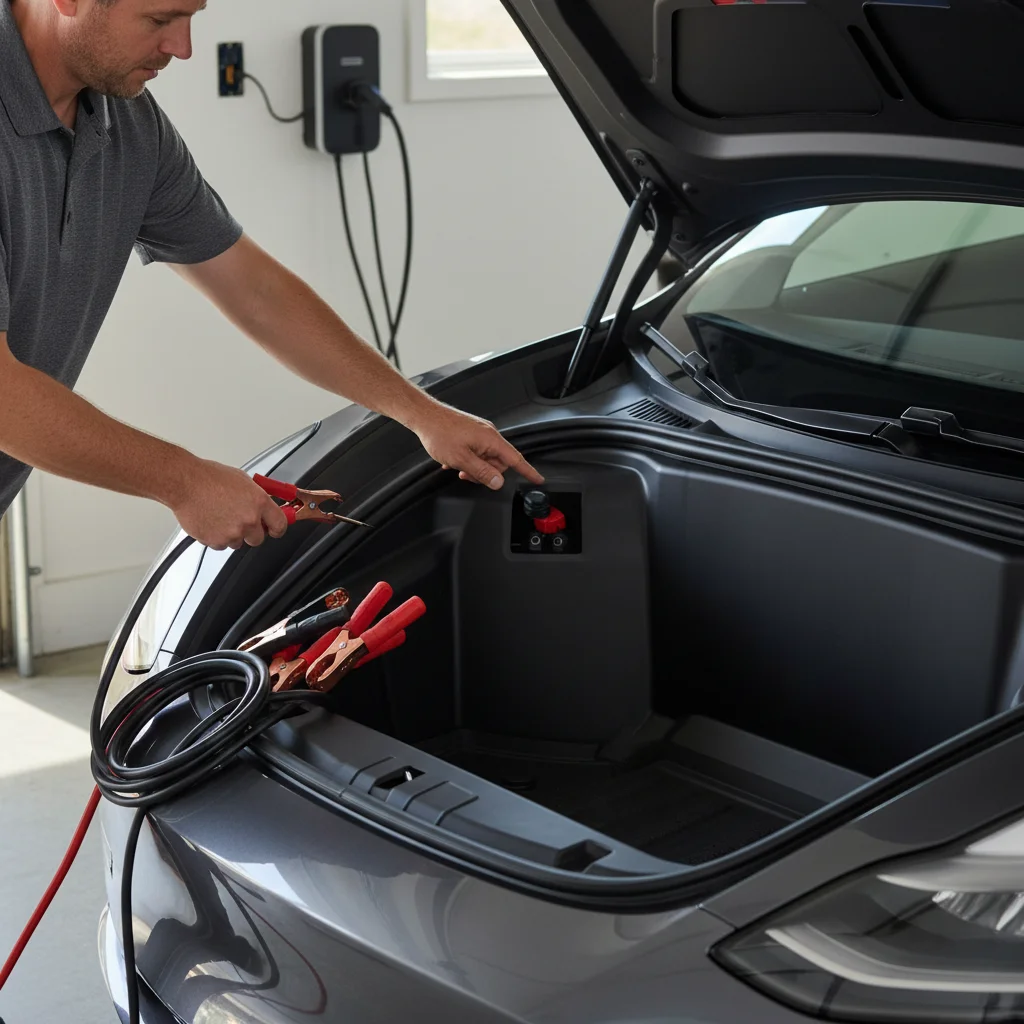
Clips of a successful jump skip the later failure. A converter can fail after you drive away. A car can refuse to wake the next morning. Leave the cables in the bag.
If your Tesla is the dead one, receiving a jump is a different task. A proper 12-volt source can wake the gateway battery. How to jump a Tesla Model 3, Y, S, or X covers post locations by model. Read your exact manual first. Polarity isn’t a guess on the shoulder.
Help on the coast without linking the cars
You can still help without tying the electrical systems together.
Keep a portable lithium jump pack in the frunk if you want to help gas drivers. It’s a self-contained starter. Clamp it to their battery. Your Tesla stays out of the circuit.
No pack in the car? Help them call for real help from a safe spot. Offer a ride off a live lane. Stay with them until a truck they hired arrives. That help doesn’t risk your modules.
If the stall is on an LA County freeway, Metro Freeway Service Patrol may already be roaming. Caltrans, the California Highway Patrol, and LA Metro run it. The patrol is free to motorists on congested freeways. Published help includes a gallon of gas. It also covers a radiator refill, a taped hose, and a tire change. FSP can tow a disabled vehicle at no charge to a CHP-chosen safe spot. FSP hours are typically weekday peaks, with extra coverage on some busy corridors and construction zones. The published list doesn’t name mobile EV charging or a Tesla 12-volt wake-up. Dial 511 and say Motorist Aid for that patrol. For an empty pack or a bricked Tesla, it’s the wrong tool.
California Vehicle Code 21718 generally bars stopping, parking, or leaving a vehicle standing on a freeway. A disabled vehicle that has summoned help is an exception. So is avoiding injury or damage, or following a peace officer. If you’re the helper, you aren’t a second disabled car unless you have a real reason to stop.
CVC 21809 is the move-over rule. Drivers approaching a stopped emergency vehicle, tow truck, or Caltrans vehicle with flashing lights have a duty. They must change to a non-adjacent lane when that’s safe. Otherwise they must slow to a reasonable speed. If you stop to help, stay out of travel lanes.
Private lots follow CVC 22658. A vehicle may be removed only with required entrance signage and written authorization. The owner gets notice, and local law enforcement gets notice within one hour. If the owner returns before the car leaves the lot, it must be released. Jumping a car already hooked may not stop a private-property tow. Confirm the lot’s process with the attendant before you start clamping anything.
Metro ExpressLanes on I-10 and I-110 need a funded FasTrak account. A stall inside those lanes is a CHP problem first, not a jumper-cable moment. Don’t treat express-lane pavement like a driveway.
When the neighbor’s car is an EV
A black Tesla screen isn’t always a dead drive pack. It may be a dead 12-volt gateway with energy still in the pack. It may also be true zero and need energy in the pack. Your jumper cables fix neither as a donor. They shouldn’t come out of your frunk for that car.
Independent operators bring a 240-volt Level 2 source to the vehicle. They use a native NACS plug for Tesla. CCS or J1772 adapters cover other brands. Typical charging time adds about 10 to 20 miles of range in 15 to 30 minutes of charging. That’s charging time. It isn’t an arrival time.
If the 12-volt battery has failed, operators can jump or replace it on site. Charge Pro LA is a referral line. We match stranded EV drivers with independent local mobile rescue operators. We perform no work and own no trucks. We don’t set prices or employ technicians. The operator quotes you before starting and bills you directly.
A long sit can mimic an empty pack. Los Angeles International Airport is a frequent version. Terminal parking structures P1 through P7 offer Level 2 and DC fast charging. The LAX Economy Parking garage has more than 4,000 stalls, including 514 active EV chargers. A traveler can still return to a car that won’t wake. A drained 12-volt battery isn’t an empty drive pack. Chargers in the garage don’t help if the car never stayed awake to use them.
The same 12-volt-after-a-trip stall happens after flights into Hollywood Burbank Airport, Long Beach Airport, and Van Nuys Airport. Charging layouts at those lots could not be confirmed from the airport pages checked for this piece. Confirm current stall maps on each airport’s own parking site. The 12-volt failure still isn’t an empty pack.
Coastal lots in Santa Monica and Manhattan Beach produce a shorter version of that stall. You parked. You walked. You came back to a brick. Antelope Valley heat around Lancaster and Palmdale, plus grades toward Malibu, cut real range below the sticker. Recurrent Auto’s research ties summer heat and air-conditioning load to lower real-world range. None of that makes your Tesla a donor battery. Don’t clamp the cars together in those lots either.
Clean Power Alliance buys generation for Malibu, Santa Monica, Manhattan Beach, Redondo Beach, Beverly Hills, West Hollywood, Culver City, and other member cities. Southern California Edison still delivers the power there. LADWP serves the City of Los Angeles. Your bill’s generation line doesn’t change what the 12-volt posts can do.
If your Tesla is the brick
A 12V Battery Needs Service warning is the early tell. Then doors may not unlatch. The screen may stay black. Range can still sit in the pack. That’s the gateway battery, not a Supercharger miss.
Don’t ask a random gas-car jump to dump starter current into your posts. Ask for a controlled 12-volt source. Tesla 12V battery jump is the on-site wake-up operators use. Coastal stalls have their own pattern in Your Tesla died in Malibu: mobile charging for coastal drivers. If you ran out on the highway itself, Ran out on PCH in Malibu with nowhere to pull over covers that stop.
If your Tesla won’t wake anywhere in Los Angeles County, skip the neighbor’s cables. Call (858) 925-5546. We’ll connect you with an independent local operator. That operator quotes you before work starts.
Frequently asked questions
Can a Tesla jump start another car?
No. A Tesla shouldn’t be used to jump-start another car. The low-voltage system isn’t a donor power source.
Can a Tesla jump start a gas car?
No. Don’t use a Tesla to jump a gas car. Use a portable jump pack, or help them call roadside help.
Can you jump a Tesla with another car?
A Tesla with a dead 12-volt battery can receive external power. Check your model’s owner’s manual before any clamps go on.