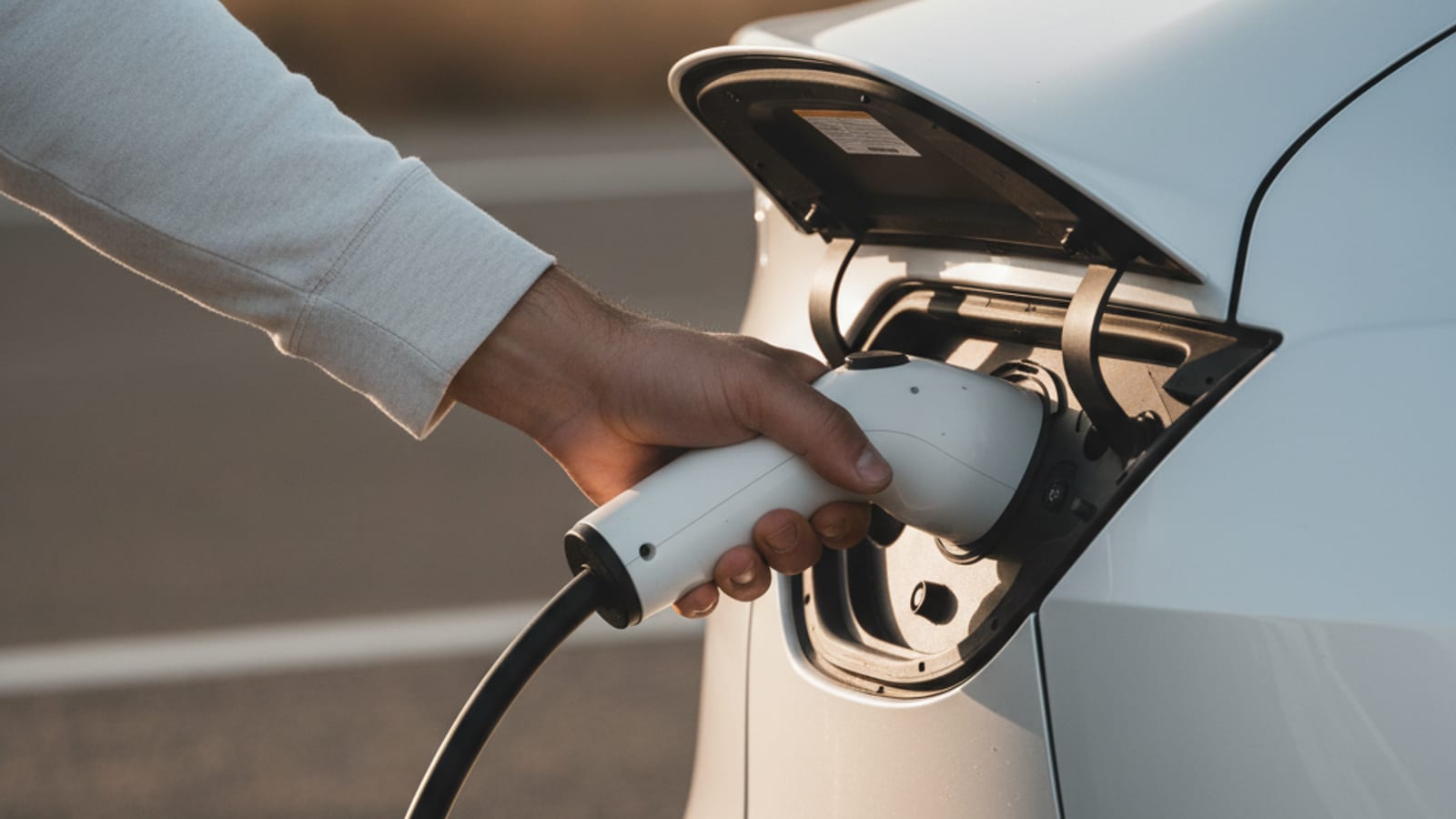
An EV charger stuck in the car is a locked latch, not a jammed handle. Stop the session on screen, then pull your model’s manual release.
Check the 12V if that solenoid still won’t move. On the Westside and downtown, this plays out at a public stall. You’re occupying a stall other drivers still need.
If you rent in Santa Monica, you may charge at a shared pedestal. Culver City and West Hollywood drivers can hit the same stall. Census figures put Santa Monica’s pre-1980 housing at 75.0%. Culver City’s share is 85.5%, and West Hollywood’s is 80.5%. The City of Los Angeles comes in at 71.0%. Those buildings went up long before a private EV outlet was a design item. A locked cable at a public stall leaves you blocking the space.
A locked plug outside UCLA in Westwood is the same hardware problem. So is a downtown garage pedestal after work.
Why the port won’t let go
The car grabs the connector with a small electric latch. That latch is a solenoid, and it stays closed until charging has stopped.
The lock stays closed for safety during a live session. Yanking a live cable can expose a high-power pin. It also stops someone from stealing your session at a shared stall.
If the solenoid never hears a release command, the plug stays put. If the 12V is too weak to move it, you get the same freeze.
Work the screen before you pull
Don’t start with force, because trim and port doors break that way.
End the session from the car
Open the charging screen and tap stop, then wait. You want a stopped confirmation, not a pause.
A stall can drop power and still leave the lock engaged. The car thinks the session is live, and your hands think it’s over.
If the pedestal itself looks dead, treat that as a charger fault. Read our guide on a public EV charger not working. Free the cable only after the session has actually ended.
Wake a car that looks asleep
A parked EV can look dead even when it isn’t. Open and close the driver’s door, then wait a few seconds. Try the handle button again after the car wakes.
On a Tesla, try unlock and charge-port controls in the app. If the phone can’t reach the car, treat it as a 12V problem.
Check the 12V before you blame the latch
The solenoid runs on 12 volts, not the drive pack. A fading 12V takes the command and does nothing.
That pattern shows up after a long sit. LAX terminal parking in structures P1 through P7 offers Level 2 and DC fast charging. You can still come back to a car that won’t unlatch. A dead 12V isn’t the same as an empty pack.
If you can reach the 12V, jump it and retry the release. Our jump-start walkthrough covers the safe sequence.
If the doors won’t open, stop and don’t pry the port.
Pull the manual release for your model
Every major EV has a mechanical backup the maker put there on purpose. You’re not breaking a seal by using it.
Hold the release while you ease the connector out. Tension on the latch is what clears it.
Tesla Model 3 and Model Y
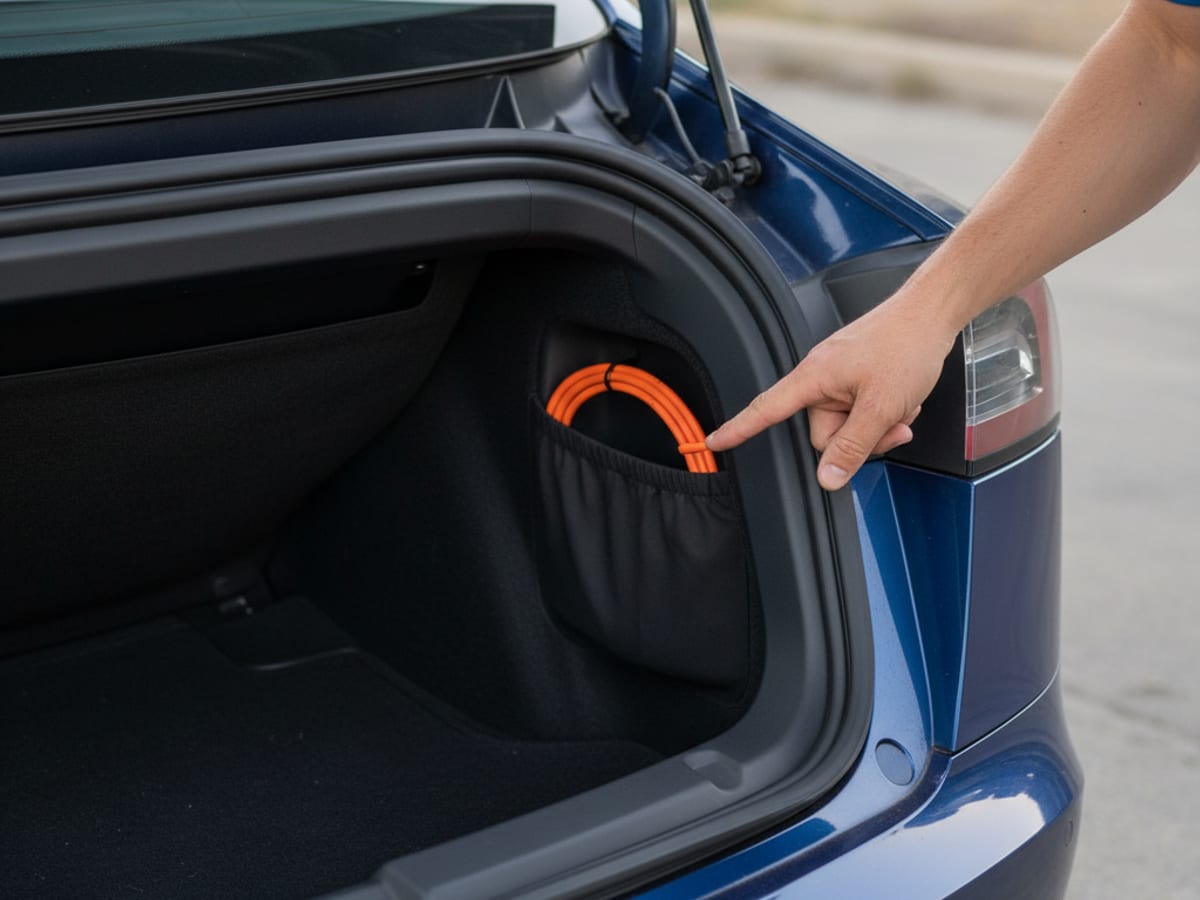
Open the trunk and go to the passenger inner wall. Peel the carpeted trim back and pop the small access panel. Behind it is a plastic tab on a cable. Pull that cable down, hold it, and slide the handle out.
Tesla Model S and Model X
On older cars, open the rear hatch and check the driver’s side near the taillight. Pull the carpeted panel; the release cable is inside. Draw it straight toward you and keep tension while the plug comes out.
On 2021 and newer refresh S and X cars, check the passenger trunk trim first. The cable sits more like a Model 3.
Rivian R1T and R1S
The release is inside the cabin, not in the port. Open the rear passenger door and lift the rear seat bottom. Find the service panel and the cord, then pull it firmly and remove the plug.
Ford F-150 Lightning and Mustang Mach-E
Ford hid a tab in the port housing, so open the charge door. Look at the top or bottom edge for a triangular unlock tab. Pull that tab away from the port as you draw the cable out.
On a Lightning, FordPass can send an unlock command. Use the Mach-E stuck cable guide for ice or a dead 12V.
Hyundai Ioniq 5, Kia EV6, and Kia EV9
Check the rear cargo wall on the driver’s side and pop the plastic cover. Press and hold the small button, then pull the connector at the same time. The Ioniq 5 steps are expanded in our Hyundai charge-port release post.
Chevrolet Bolt, Polestar 2, and Volkswagen ID.4
On a Bolt, lift the rear cargo floor. The cord sits near the 12V area, so pull the cord and the handle together.
On a Polestar 2, look in the trunk near the driver’s tailgate hinge. A small trim panel on that hinge hides the cord.
On an ID.4, lift the cargo cover and find the labeled pull loop. It’s on the passenger side, behind the C-pillar trim.
If the cable still won’t move
Confirm the car is awake, then pull the manual release again.
Rock the connector a little as you pull. Go side to side, not up and down. You’re clearing the locking lip, not ripping the housing.
Next, try a short reboot of the car. On a Tesla, hold both steering-wheel scroll wheels for about ten seconds. On a Rivian, hold the cruise stalk down for about ten seconds. On most other EVs, hold the power button until the screens reset.
After the reboot, stop charging on screen and retry.
If the button on the handle feels mushy, the cable may be the problem. Try a different connector only when the station has a second working cable.
Don’t force the handle
If the release cord moved and the plug still won’t budge, stop. A seized solenoid is a shop repair, not a curb yank. Brute force turns a latch problem into a broken port.
Leave the cable in place, and don’t cut it or twist the head.
When you’re blocking a stall
Westside street stalls and downtown garage pedestals are shared. You can’t occupy that stall all evening. Private lots can tow under California Vehicle Code 22658. They need the required 17-by-22-inch entrance signs. They also need written authorization from the owner or agent. Read the posted board before you assume you’re fine to wait.
California doesn’t set one statewide tow rate we could verify. Ask the lot or local law enforcement before you guess a number.
If the 12V is dead, you may not reach the trunk release at all. That’s when you want a local operator, not more pulling.
Charge Pro LA is a referral line, not a shop. We match you with an independent local operator. The operator quotes you before any work starts, then bills you directly. We don’t own trucks, and we don’t send a Charge Pro crew.
The pros in the network can jump or replace a dead 12V on site. They handle Tesla and every major EV brand. They can also bring a 240V Level 2 source if the pack itself is empty. Typical charging time is 15 to 30 minutes. That adds about 10 to 20 miles of range. Count that as charging time, never an arrival time.
Ask for a match if the release already failed. Do the same if the car is dark and you can’t reach the trunk. A blocked stall in Santa Monica is one reason to call. Downtown Los Angeles garages are the other busy case. A broken handle button is another reason to call.
Tesla drivers can start on our Tesla roadside rescue page.
Once the plug is free
Plug in again at a stall you can occupy, then run a full session. If it ends and the lock releases, you likely had a glitched stop.
If the lock fails a second time, schedule service. The solenoid or the cable latch needs inspection.
If you jumped the 12V to free the plug, plan a replacement. A weak 12V will lock you in again.
Work the screen, the 12V, and the manual release in that order. If you still can’t free the stall, call (858) 925-5546. Charge Pro LA will match you with a local operator. The operator quotes first, and you pay that operator directly.