Apps for EV charging help most while you still have range. In the Los Angeles basin, a stale pin often leaves you another option nearby. On PCH through Malibu, a bad listing burns more of the pack. The same is true on the Grapevine north of Castaic. Check the vehicle app, then network apps, then an aggregator map. Stop trusting pins once nothing reachable looks real.
Basin driving and grade driving aren’t the same map problem
A charging app plots listings, not the hill in front of you. Flat basin miles don’t spend a pack the way a climb does. Sepulveda Pass on the 405 links the Westside to the San Fernando Valley. The Grapevine on I-5 is the long grade north of Castaic. PCH through Malibu leaves few places to turn around. Recurrent Auto’s published tests show cold and cabin heat cut range below the sticker. Heat and air conditioning do the same on a Grapevine climb. An app pin that looked easy in the basin can sit past remaining energy. The issue is leftover range after the grade.
Start with the app that talks to your car
Your vehicle maker’s app should be the first check. It reads your pack, not a generic range guess. A third-party map only knows where stalls sit. It doesn’t know what your car can actually reach.
We won’t name a maker app or list its current features. Those screens change with each software update the maker ships. Confirm what your app does in the owner’s manual. The maker’s site or a dealer desk can confirm it too. If you’re not sure the car has an in-car planner, ask there.
Treat the suggested route as a plan, not a promise. The app can suggest a stop based on your present charge. It can’t confirm that a given plug is free when you arrive. It also can’t confirm the plug is working.
This gap matters more on a grade than in the basin. A hop from Santa Monica toward Culver City still leaves you options. You can usually reroute without climbing a long grade. A Santa Clarita driver pointed at the Grapevine doesn’t have that slack. Neither does a Malibu driver already committed to PCH.
Then open the networks that own the hardware
After the vehicle app, check the networks that run public stalls. Most networks publish their own app or a station page. That’s often the freshest status for their own equipment.
One network app only sees its own plugs. Los Angeles County mixes networks on the same corridor. LADWP serves the City of Los Angeles as a municipal utility. Southern California Edison delivers power across much of the rest of the county. Clean Power Alliance buys generation for cities such as Malibu and Santa Monica. SCE still delivers that power on the wires. None of that tells you if a public stall will start a session. Check two or three network apps before a longer drive. Don’t rely on the one you already have from habit.
We aren’t ranking network apps here, and we won’t describe their feature lists. Coverage, features, and reliability change, and we can’t verify each screen. If you need what a network’s app currently supports, use that network’s own site.
For a wider inventory, the DOE Alternative Fuels Data Center keeps a station locator. It’s drawn from reported infrastructure, not live occupancy. Use it to see what’s been listed, not what’s free this hour.
Treat aggregator pins and crowd notes as snapshots
Aggregator maps pull several networks into one view. Some add driver notes about a stall that worked last week. Those notes help you spot options a single network hid.
A pin on that map still isn’t a promise. A listed stall can be broken, occupied, or taken offline. A three-week-old comment is one driver’s one visit. It isn’t a live feed of the plug in front of you. That’s how listings work when someone else owns the hardware. It isn’t a flaw unique to one app.
For county context, use our Los Angeles County EV charging hub with those maps. A national default view misses local grades and coastal routing. If the pack is already falling, stop shopping apps. Our guide on running low before you stall covers that next decision.
Charging apps won’t wake a dead 12-volt battery
A charging map assumes the car can still roll and plug in. A dead 12V can brick the car in a garage. That can happen even when stalls sit in the same structure. LAX terminal structures P1 through P7 offer Level 2 and DC fast charging. The Economy Parking garage lists 514 active EV chargers. A week in those lots can still kill the 12V. The high-voltage pack may still hold a usable charge. The car just won’t wake to use a stall the app showed you. That’s a jump or 12V replacement job, not a mapping job.
Save a plan the maps can’t provide
Charging apps are built to find stations, not to rescue a dead session. They don’t help if the stall is dead when you arrive. They also don’t help if the car won’t take a charge. At that point it isn’t a mapping problem anymore. Work through our public charger troubleshooting steps before you leave.
Keep a backup that doesn’t depend on one app being right. Note a second listed stop along the same route before you go. Know who you’ll call if both listings fail. Apps tend to feel more useful on basin streets and packed freeway corridors. They help less once you’re committed to PCH in Malibu. They also help less on the Grapevine climb. On those stretches, a stale pin costs you climb energy you can’t put back. If PCH is already the problem, read our Malibu PCH stall guide. For the I-5 grade, use our Grapevine rescue notes.
What freeway patrol and the vehicle code actually cover
Metro’s Freeway Service Patrol is free on congested Los Angeles County freeways. Caltrans, CHP, and LA Metro run it together. It can offer a gallon of gas, tape a hose, or change a tire. It can also tow a disabled vehicle to a CHP-chosen safe spot. Its published motorist list doesn’t include mobile EV charging. An empty pack sits outside that published help, aside from the free tow. Dial 511 and say Motorist Aid if you need FSP.
California Vehicle Code 21718 bars stopping on a freeway. A disabled vehicle that’s summoned help is an exception. If you’ve called for assistance, that exception can apply. CVC 21809 is the state’s move-over law for stopped service vehicles. Approaching drivers must change lanes if it’s safe, or slow down. That’s the rule that protects you on the shoulder. Don’t keep rolling because an app pin looks close.
When every app shows nothing you can reach
Sometimes every app you open agrees on the same bad news. Nothing reachable looks real from where you sit. Checking a fourth app won’t create energy you don’t have. The question stops being which map to trust. The question becomes how to charge or move the car without driving farther.
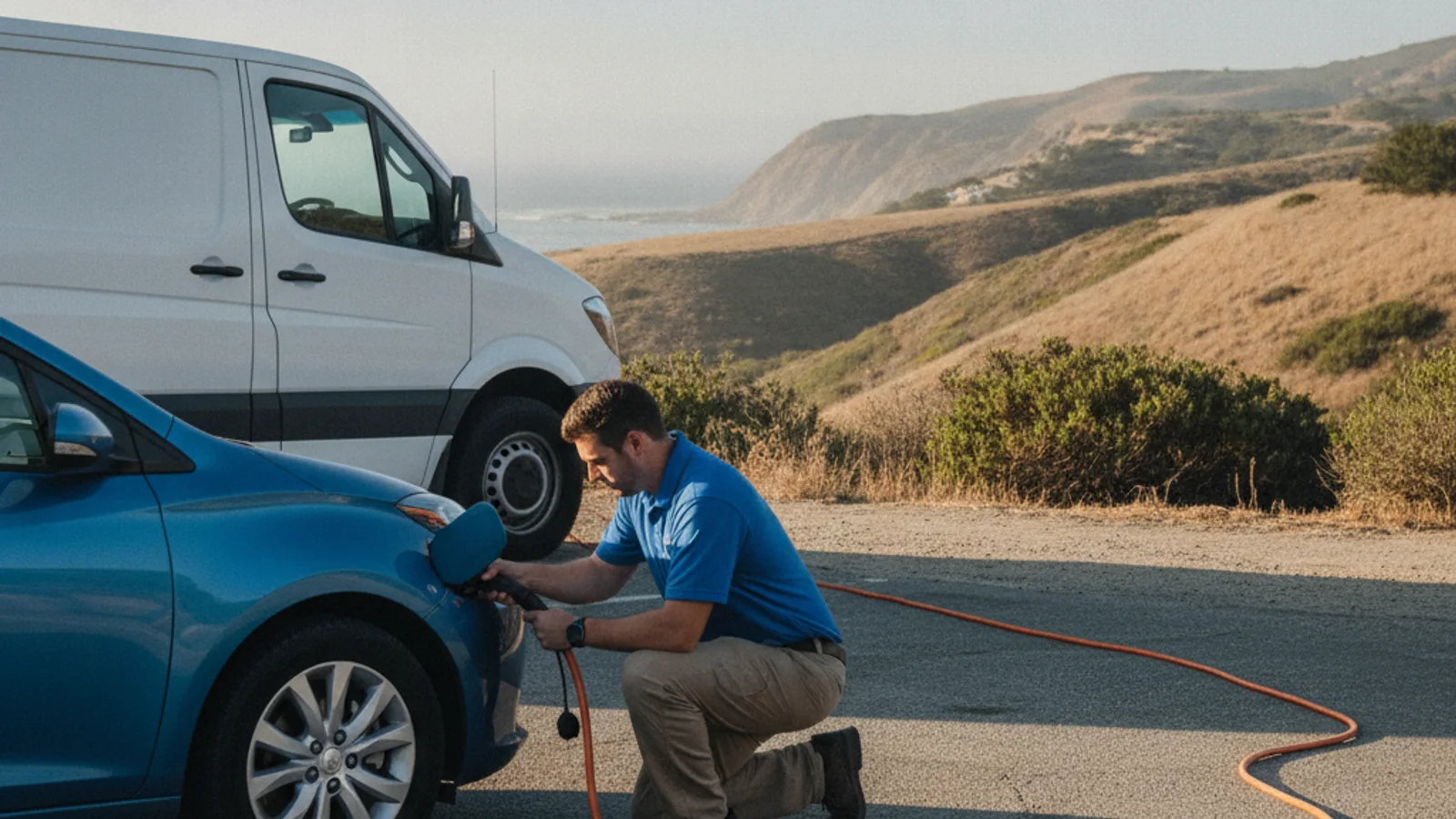
Mobile EV charging sends an independent operator to a vehicle that’s parked safely. The pros we connect you with are licensed and insured. They bring a 240V Level 2 source to the car. They use a native NACS plug, or a CCS or J1772 adapter for non-Tesla EVs. They typically add 10 to 20 miles in 15 to 30 minutes of charging. That’s charging time, not a promise about when someone arrives. Charge Pro LA is a referral line that doesn’t own trucks. The operator quotes you before starting and bills you directly.
If the pack is already at zero, ask about out-of-charge recovery instead. The operator looks at the car and the spot, then picks what fits. Don’t spend the last percent chasing an unverified pin. If the apps have run out of reachable options, stop and call.
When planning has run out of road
If every app failed and the pack is getting critical, planning is done. Call (858) 925-5546 and we’ll connect you with a local EV rescue operator.