Your EV just died in a Los Angeles County parking garage. Or it rolled to a stop on the 405 shoulder. You search “EV service” because that’s the phrase you know. It’s the wrong phrase for half of these nights. A repair bay and a roadside rescue are different trades. Charge Pro LA handles the second job as a referral line. It matches you with an independent local operator. The operator quotes you, then bills you directly.
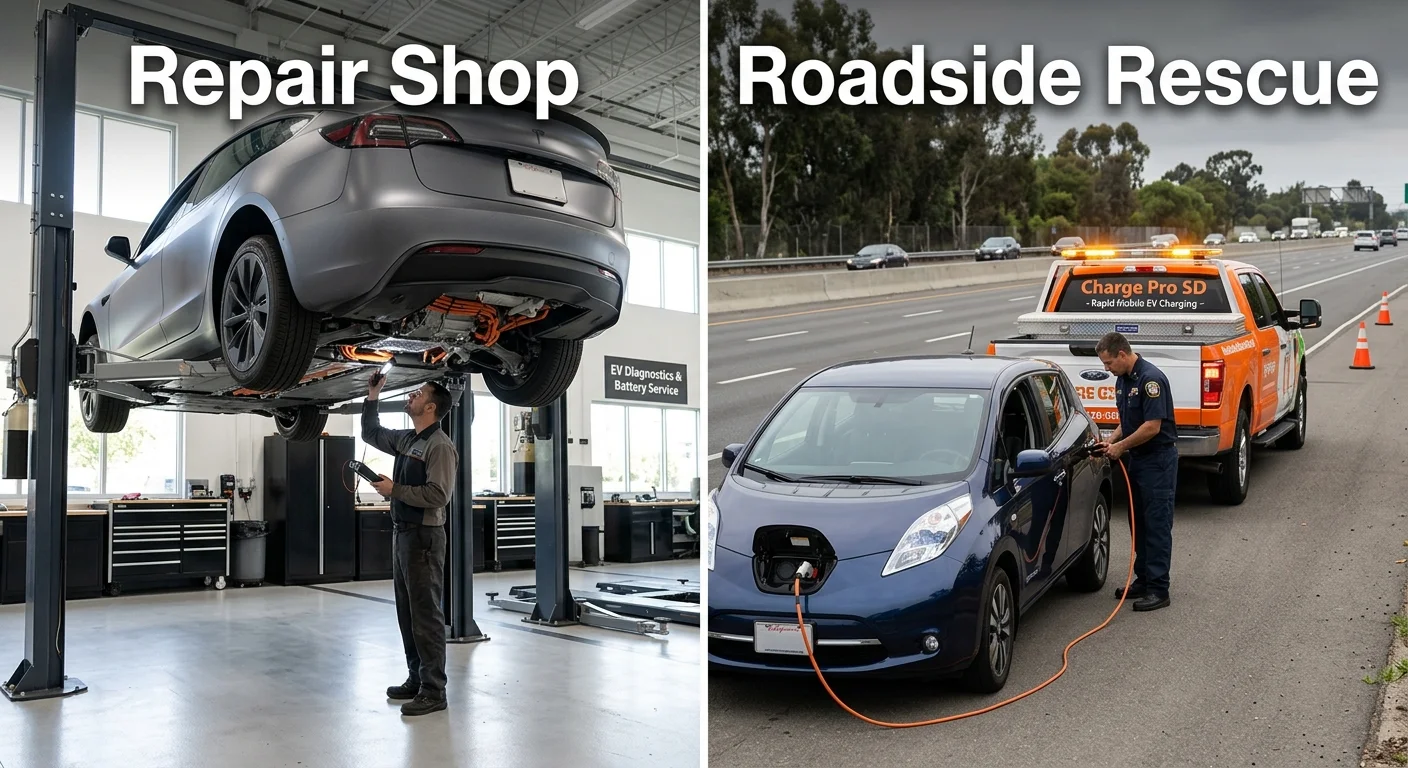
Two different jobs sit under one search
Most people who type “EV service” want a bay. They want tires rotated, brakes checked, or software updated. They want a warning light read with shop tools. That work needs a lift, a parts counter, and clock time. You schedule it ahead, then you leave the car. You don’t sit on a freeway shoulder waiting for it.
The other job is EV roadside assistance when the car won’t move. You’re not picking a Tuesday slot at that point. You’re picking who can reach the curb. That’s rescue, and it’s a separate trade.
Charge Pro LA isn’t a shop or a dealer bay. It doesn’t own trucks, a warehouse, or a lift. Independent operators do the work after the match. The brand’s job is the match, not the repair.
Shop visits are for cars that still roll
If you can drive to a dealer, you probably should. A dash light that’s been on for days belongs there. So does a new noise on the 110 through downtown. So does range that’s been fading for weeks with no weather story.
Shops run pack diagnostics you can’t do on a shoulder. They replace contactors, onboard chargers, and worn suspension parts. They process warranty claims and recall campaigns for you. They flash firmware in a controlled shop bay. None of that work is a roadside rescue.
EVs skip oil changes on every model year. They still need cabin filters, brake fluid, and tire service. Your owner’s manual sets the real service intervals. A Tesla, Rivian, Hyundai, or Chevy dealer can do that work. If the car is driveable, that’s your call.
A rattle on the way to UCLA still belongs in a shop.
Rescue is for cars that won’t leave
Rescue starts when you can’t move the car safely. The pack hit zero on the 5 north of Santa Clarita. That’s the last basin before the Grapevine climb. The 405 through Sepulveda Pass can drain a pack on the climb. Screens go dark in a Long Beach garage the same way. Doors won’t unlatch after a week in LAX parking.
Los Angeles World Airports operates LAX and those lots. Terminal structures P1 through P7 offer Level 2 and DC fast charging. The Economy Parking garage has more than 4,000 stalls. Those stalls include 514 active EV chargers. You can still come back to a car that won’t wake. A 12V failure isn’t an empty drive pack. The lot’s chargers don’t restart that small battery.
The 12V runs computers, contactors, and door locks. When it’s dead, the car behaves like a brick. That’s a job for an on-site 12V jump, not a motor teardown.
An empty traction pack is the other common stop. The operator brings a 240-volt Level 2 source to the car. Teslas use a native NACS plug on that lead. Other brands use a CCS or J1772 adapter. A typical session adds 10 to 20 miles of range. That takes 15 to 30 minutes of charging. That window is charging time, never an arrival time. The goal is enough miles to reach a charger or a shop.
Charge, jump, or tow is the decision tree for a dead EV. On-site charging versus a tow is the same fork in county traffic.
What the operator will not touch
The people Charge Pro LA matches you with are rescue operators. They aren’t your mechanic and they aren’t a dealer tech. They don’t replace a high-voltage pack on the street. They don’t chase a month-old warning light. They don’t do alignments, software campaigns, or warranty paperwork.
If the car still drives and something’s wrong inside, book a shop. A mobile EV charging visit won’t find a failing sensor. It won’t quiet a noisy wheel bearing from the curb. It’ll put miles into an empty pack.
Why this county makes the mix-up easy
This county isn’t one climate or one kind of road. Coastal nights in Santa Monica and Redondo Beach stay cool. The marine layer does that for long stretches of spring. The San Fernando and San Gabriel Valleys run hotter. Lancaster and Palmdale take hard summer heat. They also see winter nights that cut range. Recurrent Auto’s fleet data puts average range near 78% at 32°F. It falls to about 70% at 20°F. Cabin heat is the main drain in that data. Air conditioning on a long grade does the same in summer. The sticker number isn’t the Grapevine number.
Housing stock changes whether you can plug in at home. About 86% of East Los Angeles homes were built before 1980. Whittier sits near 89% on that same Census measure. Lakewood is in the same older band. Many of those garages never got a 240-volt circuit. Santa Clarita, Lancaster, and Palmdale skew newer. Stevenson Ranch is almost all post-1980 housing. A dead EV in an older Eastside driveway is often a rescue. There’s no Level 2 plug waiting on that wall. That’s the house, not a claim about public stalls.
Power companies split the map the same way. LADWP serves the City of Los Angeles. It’s the largest municipal utility in the United States. It runs a Residential EV Charger Rebate Program. Southern California Edison covers most of the rest of the county. Clean Power Alliance buys generation for many cities. Santa Monica, Culver City, and West Hollywood are on that list. Unincorporated Los Angeles County sits on that list too. SCE still delivers the power and reads the meter. None of that changes who you call when you’re already stranded. It only changes how you charge at home later.
Freeway help is still written for gas cars. Metro Freeway Service Patrol is a joint program. Caltrans, the California Highway Patrol, and LA Metro run it. It’s free to motorists on congested county freeways. Coverage is typically weekday peaks, plus some construction zones all day. They’ll pour a gallon of gas or refill a radiator. They’ll change a tire or tow you to a CHP-chosen safe spot. Their published list doesn’t include mobile EV charging. An empty pack is outside that list, except for the free tow. Dial 511 and say “Motorist Aid” if you need FSP. Don’t expect a Level 2 boost from that truck.
If you’re stopped on a freeway, the rules are specific. California Vehicle Code 21718 generally bars parking there. A disabled vehicle that’s already summoned help is an exception. California Vehicle Code 21809 is the move-over law. Other drivers must change lanes or slow for flashing lights. That covers a stopped service vehicle on the shoulder. California Vehicle Code 22651 lets an officer remove a vehicle. Four hours unattended on a freeway is enough. Call for help, and don’t walk away from the car.
How the referral call works
You call Charge Pro LA when the car is already stuck. The line matches you with an independent local operator. That operator talks to you before any cable goes on. You get a quote and you approve it. You’re billed by the operator, not by the brand.
The operator can work Tesla and every major EV brand. The operator’s truck brings Level 2 power, not a shop diagnostic suite. If the 12V is the problem, jump or replacement happens on site. If the car needs a lift, you needed a shop from the start.
A county stranded-EV guide walks these same steps in order.
Pick the call that matches the car
If the car still rolls, book a shop. If it doesn’t roll, request a rescue match. Don’t ask a mechanic to meet you on the 10. Don’t ask a charging operator to replace a motor.
Charge Pro LA serves every city in Los Angeles County. The brand doesn’t perform the licensed work itself. The operator you get does that part. When the car is a brick, call (858) 925-5546 and request a match. If the car still drives and something’s wrong, call the dealer instead.